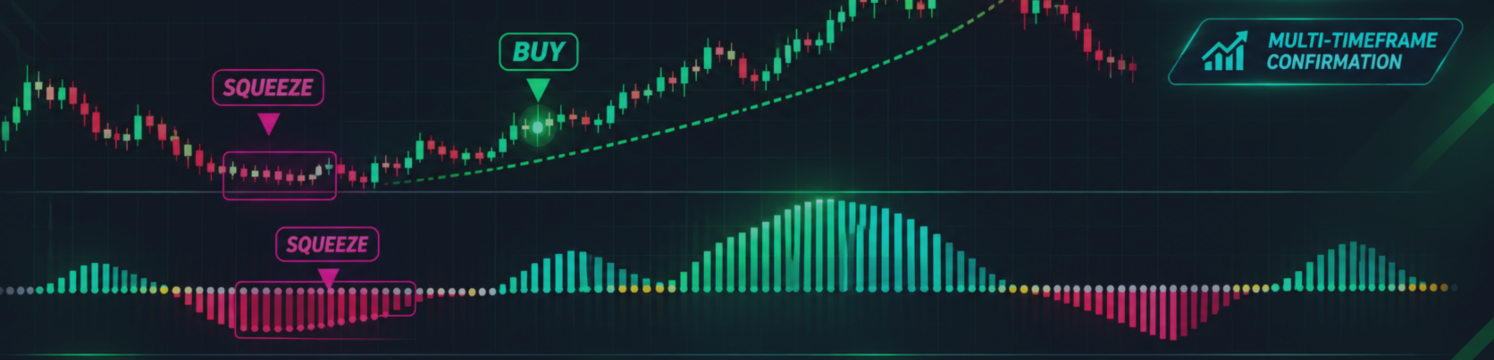
How to Trade the Squeeze: A Volatility + Momentum Strategy with Squeeze Momentum Pro

Most losing trades share one root cause: entering at the wrong time. Traders either chase a move that has already exhausted itself, or they sit in a quiet market that goes nowhere for hours. The TTM Squeeze concept was designed to solve exactly this problem — by telling you when the market is coiling for a move, and which direction that move is likely to take. In this post I will share a complete, rule-based Squeeze Momentum strategy and show how to apply it in practice using Squeeze Momentum Pro for MetaTrader 4 and MetaTrader 5.
The Core Idea: Volatility Cycles
Markets alternate between two states: contraction (low volatility, price coiling) and expansion (high volatility, price trending). The classic volatility squeeze happens when Bollinger Bands move inside the Keltner Channels — a sign that volatility has compressed to a point where a breakout is statistically more likely to follow.
The problem with a plain squeeze signal is that it only tells you a move is coming, not where it is going. That is why this strategy pairs the squeeze with a momentum oscillator: the squeeze times the entry, and momentum picks the direction.
What the Indicator Shows
Squeeze Momentum Pro puts both pieces of information in one clean window:
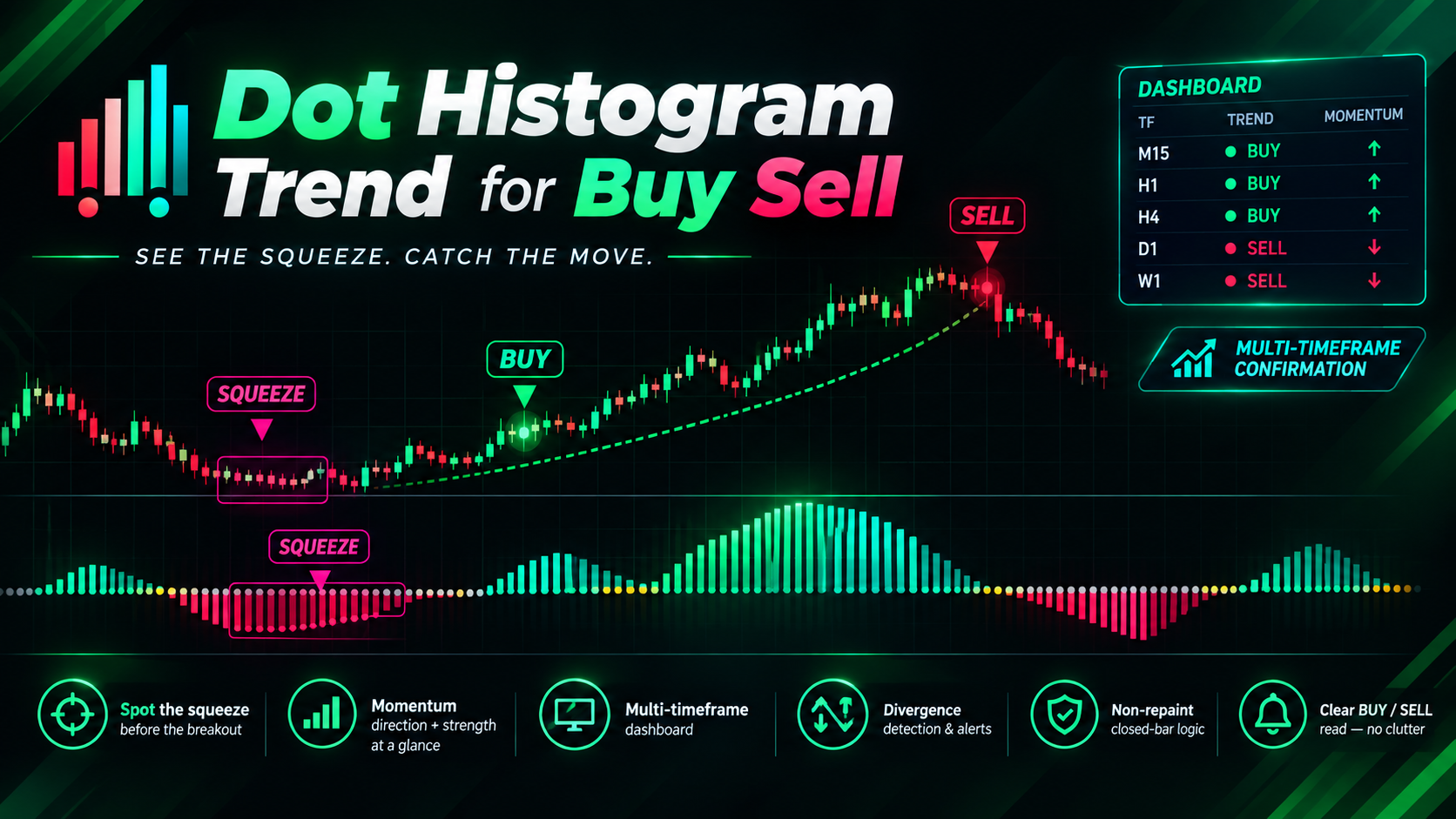
- Squeeze dots on the zero line with four compression levels — no-squeeze (fired), low, mid and high. The tighter the compression, the more energy is building.
- A four-color momentum histogram that separates accelerating momentum (bright bars) from fading momentum (dark bars), on both the bullish and bearish side.
- A multi-timeframe (MTF) dashboard so you can confirm your setup against higher timeframes at a glance.
- Automatic divergence detection and alerts (pop-up, push, email) so you never miss a setup.
Because signals are confirmed on the closed bar, the indicator is non-repaint on completed candles — the history you analyze does not change after the fact.
The Strategy, Step by Step
1. Wait for the squeeze
When you see compression dots (low, mid or high), the market is quiet and building energy. Do not trade yet. This is the patience phase, and it is where most traders go wrong by forcing entries into a dead market.
2. Trade the "fire"
When the squeeze releases, the dot turns to the "fired" state. Volatility is now expanding — this is your trigger bar. High-compression squeezes that fire tend to produce the cleanest breakout moves.
3. Let momentum choose the direction
At the moment the squeeze fires, read the momentum histogram:
- Buy when the histogram is above zero and printing bright (accelerating) bars.
- Sell when the histogram is below zero and printing bright bars.
Bright bars mean the move is strengthening; dark bars mean it is fading.
4. Confirm with higher timeframes
Open the MTF dashboard and check that the higher timeframes agree with your direction. A signal that aligns with the higher-timeframe trend is a higher-probability trade than one that fights it. Trading with the bigger picture is one of the simplest ways to tilt the odds in your favor.
5. Manage and exit
Ride the move while the histogram stays bright. Start thinking about the exit when:
- the momentum bars turn dark (the move is decelerating), or
- momentum crosses back through the zero line, or
- a divergence line appears against your position.
A trailing stop behind recent structure works well with this logic, letting winners run while momentum is strong.
A Simple Worked Example
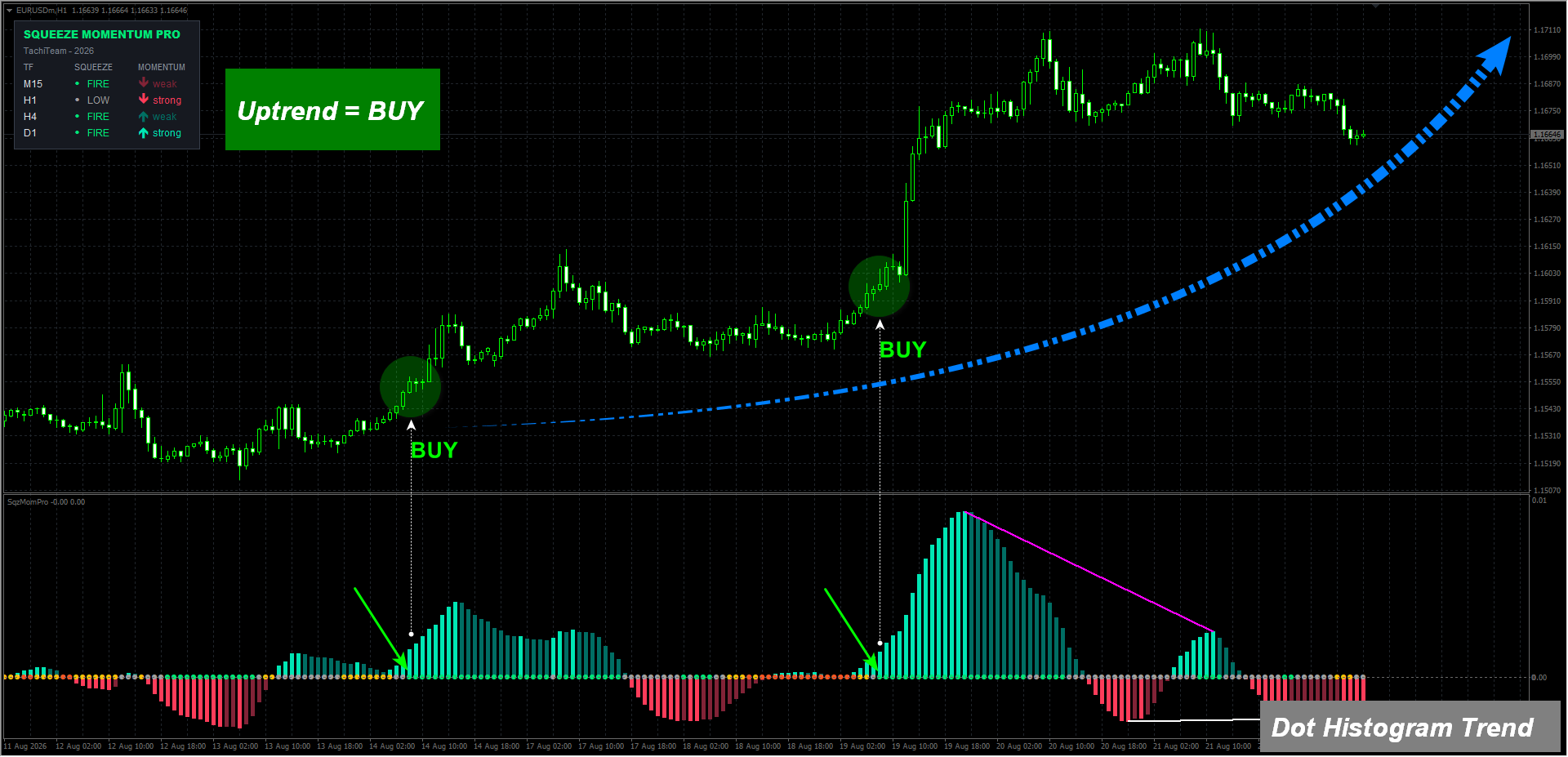
Imagine EURUSD has been ranging for hours. Compression dots build from low to high — energy is loading. The squeeze fires, and the histogram immediately pushes above zero with bright bars. The H1 and H4 rows on the dashboard are both bullish. You go long, place your stop below the range, and trail it as the bright green bars grow. When the bars begin to darken and shrink, you tighten the stop and lock in the move. The bearish setup is simply the mirror image.
Practical Tips to Improve Your Win Rate
- Be selective. The best trades come from tight (high) compression that fires with strong, aligned momentum. Skip the ambiguous ones.
- Respect divergence. When price makes a new extreme but momentum does not, the trend is tiring — a good moment to protect profits.
- Match the timeframe to your style. M5–M15 for scalping, H1–H4 for intraday and swing trading.
- It works across markets. Forex, gold (XAUUSD), indices and crypto all show the same volatility-and-momentum behavior.
- Always use risk management. No indicator wins every trade. Position sizing and a predefined stop are what keep you in the game long enough for your edge to play out.
Why a Dedicated Tool Helps
You could watch Bollinger Bands, Keltner Channels and a separate momentum oscillator and combine them in your head on every bar. Or you can read one clean panel that already does the work — multi-level squeeze, color-coded momentum, multi-timeframe confirmation and alerts — so you can focus on execution and discipline instead of calculation.
Try Squeeze Momentum Pro
If you want to trade the squeeze with a clean, professional momentum and volatility indicator, you can download and test it here:
- MetaTrader 5 version: https://www.mql5.com/en/market/product/192226
- MetaTrader 4 version: https://www.mql5.com/en/market/product/109491
Add it to any chart, wait for the squeeze to fire, follow the momentum, and confirm with the multi-timeframe dashboard. If you have questions or ideas for improvement, leave a comment on the product page — I read every message and keep the tool updated.
Trade safe, manage your risk, and let the squeeze do the timing for you.


![[iVISTscalp5]: XAUUSD. Forecast First. Market Reaction Afterwards](https://c.mql5.com/6/1035/splash-preview-777232.png "[iVISTscalp5]: XAUUSD. Forecast First. Market Reaction Afterwards")
