Young Ho Seo / Profil
- Information
|
12+ Jahre
Erfahrung
|
62
Produkte
|
1209
Demoversionen
|
|
4
Jobs
|
0
Signale
|
0
Abonnenten
|
Harmonic Pattern Indicator - Repainting + Japanese Candlestick Pattern Scanner + Automatic Channel + Many more
https://www.mql5.com/en/market/product/4488
https://www.mql5.com/en/market/product/4475
https://algotrading-investment.com/portfolio-item/harmonic-pattern-plus/
Non Repainting and Non Lagging Harmonic Pattern Indicator – Customizable Harmonic + Japanese Candlestic Pattern Scanner + Advanced Channel + Many more
https://www.mql5.com/en/market/product/41993
https://www.mql5.com/en/market/product/41992
https://algotrading-investment.com/portfolio-item/profitable-pattern-scanner/
Supply Demand Indicator – Multiple Timeframe Scanning Added + Non Repainting + Professional Indicator
https://www.mql5.com/en/market/product/40076
https://www.mql5.com/en/market/product/40075
https://algotrading-investment.com/portfolio-item/ace-supply-demand-zone/
Momentum Indicator – Path to Volume Spread Analysis
https://www.mql5.com/en/market/product/30641
https://www.mql5.com/en/market/product/30621
https://algotrading-investment.com/portfolio-item/excessive-momentum-indicator/
Elliott Wave Indicator for the Power User
https://www.mql5.com/en/market/product/16479
https://www.mql5.com/en/market/product/16472
https://algotrading-investment.com/portfolio-item/elliott-wave-trend/
Forex Prediction - Turn Support and Resistance to the Advanced Strategy
https://www.mql5.com/en/market/product/49170
https://www.mql5.com/en/market/product/49169
https://algotrading-investment.com/portfolio-item/fractal-pattern-scanner/
MetaTrader 4 and MetaTrader 5 Product Page: https://www.mql5.com/en/users/financeengineer/seller#products
Free Forex Prediction with Fibonacci Analysis: https://algotrading-investment.com/2020/10/23/forex-prediction-with-fibonacci-analysis/
Free Harmonic Pattern Signal: https://algotrading-investment.com/2020/12/17/harmonic-pattern-signal-for-forex-market/
============================================================================================================================
Here are the trading education books. We recommend reading these books if you are a trader or investor in Forex and Stock market. In the list below, we put the easy to read book on top. Try to read the easy to read book first and try to read the harder book later to improve your trading and investment.
First Link = amazon.com, Second Link = Google Play Books, Third Link = algotrading-investment.com, Fourth Link = Google Books
Technical Analysis in Forex and Stock Market (Supply Demand Analysis and Support Resistance)
https://www.amazon.com/dp/B09L55ZK4Z
https://play.google.com/store/books/details?id=pHlMEAAAQBAJ
https://algotrading-investment.com/portfolio-item/technical-analysis-in-forex-and-stock-market/
https://books.google.co.kr/books/about?id=pHlMEAAAQBAJ
Science Of Support, Resistance, Fibonacci Analysis, Harmonic Pattern, Elliott Wave and X3 Chart Pattern (In Forex and Stock Market Trading)
https://www.amazon.com/dp/B0993WZGZD
https://play.google.com/store/books/details?id=MME3EAAAQBAJ
https://algotrading-investment.com/portfolio-item/science-of-support-resistance-fibonacci-analysis-harmonic-pattern/
https://books.google.co.kr/books/about?id=MME3EAAAQBAJ
Profitable Chart Patterns in Forex and Stock Market (Fibonacci Analysis, Harmonic Pattern, Elliott Wave, and X3 Chart Pattern)
https://www.amazon.com/dp/B0B2KZH87K
https://play.google.com/store/books/details?id=7KrQDwAAQBAJ
https://algotrading-investment.com/portfolio-item/profitable-chart-patterns-in-forex-and-stock-market/
https://books.google.com/books/about?id=7KrQDwAAQBAJ
Guide to Precision Harmonic Pattern Trading (Mastering Turning Point Strategy for Financial Trading)
https://www.amazon.com/dp/B01MRI5LY6
https://play.google.com/store/books/details?id=8SbMDwAAQBAJ
http://algotrading-investment.com/portfolio-item/guide-precision-harmonic-pattern-trading/
https://books.google.com/books/about?id=8SbMDwAAQBAJ
Scientific Guide to Price Action and Pattern Trading (Wisdom of Trend, Cycle, and Fractal Wave)
https://www.amazon.com/dp/B073T3ZMBR
https://play.google.com/store/books/details?id=5prUDwAAQBAJ
https://algotrading-investment.com/portfolio-item/scientific-guide-to-price-action-and-pattern-trading/
https://books.google.com/books/about?id=5prUDwAAQBAJ
Predicting Forex and Stock Market with Fractal Pattern: Science of Price and Time
https://www.amazon.com/dp/B086YKM8BW
https://play.google.com/store/books/details?id=VJjiDwAAQBAJ
https://algotrading-investment.com/portfolio-item/predicting-forex-and-stock-market-with-fractal-pattern/
https://books.google.com/books/about?id=VJjiDwAAQBAJ
Trading Education Book 1 in Korean (Apple, Google Play Book, Google Book, Scribd, Kobo)
https://books.apple.com/us/book/id1565534211
https://play.google.com/store/books/details?id=HTgqEAAAQBAJ
https://books.google.co.kr/books/about?id=HTgqEAAAQBAJ
https://www.scribd.com/book/505583892
https://www.kobo.com/ww/en/ebook/8J-Eg58EDzKwlpUmADdp2g
Trading Education Book 2 in Korean (Apple, Google Play Book, Google Book, Scribd, Kobo)
https://books.apple.com/us/book/id1597112108
https://play.google.com/store/books/details?id=shRQEAAAQBAJ
https://books.google.co.kr/books/about?id=shRQEAAAQBAJ
https://www.scribd.com/book/542068528
https://www.kobo.com/ww/en/ebook/X8SmJdYCtDasOfQ1LQpCtg
About Young Ho Seo
Young Ho Seo is an Engineer, Financial Trader, and Quantitative Developer, working on Trading Science and Investment Engineering since 2011. He is the creator of many technical indicators, price patterns and trading strategies used in the financial market. He is also teaching the trading practice on how to use the Supply Demand Analysis, Support, Resistance, Trend line, Fibonacci Analysis, Harmonic Pattern, Elliott Wave Theory, Chart Patterns, and Probability for Forex and Stock Market. His works include developing scientific trading principle and mathematical algorithm in the work of Benjamin Graham, Everette S. Gardner, Benoit Mandelbrot, Ralph Nelson Elliott, Harold M. Gartley, Richard Shabacker, William Delbert Gann, Richard Wyckoff and Richard Dennis. You can find his dedicated works on www.algotrading-investment.com . His life mission is to connect financial traders and scientific community for better understanding of this world and crowd behaviour in the financial market. He wrote many books and articles, which are helpful for understanding the technology and application behind technical analysis, statistics, time series forecasting, fractal science, econometrics, and artificial intelligence in the financial market.
If you are interested in our software and training, just visit our main website: www.algotrading-investment.com
https://www.mql5.com/en/market/product/4488
https://www.mql5.com/en/market/product/4475
https://algotrading-investment.com/portfolio-item/harmonic-pattern-plus/
Non Repainting and Non Lagging Harmonic Pattern Indicator – Customizable Harmonic + Japanese Candlestic Pattern Scanner + Advanced Channel + Many more
https://www.mql5.com/en/market/product/41993
https://www.mql5.com/en/market/product/41992
https://algotrading-investment.com/portfolio-item/profitable-pattern-scanner/
Supply Demand Indicator – Multiple Timeframe Scanning Added + Non Repainting + Professional Indicator
https://www.mql5.com/en/market/product/40076
https://www.mql5.com/en/market/product/40075
https://algotrading-investment.com/portfolio-item/ace-supply-demand-zone/
Momentum Indicator – Path to Volume Spread Analysis
https://www.mql5.com/en/market/product/30641
https://www.mql5.com/en/market/product/30621
https://algotrading-investment.com/portfolio-item/excessive-momentum-indicator/
Elliott Wave Indicator for the Power User
https://www.mql5.com/en/market/product/16479
https://www.mql5.com/en/market/product/16472
https://algotrading-investment.com/portfolio-item/elliott-wave-trend/
Forex Prediction - Turn Support and Resistance to the Advanced Strategy
https://www.mql5.com/en/market/product/49170
https://www.mql5.com/en/market/product/49169
https://algotrading-investment.com/portfolio-item/fractal-pattern-scanner/
MetaTrader 4 and MetaTrader 5 Product Page: https://www.mql5.com/en/users/financeengineer/seller#products
Free Forex Prediction with Fibonacci Analysis: https://algotrading-investment.com/2020/10/23/forex-prediction-with-fibonacci-analysis/
Free Harmonic Pattern Signal: https://algotrading-investment.com/2020/12/17/harmonic-pattern-signal-for-forex-market/
============================================================================================================================
Here are the trading education books. We recommend reading these books if you are a trader or investor in Forex and Stock market. In the list below, we put the easy to read book on top. Try to read the easy to read book first and try to read the harder book later to improve your trading and investment.
First Link = amazon.com, Second Link = Google Play Books, Third Link = algotrading-investment.com, Fourth Link = Google Books
Technical Analysis in Forex and Stock Market (Supply Demand Analysis and Support Resistance)
https://www.amazon.com/dp/B09L55ZK4Z
https://play.google.com/store/books/details?id=pHlMEAAAQBAJ
https://algotrading-investment.com/portfolio-item/technical-analysis-in-forex-and-stock-market/
https://books.google.co.kr/books/about?id=pHlMEAAAQBAJ
Science Of Support, Resistance, Fibonacci Analysis, Harmonic Pattern, Elliott Wave and X3 Chart Pattern (In Forex and Stock Market Trading)
https://www.amazon.com/dp/B0993WZGZD
https://play.google.com/store/books/details?id=MME3EAAAQBAJ
https://algotrading-investment.com/portfolio-item/science-of-support-resistance-fibonacci-analysis-harmonic-pattern/
https://books.google.co.kr/books/about?id=MME3EAAAQBAJ
Profitable Chart Patterns in Forex and Stock Market (Fibonacci Analysis, Harmonic Pattern, Elliott Wave, and X3 Chart Pattern)
https://www.amazon.com/dp/B0B2KZH87K
https://play.google.com/store/books/details?id=7KrQDwAAQBAJ
https://algotrading-investment.com/portfolio-item/profitable-chart-patterns-in-forex-and-stock-market/
https://books.google.com/books/about?id=7KrQDwAAQBAJ
Guide to Precision Harmonic Pattern Trading (Mastering Turning Point Strategy for Financial Trading)
https://www.amazon.com/dp/B01MRI5LY6
https://play.google.com/store/books/details?id=8SbMDwAAQBAJ
http://algotrading-investment.com/portfolio-item/guide-precision-harmonic-pattern-trading/
https://books.google.com/books/about?id=8SbMDwAAQBAJ
Scientific Guide to Price Action and Pattern Trading (Wisdom of Trend, Cycle, and Fractal Wave)
https://www.amazon.com/dp/B073T3ZMBR
https://play.google.com/store/books/details?id=5prUDwAAQBAJ
https://algotrading-investment.com/portfolio-item/scientific-guide-to-price-action-and-pattern-trading/
https://books.google.com/books/about?id=5prUDwAAQBAJ
Predicting Forex and Stock Market with Fractal Pattern: Science of Price and Time
https://www.amazon.com/dp/B086YKM8BW
https://play.google.com/store/books/details?id=VJjiDwAAQBAJ
https://algotrading-investment.com/portfolio-item/predicting-forex-and-stock-market-with-fractal-pattern/
https://books.google.com/books/about?id=VJjiDwAAQBAJ
Trading Education Book 1 in Korean (Apple, Google Play Book, Google Book, Scribd, Kobo)
https://books.apple.com/us/book/id1565534211
https://play.google.com/store/books/details?id=HTgqEAAAQBAJ
https://books.google.co.kr/books/about?id=HTgqEAAAQBAJ
https://www.scribd.com/book/505583892
https://www.kobo.com/ww/en/ebook/8J-Eg58EDzKwlpUmADdp2g
Trading Education Book 2 in Korean (Apple, Google Play Book, Google Book, Scribd, Kobo)
https://books.apple.com/us/book/id1597112108
https://play.google.com/store/books/details?id=shRQEAAAQBAJ
https://books.google.co.kr/books/about?id=shRQEAAAQBAJ
https://www.scribd.com/book/542068528
https://www.kobo.com/ww/en/ebook/X8SmJdYCtDasOfQ1LQpCtg
About Young Ho Seo
Young Ho Seo is an Engineer, Financial Trader, and Quantitative Developer, working on Trading Science and Investment Engineering since 2011. He is the creator of many technical indicators, price patterns and trading strategies used in the financial market. He is also teaching the trading practice on how to use the Supply Demand Analysis, Support, Resistance, Trend line, Fibonacci Analysis, Harmonic Pattern, Elliott Wave Theory, Chart Patterns, and Probability for Forex and Stock Market. His works include developing scientific trading principle and mathematical algorithm in the work of Benjamin Graham, Everette S. Gardner, Benoit Mandelbrot, Ralph Nelson Elliott, Harold M. Gartley, Richard Shabacker, William Delbert Gann, Richard Wyckoff and Richard Dennis. You can find his dedicated works on www.algotrading-investment.com . His life mission is to connect financial traders and scientific community for better understanding of this world and crowd behaviour in the financial market. He wrote many books and articles, which are helpful for understanding the technology and application behind technical analysis, statistics, time series forecasting, fractal science, econometrics, and artificial intelligence in the financial market.
If you are interested in our software and training, just visit our main website: www.algotrading-investment.com
Young Ho Seo
Using Japanese Candlestick Patterns in X3 Chart Pattern Scanner
X3 Chart Pattern Scanner is the powerful pattern trading system with many powerful features. Properly used, this tool can yield excellent trading results. One of the trading system built inside X3 Chart Pattern Scanner is the Japanese candlestick patterns. X3 Chart Pattern Scanner can detect around 52 different Japanese candlestick patterns. They are categorized under five categories including one, two, three, four and five candlestick patterns.
To use Japanese candlestick patterns, you have to enable the candlestick pattern from X3 Chart Pattern Scanner. See the attached screenshot for the purpose. Then you can switch on and off the individual category of patterns according to your preferences. For example, you can only use two and three candlestick patterns if you wish.
In addition, you can also receive sound alert, email and push notification when new Japanese candlestick patterns are detected. Note that Japanese candlestick patterns are only one of the pattern category. It can also detect other powerful patterns like Harmonic Patterns, Elliott Wave Patterns and X3 patterns.
You can watch the YouTube Video to feel what is the automated harmonic pattern indicator like.
YouTube “Non Repainting Non Lagging Harmonic Pattern Indicator”: https://youtu.be/uMlmMquefGQ
Below we provide the link to X3 Chart Pattern Scanner available in MetaTrader 4 and MetaTrader 5.
https://algotrading-investment.com/portfolio-item/profitable-pattern-scanner/
https://www.mql5.com/en/market/product/41992
https://www.mql5.com/en/market/product/41993
X3 Chart Pattern Scanner is the powerful pattern trading system with many powerful features. Properly used, this tool can yield excellent trading results. One of the trading system built inside X3 Chart Pattern Scanner is the Japanese candlestick patterns. X3 Chart Pattern Scanner can detect around 52 different Japanese candlestick patterns. They are categorized under five categories including one, two, three, four and five candlestick patterns.
To use Japanese candlestick patterns, you have to enable the candlestick pattern from X3 Chart Pattern Scanner. See the attached screenshot for the purpose. Then you can switch on and off the individual category of patterns according to your preferences. For example, you can only use two and three candlestick patterns if you wish.
In addition, you can also receive sound alert, email and push notification when new Japanese candlestick patterns are detected. Note that Japanese candlestick patterns are only one of the pattern category. It can also detect other powerful patterns like Harmonic Patterns, Elliott Wave Patterns and X3 patterns.
You can watch the YouTube Video to feel what is the automated harmonic pattern indicator like.
YouTube “Non Repainting Non Lagging Harmonic Pattern Indicator”: https://youtu.be/uMlmMquefGQ
Below we provide the link to X3 Chart Pattern Scanner available in MetaTrader 4 and MetaTrader 5.
https://algotrading-investment.com/portfolio-item/profitable-pattern-scanner/
https://www.mql5.com/en/market/product/41992
https://www.mql5.com/en/market/product/41993
Young Ho Seo
Excessive Momentum Trading
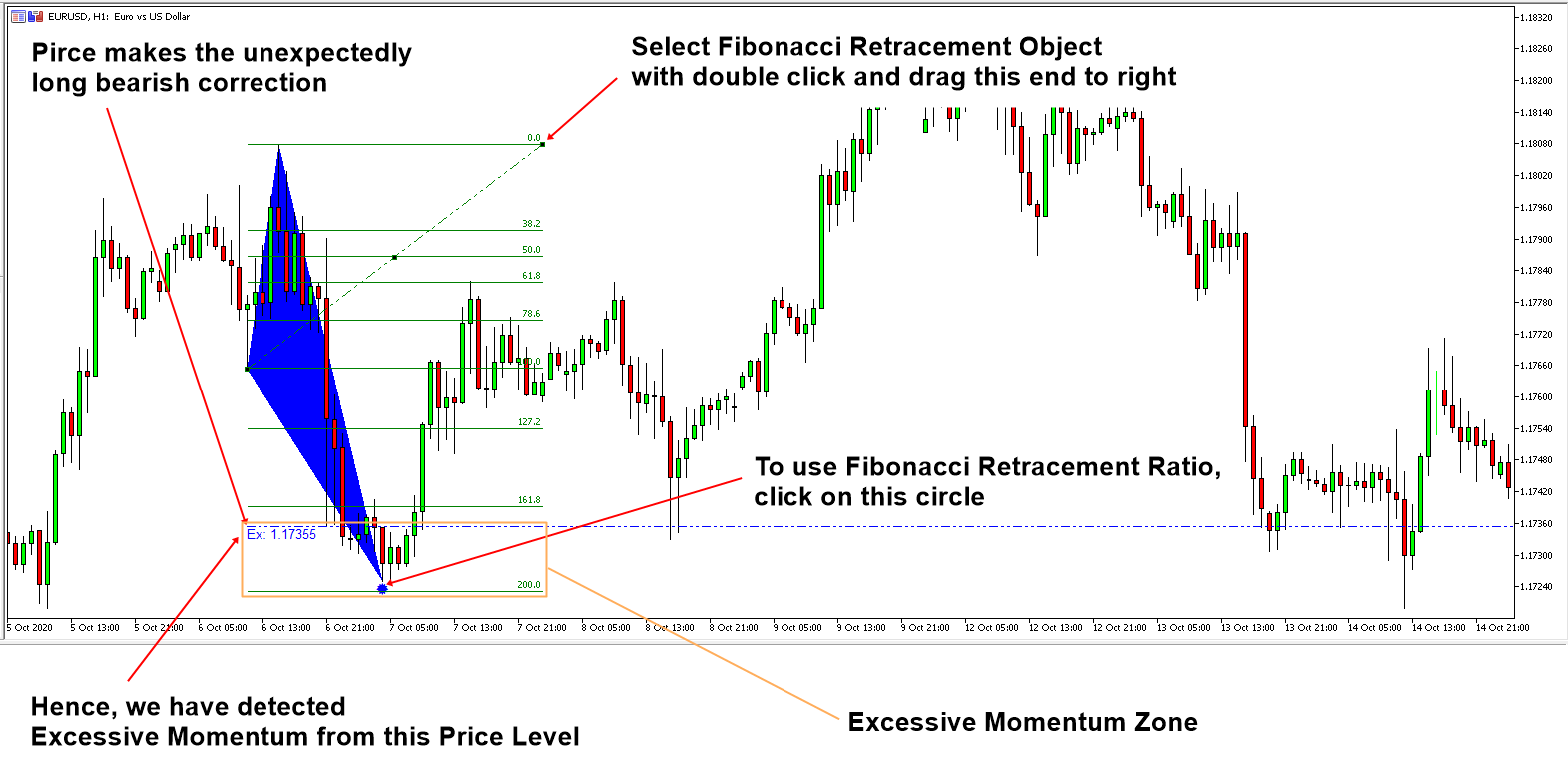
Excessive momentum is an important clue in our trading as well as the sideways market. You can consider Excessive momentum as the opposite concept to sideways market. So why Excessive momentum is important signal in our trading? Imagine that you are pouring some milk in your cup. It is fine until it is overflow. When milk is starting to get split from our cup, we realized that we need to take some correction.
This analogical concept can be applied to our trading too. Simply speaking, Excessive momentum can signal us that market can go through some brand new action from the existing trend. It might be turning point opportunity or reversal opportunity. Around this Excessive momentum area, market is more predictable. In addition, you have an opportunity to become early enterer with good profitable range.
Before, trader did not have a good tool to catch an excessive momentum but now we have the Excessive Momentum Indicator designed to catch Excessive momentum automatically in your chart. Good news is that this entry is more accurate with Excessive momentum than without Excessive momentum presents. Hence, Excessive momentum is ideal location to place your trading. Excessive momentum area is marked up as triangle in Excessive Momentum indicator.
At the same time, this Excessive Momentum Zone can be considered as either Accumulation or Distribution area in the Volume Spread Analysis. You can further find the symptoms of accumulation and distribution area using our Volume Spread Pattern Indicator (Paid and Advanced version) or Volume Spread Pattern Detector (Free and Light version). You can also watch the YouTube video to find out more about Excessive Momentum Indicator.
YouTube Video “Excessive Momentum Indicator”: https://youtu.be/oztARcXsAVA
YouTube Video “Excessive Momentum Indicator Explained”: https://youtu.be/A4JcTcakOKw
======================================
Here is the landing page for Excessive Momentum Indicator available in MetaTrader 4 and MetaTrader 5.
https://www.mql5.com/en/market/product/30641
https://www.mql5.com/en/market/product/30621
https://algotrading-investment.com/portfolio-item/excessive-momentum-indicator/
Excessive momentum is an important clue in our trading as well as the sideways market. You can consider Excessive momentum as the opposite concept to sideways market. So why Excessive momentum is important signal in our trading? Imagine that you are pouring some milk in your cup. It is fine until it is overflow. When milk is starting to get split from our cup, we realized that we need to take some correction.
This analogical concept can be applied to our trading too. Simply speaking, Excessive momentum can signal us that market can go through some brand new action from the existing trend. It might be turning point opportunity or reversal opportunity. Around this Excessive momentum area, market is more predictable. In addition, you have an opportunity to become early enterer with good profitable range.
Before, trader did not have a good tool to catch an excessive momentum but now we have the Excessive Momentum Indicator designed to catch Excessive momentum automatically in your chart. Good news is that this entry is more accurate with Excessive momentum than without Excessive momentum presents. Hence, Excessive momentum is ideal location to place your trading. Excessive momentum area is marked up as triangle in Excessive Momentum indicator.
At the same time, this Excessive Momentum Zone can be considered as either Accumulation or Distribution area in the Volume Spread Analysis. You can further find the symptoms of accumulation and distribution area using our Volume Spread Pattern Indicator (Paid and Advanced version) or Volume Spread Pattern Detector (Free and Light version). You can also watch the YouTube video to find out more about Excessive Momentum Indicator.
YouTube Video “Excessive Momentum Indicator”: https://youtu.be/oztARcXsAVA
YouTube Video “Excessive Momentum Indicator Explained”: https://youtu.be/A4JcTcakOKw
======================================
Here is the landing page for Excessive Momentum Indicator available in MetaTrader 4 and MetaTrader 5.
https://www.mql5.com/en/market/product/30641
https://www.mql5.com/en/market/product/30621
https://algotrading-investment.com/portfolio-item/excessive-momentum-indicator/
Young Ho Seo
Ace Supply Demand Zone Indicator – How to Remove Take Profit and Stop Loss Levels
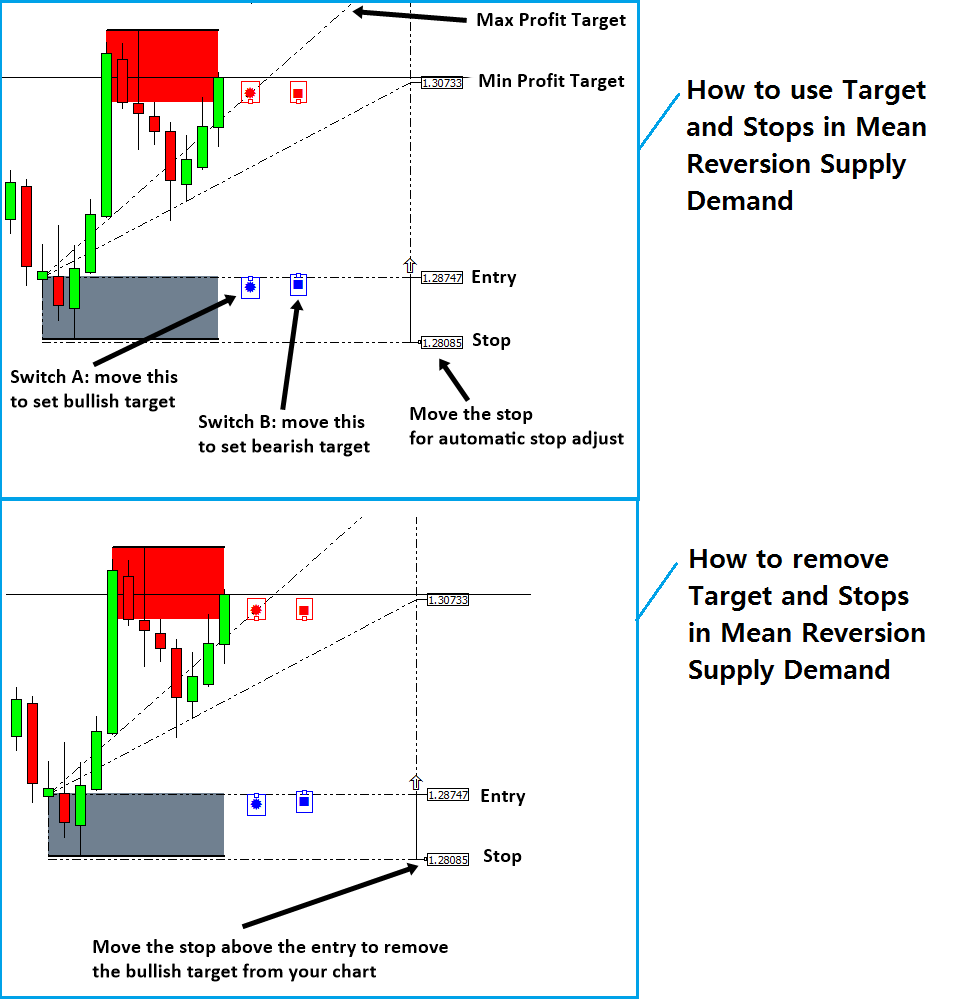
One of the greatest advantage of Ace Supply Demand Zone indicator is that it provide a flexible Profit and stop target for your trading. After you have learnt how to use this profit targets, now you want to learn how to remove them. Of course, there is a way to remove them. The trick is simply moving the stop text above the Entry text (for the case of buy). You will do the opposite for the case of sell. In the screenshot, the bottom image describe how to remove the targets from your chart.
There is another approach to remove take profit and stop loss targets. We provide the shortcut in keyboard for doing the same task. Simply hit “z” button in your keyboard. This will also remove the stop loss and take profit targets if you do not need them any longer.
In addition, we provide the YouTube video for Ace Supply Demand Zone Indicator. In terms of indicator operation, both mean reversion supply demand and ace supply demand zone indicator are similar. Hence, you can watch this YouTube Video to learn the basic operation with the supply demand zone indicator.
YouTube “Supply Demand Zone Indicator”: https://youtu.be/lr0dthrU9jo
Below is link to Ace Supply Demand Zone Indicator.
https://www.mql5.com/en/market/product/40076
https://www.mql5.com/en/market/product/40075
https://algotrading-investment.com/portfolio-item/ace-supply-demand-zone/
One of the greatest advantage of Ace Supply Demand Zone indicator is that it provide a flexible Profit and stop target for your trading. After you have learnt how to use this profit targets, now you want to learn how to remove them. Of course, there is a way to remove them. The trick is simply moving the stop text above the Entry text (for the case of buy). You will do the opposite for the case of sell. In the screenshot, the bottom image describe how to remove the targets from your chart.
There is another approach to remove take profit and stop loss targets. We provide the shortcut in keyboard for doing the same task. Simply hit “z” button in your keyboard. This will also remove the stop loss and take profit targets if you do not need them any longer.
In addition, we provide the YouTube video for Ace Supply Demand Zone Indicator. In terms of indicator operation, both mean reversion supply demand and ace supply demand zone indicator are similar. Hence, you can watch this YouTube Video to learn the basic operation with the supply demand zone indicator.
YouTube “Supply Demand Zone Indicator”: https://youtu.be/lr0dthrU9jo
Below is link to Ace Supply Demand Zone Indicator.
https://www.mql5.com/en/market/product/40076
https://www.mql5.com/en/market/product/40075
https://algotrading-investment.com/portfolio-item/ace-supply-demand-zone/
Young Ho Seo
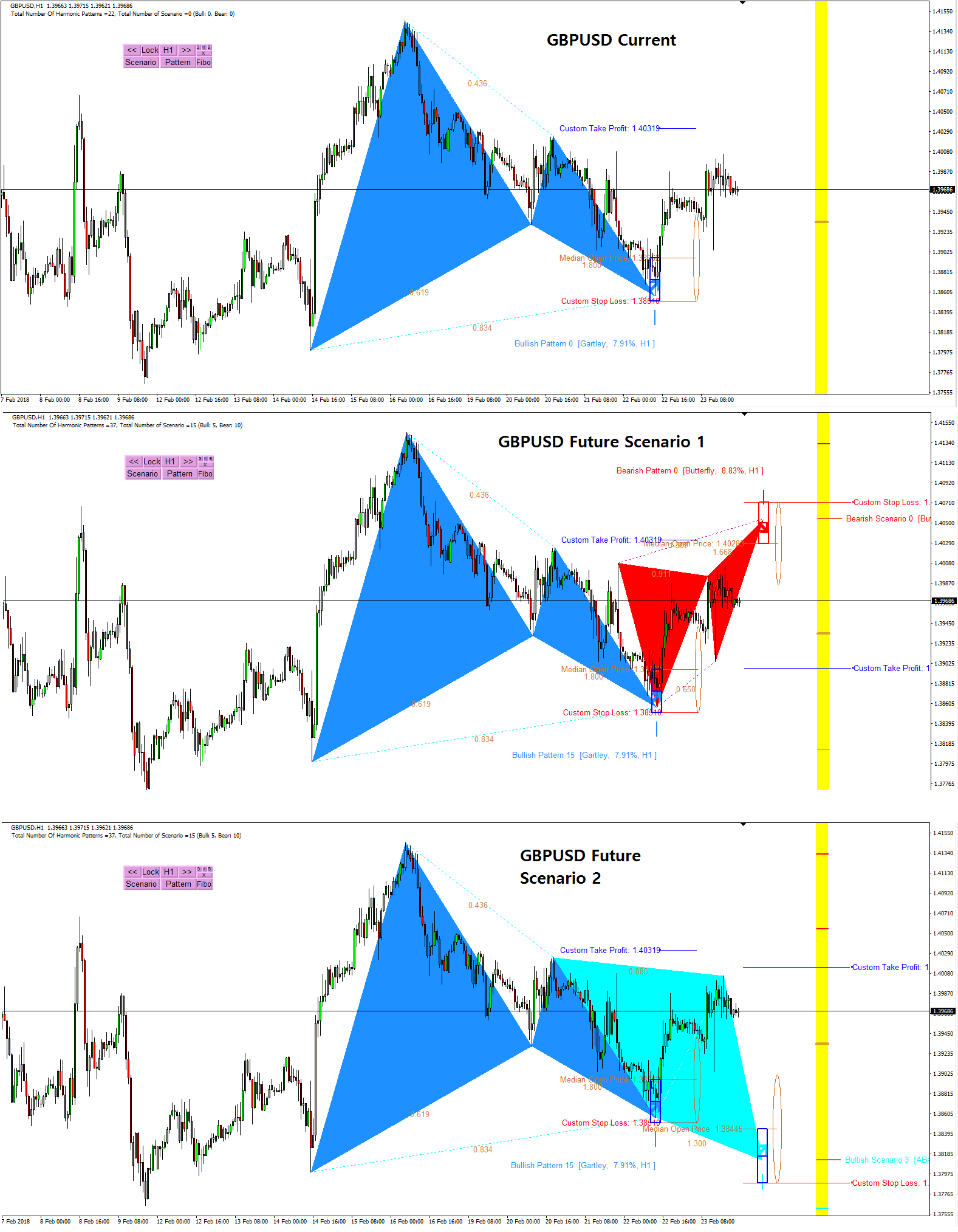
Automatic Resizing your Stop Loss and Take Profit Level with Harmonic Pattern Plus (Harmonic Pattern Scenario Planner)
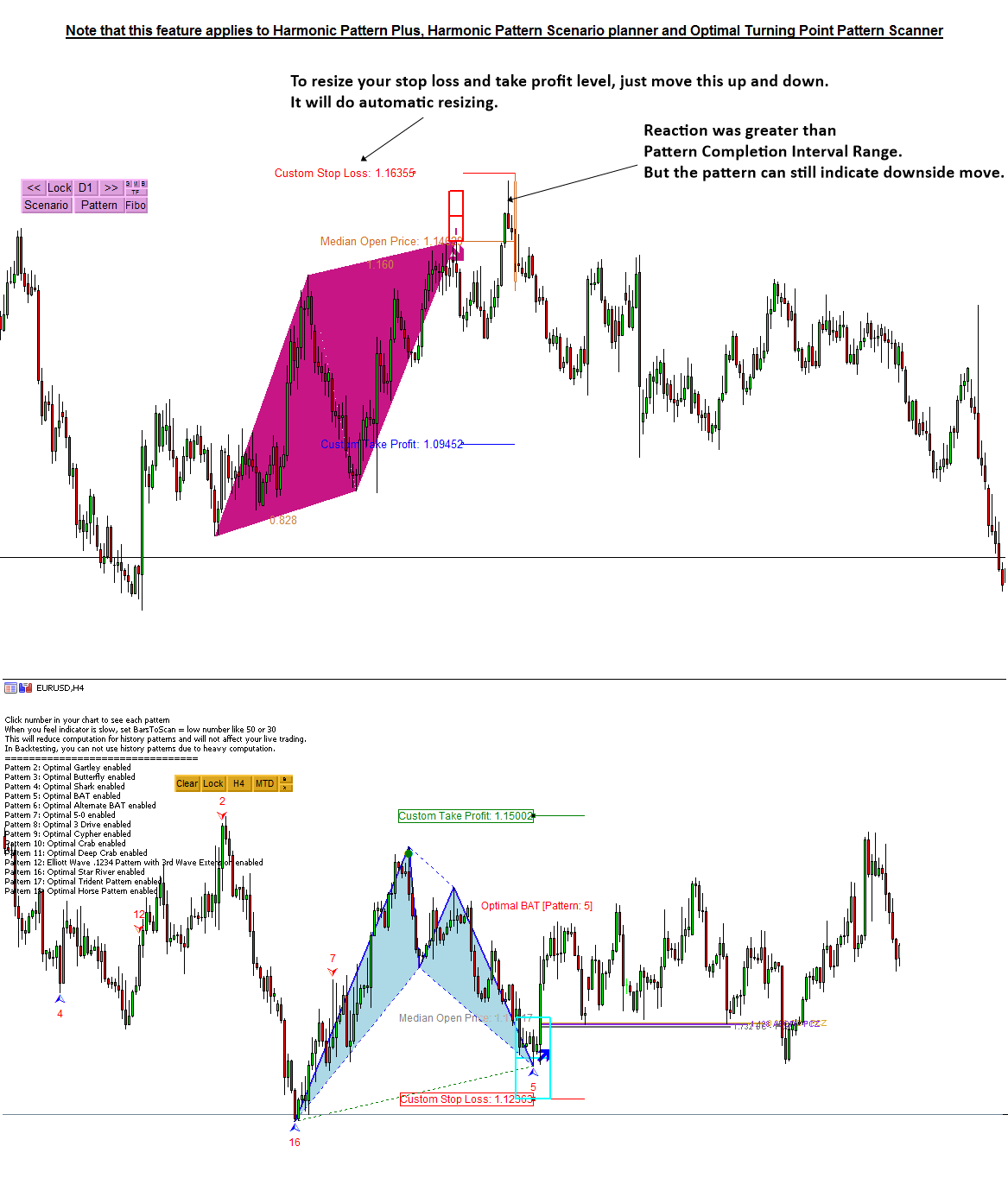
Having understood all the concept behind the Pattern Completion Interval, you might observe that sometime price can react outside the pattern completion interval. Sure, there is nothing perfect in the world. As long as you understand the pros and cons of using large stop loss size, it is still fine to control your own stop loss size.
However, we still prefer to express stop loss size in terms of pattern completion interval range for convenience. For example, if the original stop loss size was equal to 1 x pattern completion interval, you can certainly use 1.5 x pattern completion interval or 2 x pattern completion interval.
Another consideration before you are using pattern completion interval, if you can enter the market at the competitive price, then you can feel less guilty when you increase your stop loss size because you are still remaining good rewards/Risk ratio. On the other hands, if you have entered market at not so competitive price, then you might be cautious when you increase your stop loss size.
The same feature applies to X3 Chart Pattern Scanner (Non Repainting and Non Lagging Harmonic Pattern and Elliott Wave pattern scanner.)
In addition, you can watch the YouTube Video titled feel what is the automated harmonic pattern indicator like. For your information, we provides two YouTube videos with title and links below.
YouTube “Harmonic Pattern Indicator”: https://youtu.be/CzYUwk5qeCk
YouTube “Non Repainting Non Lagging Harmonic Pattern Indicator”: https://youtu.be/uMlmMquefGQ
Harmonic Pattern Plus
https://www.mql5.com/en/market/product/4488
https://www.mql5.com/en/market/product/4475
https://algotrading-investment.com/portfolio-item/harmonic-pattern-plus/
Harmonic Pattern Scenario Planner
https://www.mql5.com/en/market/product/6101
https://www.mql5.com/en/market/product/6240
https://algotrading-investment.com/portfolio-item/harmonic-pattern-scenario-planner/
X3 Chart Pattern Scanner
https://www.mql5.com/en/market/product/41993
https://www.mql5.com/en/market/product/41992
https://algotrading-investment.com/portfolio-item/profitable-pattern-scanner/
Having understood all the concept behind the Pattern Completion Interval, you might observe that sometime price can react outside the pattern completion interval. Sure, there is nothing perfect in the world. As long as you understand the pros and cons of using large stop loss size, it is still fine to control your own stop loss size.
However, we still prefer to express stop loss size in terms of pattern completion interval range for convenience. For example, if the original stop loss size was equal to 1 x pattern completion interval, you can certainly use 1.5 x pattern completion interval or 2 x pattern completion interval.
Another consideration before you are using pattern completion interval, if you can enter the market at the competitive price, then you can feel less guilty when you increase your stop loss size because you are still remaining good rewards/Risk ratio. On the other hands, if you have entered market at not so competitive price, then you might be cautious when you increase your stop loss size.
The same feature applies to X3 Chart Pattern Scanner (Non Repainting and Non Lagging Harmonic Pattern and Elliott Wave pattern scanner.)
In addition, you can watch the YouTube Video titled feel what is the automated harmonic pattern indicator like. For your information, we provides two YouTube videos with title and links below.
YouTube “Harmonic Pattern Indicator”: https://youtu.be/CzYUwk5qeCk
YouTube “Non Repainting Non Lagging Harmonic Pattern Indicator”: https://youtu.be/uMlmMquefGQ
Harmonic Pattern Plus
https://www.mql5.com/en/market/product/4488
https://www.mql5.com/en/market/product/4475
https://algotrading-investment.com/portfolio-item/harmonic-pattern-plus/
Harmonic Pattern Scenario Planner
https://www.mql5.com/en/market/product/6101
https://www.mql5.com/en/market/product/6240
https://algotrading-investment.com/portfolio-item/harmonic-pattern-scenario-planner/
X3 Chart Pattern Scanner
https://www.mql5.com/en/market/product/41993
https://www.mql5.com/en/market/product/41992
https://algotrading-investment.com/portfolio-item/profitable-pattern-scanner/
Young Ho Seo
Volume Spread Analysis Indicator List
We provide three different Volume Spread Analysis indicators and volume based tools. Our volume spread analysis tools are the hybrid of volume spread analysis and signal processing theory.
These tools will help you to complete your trading decision with high precision. As long as you understand the concept of the Accumulation and Distribution area in the volume spread analysis, these tools will help you to predict the presence of Accumulation and Distribution area. Hence, you can predict the best trading opportunity.
Firstly, Volume Spread Pattern Indicator is the powerful volume spread analysis indicator that operated across multiple timeframe. Volume Spread Pattern Indicator will not only provide the bearish and bullish volume spread pattern in the current time frame but also it will detect the same patterns across all timeframe. You just need to open one chart and you will be notified bullish and bearish patterns in all timeframe in real time.
Here is the link to Volume Spread Pattern Indicator.
https://www.mql5.com/en/market/product/32961
https://www.mql5.com/en/market/product/32960
https://algotrading-investment.com/portfolio-item/volume-spread-pattern-indicator/
Secondly, Volume Spread Pattern Detector is the light version of Volume Spread Pattern Indicator above. This is free tool with some limited features. However, Volume Spread Pattern Detector is used by thousands of traders. Especially, it works great with the support and resistance to confirm the turning point. This is free tool. Just grab one.
https://www.mql5.com/en/market/product/28438
https://www.mql5.com/en/market/product/28439
https://algotrading-investment.com/portfolio-item/volume-spread-pattern-detector/
Both Volume Spread Pattern Indicator and Volume Spread Pattern Detector works well with Excessive Momentum indicator as Excessive Momentum indicator helps to detect the potential Accumulation and Distribution area automatically. Hence, if you are using Excessive Momentum Indicator, then you can use one between Volume Spread Pattern Indicator or Volume Spread Pattern Detector. In addition, we provide the YouTube video to accomplish the basic operations of Excessive Momentum Indicator.
YouTube Video (Excessive Momentum Indicator): https://youtu.be/oztARcXsAVA
YouTube Video (Excessive Momentum Indicator Explained): https://youtu.be/A4JcTcakOKw
Here is link to Excessive Momentum Indicator for MetaTrader 4 and MetaTrader 5.
https://algotrading-investment.com/portfolio-item/excessive-momentum-indicator/
https://www.mql5.com/en/market/product/30641
https://www.mql5.com/en/market/product/30621
Thirdly, we provide the volume Zone Oscillator. This is another useful free tool that utilizes the volume information for your trading. You can use these tools for volume spread analysis, Harmonic Pattern, Elliott Wave Pattern, X3 Price Pattern further. This is free tool. Just grab one.
https://algotrading-investment.com/portfolio-item/volume-zone-oscillator/
We provide three different Volume Spread Analysis indicators and volume based tools. Our volume spread analysis tools are the hybrid of volume spread analysis and signal processing theory.
These tools will help you to complete your trading decision with high precision. As long as you understand the concept of the Accumulation and Distribution area in the volume spread analysis, these tools will help you to predict the presence of Accumulation and Distribution area. Hence, you can predict the best trading opportunity.
Firstly, Volume Spread Pattern Indicator is the powerful volume spread analysis indicator that operated across multiple timeframe. Volume Spread Pattern Indicator will not only provide the bearish and bullish volume spread pattern in the current time frame but also it will detect the same patterns across all timeframe. You just need to open one chart and you will be notified bullish and bearish patterns in all timeframe in real time.
Here is the link to Volume Spread Pattern Indicator.
https://www.mql5.com/en/market/product/32961
https://www.mql5.com/en/market/product/32960
https://algotrading-investment.com/portfolio-item/volume-spread-pattern-indicator/
Secondly, Volume Spread Pattern Detector is the light version of Volume Spread Pattern Indicator above. This is free tool with some limited features. However, Volume Spread Pattern Detector is used by thousands of traders. Especially, it works great with the support and resistance to confirm the turning point. This is free tool. Just grab one.
https://www.mql5.com/en/market/product/28438
https://www.mql5.com/en/market/product/28439
https://algotrading-investment.com/portfolio-item/volume-spread-pattern-detector/
Both Volume Spread Pattern Indicator and Volume Spread Pattern Detector works well with Excessive Momentum indicator as Excessive Momentum indicator helps to detect the potential Accumulation and Distribution area automatically. Hence, if you are using Excessive Momentum Indicator, then you can use one between Volume Spread Pattern Indicator or Volume Spread Pattern Detector. In addition, we provide the YouTube video to accomplish the basic operations of Excessive Momentum Indicator.
YouTube Video (Excessive Momentum Indicator): https://youtu.be/oztARcXsAVA
YouTube Video (Excessive Momentum Indicator Explained): https://youtu.be/A4JcTcakOKw
Here is link to Excessive Momentum Indicator for MetaTrader 4 and MetaTrader 5.
https://algotrading-investment.com/portfolio-item/excessive-momentum-indicator/
https://www.mql5.com/en/market/product/30641
https://www.mql5.com/en/market/product/30621
Thirdly, we provide the volume Zone Oscillator. This is another useful free tool that utilizes the volume information for your trading. You can use these tools for volume spread analysis, Harmonic Pattern, Elliott Wave Pattern, X3 Price Pattern further. This is free tool. Just grab one.
https://algotrading-investment.com/portfolio-item/volume-zone-oscillator/
Young Ho Seo
Introduction to Charting Techniques
For the Price Action and Pattern Analysis, it is important to have good visualization tools. Since we want to find important patterns for our trading, we will need a good size monitor and good visualization software. Of course, you should invest on them as much as you can afford. No single visualization techniques are perfect. They always possess some advantages as well as some disadvantages. Firstly, line chart is the most basic visualization technique for traders. Line is simply drawn by connecting each session’s closing price. For example, 1-hour line chart is simply drawn by connecting the closing price of 1-hour candle. As line chart are produced by connecting two points at the fixed time interval, they can provide a great insight about some regularities in the price series. For this reason, not only traders use the line chart but also many mathematicians use them to visualize the price series data. Line chart is useful when we want to exam some cyclic behaviour like seasonality or any cyclic patterns made up from sine or cosine function. Line chart is also useful when you want to compare multiple price series in one chart. On the other hands, the disadvantage of the line chart is that it does not provide the trading range of each session. In addition, due to the continuously drawn line, it is difficult to see any gap between sessions. In addition, line chart miss some important attributes like highest and lowest prices of each session.
Figure 2-1: Line chart for EURUSD from 1 September 2016 to 16 January 2017
Candlestick chart provides some additional attributes, which line chart misses. Figure 2-2 presents the anatomy of the candlestick chart. Candlestick chart provides three important information. Firstly, the bottom and top of the box represents the opening and closing price of the session. Secondly, each candlestick shows the trading range between high and low for each session. Thirdly, candlestick shows the direction of movement for each session. In Figure 2-2, the green candle reveals the upward movement for the session immediately whereas the red candle shows the downward movement. From Figure 2-3, we can feel how richer information candlestick chart provide for each session comparing to the Line chart. As shown in Figure 2-3, Candlestick chart is useful to spot the gaps in between sessions. This is very useful property of the candlestick chart since Line chart or any other chart is difficult to spot the gaps. One of the drawbacks of the candlestick chart is that it does not provide the sequence of high and low price but this is the common problem for other visualization techniques too. It is simply because the sequence of high and low price was not collected traditionally by the Financial Institutions. If anyone starts to provide the historical sequence of high and low prices for each session, then this would reveal a lot of information on the psychology of the financial market. All they have to put some simple identifier which price comes first between high and low prices during the session. For example, one can put the letter “h” to highlight that high price comes first before low price. Therefore, storing cost is no more than just a letter for this crucial information. This might be cheap but useful alternative to the expensive tick history data, which often require enormous hard drive space. In addition, the candlestick chart is the basis for the popular Japanese candlestick patterns. Although the Japanese candlestick pattern alone does not provide the perfect trading entry, many traders uses them as the confirming tool for their entry or exit.
Figure 2-2: Anatomy of the Candlestick chart.
Figure 2-3: Candlestick chart for EURUSD from 1 September 2016 to 16 January 2017.
OHLC Bar chart is another popular form of visualization techniques. The OHLC bar chart has some improvement over the line chart. It provides all of the same data including open, close, range and direction to the candlestick chart. However, OHLC bar chart is not visually easy to follow like candlestick chart. In addition, spotting the gap between sessions is not easy with the OHLC bar chart. However, many traders still not given up to use OHLC bar chart over the candlestick and line chart.
Figure 2-4: Anatomy of the Range Bar.
So far, we have introduced the visualization techniques with the fixed time interval. For example, line chart, candlestick chart and the OHLC bar chart uses the information collected in each session. The common time interval for the session is 1 hour, 4 hour, 1 day, 1 week and 1 month. Instead of using the fixed time interval, several techniques do not use the fixed time interval to construct the chart. For example, tick chart record the open, high, low and close prices during the fixed tick arrival intervals. Therefore, all the bars in the Tick chart have the same tick volumes. For example, 100 Tick chart will record the open, high, low and close price during 100 tick arrivals. All the bars in 100 Tick chart will have 100 tick volumes. One can construct line, candlestick chart and OHLC bar chart with Tick chart too. Tick chart will look like normal chart except that every bar has the identical tick volume. In Tick chart, during busy market hours, one candlestick can be formed fast but during slow market hours, one candlestick can be formed slowly. The tick chart is useful to replace the normal candlestick chart with lower timeframe when the candlestick chart produces the poor visual representation of the market with standard time interval. This is not always the case but when there is low interest in the market, this can happen. For example, Figure 2-5 shows the broken 1-minute candlestick chart for NZDSGD currency pairs. In this case, instead of using the candlestick chart with 1-minute chart, trader can use 100 tick chart. Because each candle is completed with 100 tick arrivals every time (Figure 2-6), we naturally have smoother looking chart in comparison to the broken chart in Figure 2-5. Once traders become familiar with tick chart, they tend to stick with them even for the higher timeframe. For example, you can use 500 tick chart or 1000 tick chart for your trading. Disadvantage of the tick chart is that tick is generally much heavier to store in the hard drive in terms of size. Therefore, not many trading package offer the capability of using tick chart for the time of writing this book. Just for your information, one-year worth of tick data can take up over some serous gigabytes of the space on your hard drives. In addition, Tick chart does not provide volatility information since every bar has identical tick volume. However, if programmatically doable, one can store time duration it takes to form the bar in the place of the tick volume. This would provide different insight, which the fixed time interval chart can’t provide.
Figure 2-5: Broken candlestick chart for NZDSGD currency pairs in 1-minute timeframe.
Figure 2-6: EURUSD Tick chat with 100 tick volume. On average, each bar was formed in 182.36 seconds.
Another popular visualization technique, which does not use the fixed time interval, is the Renko chart. The charting principle of the Renko Chart is quite different from the rest. For example, Renko chart is constructed by drawing bricks of fixed height in series. To illustrate the idea, consider Figure 2-7, if the price moved up by 5 points from the top of brick, then we will draw one white up brick. Likewise, if the price moved down by 5 points from the bottom of the brick, then we will draw one black down brick. The brick will be drawn either on the top or on the bottom of the other brick always.
Figure 2-7: Conceptual representation of Renko chart.
Figure 2-8 shows what happens when we transform about 100 candlesticks into Renko bricks with height of 20 pips in EURUSD 1 hour chart. As you can see, Renko bricks are much more concise and 100 candlesticks was transformed into only 52 Renko bricks. During this transformation, we are losing time information of our candlestick chart. Another important point you can observe here is that the Renko chart provide much smoother and readable visualization representation of trend. This is because the equal height of Renko brick reduces a lot of noise present in candlestick chart. With Renko Brick chart, it is much easier to identify trend and reversal patterns.
Figure 2-8: Daily EURUSD price series and Renko chart on the same period.
There are some drawbacks in Renko chart too. Because Renko chart lose all time information from our candlestick chart, you are no longer able to compare your normal candlestick chart to your Renko chart. In addition, unlike the candlestick chart, you have to select the sensible height of brick. Since there are many benefits using Renko chart, some traders are never worried about these disadvantages. Overall, Renko chart provide quite a lot of features which other chart does not provide.
About this Article
This article is the part taken from the draft version of the Book: Scientific Guide to Price Action and Pattern Trading (Wisdom of Trend, Cycle, and Fractal Wave). Full version of the book can be found from the link below:
https://algotrading-investment.com/portfolio-item/scientific-guide-to-price-action-and-pattern-trading/
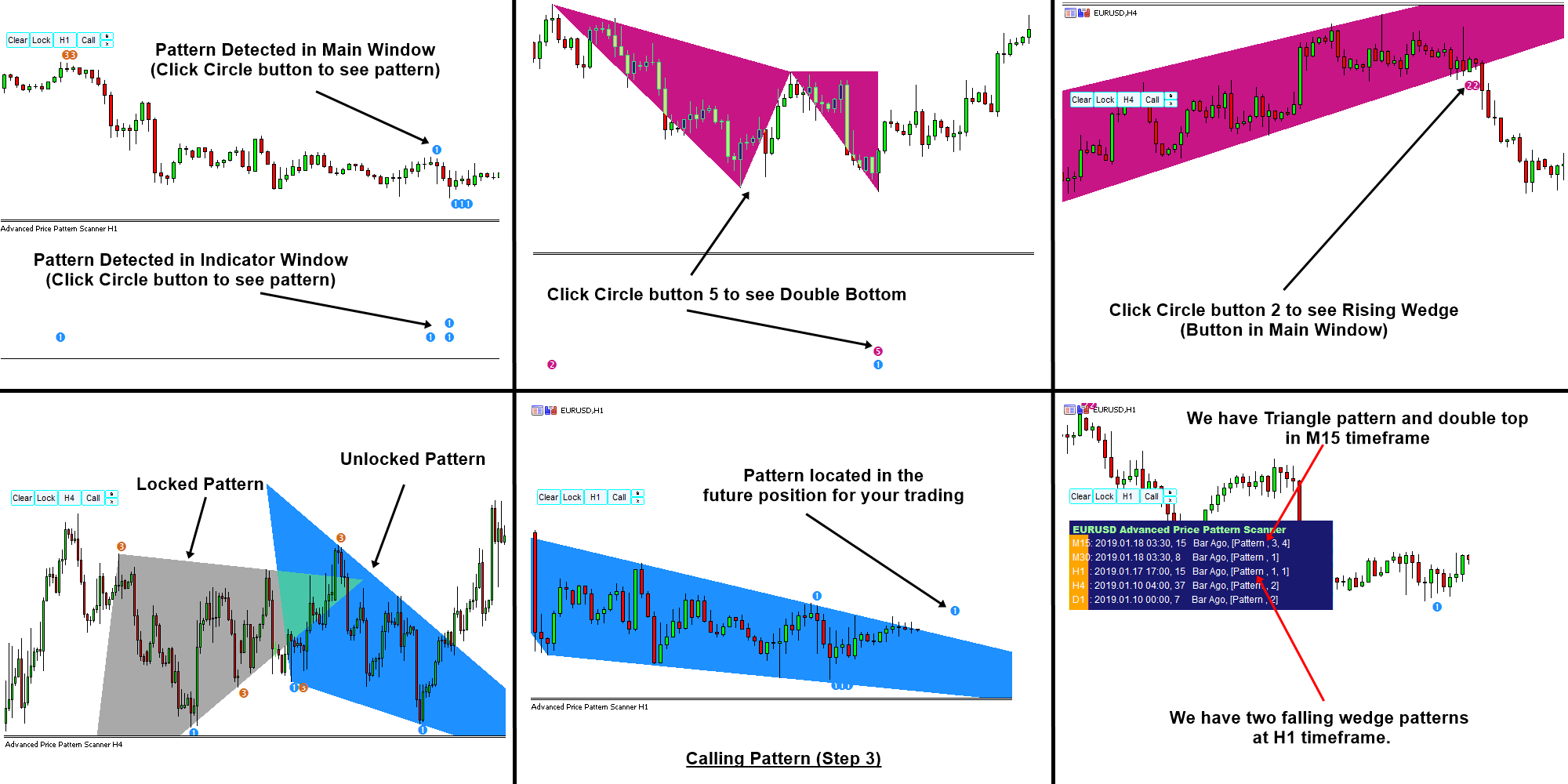
Advanced Price Pattern Scanner uses highly sophisticated pattern detection algorithm. However, we have designed it in the easy to use and intuitive manner. Advanced Price Pattern Scanner will show all the patterns in your chart in the most efficient format for your trading. It is non repainting pattern detector. Below are the links to Advanced Price Pattern Scanner.
https://algotrading-investment.com/portfolio-item/advanced-price-pattern-scanner/
https://www.mql5.com/en/market/product/24679
https://www.mql5.com/en/market/product/24678
Below is the landing page for Optimum Chart (Standalone Charting and Analytical Platform).
https://algotrading-investment.com/2019/07/23/optimum-chart/
For the Price Action and Pattern Analysis, it is important to have good visualization tools. Since we want to find important patterns for our trading, we will need a good size monitor and good visualization software. Of course, you should invest on them as much as you can afford. No single visualization techniques are perfect. They always possess some advantages as well as some disadvantages. Firstly, line chart is the most basic visualization technique for traders. Line is simply drawn by connecting each session’s closing price. For example, 1-hour line chart is simply drawn by connecting the closing price of 1-hour candle. As line chart are produced by connecting two points at the fixed time interval, they can provide a great insight about some regularities in the price series. For this reason, not only traders use the line chart but also many mathematicians use them to visualize the price series data. Line chart is useful when we want to exam some cyclic behaviour like seasonality or any cyclic patterns made up from sine or cosine function. Line chart is also useful when you want to compare multiple price series in one chart. On the other hands, the disadvantage of the line chart is that it does not provide the trading range of each session. In addition, due to the continuously drawn line, it is difficult to see any gap between sessions. In addition, line chart miss some important attributes like highest and lowest prices of each session.
Figure 2-1: Line chart for EURUSD from 1 September 2016 to 16 January 2017
Candlestick chart provides some additional attributes, which line chart misses. Figure 2-2 presents the anatomy of the candlestick chart. Candlestick chart provides three important information. Firstly, the bottom and top of the box represents the opening and closing price of the session. Secondly, each candlestick shows the trading range between high and low for each session. Thirdly, candlestick shows the direction of movement for each session. In Figure 2-2, the green candle reveals the upward movement for the session immediately whereas the red candle shows the downward movement. From Figure 2-3, we can feel how richer information candlestick chart provide for each session comparing to the Line chart. As shown in Figure 2-3, Candlestick chart is useful to spot the gaps in between sessions. This is very useful property of the candlestick chart since Line chart or any other chart is difficult to spot the gaps. One of the drawbacks of the candlestick chart is that it does not provide the sequence of high and low price but this is the common problem for other visualization techniques too. It is simply because the sequence of high and low price was not collected traditionally by the Financial Institutions. If anyone starts to provide the historical sequence of high and low prices for each session, then this would reveal a lot of information on the psychology of the financial market. All they have to put some simple identifier which price comes first between high and low prices during the session. For example, one can put the letter “h” to highlight that high price comes first before low price. Therefore, storing cost is no more than just a letter for this crucial information. This might be cheap but useful alternative to the expensive tick history data, which often require enormous hard drive space. In addition, the candlestick chart is the basis for the popular Japanese candlestick patterns. Although the Japanese candlestick pattern alone does not provide the perfect trading entry, many traders uses them as the confirming tool for their entry or exit.
Figure 2-2: Anatomy of the Candlestick chart.
Figure 2-3: Candlestick chart for EURUSD from 1 September 2016 to 16 January 2017.
OHLC Bar chart is another popular form of visualization techniques. The OHLC bar chart has some improvement over the line chart. It provides all of the same data including open, close, range and direction to the candlestick chart. However, OHLC bar chart is not visually easy to follow like candlestick chart. In addition, spotting the gap between sessions is not easy with the OHLC bar chart. However, many traders still not given up to use OHLC bar chart over the candlestick and line chart.
Figure 2-4: Anatomy of the Range Bar.
So far, we have introduced the visualization techniques with the fixed time interval. For example, line chart, candlestick chart and the OHLC bar chart uses the information collected in each session. The common time interval for the session is 1 hour, 4 hour, 1 day, 1 week and 1 month. Instead of using the fixed time interval, several techniques do not use the fixed time interval to construct the chart. For example, tick chart record the open, high, low and close prices during the fixed tick arrival intervals. Therefore, all the bars in the Tick chart have the same tick volumes. For example, 100 Tick chart will record the open, high, low and close price during 100 tick arrivals. All the bars in 100 Tick chart will have 100 tick volumes. One can construct line, candlestick chart and OHLC bar chart with Tick chart too. Tick chart will look like normal chart except that every bar has the identical tick volume. In Tick chart, during busy market hours, one candlestick can be formed fast but during slow market hours, one candlestick can be formed slowly. The tick chart is useful to replace the normal candlestick chart with lower timeframe when the candlestick chart produces the poor visual representation of the market with standard time interval. This is not always the case but when there is low interest in the market, this can happen. For example, Figure 2-5 shows the broken 1-minute candlestick chart for NZDSGD currency pairs. In this case, instead of using the candlestick chart with 1-minute chart, trader can use 100 tick chart. Because each candle is completed with 100 tick arrivals every time (Figure 2-6), we naturally have smoother looking chart in comparison to the broken chart in Figure 2-5. Once traders become familiar with tick chart, they tend to stick with them even for the higher timeframe. For example, you can use 500 tick chart or 1000 tick chart for your trading. Disadvantage of the tick chart is that tick is generally much heavier to store in the hard drive in terms of size. Therefore, not many trading package offer the capability of using tick chart for the time of writing this book. Just for your information, one-year worth of tick data can take up over some serous gigabytes of the space on your hard drives. In addition, Tick chart does not provide volatility information since every bar has identical tick volume. However, if programmatically doable, one can store time duration it takes to form the bar in the place of the tick volume. This would provide different insight, which the fixed time interval chart can’t provide.
Figure 2-5: Broken candlestick chart for NZDSGD currency pairs in 1-minute timeframe.
Figure 2-6: EURUSD Tick chat with 100 tick volume. On average, each bar was formed in 182.36 seconds.
Another popular visualization technique, which does not use the fixed time interval, is the Renko chart. The charting principle of the Renko Chart is quite different from the rest. For example, Renko chart is constructed by drawing bricks of fixed height in series. To illustrate the idea, consider Figure 2-7, if the price moved up by 5 points from the top of brick, then we will draw one white up brick. Likewise, if the price moved down by 5 points from the bottom of the brick, then we will draw one black down brick. The brick will be drawn either on the top or on the bottom of the other brick always.
Figure 2-7: Conceptual representation of Renko chart.
Figure 2-8 shows what happens when we transform about 100 candlesticks into Renko bricks with height of 20 pips in EURUSD 1 hour chart. As you can see, Renko bricks are much more concise and 100 candlesticks was transformed into only 52 Renko bricks. During this transformation, we are losing time information of our candlestick chart. Another important point you can observe here is that the Renko chart provide much smoother and readable visualization representation of trend. This is because the equal height of Renko brick reduces a lot of noise present in candlestick chart. With Renko Brick chart, it is much easier to identify trend and reversal patterns.
Figure 2-8: Daily EURUSD price series and Renko chart on the same period.
There are some drawbacks in Renko chart too. Because Renko chart lose all time information from our candlestick chart, you are no longer able to compare your normal candlestick chart to your Renko chart. In addition, unlike the candlestick chart, you have to select the sensible height of brick. Since there are many benefits using Renko chart, some traders are never worried about these disadvantages. Overall, Renko chart provide quite a lot of features which other chart does not provide.
About this Article
This article is the part taken from the draft version of the Book: Scientific Guide to Price Action and Pattern Trading (Wisdom of Trend, Cycle, and Fractal Wave). Full version of the book can be found from the link below:
https://algotrading-investment.com/portfolio-item/scientific-guide-to-price-action-and-pattern-trading/
Advanced Price Pattern Scanner uses highly sophisticated pattern detection algorithm. However, we have designed it in the easy to use and intuitive manner. Advanced Price Pattern Scanner will show all the patterns in your chart in the most efficient format for your trading. It is non repainting pattern detector. Below are the links to Advanced Price Pattern Scanner.
https://algotrading-investment.com/portfolio-item/advanced-price-pattern-scanner/
https://www.mql5.com/en/market/product/24679
https://www.mql5.com/en/market/product/24678
Below is the landing page for Optimum Chart (Standalone Charting and Analytical Platform).
https://algotrading-investment.com/2019/07/23/optimum-chart/
Young Ho Seo
Advanced Harmonic Pattern Detection Indicator
Harmonic Pattern Scenario Planner is an advanced Harmonic Pattern Detection Indicator. This is probably the most sophisticated harmonic pattern detection indicator in the market.
Harmonic Pattern Scenario planner can be used like Harmonic Pattern Plus. Hence, it is easy and friendly to use. At the same time, it combines powerful Monte Carlos Simulation to provide you advanced harmonic pattern search capability.
Monte Carlo Simulation can help you to find future reversal points in advance.
Here is the product link to Harmonic Pattern Scenario Planner. You can find more about the features of this advanced Harmonic Pattern Scenario Planner.
https://algotrading-investment.com/portfolio-item/harmonic-pattern-scenario-planner/
https://www.mql5.com/en/market/product/6101
https://www.mql5.com/en/market/product/6240
Harmonic Pattern Scenario Planner is an advanced Harmonic Pattern Detection Indicator. This is probably the most sophisticated harmonic pattern detection indicator in the market.
Harmonic Pattern Scenario planner can be used like Harmonic Pattern Plus. Hence, it is easy and friendly to use. At the same time, it combines powerful Monte Carlos Simulation to provide you advanced harmonic pattern search capability.
Monte Carlo Simulation can help you to find future reversal points in advance.
Here is the product link to Harmonic Pattern Scenario Planner. You can find more about the features of this advanced Harmonic Pattern Scenario Planner.
https://algotrading-investment.com/portfolio-item/harmonic-pattern-scenario-planner/
https://www.mql5.com/en/market/product/6101
https://www.mql5.com/en/market/product/6240
Young Ho Seo
Fibonacci Retracement and Expansion Patterns
A Fibonacci analysis is a popular tool among technical traders. It is based on the Fibonacci sequence numbers identified by Leonardo Fibonacci in the 13th century. Here are the Fibonacci sequence numbers:
0, 1, 1, 2, 3, 5, 8, 13, 21, 34, 55, 89,144, 233, 377, 610, 987, 1597, 2584, 4181, 6765, …………………
As the Fibonacci number become large, the constant relationship is established between neighbouring numbers. For example, every time, when we divide the former number by latter: Fn-1/Fn, we will get nearly 0.618 ratio. Likewise, when we divide the latter number by former: Fn/Fn-1, we will get nearly 1.618. These two Fibonacci ratio 0.618 and 1.618 are considered as the Golden Ratio. We can use these Golden ratios to start our Fibonacci analysis. However, many technical traders use additional Fibonacci ratios derived from the Golden ratio. Since the calculation of each Fibonacci ratio is well known, I have listed all the available Fibonacci ratio calculation in Table 1-1.
Type Ratio Calculation
Primary 0.618 Fn-1/Fn of Fibonacci numbers
Primary 1.618 Fn/Fn-1 of Fibonacci numbers
Primary 0.786
Primary 1.272
Secondary 0.382 0.382=0.618*0.618
Secondary 2.618 2.618=1.618*1.618
Secondary 4.236 4.236=1.618*1.618*1.618
Secondary 6.854 6.854=1.618*1.618*1.618*1.618
Secondary 11.089 11.089=1.618*1.618*1.618*1.618*1.618
Secondary 0.500 0.500=1.000/2.000
Secondary 1.000 Unity
Secondary 2.000 Fibonacci Prime Number
Secondary 3.000 Fibonacci Prime Number
Secondary 5.000 Fibonacci Prime Number
Secondary 13.000 Fibonacci Prime Number
Secondary 1.414
Secondary 1.732
Secondary 2.236
Secondary 3.610
Secondary 3.142 3.142 = Pi = circumference /diameter of the circle
Table 1-1: Fibonacci ratios and corresponding calculations to derive each ratio.
In fact, Fibonacci analysis in financial trading is extremely popular. It is popular on its own. At the same time, it is also basis for many other popular technical analyses like harmonic pattern, Elliott wave pattern, etc. As with support resistance analysis, Fibonacci analysis is probably the most popular technical analysis among traders. There are two important techniques in Fibonacci analysis. First technique is Fibonacci retracement. Second technique is Fibonacci expansion. If you are looking at some other books, you might find some confusing description about retracement, extension, expansion, and projection. For example, the book might give two different names for the ratio over 100% and for the ratio below 100%. We are not using the confusing name practice here but we will stick with just retracement and expansion because it is simple. Both retracement and expansion will need two significant peak and trough to pick up in your chart. If you want to use mechanical setup with Fibonacci analysis, the best way to start is to use the Peak Trough Transformation using ZigZag indicator. Let us start with retracement. For simple example, we use 61.8% Golden ratio. For retracement, we can have two cases including Trough-Peak retracement and Peak-Trough retracement. In Trough-Peak retracement, 61.8% retracement level will act as a support level. Price will reverse in the correction phase to follow the previous bullish movement.
Figure 1-1: Trough-Peak Retracement Example on EURUSD H4 timeframe.
Likewise, in Peak-Trough retracement, 61.8% will act as resistance. Price will reverse in the correction phase to follow the previous bearish movement. In both case, the 61.8% retracement will be measured from end of correction phase to previous peak or trough. We have used percentage in this example. Some technical traders prefer to use the ratios in decimal places like 0.618. It is just your preferences. Using ratio or percentage does not affect the accuracy of trading. You can use other Fibonacci ratios like 0.382 or 1.618 in the exactly same way as 0.618.
Figure 1-2: Peak-Trough Retracement Example on EURUSD H4 timeframe.
Fibonacci expansion is slightly more complicated than Fibonacci retracement. Still it is considered as the basic analysis among technical trader. As in retracement technique, we can have two cases including Trough-Peak expansion and Peak-Trough expansion. In Trough-Peak expansion, we will measure the expansion from where the correction ends to next peak. In the next peak, we will expect the bearish reversal in the same direction to the correction. In fact, the 100% Expansion level is act as the resistance in Figure 1-3. Likewise, in Peak-Trough expansion, we will expect the bullish reversal in the same direction to the correction. In Figure 1-4, 61.8% expansion level acts as the support.
Figure 1-3: Trough-Peak Expansion Example on EURUSD H4 timeframe.
Figure 1-4: Peak-Trough Expansion Example on EURUSD H4 timeframe.
We have just given the technical description of Fibonacci retracement and expansion. The next thing we need to ask is what is the scientific relevance or justification behind these techniques. Unfortunately, it is hard to tell. People just used them for many decades without questioning any scientific relevance. I think most of people will use them in the future without questioning too. As I have mentioned, the very purpose of this book is to connect common technical analysis and trading strategy to the existing science. We really want to break the lack of communication between them. Therefore, we will give an answer to the question.
Connecting Fibonacci ratio to science is not overly complicated. We have already covered that the building block of fractal geometry in financial market is triangle known as equilibrium fractal wave. By drawing a triangle from trough, peak, and trough, we can simply demonstrate that Fibonacci retracement is the technique that predicting the shape ratio of the triangle. In our 61.8% retracement example, we are predicting that the shape ratio of triangle is 61.8%. As we have discussed, the loose-self similarity of equilibrium fractal wave will allow us to have any shape ratio from 0.01 to above 3.0. Our prediction of 61.8% could be wrong and the shape ratio of triangle could end up 123% or 152%, etc. Do we have any justification to predict 61.8% of the triangle? Yes, the justification is how often the shape ratio of 61.8% is repeating in history. If we have 61.8% shape ratio repeating more times than other shape ratio, then we can certainly justify our prediction. To check them, we have already introduced the measurement called Shape ratio index. It is calculated by dividing number of particular shape ratio by total number of peaks and troughs in the price series. In Figure 1-7 and Figure 1-8, we show the distribution of this Shape Ratio index for both EURUSD and GBPUSD daily timeframe. By looking at the distribution in Figure 1-7 and Figure 1-8, we can confirm that 61.8% shape ratio found 27.8% and 23.3% respectively for EURUSD and GBPUSD among all found peaks and troughs. It is certainly much better than 0% or 5%. Over 20% repeating is significant outcome even in statistical sense. However, in GBPUSD, 61.8% shape ratio is not as significant as 50.0% shape ratio. This suggests that 61.8% retracement is not optimal for some currency pairs and stock prices. Another finding is that individual currency pairs or stock price has their own preferred shape ratios.
Shape ratio of equilibrium fractal wave = current move in price units (Y2)/ previous move in price units (Y1).
Shape Ratio index = number of the particular shape of equilibrium fractal wave / total number of peaks and troughs in the price series.
Figure 1-5: Trough-Peak retracement with a triangle drawn.
Figure 1-6: Structure of one triangle, equilibrium fractal wave. It is made up from two price movements (i.e. two legs).
Figure 1-7: EFW Shape Ratio Distribution for EURUSD Daily Timeframe from 2009 09 02 to 2018 02 20 (Label inside callout box, left: Ratio, right: EFW Index, vertical axis: EFW index, horizontal axis: ratio from 0.1 to 3.0).
Figure 1-8: EFW Shape Ratio Distribution for GBPUSD Daily Timeframe from 2009 09 02 to 2018 02 20 (Label inside callout box, left: Ratio, right: EFW Index, vertical axis: EFW index, horizontal axis: ratio from 0.1 to 3.0).
Of course, we can find the scientific relevance for Fibonacci expansion technique too. To do so, we just need to create two triangles by connecting peak, trough, peak, and trough. In our 61.8% expansion example, we are predicting that the Momentum ratio of two adjacent triangles is 61.8%. The loose-self similarity will allow us to have any Momentum ratio from 0.01 to above 3.0. We could be wrong or right with our Momentum ratio prediction. To justify our choice over 61.8% expansion ratio, we just need to calculate the distribution of Momentum ratio index. Unfortunately, I do not have the calculated distribution for the case of Momentum ratio. However, I have provided you the equations in this book. You might attempt it by yourself.
Momentum ratio of equilibrium fractal wave = latest price move of current wave in price units (Y3)/ first movement of previous wave in price units (Y1) where Y3 and Y1 are in the same direction.
Momentum Ratio index = number of the particular Momentum ratio / number of peaks and troughs in the price series.
Figure 1-9: Peak-Trough Expansion Example with two triangles drawn.
Figure 1-10: Momentum ratio for two ascending Equilibrium Fractal waves
Once again, we emphasize that the distribution of Shape Ratio index and Momentum Ratio index can reveal a lot about financial market. When I first created the distribution of Shape Ratio, I felt like that I found the oil reservoir in the Sahara Desert. There were many useful insights for both scientific and financial trading purpose. I do recommend further research on this in academic level too. Finally, it is important to note that Fibonacci ratio is the basis for many other advanced technical analyses including Shape Ratio trading, Harmonic pattern, and Elliott wave patterns. Therefore, it is important to understand how the Fibonacci analysis works before you proceeding to the next chapter of this book.
About this Article
This article is the part taken from the draft version of the Book: Scientific Guide to Price Action and Pattern Trading (Wisdom of Trend, Cycle, and Fractal Wave). Full version of the book can be found from the link below:
https://algotrading-investment.com/portfolio-item/scientific-guide-to-price-action-and-pattern-trading/
You can also use Harmonic Pattern Plus in MetaTrader to accomplish your technical analysis. Harmonic Pattern Plus is the advanced Fibonacci Analysis Indicator for your trading. Below are the Links to Harmonic Pattern Plus
https://www.mql5.com/en/market/product/4488
https://www.mql5.com/en/market/product/4475
https://algotrading-investment.com/portfolio-item/harmonic-pattern-plus/
Below is the landing page for Optimum Chart (Standalone Charting and Analytical Platform).
https://algotrading-investment.com/2019/07/23/optimum-chart/
A Fibonacci analysis is a popular tool among technical traders. It is based on the Fibonacci sequence numbers identified by Leonardo Fibonacci in the 13th century. Here are the Fibonacci sequence numbers:
0, 1, 1, 2, 3, 5, 8, 13, 21, 34, 55, 89,144, 233, 377, 610, 987, 1597, 2584, 4181, 6765, …………………
As the Fibonacci number become large, the constant relationship is established between neighbouring numbers. For example, every time, when we divide the former number by latter: Fn-1/Fn, we will get nearly 0.618 ratio. Likewise, when we divide the latter number by former: Fn/Fn-1, we will get nearly 1.618. These two Fibonacci ratio 0.618 and 1.618 are considered as the Golden Ratio. We can use these Golden ratios to start our Fibonacci analysis. However, many technical traders use additional Fibonacci ratios derived from the Golden ratio. Since the calculation of each Fibonacci ratio is well known, I have listed all the available Fibonacci ratio calculation in Table 1-1.
Type Ratio Calculation
Primary 0.618 Fn-1/Fn of Fibonacci numbers
Primary 1.618 Fn/Fn-1 of Fibonacci numbers
Primary 0.786
Primary 1.272
Secondary 0.382 0.382=0.618*0.618
Secondary 2.618 2.618=1.618*1.618
Secondary 4.236 4.236=1.618*1.618*1.618
Secondary 6.854 6.854=1.618*1.618*1.618*1.618
Secondary 11.089 11.089=1.618*1.618*1.618*1.618*1.618
Secondary 0.500 0.500=1.000/2.000
Secondary 1.000 Unity
Secondary 2.000 Fibonacci Prime Number
Secondary 3.000 Fibonacci Prime Number
Secondary 5.000 Fibonacci Prime Number
Secondary 13.000 Fibonacci Prime Number
Secondary 1.414
Secondary 1.732
Secondary 2.236
Secondary 3.610
Secondary 3.142 3.142 = Pi = circumference /diameter of the circle
Table 1-1: Fibonacci ratios and corresponding calculations to derive each ratio.
In fact, Fibonacci analysis in financial trading is extremely popular. It is popular on its own. At the same time, it is also basis for many other popular technical analyses like harmonic pattern, Elliott wave pattern, etc. As with support resistance analysis, Fibonacci analysis is probably the most popular technical analysis among traders. There are two important techniques in Fibonacci analysis. First technique is Fibonacci retracement. Second technique is Fibonacci expansion. If you are looking at some other books, you might find some confusing description about retracement, extension, expansion, and projection. For example, the book might give two different names for the ratio over 100% and for the ratio below 100%. We are not using the confusing name practice here but we will stick with just retracement and expansion because it is simple. Both retracement and expansion will need two significant peak and trough to pick up in your chart. If you want to use mechanical setup with Fibonacci analysis, the best way to start is to use the Peak Trough Transformation using ZigZag indicator. Let us start with retracement. For simple example, we use 61.8% Golden ratio. For retracement, we can have two cases including Trough-Peak retracement and Peak-Trough retracement. In Trough-Peak retracement, 61.8% retracement level will act as a support level. Price will reverse in the correction phase to follow the previous bullish movement.
Figure 1-1: Trough-Peak Retracement Example on EURUSD H4 timeframe.
Likewise, in Peak-Trough retracement, 61.8% will act as resistance. Price will reverse in the correction phase to follow the previous bearish movement. In both case, the 61.8% retracement will be measured from end of correction phase to previous peak or trough. We have used percentage in this example. Some technical traders prefer to use the ratios in decimal places like 0.618. It is just your preferences. Using ratio or percentage does not affect the accuracy of trading. You can use other Fibonacci ratios like 0.382 or 1.618 in the exactly same way as 0.618.
Figure 1-2: Peak-Trough Retracement Example on EURUSD H4 timeframe.
Fibonacci expansion is slightly more complicated than Fibonacci retracement. Still it is considered as the basic analysis among technical trader. As in retracement technique, we can have two cases including Trough-Peak expansion and Peak-Trough expansion. In Trough-Peak expansion, we will measure the expansion from where the correction ends to next peak. In the next peak, we will expect the bearish reversal in the same direction to the correction. In fact, the 100% Expansion level is act as the resistance in Figure 1-3. Likewise, in Peak-Trough expansion, we will expect the bullish reversal in the same direction to the correction. In Figure 1-4, 61.8% expansion level acts as the support.
Figure 1-3: Trough-Peak Expansion Example on EURUSD H4 timeframe.
Figure 1-4: Peak-Trough Expansion Example on EURUSD H4 timeframe.
We have just given the technical description of Fibonacci retracement and expansion. The next thing we need to ask is what is the scientific relevance or justification behind these techniques. Unfortunately, it is hard to tell. People just used them for many decades without questioning any scientific relevance. I think most of people will use them in the future without questioning too. As I have mentioned, the very purpose of this book is to connect common technical analysis and trading strategy to the existing science. We really want to break the lack of communication between them. Therefore, we will give an answer to the question.
Connecting Fibonacci ratio to science is not overly complicated. We have already covered that the building block of fractal geometry in financial market is triangle known as equilibrium fractal wave. By drawing a triangle from trough, peak, and trough, we can simply demonstrate that Fibonacci retracement is the technique that predicting the shape ratio of the triangle. In our 61.8% retracement example, we are predicting that the shape ratio of triangle is 61.8%. As we have discussed, the loose-self similarity of equilibrium fractal wave will allow us to have any shape ratio from 0.01 to above 3.0. Our prediction of 61.8% could be wrong and the shape ratio of triangle could end up 123% or 152%, etc. Do we have any justification to predict 61.8% of the triangle? Yes, the justification is how often the shape ratio of 61.8% is repeating in history. If we have 61.8% shape ratio repeating more times than other shape ratio, then we can certainly justify our prediction. To check them, we have already introduced the measurement called Shape ratio index. It is calculated by dividing number of particular shape ratio by total number of peaks and troughs in the price series. In Figure 1-7 and Figure 1-8, we show the distribution of this Shape Ratio index for both EURUSD and GBPUSD daily timeframe. By looking at the distribution in Figure 1-7 and Figure 1-8, we can confirm that 61.8% shape ratio found 27.8% and 23.3% respectively for EURUSD and GBPUSD among all found peaks and troughs. It is certainly much better than 0% or 5%. Over 20% repeating is significant outcome even in statistical sense. However, in GBPUSD, 61.8% shape ratio is not as significant as 50.0% shape ratio. This suggests that 61.8% retracement is not optimal for some currency pairs and stock prices. Another finding is that individual currency pairs or stock price has their own preferred shape ratios.
Shape ratio of equilibrium fractal wave = current move in price units (Y2)/ previous move in price units (Y1).
Shape Ratio index = number of the particular shape of equilibrium fractal wave / total number of peaks and troughs in the price series.
Figure 1-5: Trough-Peak retracement with a triangle drawn.
Figure 1-6: Structure of one triangle, equilibrium fractal wave. It is made up from two price movements (i.e. two legs).
Figure 1-7: EFW Shape Ratio Distribution for EURUSD Daily Timeframe from 2009 09 02 to 2018 02 20 (Label inside callout box, left: Ratio, right: EFW Index, vertical axis: EFW index, horizontal axis: ratio from 0.1 to 3.0).
Figure 1-8: EFW Shape Ratio Distribution for GBPUSD Daily Timeframe from 2009 09 02 to 2018 02 20 (Label inside callout box, left: Ratio, right: EFW Index, vertical axis: EFW index, horizontal axis: ratio from 0.1 to 3.0).
Of course, we can find the scientific relevance for Fibonacci expansion technique too. To do so, we just need to create two triangles by connecting peak, trough, peak, and trough. In our 61.8% expansion example, we are predicting that the Momentum ratio of two adjacent triangles is 61.8%. The loose-self similarity will allow us to have any Momentum ratio from 0.01 to above 3.0. We could be wrong or right with our Momentum ratio prediction. To justify our choice over 61.8% expansion ratio, we just need to calculate the distribution of Momentum ratio index. Unfortunately, I do not have the calculated distribution for the case of Momentum ratio. However, I have provided you the equations in this book. You might attempt it by yourself.
Momentum ratio of equilibrium fractal wave = latest price move of current wave in price units (Y3)/ first movement of previous wave in price units (Y1) where Y3 and Y1 are in the same direction.
Momentum Ratio index = number of the particular Momentum ratio / number of peaks and troughs in the price series.
Figure 1-9: Peak-Trough Expansion Example with two triangles drawn.
Figure 1-10: Momentum ratio for two ascending Equilibrium Fractal waves
Once again, we emphasize that the distribution of Shape Ratio index and Momentum Ratio index can reveal a lot about financial market. When I first created the distribution of Shape Ratio, I felt like that I found the oil reservoir in the Sahara Desert. There were many useful insights for both scientific and financial trading purpose. I do recommend further research on this in academic level too. Finally, it is important to note that Fibonacci ratio is the basis for many other advanced technical analyses including Shape Ratio trading, Harmonic pattern, and Elliott wave patterns. Therefore, it is important to understand how the Fibonacci analysis works before you proceeding to the next chapter of this book.
About this Article
This article is the part taken from the draft version of the Book: Scientific Guide to Price Action and Pattern Trading (Wisdom of Trend, Cycle, and Fractal Wave). Full version of the book can be found from the link below:
https://algotrading-investment.com/portfolio-item/scientific-guide-to-price-action-and-pattern-trading/
You can also use Harmonic Pattern Plus in MetaTrader to accomplish your technical analysis. Harmonic Pattern Plus is the advanced Fibonacci Analysis Indicator for your trading. Below are the Links to Harmonic Pattern Plus
https://www.mql5.com/en/market/product/4488
https://www.mql5.com/en/market/product/4475
https://algotrading-investment.com/portfolio-item/harmonic-pattern-plus/
Below is the landing page for Optimum Chart (Standalone Charting and Analytical Platform).
https://algotrading-investment.com/2019/07/23/optimum-chart/
Young Ho Seo
Fibonacci Price Patterns
A Fibonacci analysis is a popular tool among technical traders. It is based on the Fibonacci sequence numbers identified by Leonardo Fibonacci in the 13th century. The Fibonacci sequence numbers are:
0, 1, 1, 2, 3, 5, 8, 13, 21, 34, 55, 89,144, 233, 377, 610, 987, 1597, 2584, 4181, 6765, …………………
As the Fibonacci number become large, the constant relationship is established between neighbouring numbers. For example, every time, when we divide the former number by latter: Fn-1/Fn, we will get nearly 0.618 ratio. Likewise, when we divide the latter number by former: Fn/Fn-1, we will get nearly 1.618. These two Fibonacci ratio 0.618 and 1.618 are considered as the Golden Ratio. We can use these Golden ratios to start our Fibonacci analysis. However, many technical traders use additional Fibonacci ratios derived from the Golden ratio. Since the calculation of each Fibonacci ratio is well known, I have listed all the available Fibonacci ratio calculation in Table 6.1.
In fact, Fibonacci pattern analysis in financial trading is extremely popular. As with support and resistance analysis, Fibonacci analysis is probably the most popular technical analysis among traders. There are two important techniques in Fibonacci analysis. First technique is Fibonacci retracement. Second technique is Fibonacci expansion. In fact, former is just one triangle pattern and latter is two triangle patterns. Hence, you can consider these two as Fibonacci price patterns. These two price patterns share the identical concept to the retracement ratio and expansion ratio.
There are two important points in regards to Fibonacci patterns. Firstly, you need to spot swing high and swing low in price series to identify Fibonacci price patterns. The easiest way of doing this is just to apply Peak Trough Transformation using either ZigZag indicator or Renko chart. Therefore, you start with predefined swing points in your chart. Secondly, Fibonacci retracement technique will concern one triangle that is two price swings. Fibonacci expansion technique will concern two triangles that are three price swings. Most importantly, calculation of Fibonacci retracement and expansion is identical to the retracement ratio and expansion ratio calculation in RECF notation. Sometimes, we might use percentage format instead of decimal format. However, two quantities are the same. For example, the Golden ratio 0.618 is the same as 61.8%.
Let us start with Fibonacci retracement example. For simple example, we use 61.8% Golden ratio. For retracement, we can have two cases including bullish (Trough-Peak) retracement and bearish (Peak-Trough) retracement. In bullish retracement, 61.8% retracement level will act as a support level. Price will reverse in the correction phase to follow the previous bullish movement. In RECF pattern definition, 61.8% bullish retracement can be expressed as below:
R0 = 0.618 = Right swing of first triangle / Left swing of first triangle
Likewise, in bearish retracement, 61.8% level will act as resistance. Price will reverse in the correction phase to follow the previous bearish movement. In both case, the 61.8% retracement will be measured from end of correction phase to previous peak or trough. We have used percentage in this example. Some technical traders prefer to use the ratios in decimal places like 0.618. It is just your preferences. Using ratio or percentage does not affect the accuracy of trading. In RECF pattern definition, 61.8% bearish retracement can be expressed as below:
R0 = 0.618 = Right swing of first triangle / Left swing of first triangle
You can use other Fibonacci ratios like 0.382 or 1.618 in the exactly same way as 0.618. Some traders use secondary Fibonacci ratios in addition to the primary ratios.
Fibonacci expansion is slightly more complicated than Fibonacci retracement because it concerns two triangle (i.e. three price swings). As in retracement technique, we can have two cases including bearish (Trough-Peak) expansion and bullish (Peak-Trough) expansion. In bearish expansion, we will measure the expansion from where the correction ends to next peak. In the next peak, we will expect the bearish reversal in the same direction to the correction. In fact, the 100% Expansion level is act as the resistance in Figure 6-3. Likewise, in bullish expansion, we will expect the bullish reversal in the same direction to the correction. In Figure 6-4, 61.8% expansion level acts as the support. In RECF pattern definition, 61.8% bearish and bullish retracement can be expressed as below:
E0 = 0.618 = Right swing of first triangle / Left swing of second triangle
About this Article
This article is the part taken from the draft version of the Book: Profitable Chart Patterns in Forex and Stock Market: Fibonacci Analysis, Harmonic Pattern, Elliott Wave, and X3 Chart Pattern. Full version of the book can be found from the link below:
https://algotrading-investment.com/portfolio-item/profitable-chart-patterns-in-forex-and-stock-market/
You can also use Harmonic Pattern Plus in MetaTrader to accomplish your technical analysis. Harmonic Pattern Plus is the advanced Fibonacci Analysis Indicator for your trading. Below are the Links to Harmonic Pattern Plus
https://www.mql5.com/en/market/product/4488
https://www.mql5.com/en/market/product/4475
https://algotrading-investment.com/portfolio-item/harmonic-pattern-plus/
Below is the landing page for Optimum Chart (Standalone Charting and Analytical Platform).
https://algotrading-investment.com/2019/07/23/optimum-chart/
A Fibonacci analysis is a popular tool among technical traders. It is based on the Fibonacci sequence numbers identified by Leonardo Fibonacci in the 13th century. The Fibonacci sequence numbers are:
0, 1, 1, 2, 3, 5, 8, 13, 21, 34, 55, 89,144, 233, 377, 610, 987, 1597, 2584, 4181, 6765, …………………
As the Fibonacci number become large, the constant relationship is established between neighbouring numbers. For example, every time, when we divide the former number by latter: Fn-1/Fn, we will get nearly 0.618 ratio. Likewise, when we divide the latter number by former: Fn/Fn-1, we will get nearly 1.618. These two Fibonacci ratio 0.618 and 1.618 are considered as the Golden Ratio. We can use these Golden ratios to start our Fibonacci analysis. However, many technical traders use additional Fibonacci ratios derived from the Golden ratio. Since the calculation of each Fibonacci ratio is well known, I have listed all the available Fibonacci ratio calculation in Table 6.1.
In fact, Fibonacci pattern analysis in financial trading is extremely popular. As with support and resistance analysis, Fibonacci analysis is probably the most popular technical analysis among traders. There are two important techniques in Fibonacci analysis. First technique is Fibonacci retracement. Second technique is Fibonacci expansion. In fact, former is just one triangle pattern and latter is two triangle patterns. Hence, you can consider these two as Fibonacci price patterns. These two price patterns share the identical concept to the retracement ratio and expansion ratio.
There are two important points in regards to Fibonacci patterns. Firstly, you need to spot swing high and swing low in price series to identify Fibonacci price patterns. The easiest way of doing this is just to apply Peak Trough Transformation using either ZigZag indicator or Renko chart. Therefore, you start with predefined swing points in your chart. Secondly, Fibonacci retracement technique will concern one triangle that is two price swings. Fibonacci expansion technique will concern two triangles that are three price swings. Most importantly, calculation of Fibonacci retracement and expansion is identical to the retracement ratio and expansion ratio calculation in RECF notation. Sometimes, we might use percentage format instead of decimal format. However, two quantities are the same. For example, the Golden ratio 0.618 is the same as 61.8%.
Let us start with Fibonacci retracement example. For simple example, we use 61.8% Golden ratio. For retracement, we can have two cases including bullish (Trough-Peak) retracement and bearish (Peak-Trough) retracement. In bullish retracement, 61.8% retracement level will act as a support level. Price will reverse in the correction phase to follow the previous bullish movement. In RECF pattern definition, 61.8% bullish retracement can be expressed as below:
R0 = 0.618 = Right swing of first triangle / Left swing of first triangle
Likewise, in bearish retracement, 61.8% level will act as resistance. Price will reverse in the correction phase to follow the previous bearish movement. In both case, the 61.8% retracement will be measured from end of correction phase to previous peak or trough. We have used percentage in this example. Some technical traders prefer to use the ratios in decimal places like 0.618. It is just your preferences. Using ratio or percentage does not affect the accuracy of trading. In RECF pattern definition, 61.8% bearish retracement can be expressed as below:
R0 = 0.618 = Right swing of first triangle / Left swing of first triangle
You can use other Fibonacci ratios like 0.382 or 1.618 in the exactly same way as 0.618. Some traders use secondary Fibonacci ratios in addition to the primary ratios.
Fibonacci expansion is slightly more complicated than Fibonacci retracement because it concerns two triangle (i.e. three price swings). As in retracement technique, we can have two cases including bearish (Trough-Peak) expansion and bullish (Peak-Trough) expansion. In bearish expansion, we will measure the expansion from where the correction ends to next peak. In the next peak, we will expect the bearish reversal in the same direction to the correction. In fact, the 100% Expansion level is act as the resistance in Figure 6-3. Likewise, in bullish expansion, we will expect the bullish reversal in the same direction to the correction. In Figure 6-4, 61.8% expansion level acts as the support. In RECF pattern definition, 61.8% bearish and bullish retracement can be expressed as below:
E0 = 0.618 = Right swing of first triangle / Left swing of second triangle
About this Article
This article is the part taken from the draft version of the Book: Profitable Chart Patterns in Forex and Stock Market: Fibonacci Analysis, Harmonic Pattern, Elliott Wave, and X3 Chart Pattern. Full version of the book can be found from the link below:
https://algotrading-investment.com/portfolio-item/profitable-chart-patterns-in-forex-and-stock-market/
You can also use Harmonic Pattern Plus in MetaTrader to accomplish your technical analysis. Harmonic Pattern Plus is the advanced Fibonacci Analysis Indicator for your trading. Below are the Links to Harmonic Pattern Plus
https://www.mql5.com/en/market/product/4488
https://www.mql5.com/en/market/product/4475
https://algotrading-investment.com/portfolio-item/harmonic-pattern-plus/
Below is the landing page for Optimum Chart (Standalone Charting and Analytical Platform).
https://algotrading-investment.com/2019/07/23/optimum-chart/
Young Ho Seo
Japanese candlestick pattern is a popular pattern analysis used by many traders. It provides visual insight for buying and selling momentum present in the market. Japanese candlestick pattern can provide both entry and exit signal for traders. At the same time, many traders use them as the confirmation techniques. Japanese candlestick patterns provide both trend continuation and trend reversal patterns as shown in Figure 1-6 and Figure 1-7. The main advantage of Japanese candlestick is that they are simple and universal. Japanese candlestick pattern can be detected visually without need of the sophisticated tool. At the same time, the accuracy of the Japanese candlestick can be quite subjective to traders. Unless you want to hold your trade for one bar or two bar only, sometime Japanese candlestick pattern can predict the direction wrong against long-term price movement. So the caution must be made to use together with other technical indicator or other pattern analysis. From my experience, Japanese candlestick has more values as the confirmation technique rather than main signal for your trading.
Figure 1- 6: Trend reversal Japanese candlestick patterns.
Figure 1- 7: Trend continuation Japanese candlestick patterns.
Mathematical method is one form of the technical analysis even though they were not originally developed for the financial trading. The common statistical method like multiple regressions is often applied for trading and investment. Principal Component Analysis is the common techniques used to extract some meaningful information from the financial price series. In addition, the Vector autoregressive method or error correction model is popular mathematical trading tool among mathematician. Advantage of mathematical method is their ability to incorporate robust analytical methodology. For example, with Monte Carlos simulation method, one can develop rigorous trading strategy with precise statistical inference about the trading setup. For example, traders can illustrate the worst and best outcome of the trading setup for the given volatility of the price series. The disadvantage of the mathematical method is that they might be too complex for average traders. Even though modern trading software comes with the built in script language, implementation of serious mathematical model takes considerable amount of time and efforts for trading and investment. It is also important for the model builder to understand the operating principle and practical limitation of the methods. For example, the Generalized Autoregressive Conditional heteroscedasticity (GARCH) model can be used to model the volatility of the financial market. When they built well, they can offer the considerable insight about the current and future volatility of the financial market. However, some people mistakenly uses the least square estimation in the place of the maximum likelihood estimation because of the readily available source code for the least square curve fitting method on online. The wrongly applied mathematical model can do more harm than good for your trading. Therefore, you must carefully think if the mathematical method can provide sufficient benefit to overcome the complexity. Considering that many investment banks hires applied mathematicians and physicists, exploring mathematical trading model is worth for your future career when you can afford the time and cost for building such a model.
Figure 1-8: GARCH and EWMA Volatility for FTSE 100. (Alexander, 2008)
Artificial intelligence techniques are another alternative approach for technical analysis. In fact, the computer scientist had a long interest in using artificial intelligence for the financial market. They are often considered as more complex methods than the mathematical methods. For example, multilayer feedforward neural networks are one form of the nonlinear regression. The method extends the capability of multiple regression by connecting multiple of neurons, in which each neuron resembles multiple regression. Advantage of the artificial intelligence is that they are nonlinear method with the capability of capturing nonlinear patterns. The disadvantage of the artificial intelligence is that one requires quite a lot of data and high speed computing facility. Most of time, one requires impressive hardware to deal with the computation required for the artificial intelligence model. Apparently, the artificial intelligence has proven its ability for the real world application. For example, Google’s Alphago beat the world champion Lee Se-Dol and European champion Fan Hui at the board game GO with a best of five win. However, considering that Alphago used a larger network of computers that spanned about 1200 CPUs to match with Lee Se-Dol and Fan Hui, it is questionable if it was a fair match for one human to compete with 1200 CPUs. In addition, this also confirms that this technology is still rather expensive for the budget of the average traders. Applying artificial intelligence for making prediction for stock index and currency markets are not a new story any more. Artificial intelligence sounds so futuristic and promising. However, one caution must be made before you become a huge fan of artificial intelligence. Ability of artificial intelligence is limited by usefulness of the data feeding into the model. For example, artificial intelligence can deal with what is inside the data only. For the poor data, artificial intelligence can only predict with poor accuracy. Due to their complex internal structure, they are prone to noise in the data too. Artificial intelligence can produce non-reliable prediction for highly complex data sets sometimes. If the simple methods can produce more or less the same results in comparison to artificial intelligence, it is better to stick with the simple method. Simple method will provide you more reliable trading operation in long run.
Figure 1-9: Topology of feed forward neural network model with 3 input neurons, 5 hidden neurons and 1 output neuron (Left) and multiple regression model expressed using neural network topology (right).
About this Article
This article is the part taken from the draft version of the Book: Scientific Guide to Price Action and Pattern Trading (Wisdom of Trend, Cycle, and Fractal Wave). Full version of the book can be found from the link below:
https://algotrading-investment.com/portfolio-item/scientific-guide-to-price-action-and-pattern-trading/
Price Breakout Pattern Scanner is the powerful pattern scanner designed to solve the puzzle of the market geometry beyond the technical indicators. With built in Japanese candlestick patterns + Smart Renko features together, Price Breakout pattern scanner can help you to define the accurate market entry for your breakout trading. Here is some screenshots from Price Breakout Pattern Scanner.
Below are the links to Price breakout Pattern Scanner
https://www.mql5.com/en/market/product/4859
https://www.mql5.com/en/market/product/4858
https://algotrading-investment.com/portfolio-item/price-breakout-pattern-scanner/
Below is the landing page for Optimum Chart (Standalone Charting and Analytical Platform).
https://algotrading-investment.com/2019/07/23/optimum-chart/
Figure 1- 6: Trend reversal Japanese candlestick patterns.
Figure 1- 7: Trend continuation Japanese candlestick patterns.
Mathematical method is one form of the technical analysis even though they were not originally developed for the financial trading. The common statistical method like multiple regressions is often applied for trading and investment. Principal Component Analysis is the common techniques used to extract some meaningful information from the financial price series. In addition, the Vector autoregressive method or error correction model is popular mathematical trading tool among mathematician. Advantage of mathematical method is their ability to incorporate robust analytical methodology. For example, with Monte Carlos simulation method, one can develop rigorous trading strategy with precise statistical inference about the trading setup. For example, traders can illustrate the worst and best outcome of the trading setup for the given volatility of the price series. The disadvantage of the mathematical method is that they might be too complex for average traders. Even though modern trading software comes with the built in script language, implementation of serious mathematical model takes considerable amount of time and efforts for trading and investment. It is also important for the model builder to understand the operating principle and practical limitation of the methods. For example, the Generalized Autoregressive Conditional heteroscedasticity (GARCH) model can be used to model the volatility of the financial market. When they built well, they can offer the considerable insight about the current and future volatility of the financial market. However, some people mistakenly uses the least square estimation in the place of the maximum likelihood estimation because of the readily available source code for the least square curve fitting method on online. The wrongly applied mathematical model can do more harm than good for your trading. Therefore, you must carefully think if the mathematical method can provide sufficient benefit to overcome the complexity. Considering that many investment banks hires applied mathematicians and physicists, exploring mathematical trading model is worth for your future career when you can afford the time and cost for building such a model.
Figure 1-8: GARCH and EWMA Volatility for FTSE 100. (Alexander, 2008)
Artificial intelligence techniques are another alternative approach for technical analysis. In fact, the computer scientist had a long interest in using artificial intelligence for the financial market. They are often considered as more complex methods than the mathematical methods. For example, multilayer feedforward neural networks are one form of the nonlinear regression. The method extends the capability of multiple regression by connecting multiple of neurons, in which each neuron resembles multiple regression. Advantage of the artificial intelligence is that they are nonlinear method with the capability of capturing nonlinear patterns. The disadvantage of the artificial intelligence is that one requires quite a lot of data and high speed computing facility. Most of time, one requires impressive hardware to deal with the computation required for the artificial intelligence model. Apparently, the artificial intelligence has proven its ability for the real world application. For example, Google’s Alphago beat the world champion Lee Se-Dol and European champion Fan Hui at the board game GO with a best of five win. However, considering that Alphago used a larger network of computers that spanned about 1200 CPUs to match with Lee Se-Dol and Fan Hui, it is questionable if it was a fair match for one human to compete with 1200 CPUs. In addition, this also confirms that this technology is still rather expensive for the budget of the average traders. Applying artificial intelligence for making prediction for stock index and currency markets are not a new story any more. Artificial intelligence sounds so futuristic and promising. However, one caution must be made before you become a huge fan of artificial intelligence. Ability of artificial intelligence is limited by usefulness of the data feeding into the model. For example, artificial intelligence can deal with what is inside the data only. For the poor data, artificial intelligence can only predict with poor accuracy. Due to their complex internal structure, they are prone to noise in the data too. Artificial intelligence can produce non-reliable prediction for highly complex data sets sometimes. If the simple methods can produce more or less the same results in comparison to artificial intelligence, it is better to stick with the simple method. Simple method will provide you more reliable trading operation in long run.
Figure 1-9: Topology of feed forward neural network model with 3 input neurons, 5 hidden neurons and 1 output neuron (Left) and multiple regression model expressed using neural network topology (right).
About this Article
This article is the part taken from the draft version of the Book: Scientific Guide to Price Action and Pattern Trading (Wisdom of Trend, Cycle, and Fractal Wave). Full version of the book can be found from the link below:
https://algotrading-investment.com/portfolio-item/scientific-guide-to-price-action-and-pattern-trading/
Price Breakout Pattern Scanner is the powerful pattern scanner designed to solve the puzzle of the market geometry beyond the technical indicators. With built in Japanese candlestick patterns + Smart Renko features together, Price Breakout pattern scanner can help you to define the accurate market entry for your breakout trading. Here is some screenshots from Price Breakout Pattern Scanner.
Below are the links to Price breakout Pattern Scanner
https://www.mql5.com/en/market/product/4859
https://www.mql5.com/en/market/product/4858
https://algotrading-investment.com/portfolio-item/price-breakout-pattern-scanner/
Below is the landing page for Optimum Chart (Standalone Charting and Analytical Platform).
https://algotrading-investment.com/2019/07/23/optimum-chart/
: