Nasdaq Institutional Technical Map
- Uzmanlar
- Sürüm: 3.53
- Etkinleştirmeler: 5

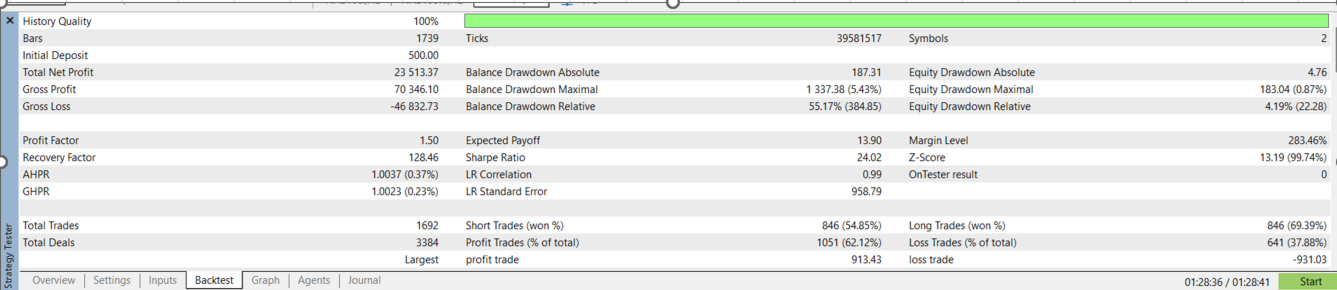
NASDAQ Institutional Map is an automated quantitative trading system engineered specifically for NASDAQ index instruments. Designed around institutional hedging principles, the Expert Advisor monitors structural pricing , volume/ liquidity imbalances, and volatility regime shifts across NASDAQ contracts rather than relying on lagging retail oscillators.Cross-Instrument Basis Filtering: Continuously evaluates dynamic spread relationships and regime stability between spot and futures index feeds, executing only when structural conditions fall within calibrated statistical boundaries.
- Institutional Flow and Range Detection: Combines multi-bar volume expansion with directional price-action dispersion to identify genuine participation surges and filter out low-liquidity noise.
- Controlled Exposure Architecture: Operates without martingale, grid averaging, or open-ended recovery loops. Every cycle is governed by strict position limits, slippage tolerances, and predefined exit logic.
- Real-Time Diagnostic Telemetry: Includes an on-chart HUD displaying live market phase, regime filter status, and execution readiness, alongside a Monitor-Only mode for zero-risk forward observation.
Recommended Setup and Requirements
-
Symbols: NASDAQ / US100 Cash and Futures CFD pairs (verify symbol suffixes with your broker).
-
Account Type: Hedging ECN/Raw spread account with low index commissions.
-
Minimum Deposit: $500 (scaling proportionally with risk settings).
-
Execution Environment: Low-latency VPS running 24/5 during active market sessions.
Main Input Parameters
-
Operation Mode: Switch between Monitor Only (visual diagnostics) and Live Execution.
-
Risk and Sizing: Configurable fixed lot sizing, maximum concurrent positions, and slippage protection.
-
Statistical Regime Filters: Adjustable lookback windows, volume/range expansion thresholds, and basis corridor bounds.
-
Risk Disclaimer: Trading leveraged index CFDs carries a high level of risk and may not be suitable for all investors. Past performance and historical simulations do not guarantee future results.