Volatility Indices EA Pro
- Uzmanlar
- Sürüm: 6.0
- Etkinleştirmeler: 20

Volatility Indices EA Pro — Overview
The Trader's Edge, Engineered for Volatility Indices
Volatility Indices EA Pro is not another grid-spamming, martingale-hiding robot that looks like a hero in backtests and detonates live accounts. It is a disciplined, structure-based intraday system built from the ground up for the unique personality of Volatility Indices — most notably the Volatility 75 Index (V75) — where price moves are driven by synthetic randomness, not news, and where risk control is the only true edge a trader has.
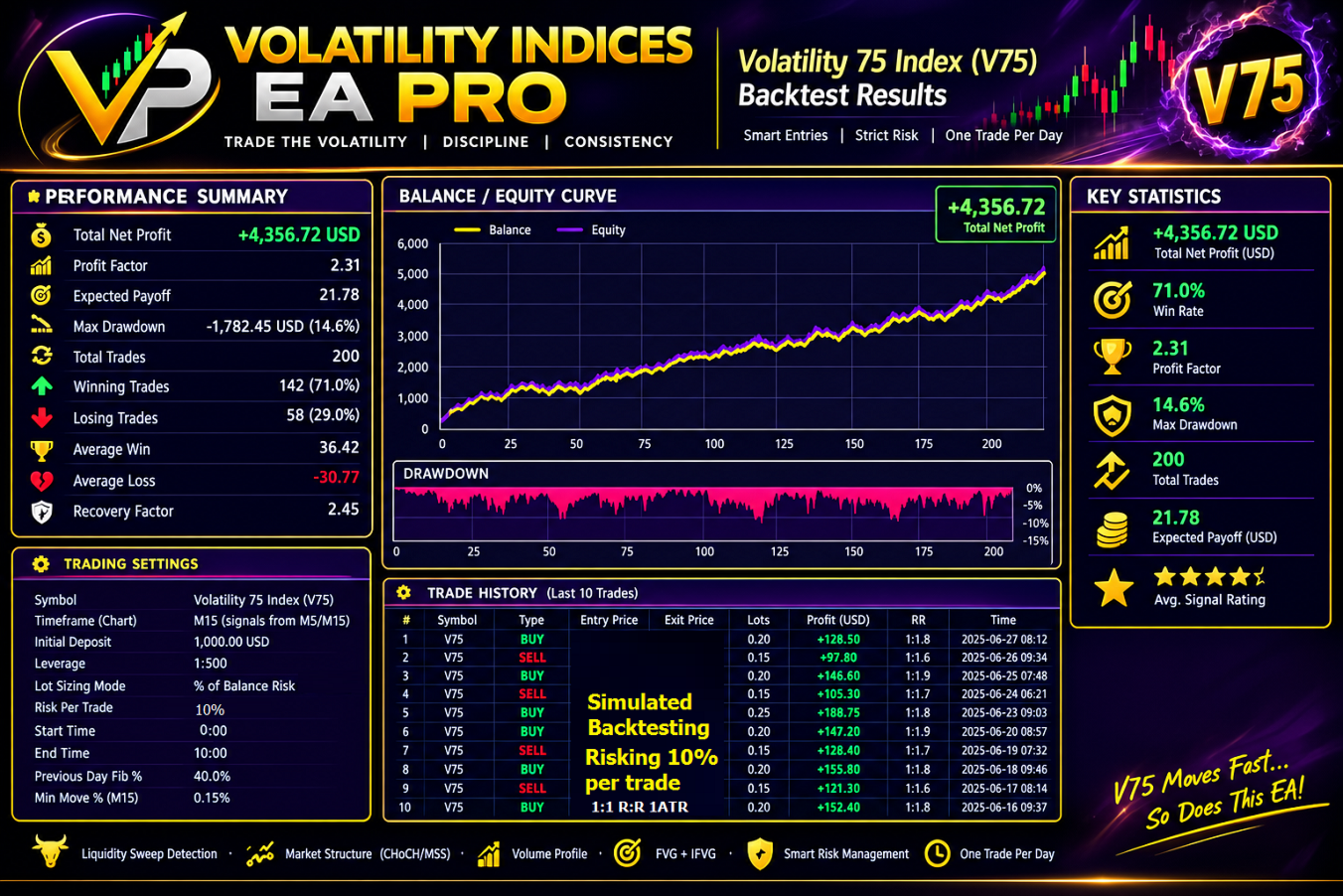
This EA takes a professional approach: it hunts the daily Fibonacci framework, waits for lower-timeframe market structure shifts (CHoCH / CISD / MSS) on M5, demands M15 close confirmation, and executes exactly one trade per day with broker-verified risk sizing and ATR-based SL/TP. No over-trading. No revenge entries. No ambiguity. Just a clean, repeatable, rules-based process.
---
The Philosophy: Structure First, Risk Always
Volatility Indices are deceptively simple-looking — a smooth chart, continuous ticks, no gaps. But anyone who has traded V75 for more than a week knows the trap: the market lures you in with small, tempting moves and then runs 400 points against you if your stop was placed "where it looked good."
This EA was built around three ironclad principles:
1. Trade only when the market proves itself. A signal is not a feeling — it is a sequence of confirmations on M15 and M5 that must all align before a single order is sent.
2. Risk is calculated, then verified, then verified again. Position size is derived from a broker's own profit calculator and cross-checked against tick-value math. If the two disagree beyond tolerance, the EA walks away.
3. One trade per day. Period. No averaging in, no re-entries, no "second chances." Each day offers a single decision, and once made, the EA stands down until the next session.
The result is an EA that behaves less like a signal generator and more like a professional risk manager with a trader's eye for structure.
---
Core Strategy: Daily Fibonacci + LTF Confirmation
Step 1 — The Previous Day's Framework
At the start of each session, the EA pulls the previous day's high and low, calculates the total range, and derives a Fibonacci retracement grid based on a user-configurable percentage (default 40%) of yesterday's move. This Fibonacci framework acts as the day's structural roadmap — the zones where reversals, continuations, and liquidity grabs are statistically most likely to occur on Volatility Indices.
Step 2 — First Significant Move Detection (M15)
The EA watches M15 price action to identify the first significant move of the day — the initial directional push that sets the day's bias. A minimum-move filter (default 0.15% of yesterday's range) prevents the EA from reacting to noise. Once a valid first move is detected, the EA sets its directional bias:
· First move was down from a high → bullish bias (BUY setups)
· First move was up from a low → bearish bias (SELL setups)
Step 3 — M5 Structure Confirmation (CHoCH / CISD / MSS)
Here is where most retail EAs fall apart — and where this one earns its keep.
Once the M15 anchor extreme is identified, the EA drops to M5 and begins a state machine that hunts for reversal confirmation using swing-point logic:
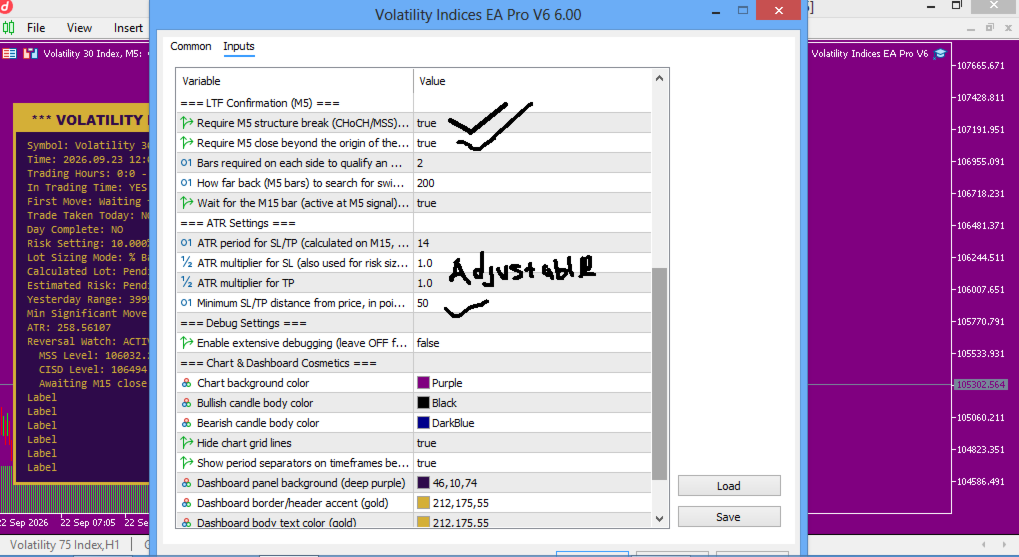
· CHoCH (Change of Character): Price must break past a qualifying minor swing point, with swing strength defined by a user-configurable number of bars on each side (default 2).
· CISD (Change in State of Delivery): Price must close beyond the origin candle of the leg that built the M15 anchor extreme.
· MSS (Market Structure Shift): The combined CHoCH + CISD alignment constitutes a genuine structural shift, not a wick fakeout.
Each confirmation is optional via inputs, but both default to ON — because on synthetic indices, a CHoCH without CISD is often just a liquidity sweep.
Step 4 — M15 Close Confirmation
Even after M5 signals fire, the EA does not enter immediately. It waits for the currently active M15 bar to close in the same direction as the signal. This single filter eliminates a massive class of false entries caused by intrabar spikes — a notorious feature of V75.
Step 5 — Entry with ATR-Based Risk
Once all confirmations align, the EA enters at market with:
· Stop Loss: ATR(14) on M15 × user multiplier (default 1.0), with a minimum points buffer
· Take Profit: ATR(14) on M15 × user multiplier (default 1.0), with the same minimum buffer
ATR-based stops adapt to the current volatility regime, which is essential on Volatility Indices where ranges can double or halve from one session to the next.
---
Risk Management: The Feature That Matters Most
Most EAs treat position sizing as a formula. This one treats it as a contract with reality.
Broker-Verified Lot Sizing
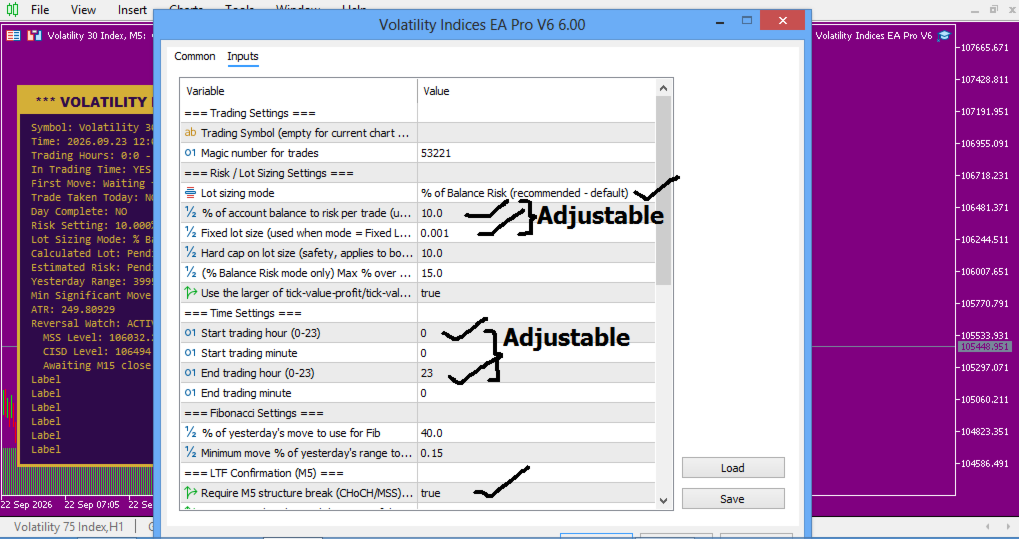
When LotSizingMode = % of Balance Risk, the EA:
1. Reads the account balance and computes **target $ risk** (e.g., 0.1% of a $10,000 account = $10).
2. Calls OrderCalcProfit() on a 1.0-lot reference position to obtain the broker's authoritative loss figure for the exact SL distance.
3. Independently computes a tick-value-based estimate of the same loss.
4. Compares the two — and takes the larger, more conservative figure.
Why? Because on synthetic indices, tick-value, tick-size, and contract-size conventions are not uniform across brokers. A naive FX-style formula can understate real risk by 5x or more. This EA refuses to trust any single source.
Hard Safety Nets
· Max Lot Size Cap — absolute ceiling regardless of sizing mode
· Max Risk Overshoot Tolerance — if the verified risk exceeds the target by more than X% (default 15%), the EA refuses to trade and logs an alert
· Conservative Tick Value Mode — always uses the larger of profit-side / loss-side tick values when sizing risk
· Refuses to trade on invalid inputs — zero balance, negative risk, or broken symbol data all trigger a safe abort
This is the difference between an EA that claims to risk 0.1% and one that proves it.
---
The Dashboard: Purple & Gold, Built for Clarity
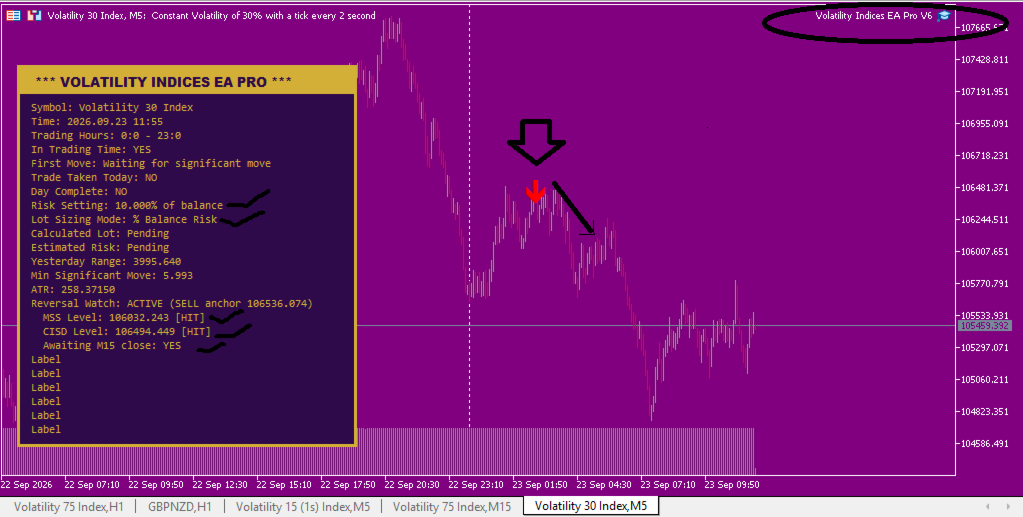
The EA renders a custom multi-line dashboard on the chart — one label object per line, because MQL5's OBJ_LABEL does not honor embedded line breaks. The design language is deliberate:
· Deep purple background — easy on the eyes during long sessions
· Gold accents and text — high contrast without strain
· Positioned lower-left (configurable X/Y) so it never collides with the chart's OHLC readout
The dashboard shows everything that matters at a glance: current bias, first-move status, pending reversal state, anchor price, M5 confirmation flags, ATR value, calculated lot size, estimated risk in dollars, and one-trade-per-day status. No need to open the Experts log to know what the EA is thinking.
---
Chart Cosmetics: A Cleaner Workspace
The EA takes over chart styling at initialization:
· Configurable background color (default purple)
· Configurable bullish / bearish candle colors (default black / dark blue)
· Optional grid hiding for a distraction-free view
· Period separators enabled on all sub-H4 timeframes
· Uses candlestick mode (not bars) for precise wick analysis
If you change timeframes on the chart, initialization re-runs and re-applies cosmetics automatically.
---
Time Settings: Built Around the V75 Session
Default trading window is 03:00 to 10:00 server time — the window where Volatility Indices typically deliver their cleanest structural moves. Both start and end times are fully configurable in hours and minutes.
Outside the window, the EA does nothing. No late-night impulse trades. No "just one more setup." The window closes; the EA sleeps.
---
One Trade Per Day — Enforced, Not Suggested
Internal daily flags ensure that once the day's decision is made — whether the trade is opened or the setup is invalidated — the EA stands down until the next daily reset at 00:00 server time. This single feature eliminates the most common account-killer on synthetic indices: over-trading in choppy conditions.
---
Debug Mode: Quiet by Default, Verbose on Demand
For long backtests, verbose per-bar logging can blow past the MT5 terminal's log size limit and abort the test mid-run. This EA defaults to debug off — clean, quiet, reliable. Turn it on for live troubleshooting and you get a forensic trail: tick-value diagnostics, swing-point detection, state-machine transitions, sizing decisions, and safety-net triggers.
---
Recommended Usage
Symbol: Volatility 75 Index (V75) — also works on V10, V25, V50, V100, V150, V200, and V250.
Chart timeframe: M15. The EA can be attached to any timeframe, but all signals are sourced internally from M15 and M5.
Account type: Any — but broker-verified sizing shines on brokers with non-standard tick conventions.
Risk per trade: 0.1% to 0.5% of balance (default 0.1%).
Trading hours: 03:00 to 10:00 server time — adjust to your broker's server offset.
Minimum deposit: $100 or more is recommended for proper lot-step granularity.
VPS: Strongly recommended — the EA must be running at the exact M15 close.
---
What This EA Is Not
· Not a scalper. It takes at most one trade per day.
· Not a martingale. No recovery lots, no grid, no averaging.
· Not a news trader. Volatility Indices have no news; this EA plays pure structure.
· Not a "set and forget forever" bot. Like any strategy, it needs periodic review of risk settings as your account grows.
· Not magic. It is a disciplined, rule-based system with verified risk. It will have losing days. The edge is in the process, not in any single trade.
---
Why Volatility Indices Deserve a Purpose-Built EA
Standard forex EAs often fail on synthetic indices because they assume stable tick values, session-based liquidity patterns, FX-like spreads, and order-flow-driven support and resistance. None of those assumptions hold on a synthetic market.
Volatility Indices EA Pro was designed from day one with these realities in mind. ATR-based stops adapt to synthetic volatility. Broker-verified sizing handles non-standard tick conventions. Structure-based entries work because price on synthetic indices still respects swing points, liquidity levels, and Fibonacci zones — the language of technical analysis, even in a synthetic market.
---
Final Word
If you are looking for an EA that trades 30 times a day, promises 90% win rates, and hides its risk in a black box — this is not it.
If you are looking for a professional-grade, risk-first, structure-driven system that treats every trade as a calculated decision worth making or skipping entirely, with full transparency into every step of its logic, then Volatility Indices EA Pro is built for you.
One setup. One trade. One day at a time. Verified risk, every time.
Attach it to a V75 M15 chart, set your risk percentage, and let it work the daily Fibonacci framework the way a disciplined trader would — with patience, structure, and an unshakeable respect for risk.
---
Past performance does not guarantee future results. Always test on a demo account before deploying live capital. Use risk you can afford to lose.