Tokyo Gotobi Clock
- Göstergeler
- Sürüm: 1.0

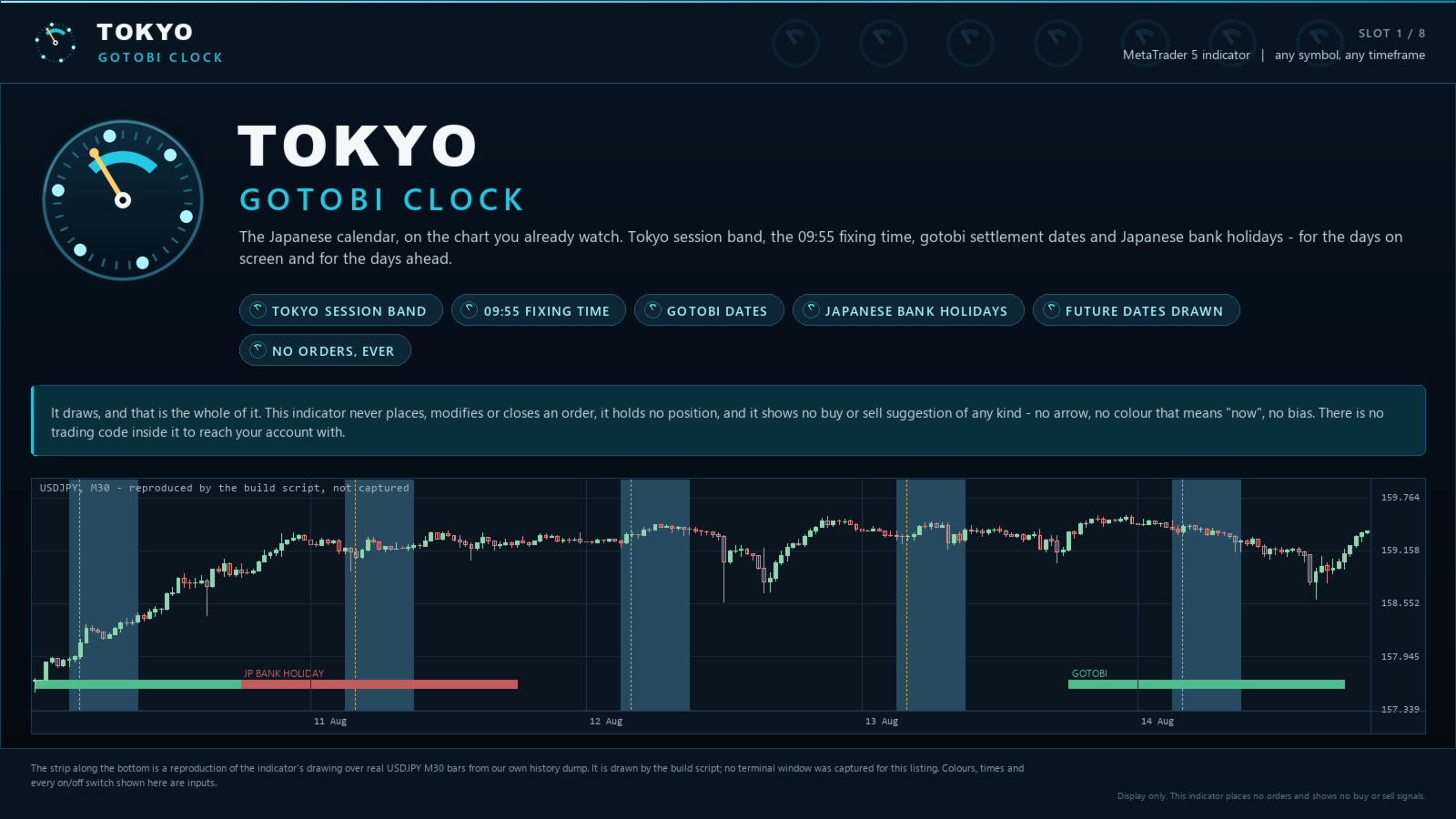
Tokyo Gotobi Clock - a chart clock for the Japanese trading day. It draws the Tokyo session, the fixing time, and the Japanese calendar dates the yen market settles on. It is free.
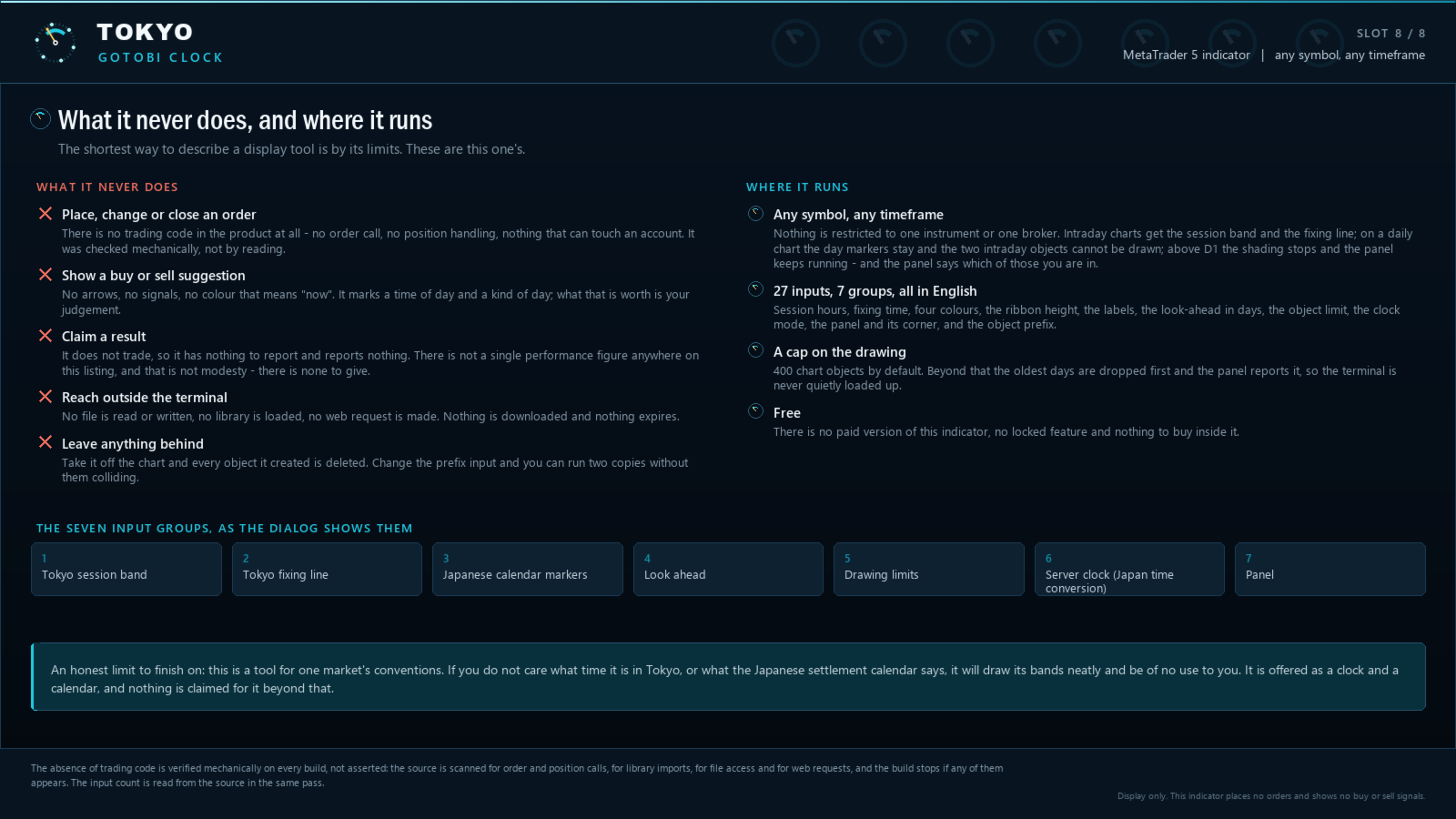
== IT DOES NOT TRADE ==
This is an indicator. It never places an order, never modifies one and never closes one. There is no trading code inside it. It does not predict anything, and it makes no claim about profit or performance. It draws, and that is all.
== WHAT IT DRAWS ==
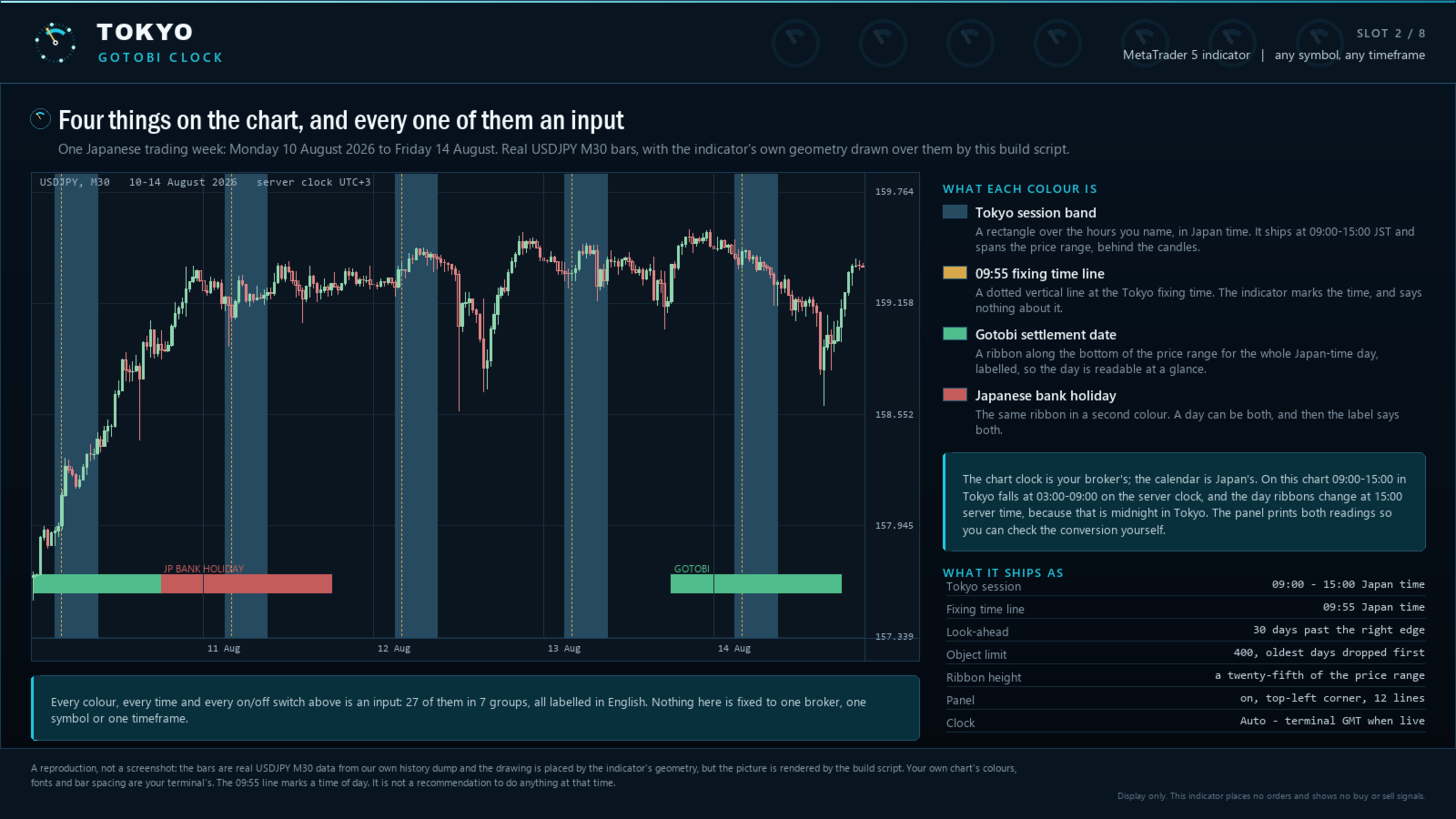
The Tokyo session, as a band across the chart. You set the start and the end in Japan time; it is 09:00 to 15:00 out of the box.
The Tokyo fixing time, as a vertical line. 09:55 Japan time by default.
Gotobi settlement dates, as a coloured ribbon along the day.
Japanese bank holidays, in a second colour.
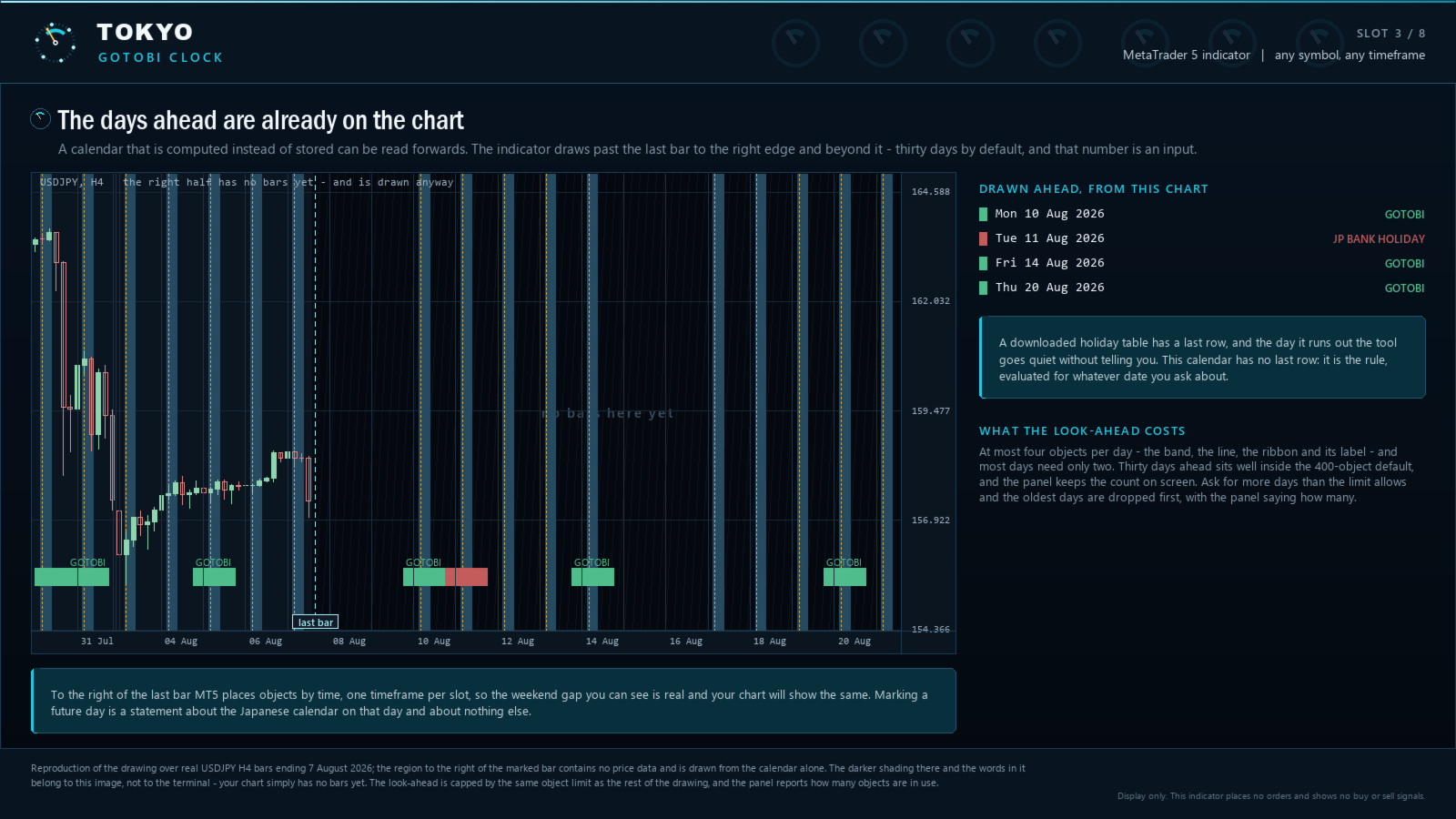
And all of that for days that have not happened yet - up to 30 days past the right edge of the chart, so you can see the next settlement date before you get to it.
== WHAT A GOTOBI DATE IS ==
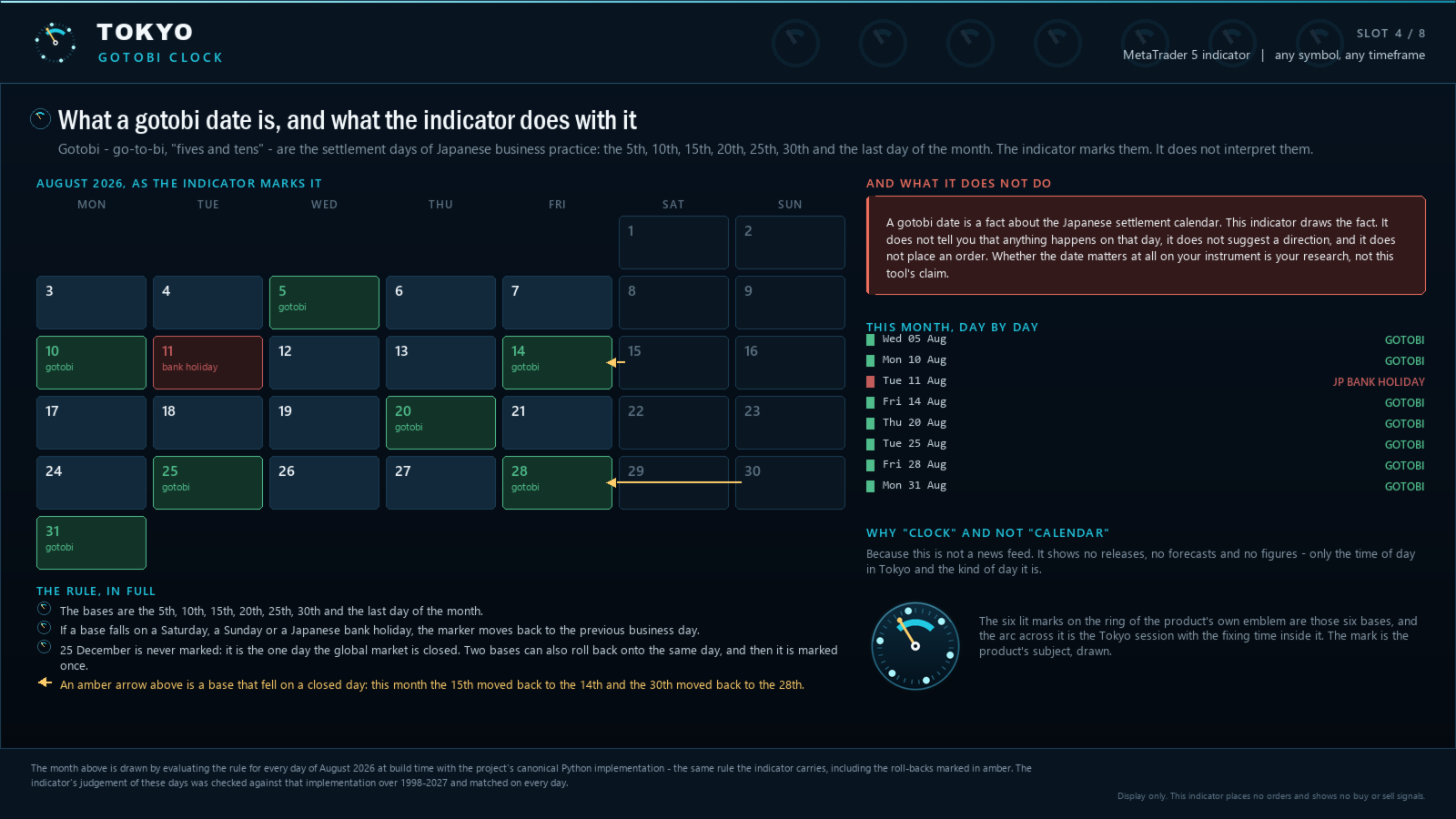
In Japan, settlement concentrates on days whose date ends in 5 or 0, and on the last day of the month. The base days this indicator uses are the 5th, 10th, 15th, 20th, 25th, 30th and the final day of the month. When a base day falls on a day the Japanese banks are closed, settlement moves back to the previous open day, and the marker moves with it. 25 December is left out, because the wider currency market is closed that day.
That is a description of a settlement convention. It is not a trading rule, and this indicator does not tell you to buy or sell anything.
== THE CALENDAR IS CALCULATED, NOT LOOKED UP ==
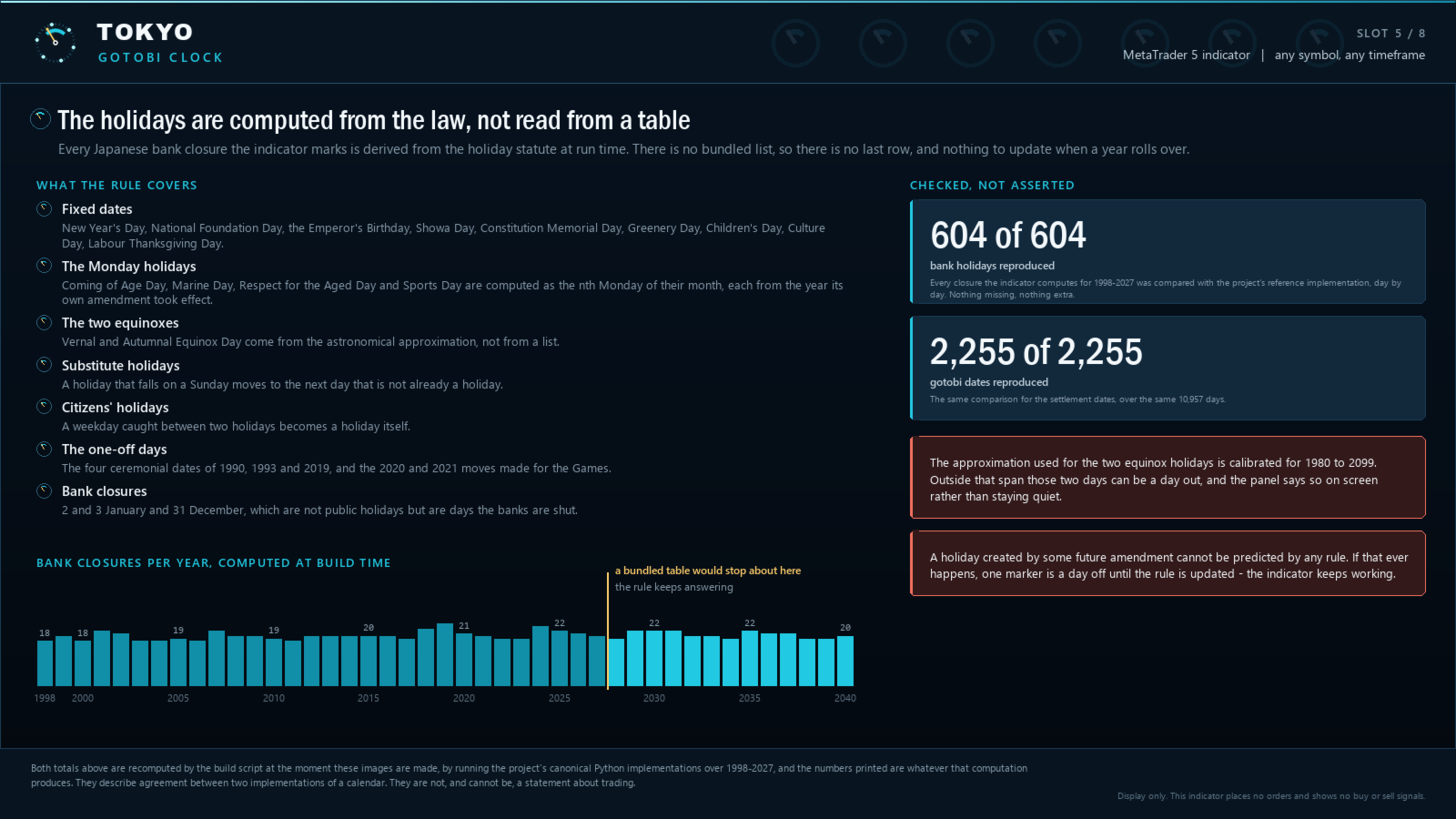
Most tools that know about Japanese holidays carry a table, and a table has a last row. When it runs out, the tool stops being right without saying so.
This one computes the holidays from the rules in the statute: the fixed dates, the Monday holidays, the equinox formula, the substitute holiday when a holiday falls on a Sunday, the citizens' holiday between two holidays, the one-off dates, and the Olympic year moves.
It was checked line by line against an independent implementation across 1998 to 2027 - 10,957 days examined, 604 bank holidays, zero mismatches - and over the same range the gotobi dates agreed on all 2,255 of them.
The equinox formula is valid from 1980 to 2099, and the panel tells you if you ask for a year outside that range. There is no table to expire and nothing to update. A holiday newly created by future legislation cannot be predicted by any method, and that limit belongs to the calendar itself rather than to this implementation.
== THE PANEL ==
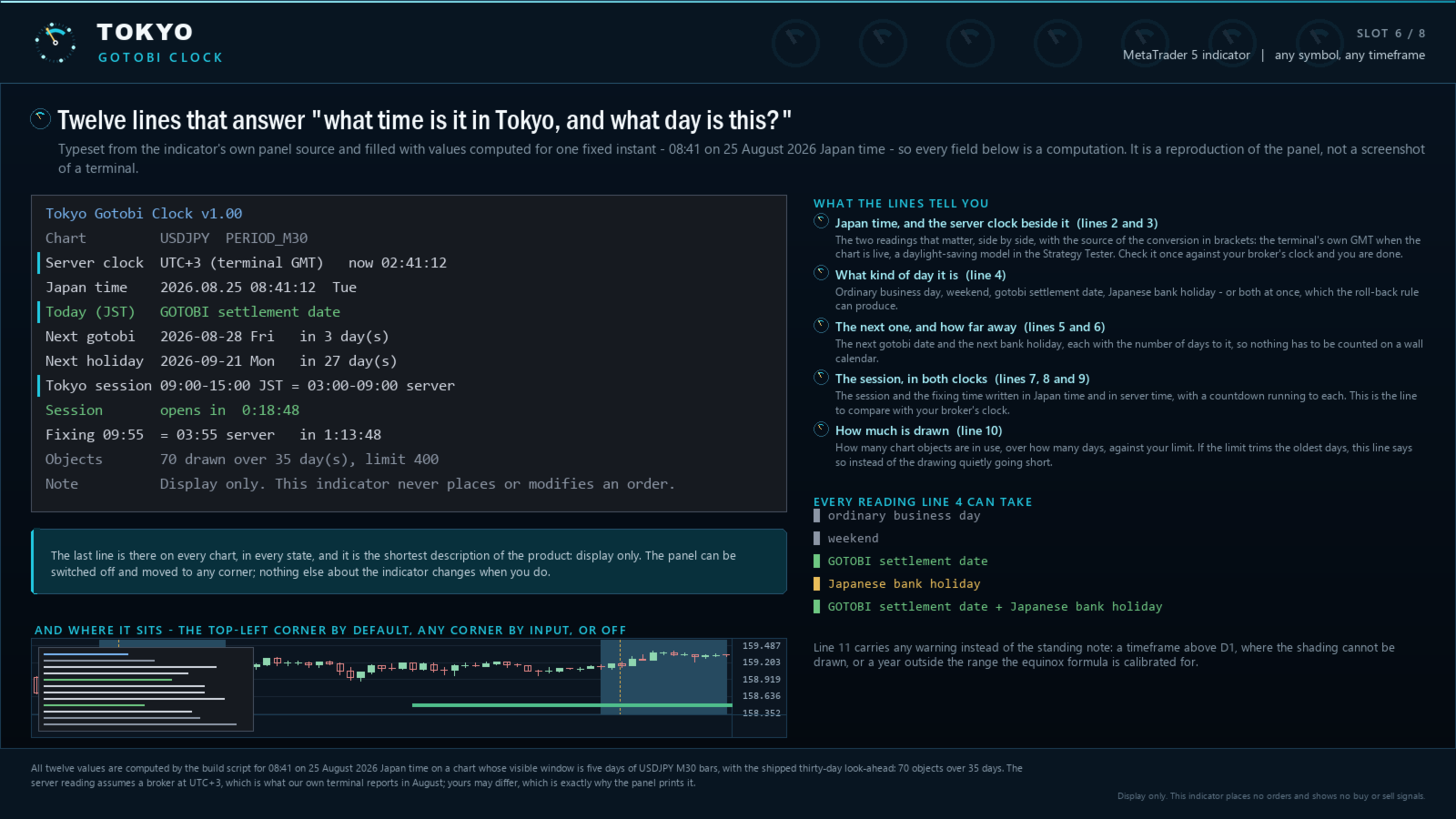
Twelve lines in the corner of the chart: the resolved server clock and where that resolution came from, the current Japan time, whether today is a gotobi date or a bank holiday, the next gotobi date and the next holiday with the days remaining, the session window written in both Japan time and your server's time, a countdown to the session opening or closing, and the fixing time converted to your server's time.
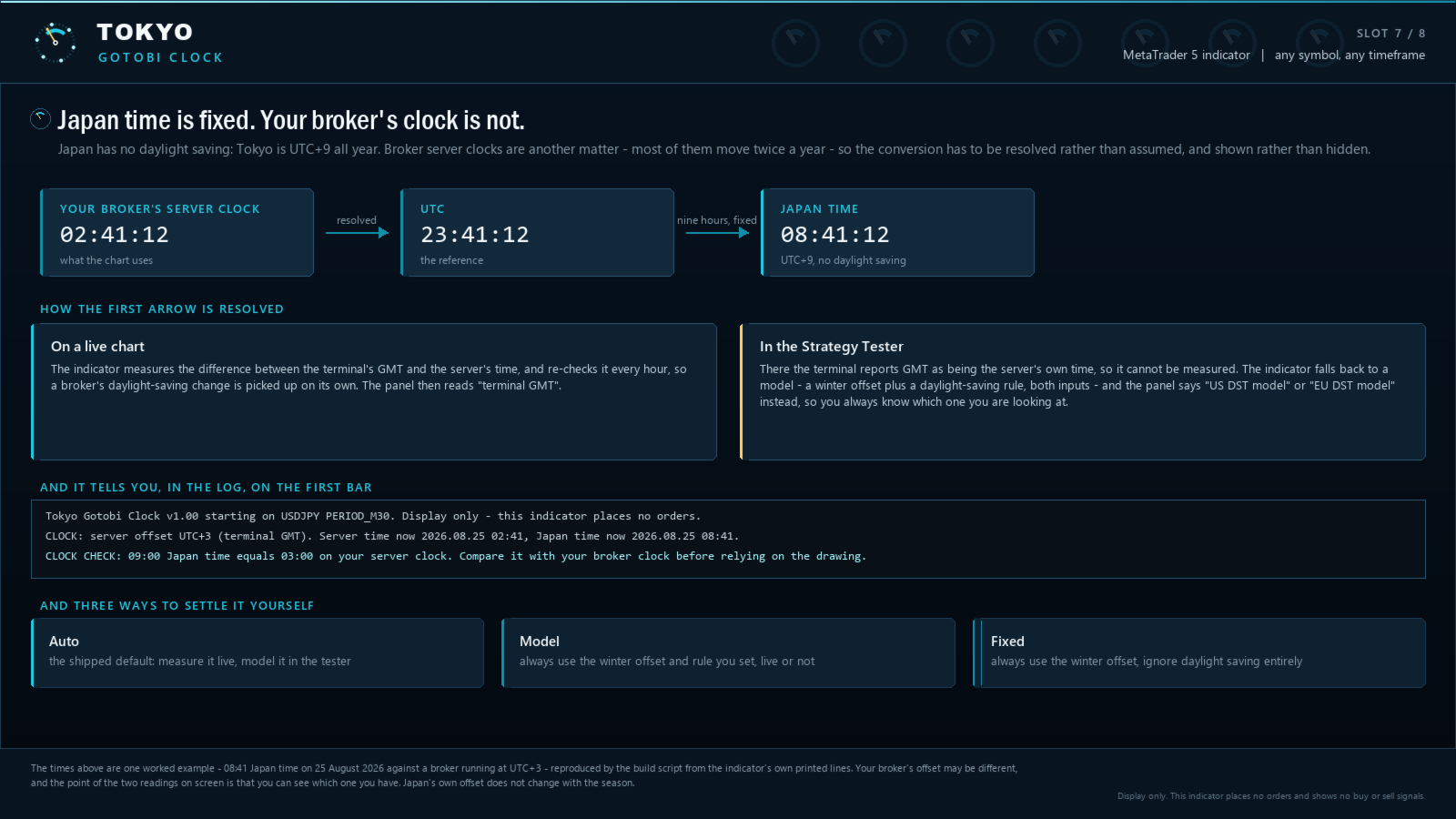
Time is the part most likely to be wrong, so it is shown rather than hidden. On a live chart the offset comes from your terminal. In the strategy tester the terminal cannot supply it, so a daylight saving model is used instead - and the panel says which of the two you are looking at. Compare the server time on the panel against your broker's clock once, on the first day, and you are done.
== SETTINGS ==
27 inputs in 7 groups: the session window and its colour, the fixing time, the two calendar markers and their colours, how far ahead to draw, an object limit so that a long chart stays responsive, the handling of your broker's time zone, and the panel.
The object prefix is an input as well, so two copies with different settings can share one chart. Every object it created is removed when you take it off the chart.
== WHERE IT WORKS ==
MetaTrader 5, any symbol, any timeframe. The Japanese calendar is drawn wherever you put it. It is most useful on yen pairs, and that is a recommendation rather than a restriction. Above the daily timeframe a session band cannot be drawn inside a single bar; the indicator says so on the panel and keeps drawing the calendar markers.
== FREE ==
The whole thing, with nothing held back for a paid version. Updates are free.