PropStockDip
- Experts
-
Timon-pascal Krueger
 Systematic index trader and MT5 developer from Germany.
I trade my own capital and funded accounts, including a live FTMO account, with time anchored breakout strategies on DAX, FTSE, Dow and Nasdaq. - Versão: 1.0
- Ativações: 10
PropStockDip: buys short pullbacks in S&P 500 stocks, one chart for the whole list, with a rule I measured before I built it.
Who it is for: traders who trade single US stocks as CFDs in MT5 and want one tested, rule based way to buy pullbacks across the whole index. It is a small addition, not a main strategy: the return is small and changes a lot from year to year. If your broker has no US share CFDs, or you only trade indices, forex or gold, PropStockDip does nothing for you.
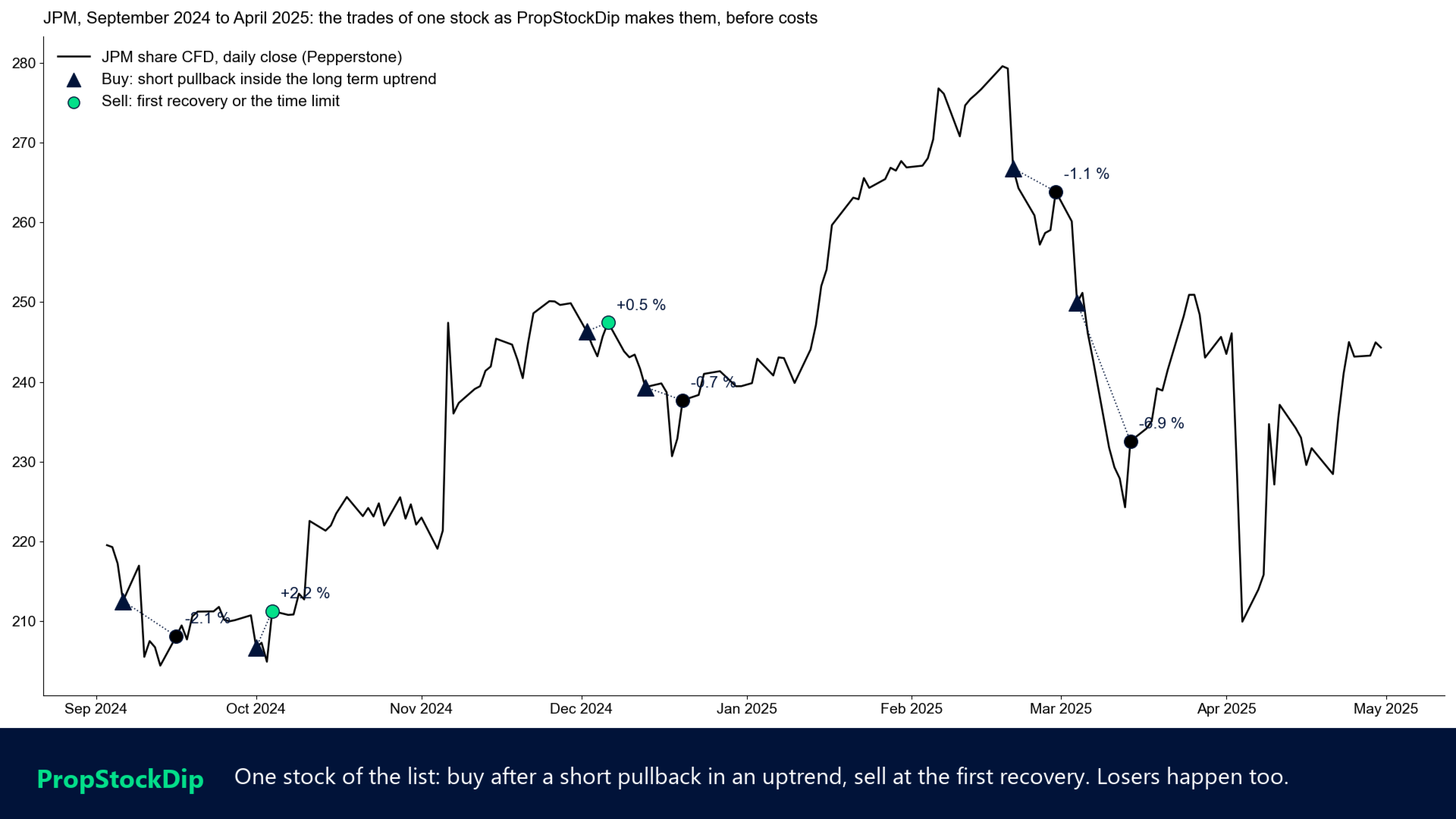
PropStockDip runs a short term mean reversion rule on US share CFDs. Once a day, shortly before the US close, it checks about 500 S&P 500 stocks, buys the ones that had a sharp short pullback inside a long term uptrend, and sells them at the first recovery or after about two weeks at the latest. Long only, at most N positions of equal value. I tested the rule with share CFD costs on 2005 to 2018 and then once on a separate holdout from 2019 to 2026.
Setup: attach PropStockDip to any one chart, let it find your broker's share CFDs, choose how many positions and how large. Keep the terminal running before the US close.
Try it first: in the strategy tester choose one of the stocks as the test symbol, for example your broker's Apple CFD, and use the ticker list input for a smaller list (a full list of 500 stocks is slow in the tester). Start about a year before the period you want to see, the rule needs a year of daily history. On other symbols the tester runs a demo schedule (one trade every weekday) so you can watch the order handling.
What it does
- The tested rule, nothing tuned. The entry, exit and trend values are fixed in the code, the same values as in the study. Nothing to optimise into a nice backtest.
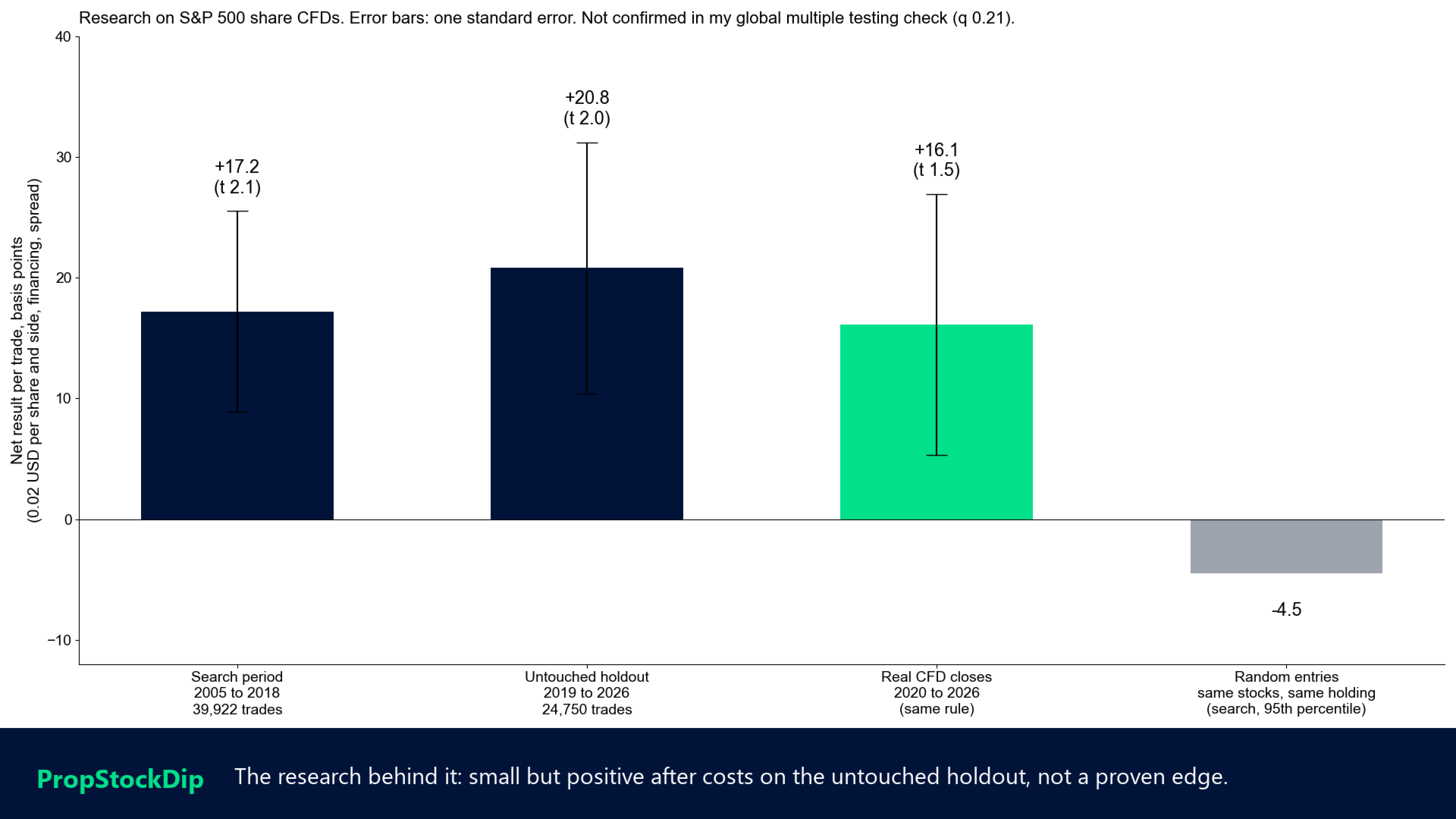
- The numbers, after costs. Costs as at my broker: 0.02 USD commission per share and side, overnight financing and spread. On 2005 to 2018 the rule made +17.2 basis points per trade (39,922 trades). On the untouched holdout from 2019 to October 2026 it made +20.8 basis points per trade (24,750 trades, t 2.0). Recalculated on the real CFD closing prices of my broker (2020 to 2026) it made +16.1 basis points per trade (t 1.5).
- Honest status. Across all rules I tested on separate data, this one did not pass the correction for multiple testing (q 0.21). The effect is broad (every neighbouring parameter setting I checked was positive), but statistically it is a weak result, not a proven edge.
- One chart, many stocks. The stock list is built in (S&P 500, August 2026). Symbol names are found automatically (AAPL.US, AAPL, #AAPL, AAPL.NAS and similar), or you set the prefix and suffix of your broker. You can also give your own list.
- Equal weight, limited slots. At most N positions (default 10), each with the same position value in % of equity. With more signals than free slots it takes them in the tested order.
- Checked against the tester. In the MT5 strategy tester on my broker's data the EA makes the same trades as my Python calculation of the rule (558 of 563 on 20 stocks, 2021 to 2024; the rest are small differences in the daily history).
- Restart safe. The state comes from the open positions and the deal history: no second entry after a restart, no exit on the entry day, re-entry only by the rule.
Optional controls, not validated
- VIX control: trade only, or trade larger, while the VIX of your broker is above a level. Volatility preference: rank by 60 day volatility, or skip calm stocks.
- In my data the rule did better in high VIX periods and on volatile stocks. I found that only after the holdout, on the same data, so it is a hypothesis and not a tested result. Both controls are off by default. I wrote down a forward test for them on a demo account before it starts, and I will report the result, also if it is negative.
What to expect
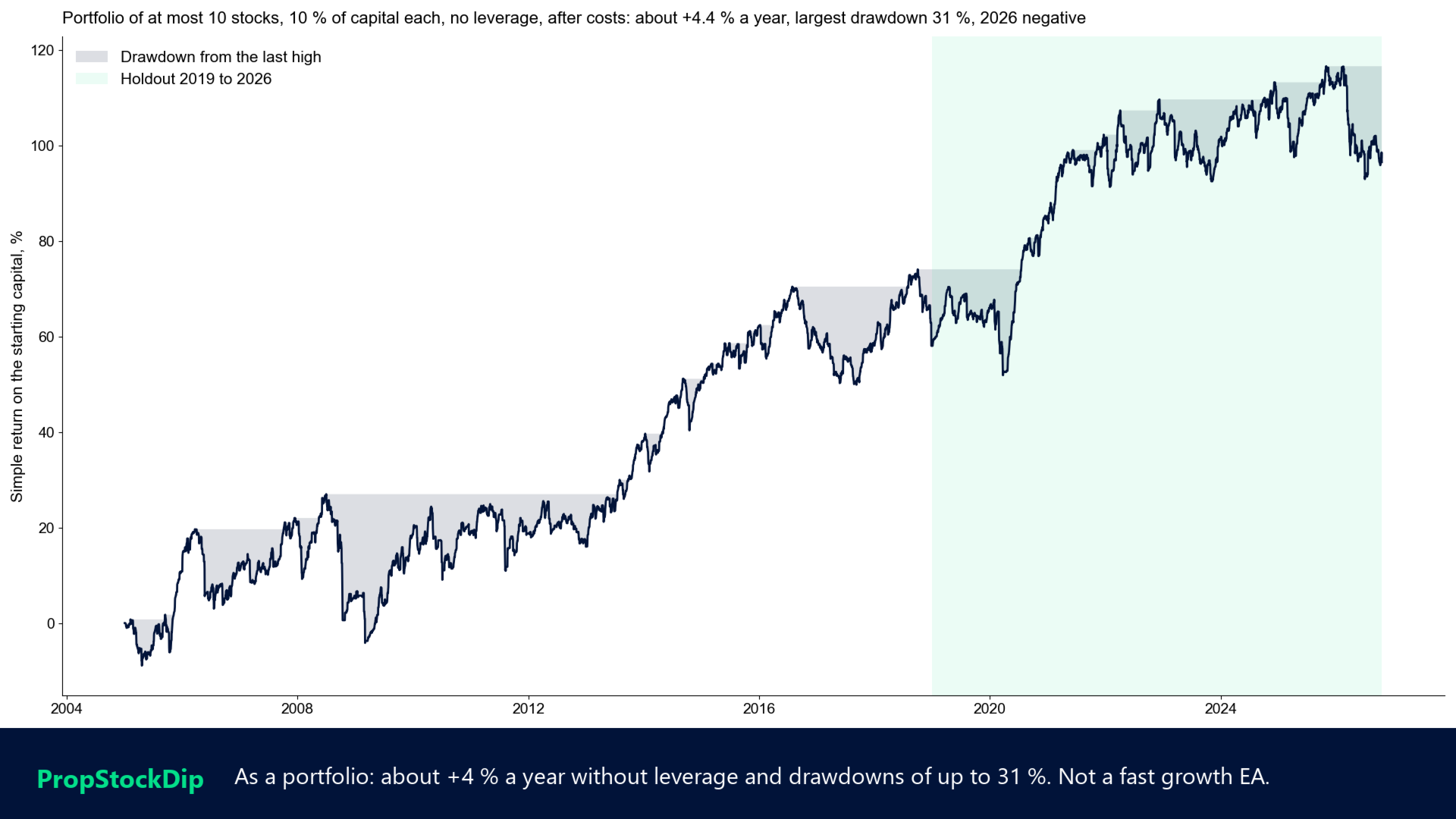
- Small returns that swing from year to year. As a portfolio with 10 positions of 10 % each and no leverage the rule made about +4 % per year on 2005 to 2026, with a Sharpe ratio of about 0.4. The best year was +22 % (2013). There were long flat or negative stretches (2010 to 2012, 2016 to 2018), 2008 lost about 16 %, and 2026 is about minus 16 % so far (January to mid October), the weakest year in the test. The largest drawdown was about 31 % of the starting capital (2008 to 2009). This is not a fast growth EA.
- A thin margin per trade. On average a trade makes about 0.2 % after costs, and costs take about half of the gross move. With wider share CFD spreads the advantage shrinks quickly: at 0.15 % spread per round trip the average falls to +8.6 basis points and is no longer significant. Check your broker's spreads on US shares before you start.
- No stop loss. The tested rule has none, and I did not add one I have not tested. Risk comes from the position value and the number of positions. On a crash day many stocks signal at once and the slots fill with one bet on a rebound.
- Prop accounts with loss limits need much smaller positions than the default: with a 10 % total loss limit a third of the default size or less. Check your firm's rules on share CFDs and on holding over the weekend.
- Trades last about 4 trading days on average and about two thirds run over a weekend, so the account must allow weekend holding. Financing costs are part of the numbers above.
Where it fits
Any MT5 broker with US share CFDs, hedging or netting. A VPS is recommended so the daily check happens every day before the US close. Short term mean reversion on stocks has been published for years; crowding and decay are possible. I built PropStockDip from my own research, for my own trading. Past results do not guarantee future results.
Activations: 10, one per computer or VPS where you run PropStockDip.
Features
- Built in S&P 500 list or your own ticker list, automatic symbol naming or prefix and suffix inputs
- One chart runs the whole list, daily check before the US close, broker clock models with automatic check
- Maximum positions, position value in % of equity or fixed lots, margin and volume checks
- Spread filter per stock, split detection in the daily history, skips stocks with broken prices
- Optional VIX control (only above a level, or larger size above a level) and volatility ranking or filter, off by default
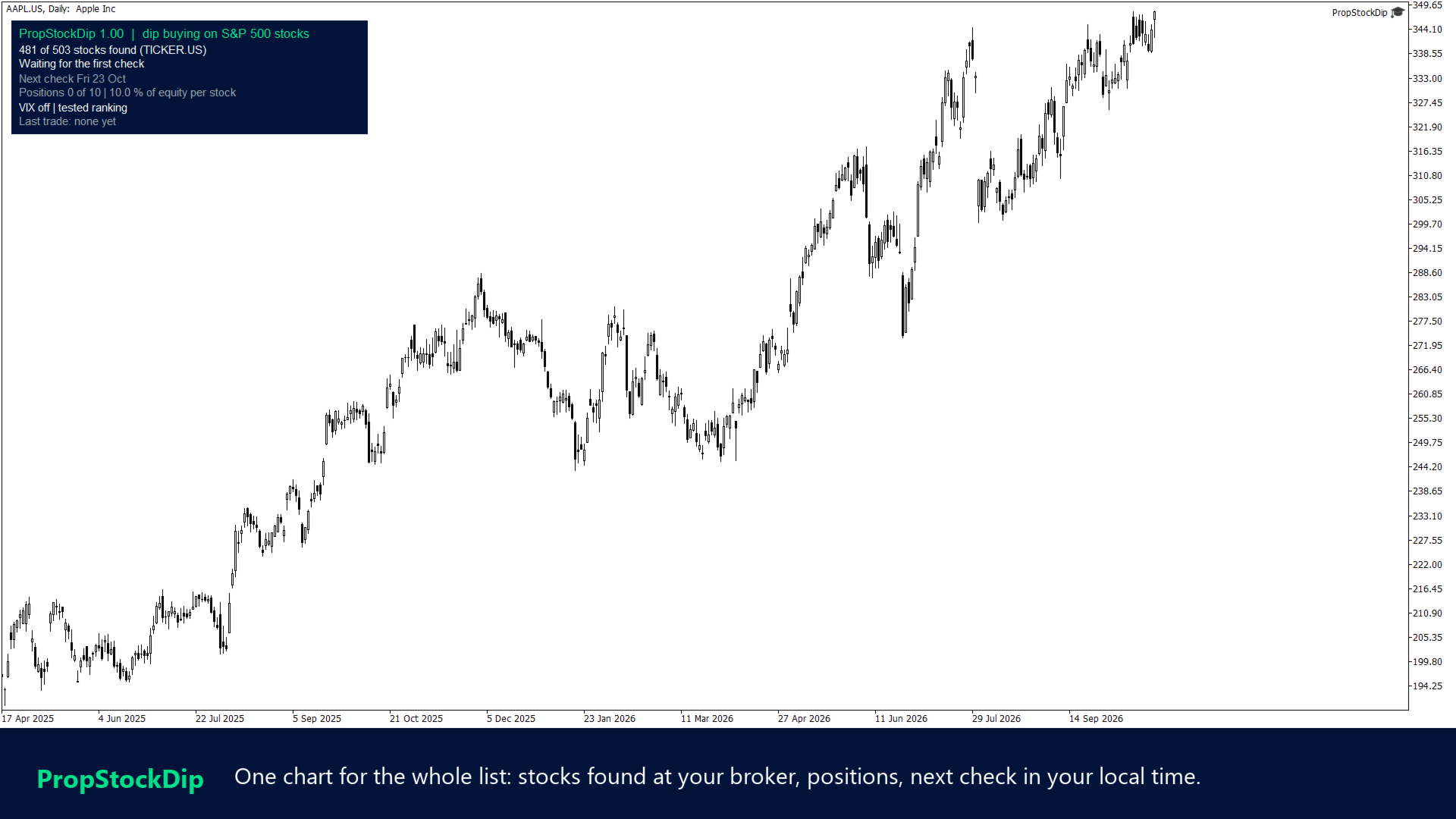
- Status panel: stocks found, last check with signals, positions, next check in your local time, controls, last trade
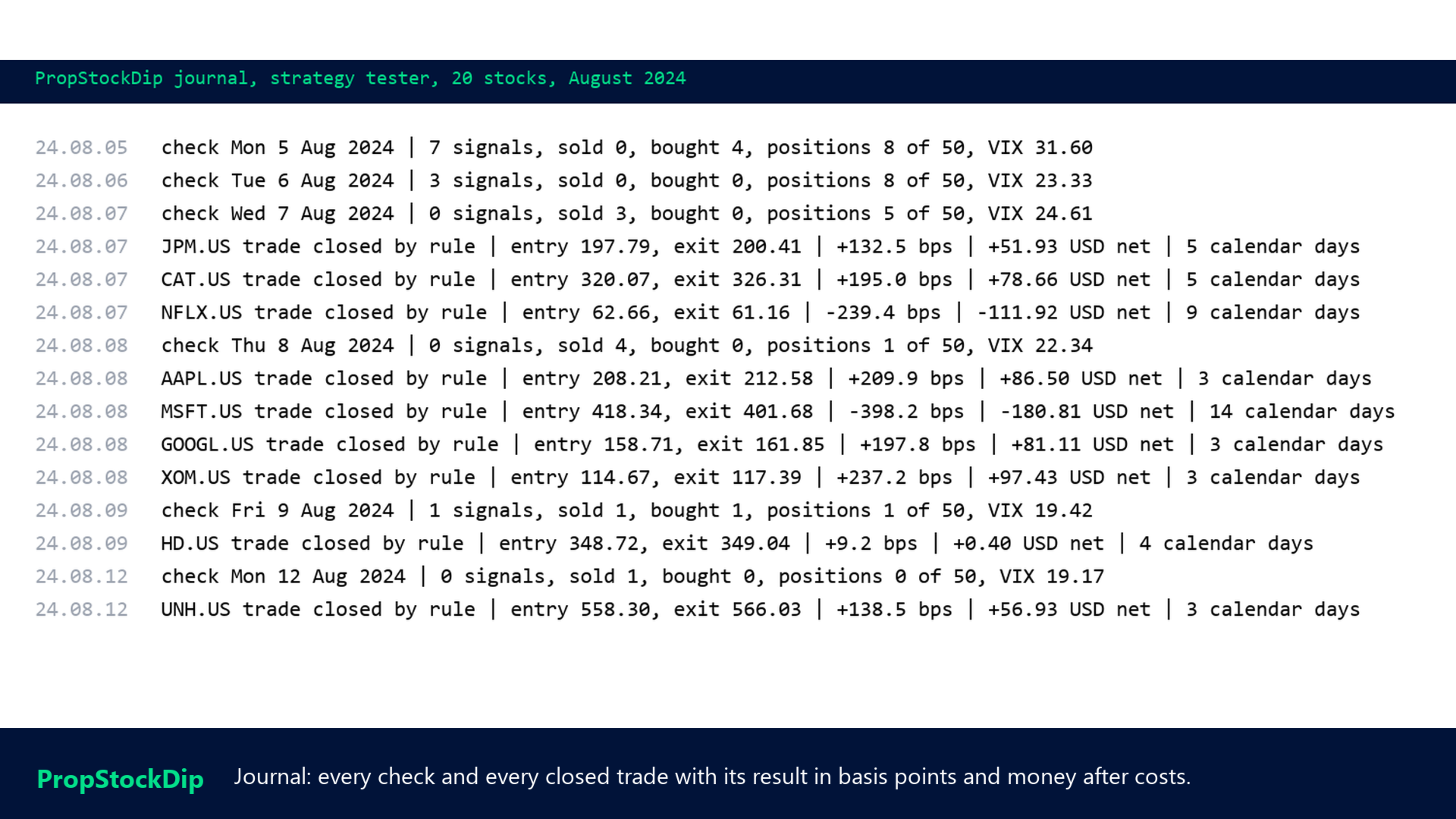
- Journal line for every entry and exit with the reason, optional values of every signal, push notification
- Own magic number, hedging and netting accounts
Quick start
- Open any chart and attach PropStockDip. Check the panel: it shows how many stocks of the list your broker has.
- If it finds none, set the symbol suffix (for example .US) or prefix of your broker's US shares.
- Choose the maximum positions and the position value (default 10 positions of 10 % of equity, smaller on prop accounts).
- Enable AutoTrading and keep the terminal running before the US close every trading day, ideally on a VPS.
Questions: write in the Comments section or send me a message, I answer every question. If PropStockDip does something you do not expect, please contact me before you rate it. All my products are on my seller page.