Triple Confluence Gold
- Experts
- Versão: 1.1
- Ativações: 6

Triple Confluence Gold opens a trade only when three separate checks agree: a momentum and trend gate on the chart timeframe, a higher-timeframe trend engine, and an EMA trend filter. It does not use martingale, grid strategies or position scaling.
Core Features
Engine 1 — Momentum and Trend Gate Price must be on the right side of session VWAP and Ichimoku Span B must slope the same way. At least 3 of 4 oscillators must agree: RSI(13), Stochastic(8,3,3), Momentum(8) and DeMarker(14).
DeMarker Safety Filter Blocks buys when DeMarker is above 0.7 and sells when below 0.3.
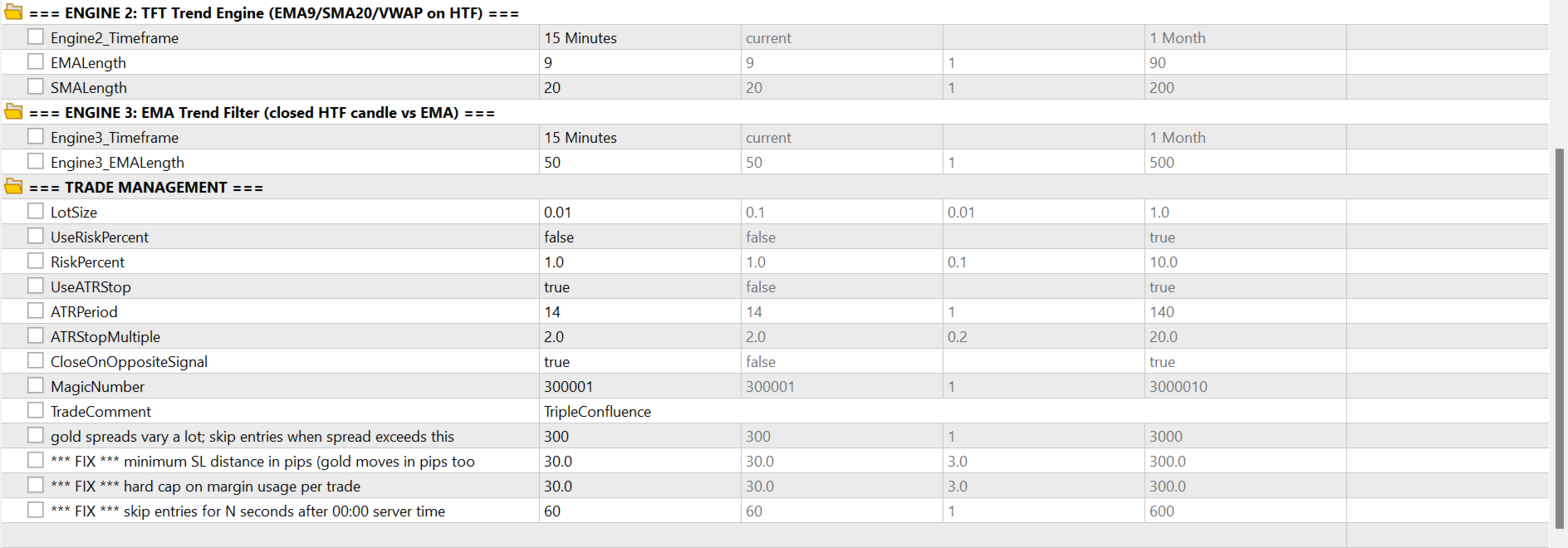
Engine 2 — Higher-Timeframe Trend (M15 default) EMA(9) vs SMA(20), and close vs that timeframe's session VWAP.
Engine 3 — EMA Filter (M15 default) The last closed candle must be above (buy) or below (sell) EMA(50).
Protective Stop and Exit ATR(14) x 2.0 stop. Position closes if the opposite triple signal appears.
Structural Architecture
Gate Layer: VWAP and Span B direction. Oscillator Vote: 3-of-4 agreement. HTF Trend Engine: EMA/SMA/VWAP. EMA Filter: closed-candle test. Execution Layer: once per closed bar, spread filter, fixed-lot or risk-percent sizing.
Operating Parameters
Primary instrument: XAUUSD (Gold) Suggested timeframe: M5–M30 Recommended deposit: $500+ (default 0.10 lot is large; start at 0.01 on small accounts) Minimum supported deposit: $200 Minimum leverage: 1:20 Hedging or netting account both work ECN / low-spread broker recommended (max spread filter included) The system does not use martingale, grid strategies or position scaling
Why Triple Confluence Gold Stands Apart
Three independent confirmations before every trade Fewer, more selective entries Defined ATR stop on every trade Exits when conditions flip All settings exposed for optimisation
Positioning
For traders who prefer selective entries with several confirmations over frequent trading.
Disclaimer
Backtesting results do not guarantee future performance. Trading leveraged products carries a high risk of loss. Users are responsible for choosing risk settings and should test on demo first.