The Harrier
- Experts
- Versão: 1.54
- Ativações: 10

Harrier is a trend-following expert advisor for gold (XAUUSD). It trades only in the direction of the trend, and you choose how: a bounded basket of at most five legs, or a single trade with a hard stop and target and no grid at all.
What makes Harrier different
- It never trades against the trend. Every entry needs the 4-hour and the 1-hour trend pointing the way of the trade. No fading of support and resistance, no "it went up too far, so sell", no reversal guesses, and never a buy and a sell open at the same time. The trend gate is part of the engine and cannot be switched off. The one entry with a gate of its own, late-session strength, only buys, and only above its moving averages. You can see it in the results: across both test periods not a single sell basket closed at a loss (349 sells since October 2020, 70 in 2018–2020).
- Two modes, your choice. Basket mode is the default. SL/TP mode trades one position per signal with a hard stop and target on the order itself, sized as a percent of your equity: no grid, no averaging, and the maximum loss of every trade is known before it opens. It is made for prop firms and accounts where an averaging basket is not allowed. Both modes trade the same trend entries.
- A basket with an end. Never more than five legs. The worst basket is measured on real ticks and published below, a daily stop on equity is on by default, and the position size follows from that worst case, not from a profit target.
- Built around gold's own calendar. Next to the classic trend entries, Harrier trades the moments that move gold: the London and New York opens, the London morning fix, the COMEX settlement and the Shanghai fix. It trades them only when the move since that moment goes with the trend and the market is active enough.
- Tested outside the period it was built on, with the result of the previous version next to it. Few sellers show this; see "Outside its development period" below.
The two modes at a glance
| Basket mode (default) | SL/TP mode (no grid) | |
| Direction | With the trend only | With the trend only |
| Positions | One basket at a time, at most five legs | One position at a time |
| Exit | The whole basket closes at a fixed distance beyond its weighted breakeven | Hard stop 3 × ATR, target 3 × the stop, both on the order |
| Time limit | None | Closes after 24 hours (adjustable, or off) |
| Position size | Risk profile: 0.01 lot per X of equity | Risk percent per trade (default 1%) |
| Protection | Daily stop on equity (default 15%) | The stop on every order, plus the same daily stop |
| Entries | All fourteen | The five core trend entries: CT, TR, SO, N2, CX |
| Best for | The highest return per unit of drawdown in our tests | Prop firms and accounts that forbid averaging; a loss per trade you know in advance |
Live signal
Harrier runs live on a real account at VT Markets (XAUUSD, 1:500) in basket mode with the Medium risk profile: Harrier medium risk VT Markets, live since 22 September 2026. The account is young, so its figures still say little. Compare it with the test under the same conditions rather than with the profit figure alone: a live result below the test is normal, a basket deeper than -341 per 0.01 lot is possible, and the daily stop is there for exactly that case.
Basket mode: how it works
- Entries. Fourteen entry models, each switchable: TR (trend), CT (continuation), PB (pullback), SO (session open), NF (news follow-through, off by default), MG (Monday gap), DS (day sweep), TD (trend day), N2 (second wave New York), L2 (second wave London), FA (London morning fix), CX (COMEX settlement), EP (late-session strength, buy only), SG (Shanghai fix). All except EP must agree with the 4-hour and 1-hour trend; EP has its own strength test and only buys. The five time-anchored entries (SO, L2, FA, CX, SG) also need a minimum volatility. All of them hand their basket to the same management engine.
- Basket. If price moves against the first leg, the EA adds legs in the same direction at distances that scale with current volatility, up to a hard maximum of five. The lot progression is fixed and shown live on the panel.
- Exit. The whole basket closes together at a fixed distance beyond its weighted breakeven. There is no take-profit per leg and no averaging beyond leg five.
- News. FOMC, CPI and NFP windows block new baskets; on an FOMC day an open basket exits at breakeven instead of waiting for its target.
- Protection. A daily stop in percent of the day-open balance, measured on equity including the floating loss of an open basket, that closes everything and stops for the day. Default 15%, right for the Low profile (750 per 0.01 lot); set it per profile from the table below, -1 for automatic, or 0 for off. The EA warns in the journal and on the panel when it is too tight for your profile. It never triggered in the six-year test. Optional: a per-leg daily limit, and an emergency stop at X percent drawdown from the equity peak, which closes everything and blocks trading for 72 hours.
Position sizing in basket mode
A risk profile is simply 0.01 lot per X of equity. Nothing is hidden behind a percentage: you choose the ratio, and the EA prints what that ratio means for the two numbers that matter. A fixed base lot is also possible: with Position size = Fixed and one of the ratios below the EA trades exactly that lot, and warns when it is above the ratio's risk limit. The Custom profile lets you set the ratio yourself and always sizes from equity. The panel shows the lot that is actually used.
| Profile | Setting | Daily stop to set (750 per 0.01 lot) | Deepest basket of the test (-341) | Measured max equity drawdown of the test |
| Prop firm | 0.01 lot per 10,000 | 7.5% | 3.4% | 2.9% |
| Very low | 0.01 lot per 8,000 | 9.4% | 4.3% | 3.6% |
| Low (default) | 0.01 lot per 5,000 | 15.0% (default) | 6.8% | 5.8% |
| Medium | 0.01 lot per 3,000 | 25.0% | 11.4% | 9.6% |
| Medium-high | 0.01 lot per 2,000 | 37.5% | 17.1% | 14.5% |
| High | 0.01 lot per 1,000 | 75.0% | 34.1% | 28.9% |
| Very high | 0.01 lot per 700 | above 100% – no protection | 48.7% | 41.3% |
We would not go beyond 0.01 lot per 2,000: two stopped days can follow each other, and at 0.01 per 1,000 one daily stop already costs three quarters of the account.
Size on the third column. The depth of a basket depends on the prices of your broker and on timing. On the real ticks of a second broker, one basket that closed after two legs in our test went on to five legs and floated to about -700 per 0.01 lot. In 16 stress variants the deepest basket reached -4,818 per 0.01 lot before recovering; the daily stop closes any basket at 750. The third column is the daily stop that gives exactly that at each ratio; the fourth and fifth are the deepest basket and the measured maximum equity drawdown of the six-year test.
Test result – basket mode (please read the conditions)
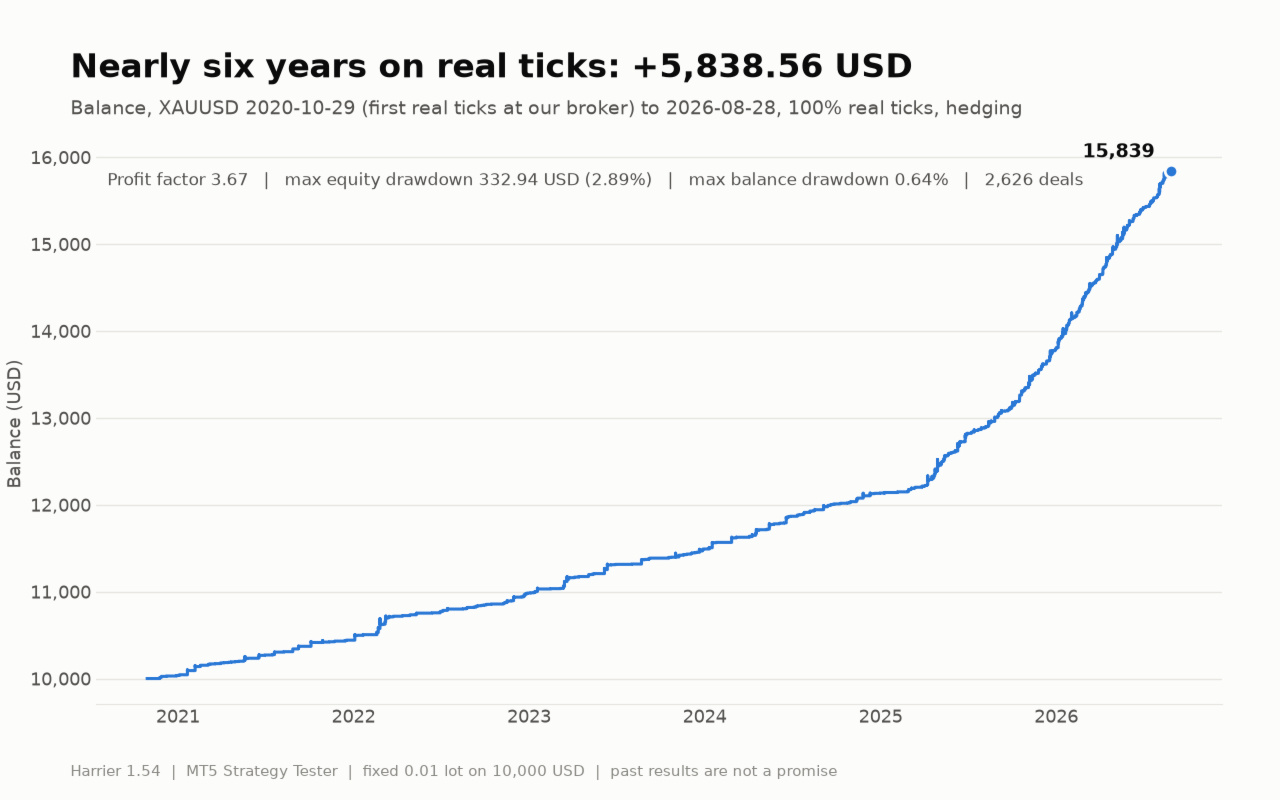
MT5 Strategy Tester, XAUUSD, 2020.10.29 (first real ticks at our broker) – 2026.08.28, 100% real ticks, hedging account, spread from the tick data, fixed 0.01 lot on a 10,000 USD account – the most conservative setting; the risk profiles use larger lots.
| Net profit | +5,838.56 USD (+58% on 10,000) |
| Profit factor | 3.67 |
| Max equity drawdown | 332.94 USD (2.89%) |
| Max balance drawdown | 80.27 USD (0.64%) |
| Recovery factor | 17.5 |
| Deals | 2,626 |
| Net per year | 2020 (2 months) +36 2021 +405 2022 +542 2023 +508 2024 +644 2025 +1,673 2026 (8 months) +2,031 |
What this does not tell you. The entry models were developed on this same period, so part of the result is in-sample; a live result below the test is the normal outcome, not the exception. Two of the six years carry more than half of the profit. The worst basket in this test floated -341 per 0.01 lot, and on the ticks of another broker the same basket reached about -700. A basket on your feed can be deeper than any basket in a test; the daily stop closes it at 750 per 0.01 lot: at 0.01 per 1,000 USD that is 75% of the account, at 0.01 per 10,000 USD 7.5%. Past results are not a promise.
Outside its development period
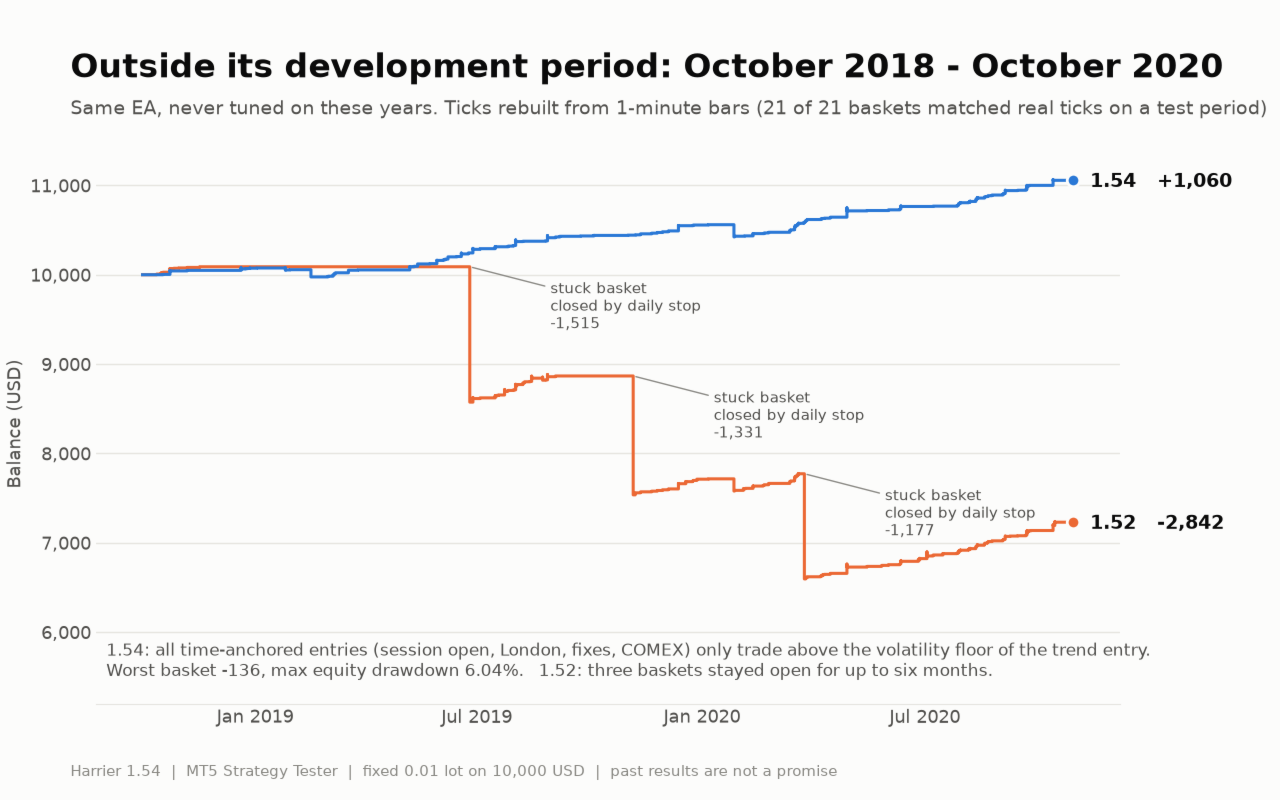
The entry models were built on 2021–2026. We then ran the unchanged EA on October 2018 – October 2020, including the March 2020 crash. Our broker has no real ticks that far back, so we rebuilt them from one-minute bars, with the tick volume of each bar and a fixed spread of 0.15. On a period where we have both, this method reproduced the real-tick run basket for basket (21 of 21).
| October 2018 – October 2020, fixed 0.01 lot on 10,000 USD | Version 1.52 | Version 1.54 |
| Net profit | -2,842 | +1,060 |
| Worst basket | -1,515 | -136 |
| Max equity drawdown | 40.7% | 6.04% |
What went wrong in 1.52: three time-anchored baskets (session open, COMEX settlement, Shanghai fix) opened in a quiet, trending market and stayed open for up to six months until the daily stop closed them. A fourth basket of the same kind (London fix, 30 November 2020) showed up when we extended the real-tick test back to late October 2020. Since 1.54 all five time-anchored entries (SO, L2, FA, CX, SG) only trade above the same volatility floor as the trend entry; on the main test no basket reached the daily stop. That floor has a price, and it is paid in quiet years: against 1.52 it gives up about a fifth of the profit, almost all of it in 2021–2024. We chose robustness over the higher number.
SL/TP mode in detail
- One trade, one stop. Every signal opens one position with its stop (3 × ATR) and target (3 × the stop) placed on the order itself, so they hold even when the terminal is offline.
- Risk per trade. The lot follows from the stop distance and your risk percent (default 1% of equity). If even the minimum lot would risk more than that, the EA skips the trade and says so in the journal. A fixed lot is also possible.
- Time stop. A trade that has reached neither stop nor target after 24 hours is closed (adjustable, 0 = off).
- Optional limit entry. Instead of entering at market, the EA can place a limit order a set fraction of ATR back, valid for a set number of minutes.
- The honest trade-off. In our tests the basket earns more per unit of drawdown. What SL/TP mode gives you is certainty: no basket that can run deep, and a loss per trade that is fixed before it opens. The test figures on this page are for basket mode.
Requirements
- Hedging account. The EA refuses to start on a netting account: the legs would merge into one position and the ladder logic would break.
- XAUUSD (any suffix). Gold only – the measured distances do not transfer to other symbols.
- Any chart timeframe; the EA uses its own internal clock.
- A VPS is recommended but not required: the EA recovers its own state after a restart.
- No DLL, no internet calls, no external files.
Settings and panel
The settings are grouped: General, Risk and position size, Protection, Entries, News, SL/TP mode, Other, Friday and weekend. Under General you choose the mode (basket or SL/TP) and the trade direction: Both (default), Buy only or Sell only. The measured engine values (target, leg distance, ladder, filters, trend gate) are fixed in the code and not exposed, so they cannot be broken by accident. On Friday no new trade opens from 17:00 server time (adjustable); for prop firms that forbid weekend positions an optional Friday close shuts everything at a time you set (off by default).
The panel on the chart shows balance, equity and floating result, the realised result per day, month and total, the open basket with its next leg and target, win rate, current and maximum drawdown, and the reason why the EA is waiting when it is not trading.
Trading gold with leverage can cost more than you intend. All figures are measured on historical data under the stated conditions; they are not a promise of future results.