MSR Nexora EA
- Experts
- Versão: 2.56
- Atualizado: 28 agosto 2026
- Ativações: 5

Nexora EA - Smart Recovery System for XAUUSD (Gold)
Nexora EA is a fully automated MetaTrader 5 Expert Advisor for Gold (XAUUSD), combining EMA-biased mean reversion entries with a martingale-based recovery layer and a basket trailing exit. Designed for MT5 hedging accounts, it identifies mean-reversion setups on Gold, manages adverse price movement through a regime-gated averaging ladder, and exits each basket as a single managed position.
Nexora EA does not attempt to predict news events and does not use artificial intelligence or neural networks. It follows fixed, rule-based logic validated through extensive backtesting on real-tick XAUUSD data.
Read this first: capital and layer depth
This EA exits a basket through a trailing stop that only arms once averaging has pulled the basket's average price back within reach. The averaging ladder is therefore not an optional risk setting - it is part of the exit mechanism. Cap it too shallow and a basket can remain open for months. Run it too deep for your capital and the account will margin-call.
Because of this, MaxLevels must be matched to your capital, and the figure that matters is capital per 0.01 of base lot, not your account balance on its own.
| MaxLevels | Capital per 0.01 base lot | Tested result |
|---|---|---|
| 4 | $20,000 | Net +16,653, PF 2.01, equity drawdown 28.8%, Sharpe 1.19 |
| 5 – 8 | No capital level makes this range safe | Account destroyed at $30,000: MaxLevels 5, 7 and 8 all ended with ~100% equity drawdown |
| 9 | $30,000 | Net +66,231, PF 2.11, margin level 337.1%, equity drawdown 58.5% |
| 10 | $30,000 minimum | Net +76,647, PF 2.03, margin level 343.8%, equity drawdown 42.2%, win rate 79.3% |
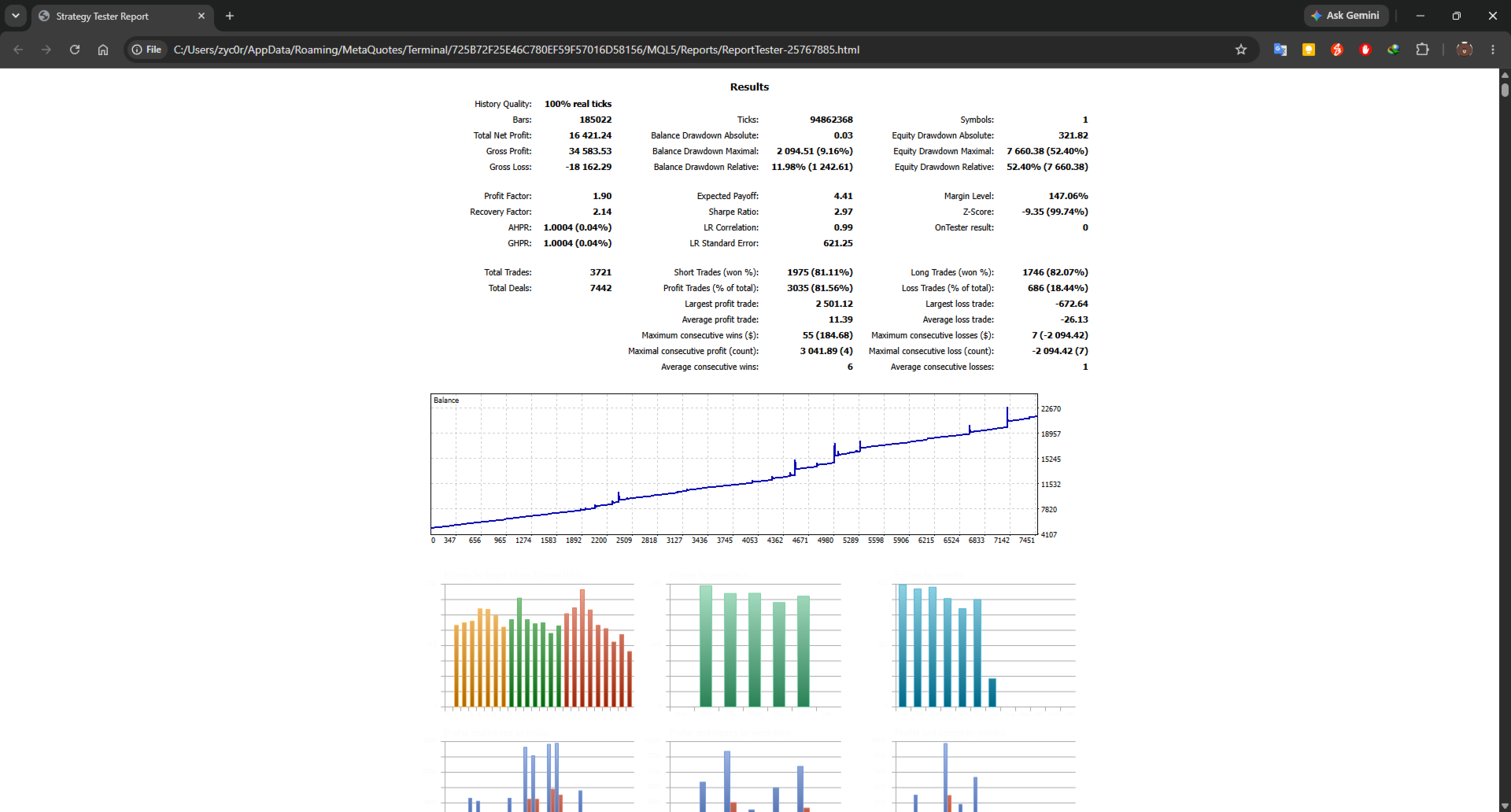
All figures: XAUUSD, 2024.01.01 – 2026.08.08, 99% real tick data, fixed lot mode, BaseLot 0.01, MartMultiplier 2.0, MinLayerPoints 500, OverallTP_Pct 10, Trend Gate on - the exact configuration in the supplied presets. Deposit is the only variable that differs between runs.
MaxLevels does not behave the way intuition suggests, and this matters more than any other setting. Performance is not a smooth curve where shallower means safer and deeper means riskier. It has a hole in the middle. Tested at $30,000 with everything else identical, MaxLevels 4 returned +$16,653 and MaxLevels 10 returned +$76,647, while 5, 7 and 8 each lost essentially the entire deposit. MaxLevels 6 finished at +$1,280 after an 87.6% equity drawdown, which is survival in name only.
The reason is structural. The averaging ladder is the exit mechanism. A shallow ladder builds too little exposure to hurt you. A deep ladder completes and pulls the basket back to where the trailing stop can close it. The middle range is the worst of both: deep enough to accumulate serious exposure against a trend, too shallow to ever finish averaging out of it.
If you are tempted to compromise between 4 and 10, that is precisely the range that destroys accounts. Use 4 or 10.
On the lower bound. The capital figures above are derived from the size of the drawdown, not from the smallest deposit that happened to survive a backtest. At MaxLevels 4, the same test was run at $2,000, $3,000, $5,000, $10,000, $20,000 and $30,000. Every run produced an identical trade sequence and an identical worst-case equity drawdown of $12,575 per 0.01 lot - capital changed nothing except what percentage that drawdown represented. The smaller deposits finished profitable, but only because that drawdown arrived late in the test, after profit had already built a cushion. Had it arrived in the first month, they would not have survived it. $20,000 is quoted because it keeps that drawdown near 29% instead of near 57%.
At MaxLevels 10 the same logic applies with a harder edge, because there the ladder can also be blocked by margin. In that configuration a run at $15,000 per 0.01 lot destroyed the account, while $15,500 - 3.3% more capital - survived the identical period. The threshold behaves as a cliff, not a gradient. Do not interpolate below a tested figure, and do not sit close to one.
Why $30,000 rather than a smaller number. Absolute drawdown in this system is determined by lot size and by the market, not by your balance. Across eight backtests differing only in starting deposit, the maximum equity drawdown was identical to the cent in every surviving run. Capital does not change what the EA does - it decides whether the account can hold through it. $30,000 per 0.01 lot is the level at which relative equity drawdown stays near 56% instead of near 96%.
If you scale BaseLot up, scale capital with it. BaseLot 0.03 at MaxLevels 10 requires $90,000, not $30,000.
The 2024 – 2026 window is used deliberately. It contains the sustained gold uptrend that is the hardest condition for any averaging system, and it measures the account from its starting balance rather than after years of accumulated profit buffer.
Broker conditions are a survival variable, not a preference
Spread is not a cost detail for this method - it is part of whether a basket recovers. In a controlled comparison of the same adverse period, a non-ECN spread of 55 – 60 points accounted for roughly 54% of the gap between an account that survived and one that did not, against 10 – 13 points on ECN.
Use an ECN account with tight, consistent spreads. On a broker quoting 200 – 300 points on gold, the exit mechanism itself stops working: the spread becomes larger than the distance the trailing stop needs in order to arm in profit.
Default settings are not a trading configuration
Out of the box, Nexora EA ships with MaxLevels 3 - a minimum-exposure configuration required for platform validation. It is not a recommended trading configuration and should not be used as one. At these defaults the averaging ladder is too shallow to complete a recovery, which can leave a basket open for an extended period while the EA is unable to open anything else.
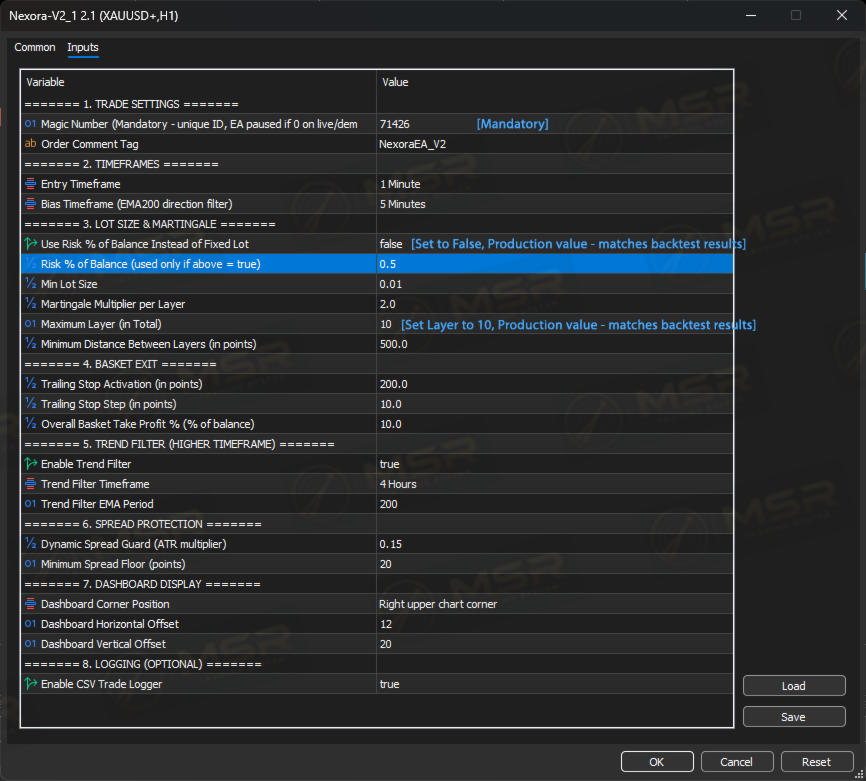
Before running the EA, load one of the two presets posted in the Comments section:
- Nexora-V2_ML4_min20k_2026-08.set : MaxLevels 4, BaseLot 0.01, from $20,000 per 0.01 lot. Smaller returns and the best risk-adjusted figures of anything tested (Sharpe 1.19), but expect long holding periods: in testing, one basket stayed open for 69 days. While a basket is open the EA takes no other trade. That is the trade-off - small exposure, bled slowly, rather than deep exposure resolved quickly.
- Nexora-V2_ML10_min30k_2026-08.set : MaxLevels 10, BaseLot 0.01, from $30,000 per 0.01 lot. Higher returns, deeper drawdown, longest basket in testing 65 hours.
Do not use MaxLevels between 5 and 8. See the capital section above — that range is not a middle ground, it is the failure zone.
Load from the Inputs tab using "Load". After loading, set your own unique Magic Number before the EA will trade. Earlier preset attachments in the Comments section are superseded - check the filename.
Strategy overview
Entry is decided by a deliberately minimal decision engine: price position relative to the 200 EMA and the Bollinger Band middle line, filtered by ADX and aligned with a higher-timeframe bias. This core logic was empirically tested against a more complex multi-oscillator voting system and consistently outperformed it, so Nexora EA keeps its entry logic minimal rather than stacking confirmation filters.
RSI, Stochastic and MACD act as assistive momentum confirmations inside the entry logic - any one is sufficient, they are not required to agree. In live logging, MACD accounts for the large majority of entry filter decisions. These parameters are locked at their validated values and intentionally not exposed as inputs, so the tested entry logic cannot be altered by accident.
A Trend Gate on the H4 timeframe blocks new base entries that go against the dominant macro trend, reducing exposure to the prolonged directional moves that are historically the largest risk factor for any averaging-based gold system. The Trend Gate applies to base entries only. Once a basket is open, layering is not blocked by it - cutting off the ladder mid-recovery removes the exit path, which testing showed to be more dangerous than the exposure it would avoid.
Note that the Trend Gate can hold the EA to one direction for weeks at a time during a persistent trend. That is the mechanism working, not a fault. It costs profit in ranging markets and protects the account in trending ones.
Recovery and risk management
When price moves against an open position, Nexora EA adds further positions (layers) at a multiplied lot size to average the basket's entry price, up to the configured maximum. New layers are gated by a regime filter (ADX and ATR ratio) that restricts additional layering during high-volatility conditions, and by a margin check that blocks a layer the account cannot support.
The basket is closed as a single unit. In practice the trailing stop is the exit that fires: across 491 closed baskets on the live account, every one exited through the trailing stop. The overall percentage take-profit target exists as a secondary path, but at realistic balances the trailing stop reaches its target first, so treat the trailing exit as the mechanism that closes your baskets.
What the drawdown actually looks like
This deserves stating plainly rather than leaving you to discover it in month three.
In the verified $30,000 / MaxLevels 10 configuration, equity fell from roughly $37,000 to roughly $16,200 at the worst point before recovering - a 56% drop from peak, and well below the starting deposit. The system recovered and finished the period profitable, but you have to be able to hold through that without intervening manually.
The largest single losing position over the whole period was $1,354, and the longest a basket stayed open was 65 hours. The pain in this system does not come from one catastrophic trade - it comes from holding a deep basket while it works its way back.
Because of how the recovery mechanism works, this EA produces a high win rate with occasional large losing clusters. Risk-adjusted metrics such as Sharpe ratio will look modest even when profit factor is strong. That is the signature of the method, not a defect - but if a drawdown of that shape would be intolerable for you, use MaxLevels 4 and accept smaller returns, or do not use this EA.
Transparent status panel
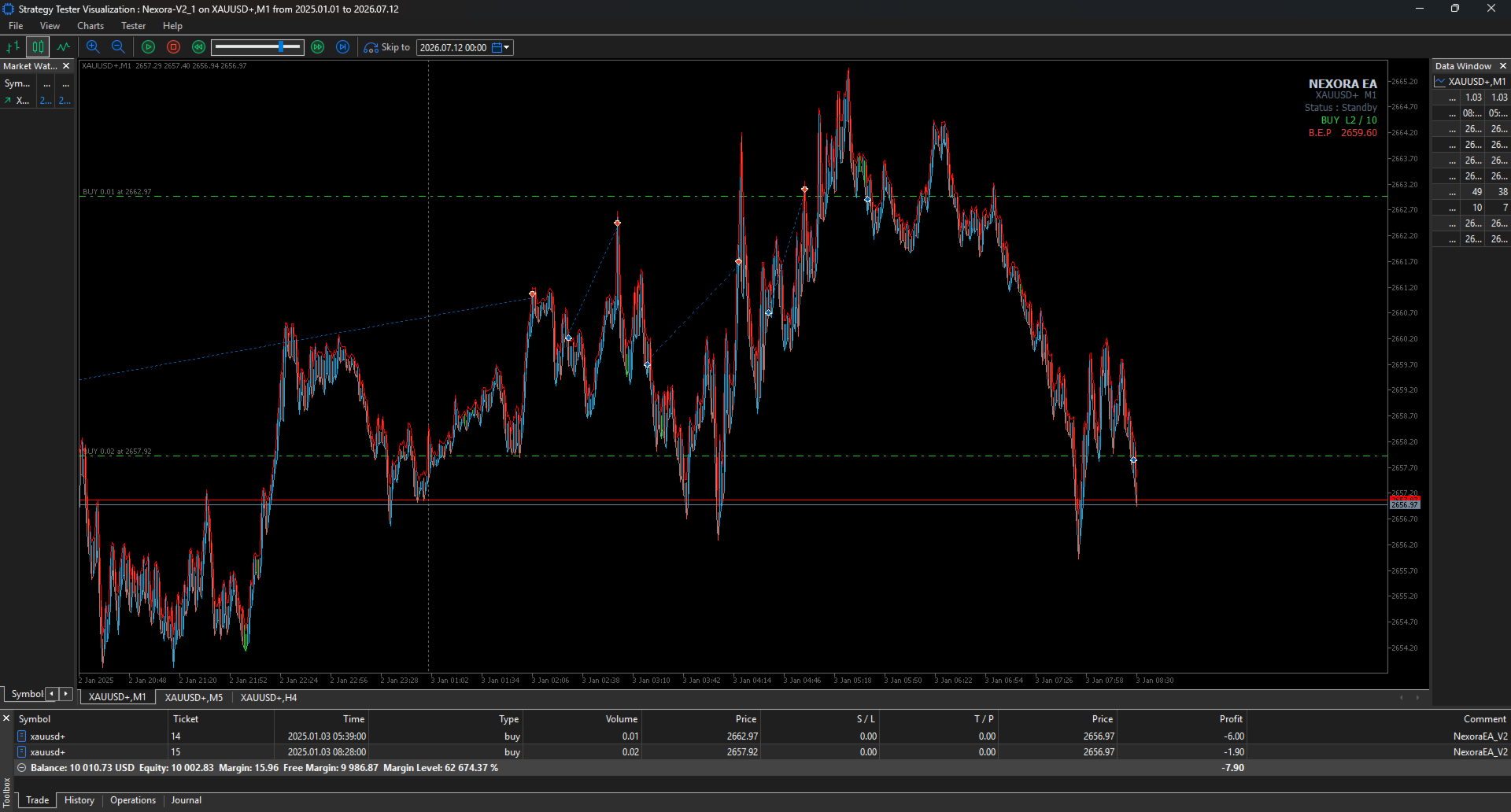
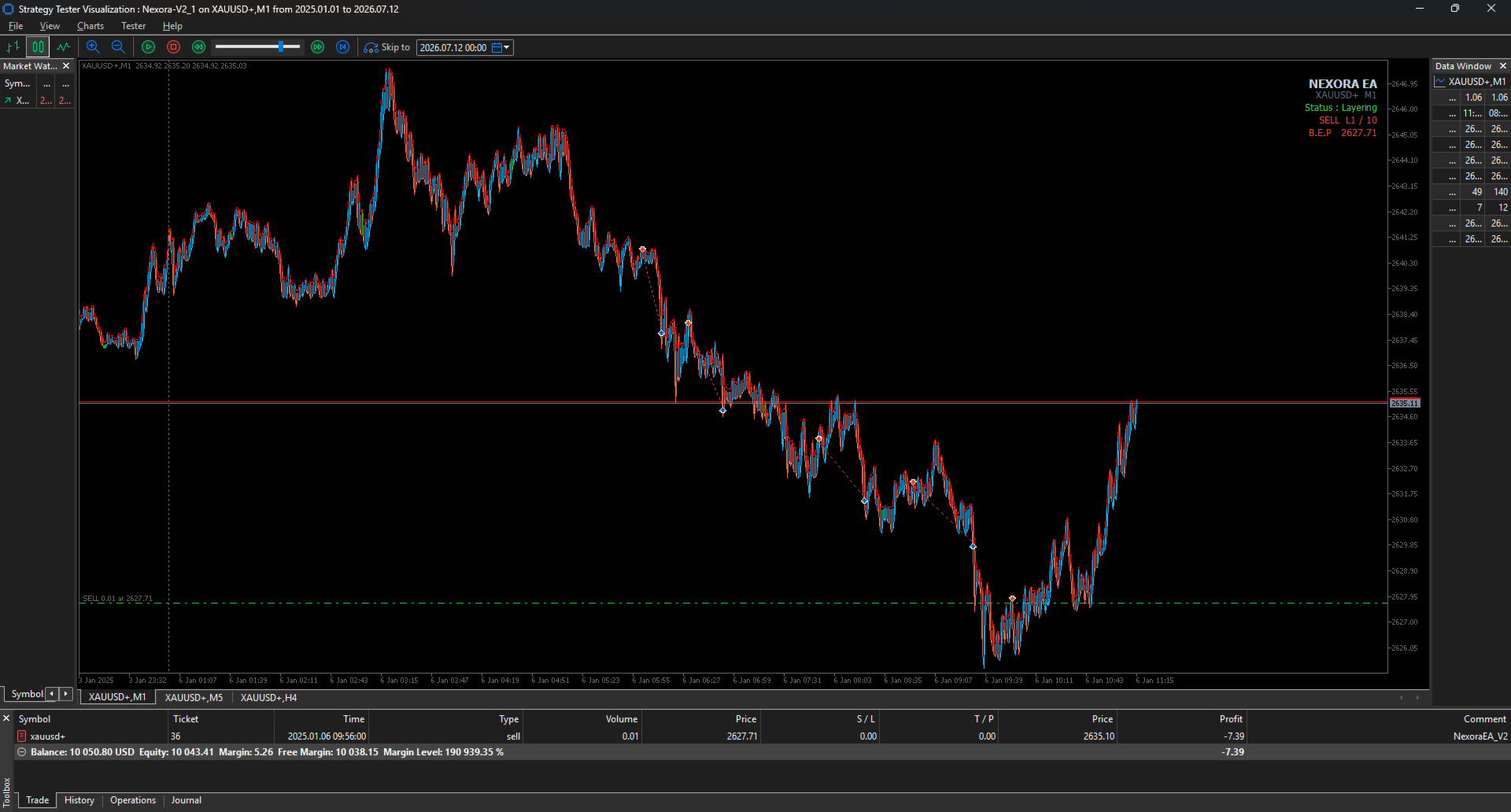
The on-chart dashboard always tells you what the EA is doing and why. Instead of a generic "Ready", it reports the exact state: waiting for an entry, waiting for the next layer, holding at maximum layers, or the specific reason it is standing aside — a higher-timeframe trend conflict, ADX above the allowed threshold, spread too wide, or the market being closed.
Development history and live track record
Nexora EA is not a first-attempt system. It evolved from an earlier BB Martingale EA running live on a real cent account since May 13, 2026.
During that period, backtesting and custom diagnostic tooling identified a critical bug: under a specific sequence of price action, the trailing-stop state could lock permanently, preventing a recovery basket from averaging or closing (a "zombie basket"). Zero-execution signal logging confirmed 72,852 bars of averaging opportunities the EA should have taken and did not, which led to the root cause.
That fix, together with the H4 Trend Gate, defines the current architecture. Full-history backtesting (2020 – 2026, 99% real tick) confirms the corrected logic resolves the issue across the entire dataset: maximum basket holding time dropped from over a year to under 5 days.
Several features were built, tested and then removed rather than shipped - including a time-based basket cut and a profit-protection guard that closed full baskets to preserve accumulated profit. Both were measured, both made results significantly worse, and both were deleted rather than left in as optional settings. The reasoning is consistent: in this system the ladder is the exit, so a guard that closes a basket before the ladder finishes does not reduce risk, it cancels the recovery.
The live track record for this exact version is still short and will grow in real time. The live account has received deposit top-ups and a withdrawal during its history, which affect the growth percentage shown — the underlying trade history is continuous.
Live account: MQL5's rules do not allow external links inside this description. The live Myfxbook link (tracked in USC/cent, includes pre-Nexora and development history) is posted in the product's Comments section below.
Important risk disclosure
Nexora EA uses a martingale-style averaging method. Losing positions can be added to at increasing lot sizes before the basket recovers, which increases exposure and drawdown during unfavorable market conditions. This strategy is not suitable for traders who require a strictly bounded per-trade risk.
No configuration of this or any martingale EA is immune to account loss. The settings above have smaller worst cases than the alternatives tested; they do not eliminate the worst case. The tested figures describe past market conditions, and a trend more severe or more prolonged than anything in the test window remains possible. Always test on a demo account first.
General risk warning: Trading forex, gold (XAUUSD), and other leveraged instruments carries a high level of risk and may not be suitable for all traders. Past performance, whether from backtesting or live results, is not a reliable indicator of future results. Automated trading systems can be affected by broker execution differences, connectivity issues, and market conditions that differ from historical data. You could lose part or all of your invested capital. Only trade with funds you can afford to lose, and seek independent financial advice if you are unsure whether this product is appropriate for your situation. This description is provided for informational purposes and does not constitute financial or investment advice.
Requirements
- Symbol: XAUUSD (Gold)
- Account type: hedging - the EA's layer tracking and basket average-price logic depend on multiple open tickets per direction
- Magic Number: must be set to a unique, non-zero value, or the EA remains paused
- Broker: ECN with tight, consistent spreads - see the section above; this materially affects survival
- Minimum capital: see the capital table. There is no single minimum balance - it depends on the MaxLevels and BaseLot you run.