Trove Adaptive AI Grid
- エキスパート
- バージョン: 16.31
- アクティベーション: 11

Trove Adaptive Grid
Trove Adaptive Grid is a dual-side grid EA for gold (XAUUSD) that we built to fix the known problems of grid trading one by one. We took it as a challenge, and it took us many months to finish. We built and threw away 1000's of versions, traded them on live accounts, studied every losing basket candle by candle, and kept only what worked. What you get is the version that survived all of that. We are proud to say we made 1630 mistakes to find the 1631th right version.
The grid problems we solved
- Levels bunching together. Many grids open several orders at almost the same price when the broker is slow. Trove Adaptive Grid books each level the moment the broker confirms it, so two levels are never closer than the spacing you set.
- Baskets closing in pieces. The whole basket closes together in one burst. There are no partial closes and no orders left behind.
- Waiting too long for the exit. The power ladder is built so a basket only needs about a 32% pull-back to close in profit, at any depth.
- Commission eating the profit. The EA reads your broker's commission from your own fills and adds it to every exit, so a break-even exit really is break-even.
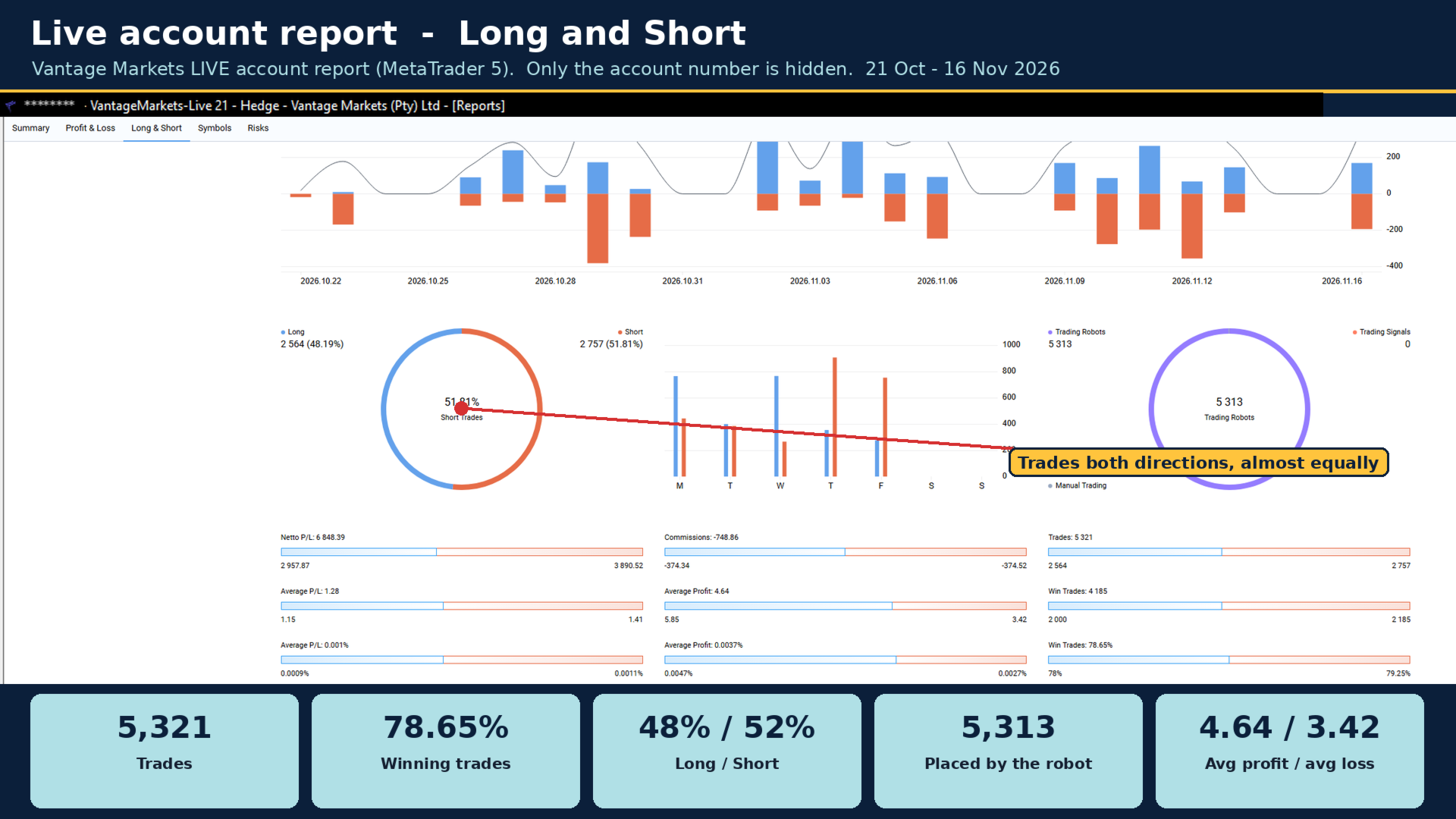
- Trading blindly in both directions. A direction engine reads market structure on M5, M15 and H1 and decides which side may open. The side against the trend trades at half lot.
- Entering at the top or bottom. A stretch guard blocks new baskets when price is already extended.
- Getting caught by a breakout. Capital protection widens the spacing of a basket the moment structure breaks against it and brings its exit to break-even.
How the EA senses risk, and what it does about it
Trove Adaptive Grid does not grid blindly. On every tick it reads the market and changes its own behaviour: it cuts the lot, stands aside, widens the grid or leaves early.
| What the EA senses | What it does |
|---|---|
| The trend on H1 and the structure on M5, M15 and M30 (higher highs, lower lows, ranges) | Opens only the safe side in a trend; both sides only in a proven range |
| A basket that would go against the trend | Opens it at half lot |
| M15 and M5 turning while H1 has not turned yet (an early turn) | Trades the new direction at half lot until H1 agrees |
| A pull-back inside the trend | Trades the trend side at half lot until the pull-back ends |
| Price already stretched far from its average | Opens no new basket: it will not buy a top or sell a bottom |
| A candle that broke a level and was rejected with a long wick | Stops trading that side for the next bars |
| An M5 break that M15 has not confirmed yet | Waits for the confirmation before choosing a side |
| A tight range breaking out on high volume | Follows the breakout side only |
| Structure breaking against an open basket | Capital protection: widens that basket's spacing and moves its exit to break-even |
| A basket sitting at the tail of a trend, started at a peak, or with the trend now against it | AI TP: takes the first profit instead of waiting for the full target |
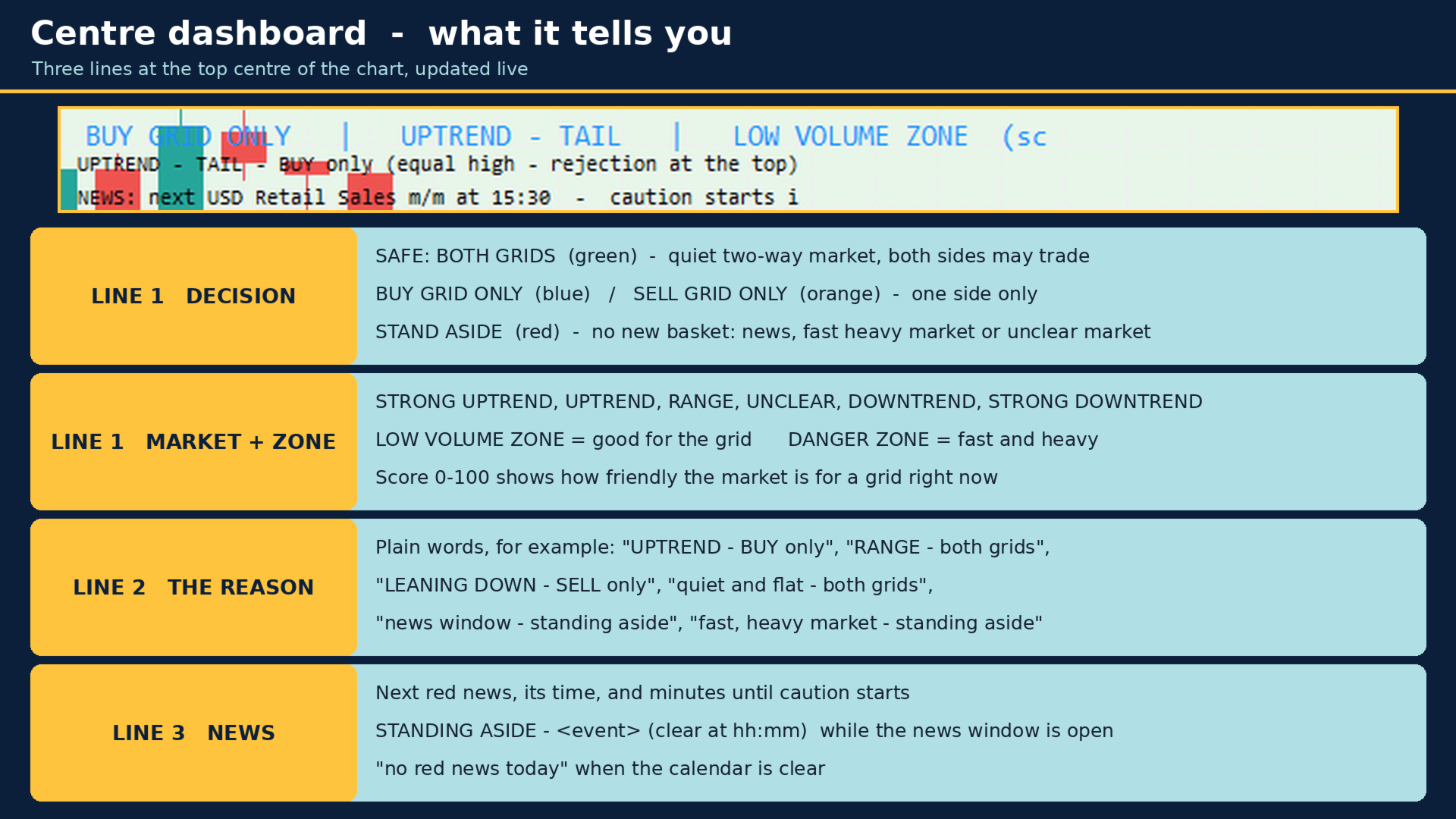
| Volume, speed, candle bodies and efficiency turning fast and heavy (danger zone) | Stands aside until the market calms |
| A sudden volatility spike | Stands aside; open baskets leave at the first profit |
| Red news on the calendar (NFP, CPI, FOMC) | No new basket before the release, targets pulled in, waits for calm afterwards |
| A basket that reached profit and is falling back | Profit lock: closes it before it turns red |
| Friday evening | No new baskets; profitable baskets are closed before the weekend |
| Spread too wide, margin too low or the broker's volume limit reached | Skips the order; if the margin level falls dangerously low it closes everything before the broker's stop-out |
The lot ladder itself is a safety feature. Lots grow by a fixed power formula, not by doubling, so the size can never run away like a martingale, and a basket at any depth needs the same pull-back of about 32% to close in profit.
Multiple safety checks
- Exact spacing: no level opens closer than your set step.
- One-burst exit: the whole basket closes together; nothing is left behind.
- Never close in loss: only the reasons you authorise may book a loss.
- Commission-aware exits: every target pays the broker's commission first.
- Lot and level caps: maximum lot per order and maximum levels per side.
- Optional hard limits, off by default: stop loss, side loss limit, account floating limit, equity stop and hard stop.
- Funded-account mode: one basket at a time and a guard that acts before your firm's daily and total limits.
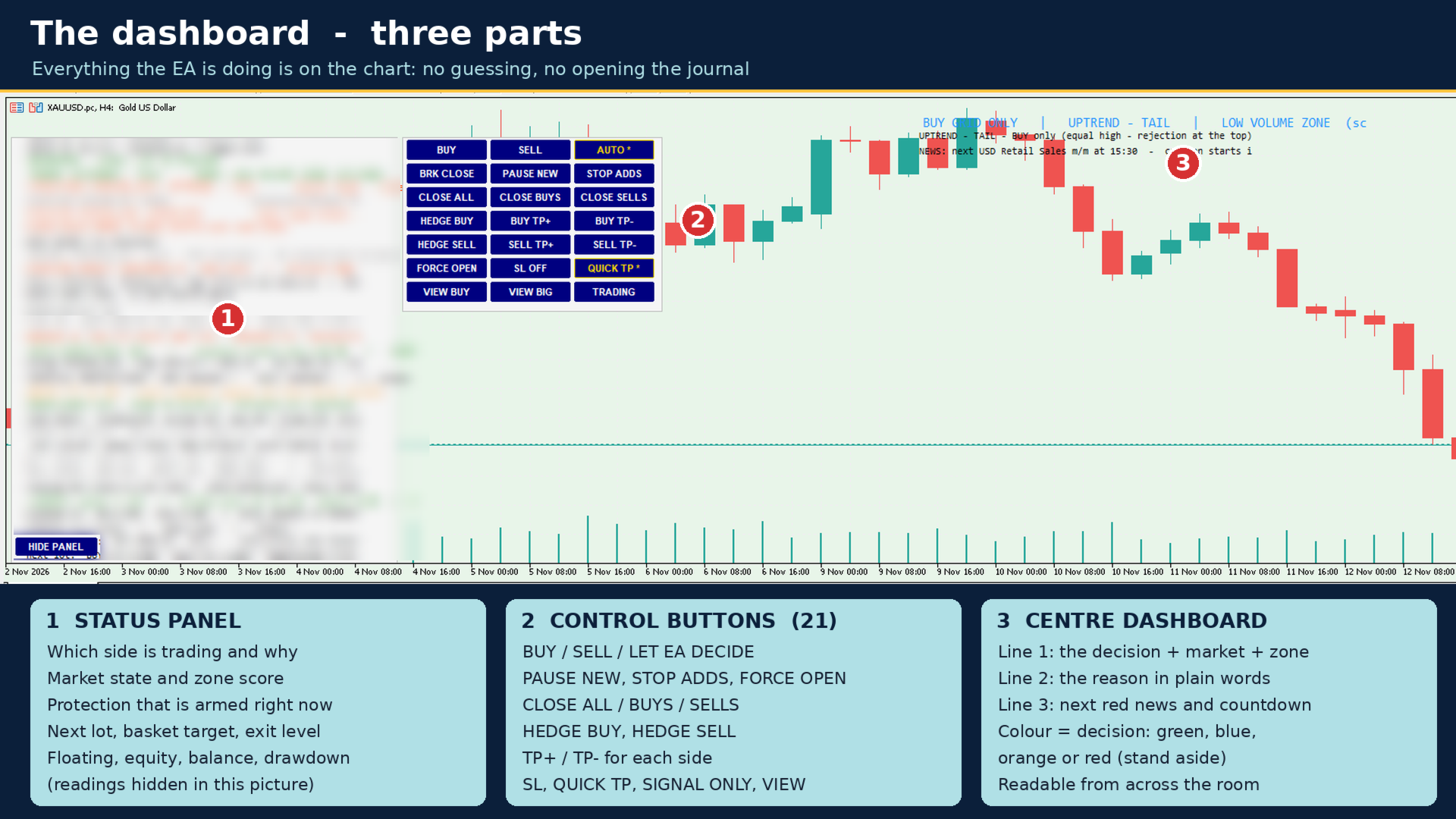
- Manual control: panel buttons to pause, stop adding, hedge, close a side or close everything.
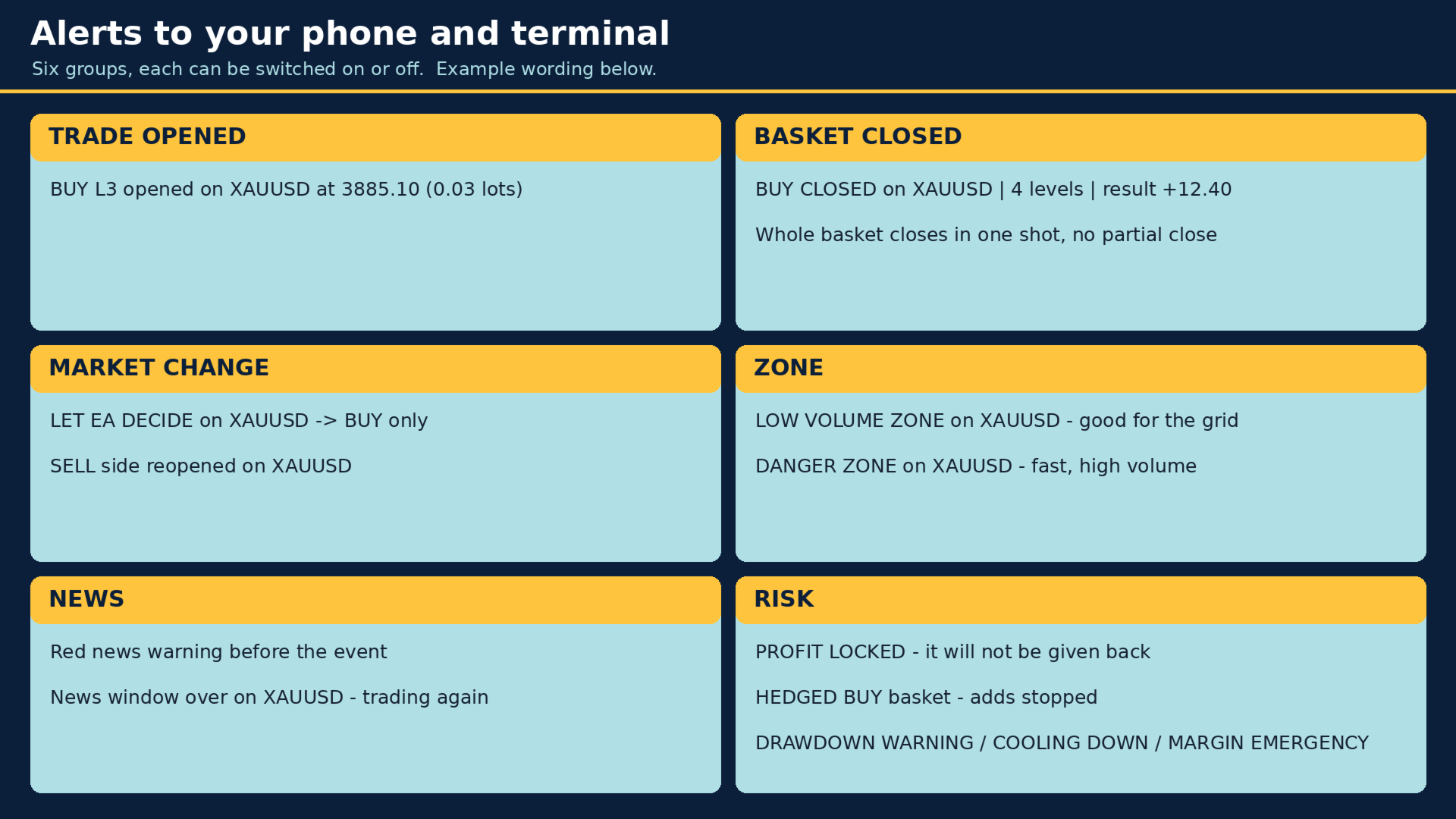
- One alert per event: push notifications for trend changes, closes, protection and news, without flooding your phone.
- Restart safe: the EA remembers its baskets and your button choices after a restart.
Why the back test does not show the real result
Several controls depend on live data that the MT5 Strategy Tester cannot replay:
- Economic calendar. The tester has no calendar, so the news guard is off in a backtest and the EA trades straight through NFP, CPI and FOMC.
- Broker commission. The EA learns the commission from your real account fills.
- Real execution. The spacing fix and the one-burst basket close are built for real broker confirmation delays, which the tester does not have.
- Notifications and panel buttons. Push alerts and manual control only exist on a live chart.
$$$$$ A backtest is still useful to see how the EA grids and exits. The real proof is a forward test, so we have kept the price at only 49 dollars: run it on a demo or cent account yourself before you commit real capital$$$$$$
Our forward test
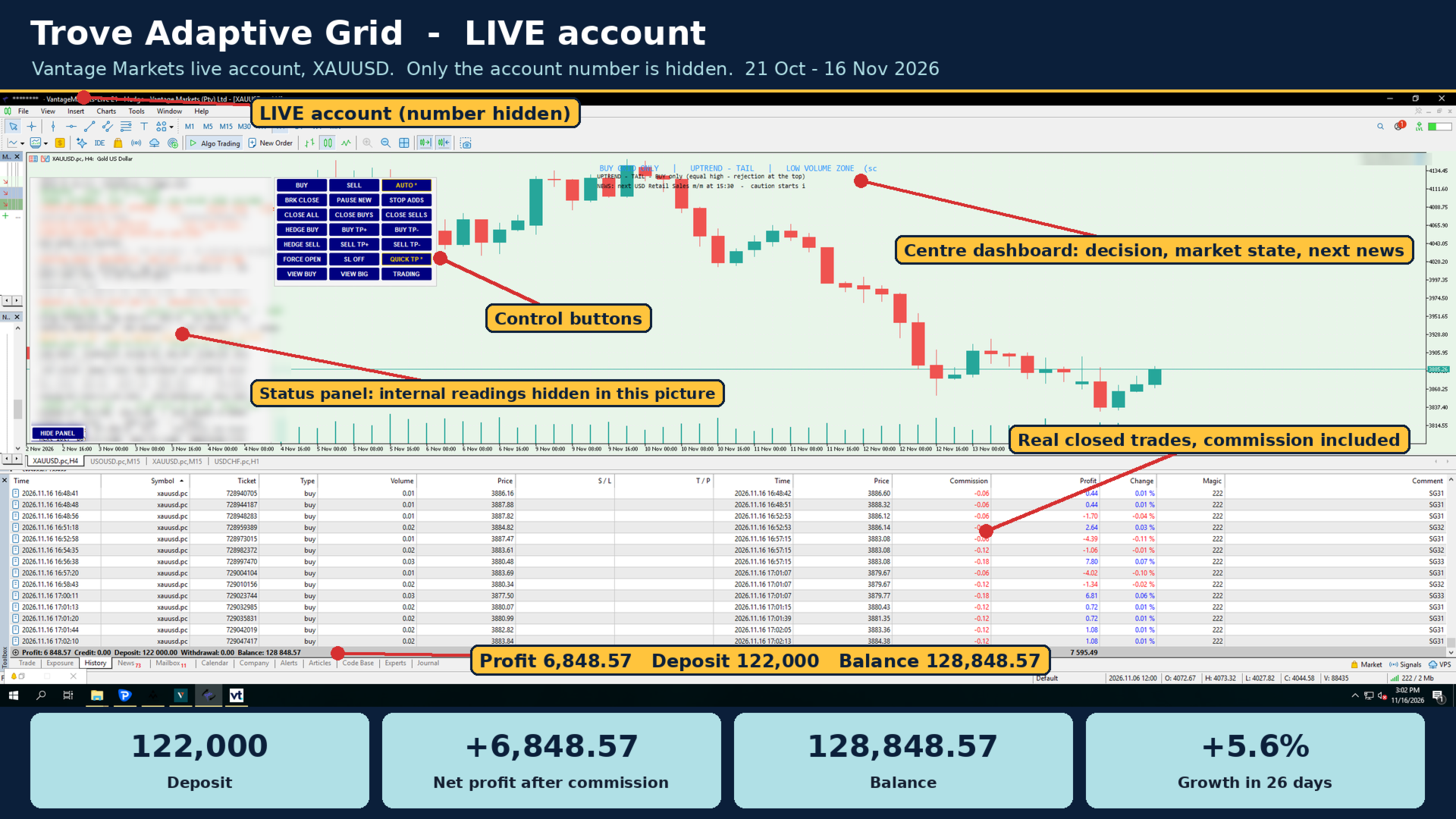
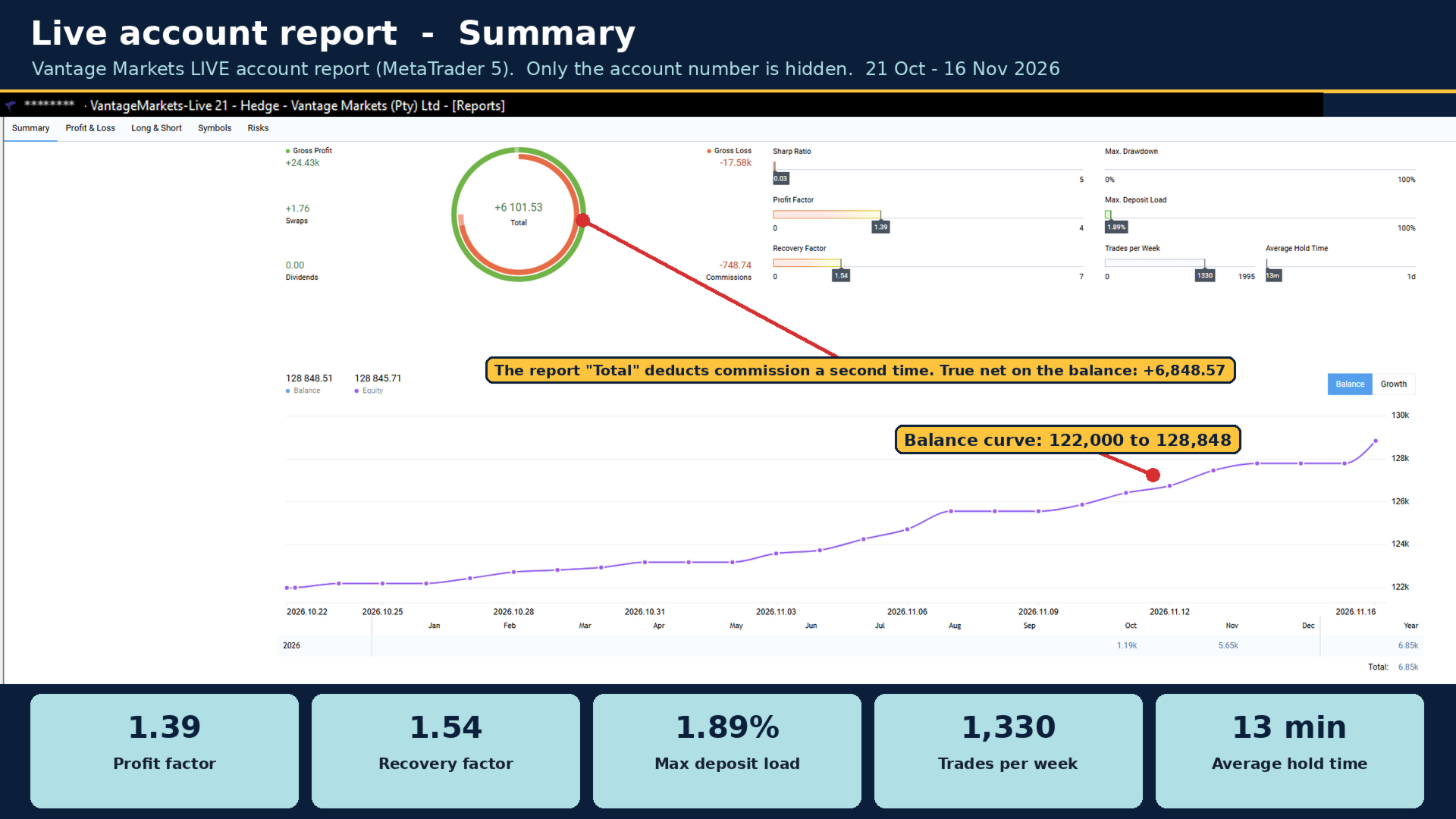
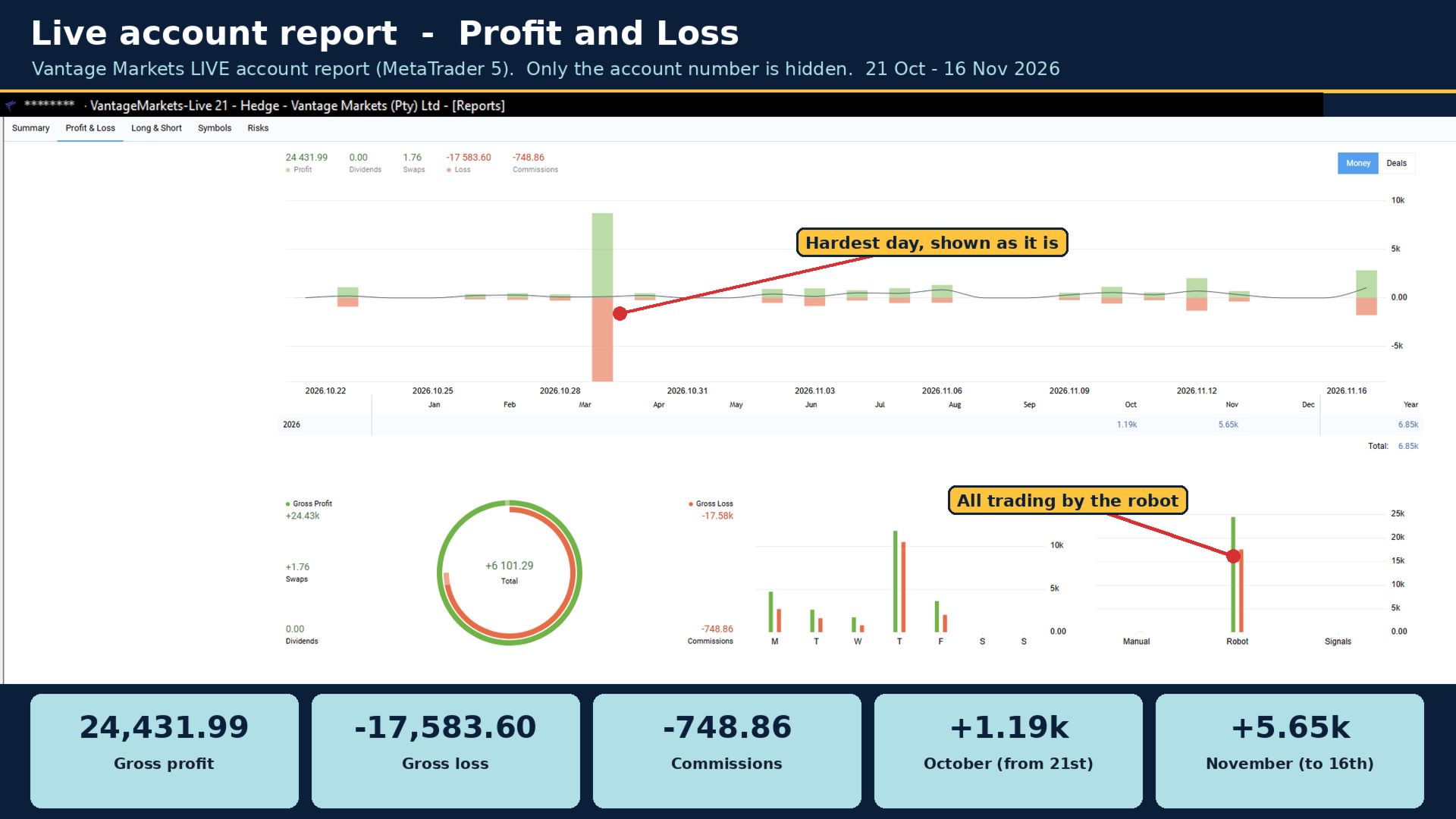
We ran a 40-day forward test on a live cent account. In that test the EA made about 60% in a month. Past results do not guarantee future results.
Recommended capital
The EA works on cent and standard accounts. Start with a 0.01 lot.
| Capital | Use |
|---|---|
| 100,000 cents ($1,000) | Starting point for testing |
| 300,000 cents ($3,000) | Minimum recommended, Best For Lot reduction during Risk |
| 500,000 cents ($5,000) | Best: the grid has the most room and the lowest drawdown |
Which pairs it works on
| Symbol | Status |
|---|---|
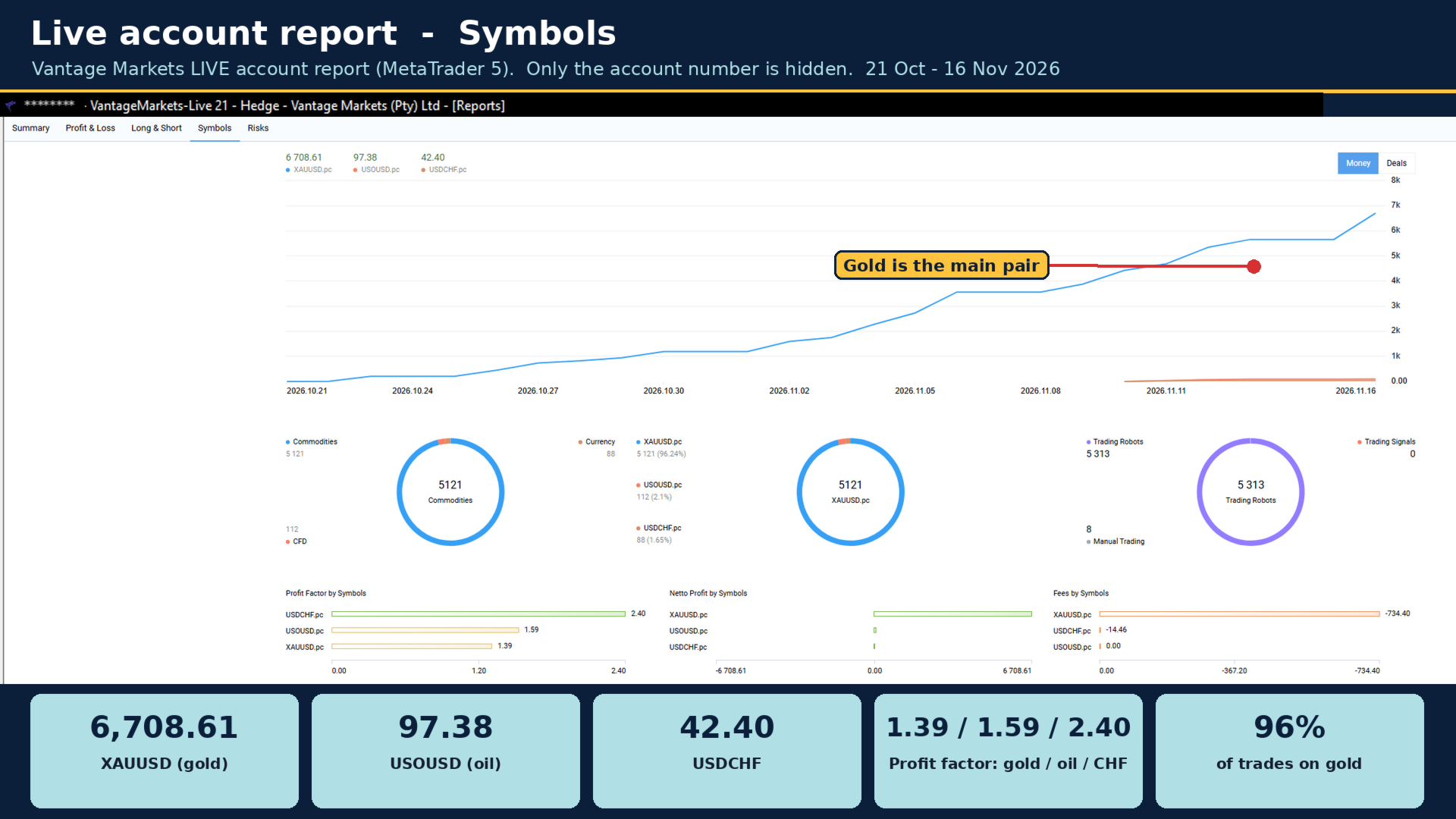
| XAUUSD (gold) | Main symbol. Built, tuned and forward tested on gold; the defaults are for gold |
| USDJPY, USDCHF | Supported with their own spacing. Set the pip mode to FX and use a wider spacing as the basket deepens |
| Oil (USOIL / WTI) | Supported with the pip mode set to OIL. Oil gaps over the weekend, so use a small lot and the Friday close |
Run one chart per symbol, each with its own magic number. Gold is where the EA is proven; forward test any other symbol on a demo or cent account before going live.
Parameters
Trove Adaptive Grid has 299 parameters in 26 groups, so you control every part of it: direction engine, spacing, lots, exits, stop loss, risk limits, notifications, market structure, protection, news, Friday guard, sessions and dashboard. The defaults are ready for gold; you do not need to change them to start.
Setup
- Symbol: XAUUSD. Attach to one chart, any timeframe (the EA reads M1, M5, M15, M30 and H1 itself).
- Account: hedging account, low-spread broker.
- Set parameter 255 to the hours your local time is ahead of the broker server.
- Allow Algo Trading. For push alerts, set your MetaQuotes ID in MT5.
- Keep the terminal running on a VPS.
To be Honest It is very hard even for us to create this AI Grid EA again.