Glazing Index Pullback
- エキスパート
- バージョン: 1.0
- アクティベーション: 10

Glazing Index Pullback buys short, sharp pullbacks in US stock indices (S&P 500, Nasdaq 100, Dow 30) while their long-term trend is up, and exits on the first bounce. It makes one decision per day per index. Every trade has a stop and is sized by a fixed risk percentage of equity.
How it works
- Once per day, the EA checks each index for a long-term uptrend and a short-term oversold pullback. When both are present, it buys at the next open.
- It exits when the price has recovered. A typical trade lasts a few days.
- Every trade has a volatility-based stop, and the position size is set so that hitting the stop costs the configured risk (2% of equity by default).
- Only one position per index, long only.
- The rules were fixed in advance from published research on short-term mean reversion in equity indices and were not optimized. They use the same settings on all three indices.
Risk controls
- Risk per trade is fixed as a percentage of equity, with a stop on every trade.
- Kill-switch: if the EA's own drawdown reaches 15% from its peak, it closes its positions and stops trading until you reset it.
- Manages only positions with its own magic number.
- Before every order it checks margin, volume limits, trading sessions and the broker's stop and freeze levels.
Backtest (hypothetical)
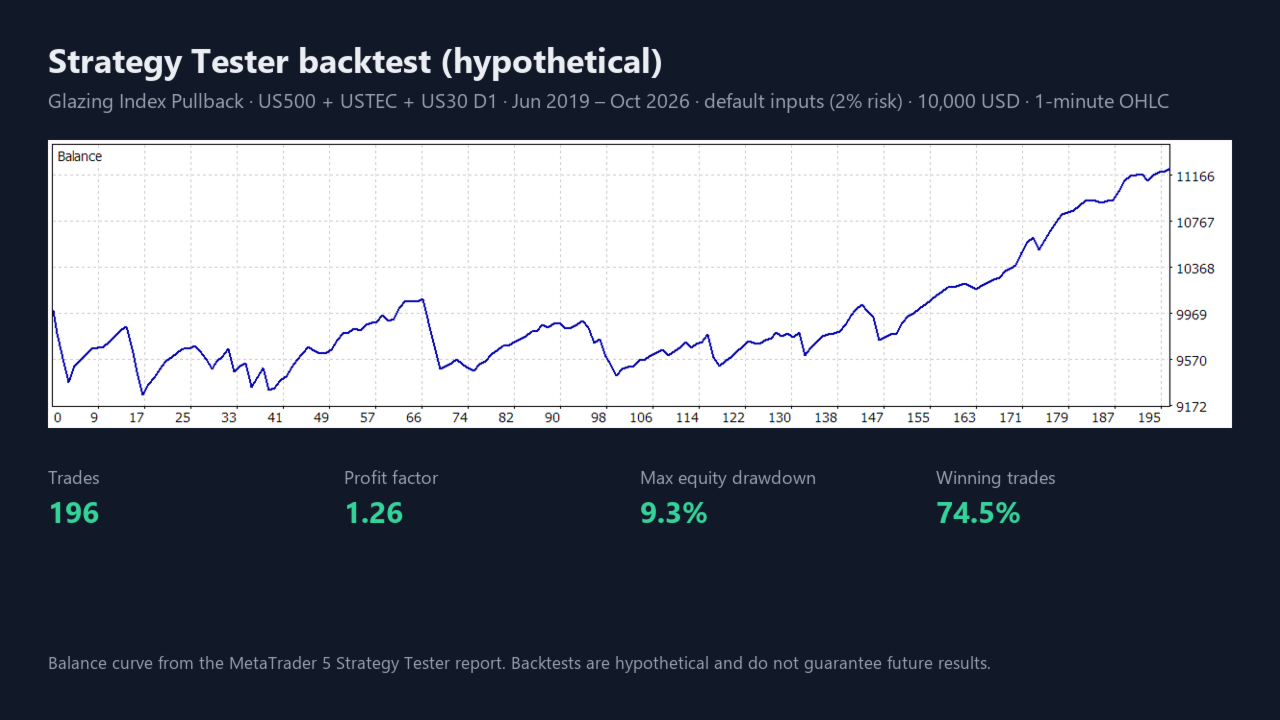
Strategy Tester, default inputs (2% risk), US500 + USTEC + US30, D1, June 2019 to October 2026, 10,000 USD, 1-minute OHLC, on a broker with GMT+0 server time:
- Net profit +1,228 USD (+12.3%), maximum equity drawdown 9.3%, trades 196, profit factor 1.26, winning trades 74.5%.
Developer research with modelled spread, slippage and swap, at 1% risk per trade:
- US index data 2009–2026: profit factor 1.55 over 480 trades, maximum drawdown −7%.
- Broker CFD data 2019–2026: profit factor 1.44 over 205 trades, 74% winning trades, maximum drawdown −3.3%.
- Results stayed positive across nearby settings, so they do not depend on one lucky parameter choice.
Backtests are hypothetical and do not guarantee future results. The three indices are highly correlated, so their trades often cluster on the same days. Positions are open only about 10% of the time, so absolute returns are modest.
Requirements
- CFDs on the S&P 500, Nasdaq 100 and/or Dow 30. The EA finds names such as US500, SPX500, SP500, NAS100, US100, USTEC, US30, DJ30 or WS30 automatically, with any prefix or suffix. Otherwise enter them in the Symbols input. Indices that are not found are skipped.
- Recommended capital: about 10,000 USD or more. With a wide stop and a 2% risk, small accounts can fall below the minimum lot, especially on the Dow. The EA then uses the minimum lot only if its risk is at most 1.5 times the configured risk; otherwise it skips the trade and logs why.
- A VPS or a computer that runs continuously.
- Hedging and netting accounts are both supported.
Setup
1. Open a US500 chart (any timeframe; D1 is convenient) and attach the EA.
2. Keep Symbols = "auto" or enter your broker's names, e.g. "SPX500,NAS100,US30".
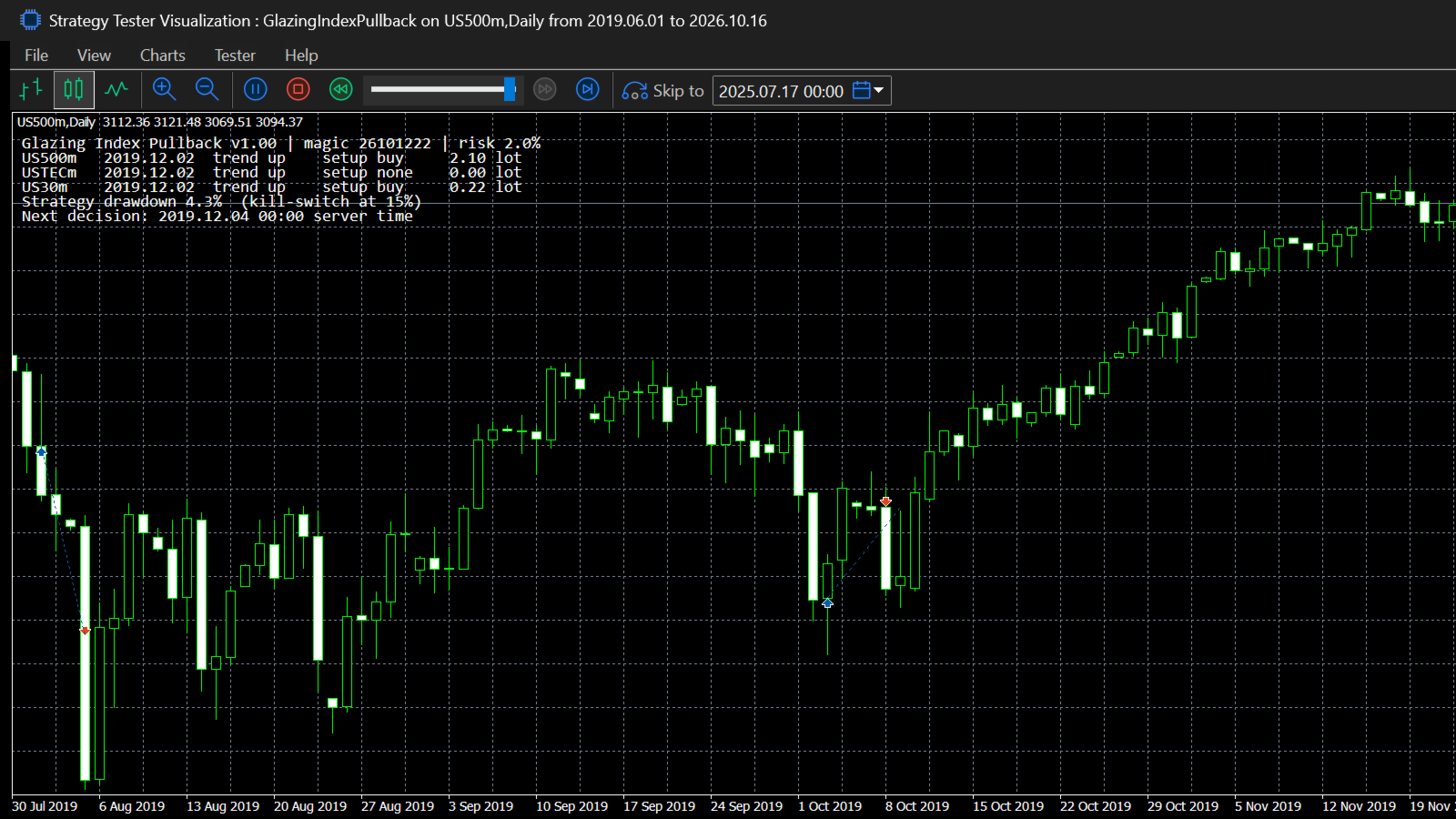
3. Enable Algo Trading. The panel shows each index, the trend filter (up/down), the current setup (none / buy / holding / exit), the position and the strategy drawdown.
4. Only one chart is needed: the EA manages all detected indices.
Testing the demo
Test on US500 (or your broker's S&P 500 name), D1, with at least two years of history, because the EA needs about a year of daily data before its first decision. If you test on a symbol outside its list, for example EURUSD, the EA trades that symbol alone so you can inspect its behaviour; the strategy was researched on US stock indices only.
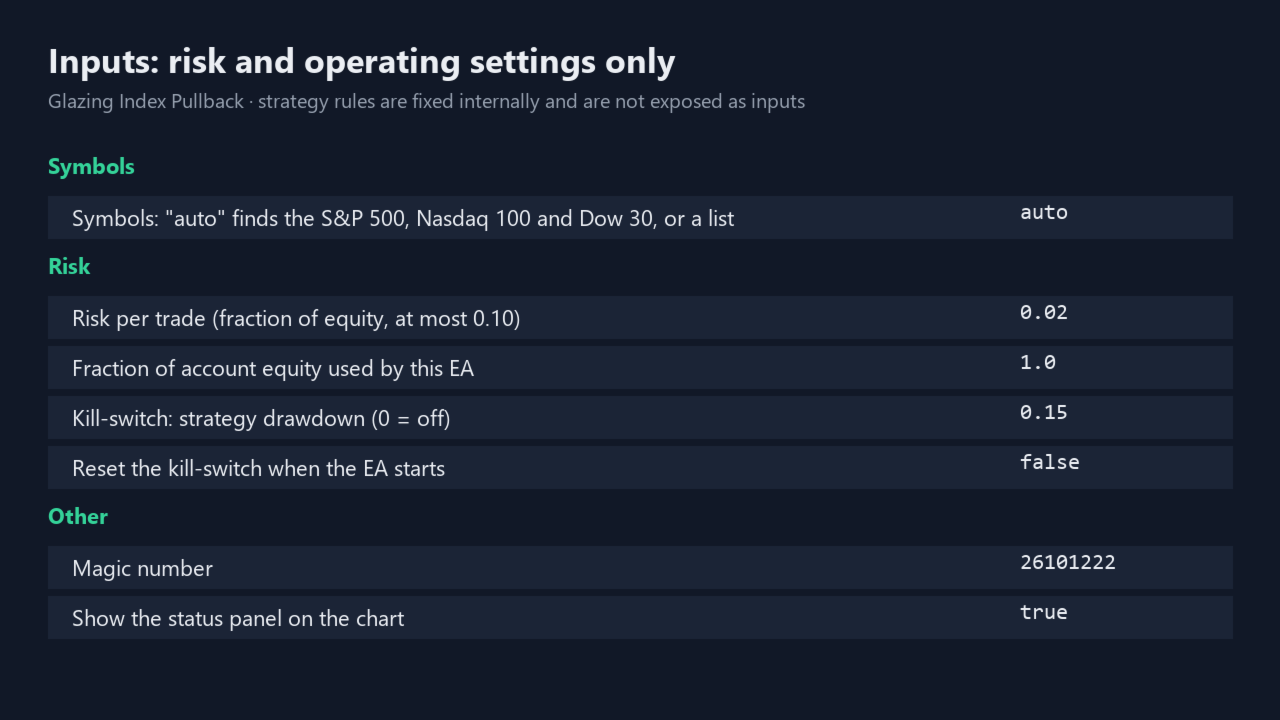
Inputs
| Input | Default | Meaning |
|---|---|---|
| Symbols | auto | "auto" or a comma-separated list |
| Risk per trade | 0.02 | Fraction of equity lost if the stop is hit, at most 0.10 |
| Fraction of account equity | 1.0 | |
| Kill-switch drawdown | 0.15 | 0 = off |
| Reset the kill-switch | false | Set to true once to resume after a halt |
| Magic number | 26101222 | |
| Show panel | true |
FAQ
- Why no trades for weeks? Entries need a sharp pullback while the index is in an uptrend. In strong steady rallies, or in bear markets, there may be no setup for weeks.
- Why is the stop so wide? A wide stop gives a pullback trade room to recover. The position size is reduced so that hitting the stop costs only the configured risk.
- Can it run with Glazing Crypto Trend on the same account? Yes. They use different magic numbers and kill-switches.
Risk disclosure
Trading leveraged CFDs carries a high risk of loss. Backtest results are hypothetical, are based on historical data and assumed costs, and do not guarantee future results. Live results depend on your broker's spreads, swaps, symbol specifications and execution. Only risk capital you can afford to lose.