The Judas Window
- エキスパート
-
Alex Amuyunzu Raymond
 I’m an experienced MQL5 developer and software engineer specializing in building robust, high-performance algorithmic trading systems for MetaTrader 5. My work goes beyond standard EA development — I design intelligent, scalable solutions that combine market logic, automation, and external
 - バージョン: 1.10
- アクティベーション: 5
THE JUDAS WINDOW — When the Market Lies, This EA Reads the Truth
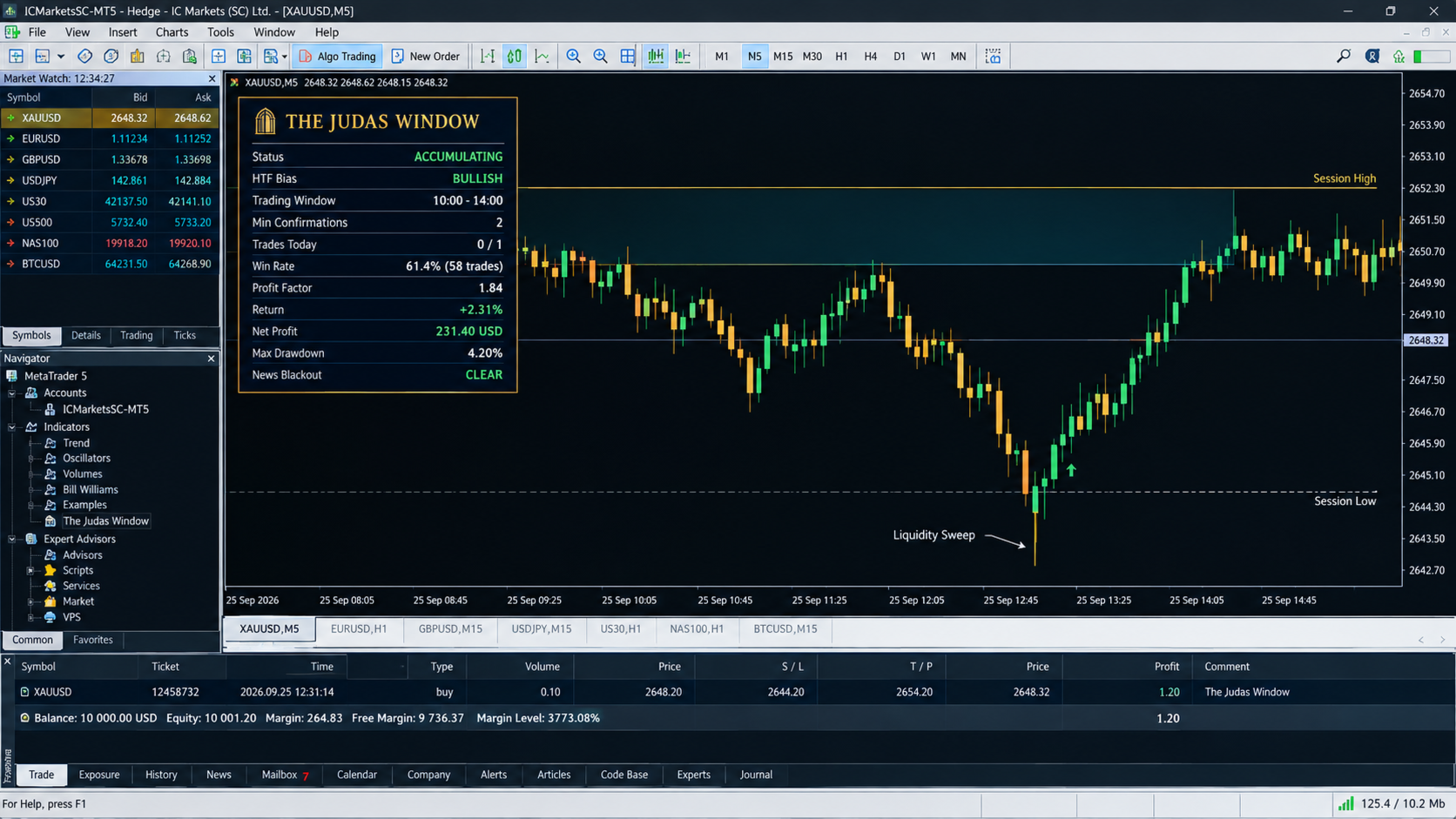
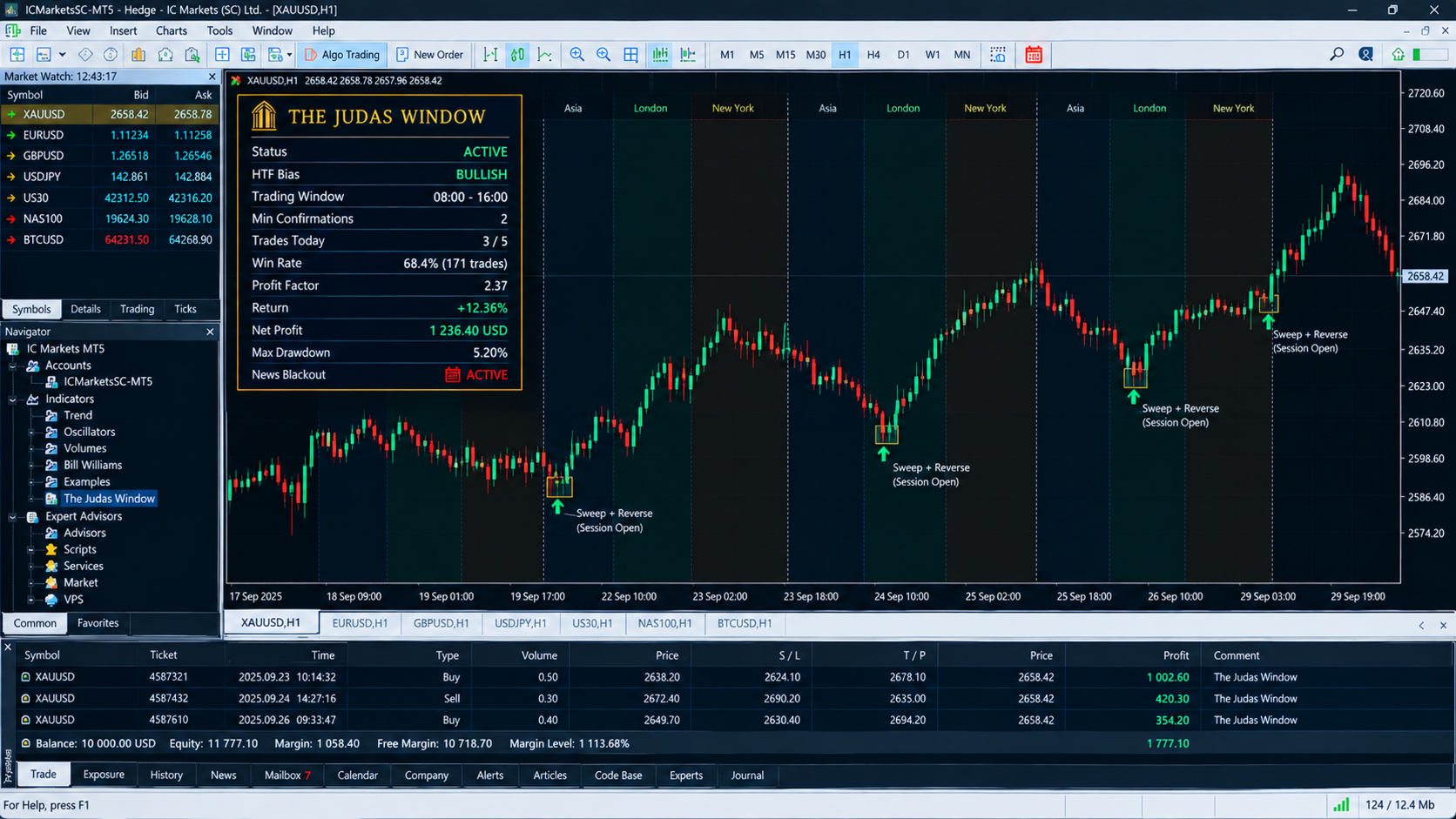
Every session opens with a lie. Price sweeps one direction to trap the crowd, then reverses and delivers in the true direction — a deliberate manipulation institutional order flow uses to fill positions at the best possible price before running the real move. Retail traders call this the "stop hunt." Smart money calls it Tuesday. The Judas Window is built to trade exactly this moment: the false break, the judas swing, the manipulation candle that fools everyone watching a chart without a framework for it.
This is not a generic breakout robot with a fancy name slapped on it. The Judas Window runs a full Power of Three (Accumulation – Manipulation – Distribution) session model, the same structural logic institutional and smart-money traders use to frame a session before it happens. It waits patiently through the accumulation phase, defines a genuine session range, and only engages once price manipulates beyond that range against a higher-timeframe bias — the exact fingerprint of a liquidity sweep, not a random breakout.
But detecting the sweep is only step one. The Judas Window does not fire blind. It requires confluence before committing capital, stacking up to three independent confirmations: a Change in State of Delivery (CISD) — the market's own signature that intent has flipped — an Inverse Fair Value Gap reclaim, showing price has aggressively returned through an imbalance in the new direction, and a clean break of the session's opening price, the simplest and most reliable directional tell available. You choose how many of these must align — one for more frequent entries, three for surgical selectivity — so the EA matches your risk appetite instead of forcing one style on every account.
Risk control is built the way a funded-account trader would build it, not the way a marketing page describes it. Every position is sized by a fixed percentage of account balance against the actual stop distance, never a flat lot size. A hard daily loss cap flattens trading for the rest of the day the moment it's breached. A maximum trades-per-day limiter stops overtrading cold. High-impact news is filtered on two fronts — the EA can sit out the entire day before a major release and impose a tight time buffer around the event itself, using the platform's own economic calendar, not a third-party feed that can desync.
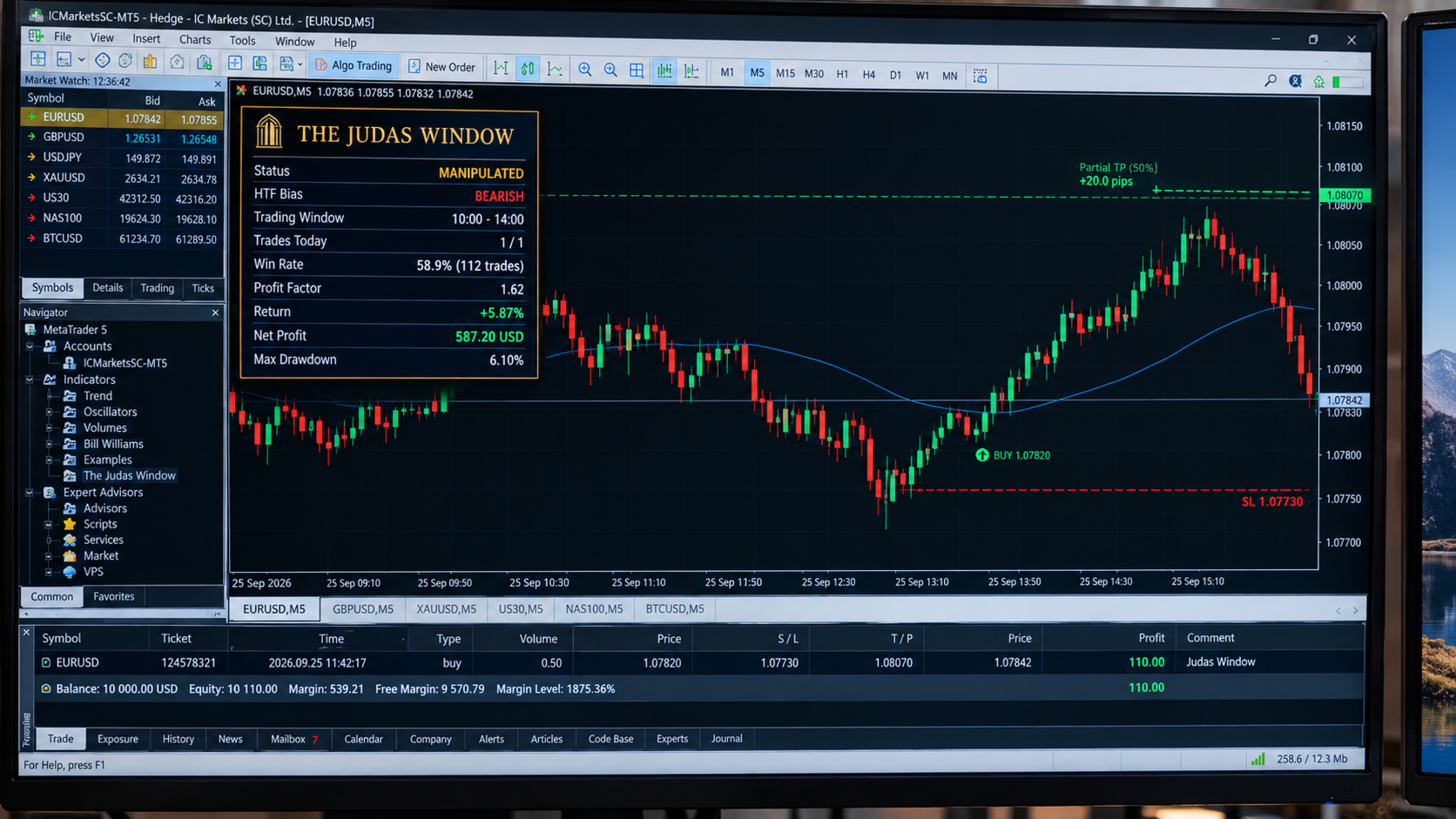
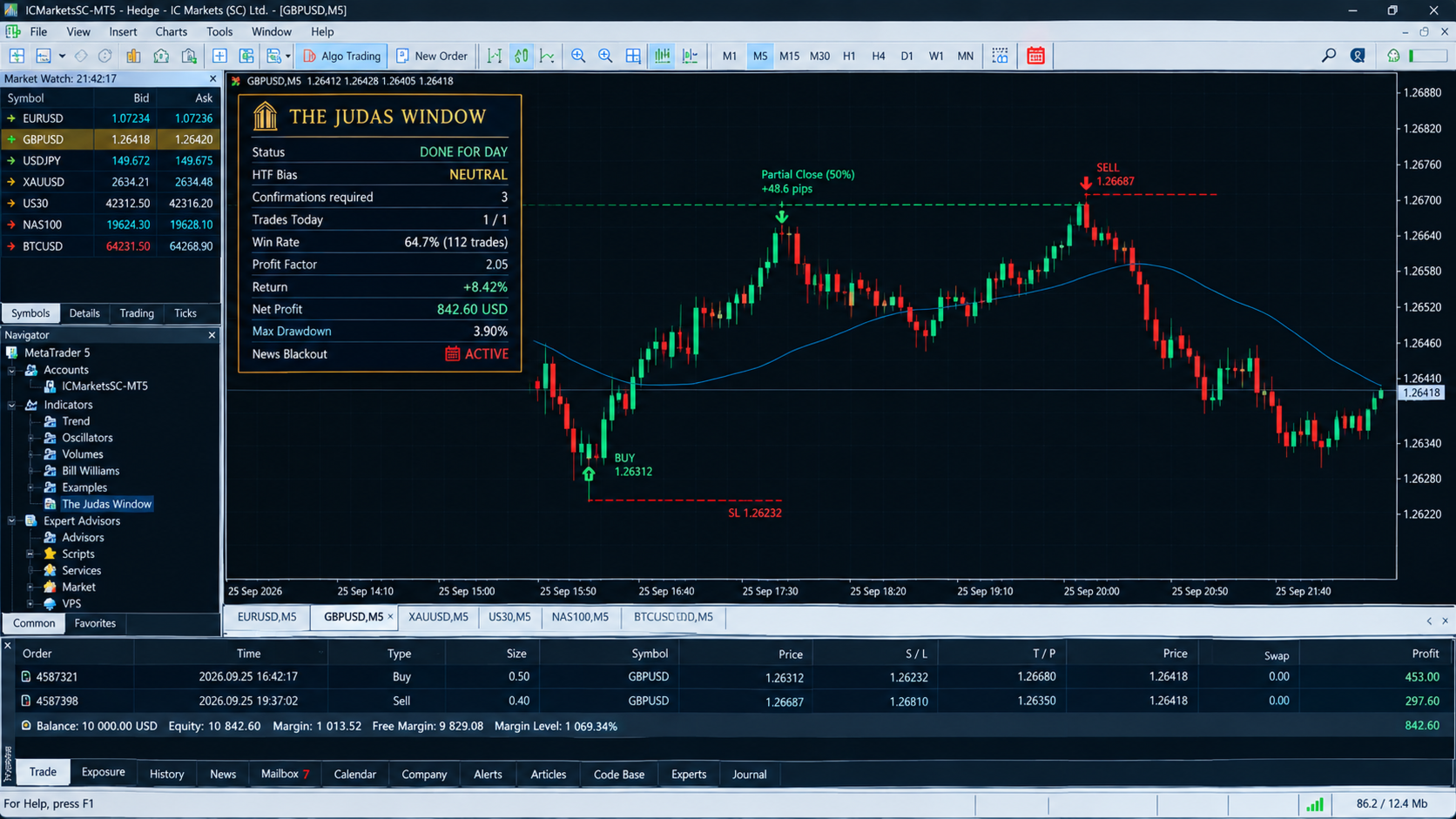
Trade management doesn't stop at entry. The Judas Window locks in the first leg of profit automatically at a configurable reward-to-risk ratio, closing the bulk of the position and leaving a runner. From there you choose your management style: a classic move-to-breakeven for a "can't lose" runner, or a live ATR-based trailing stop that lets the runner ride the real distribution move without a static stop capping the upside. Stop-loss placement itself can run on fixed points or scale dynamically with ATR, so the same logic performs consistently whether you're running it on a calm major pair or a volatile index.
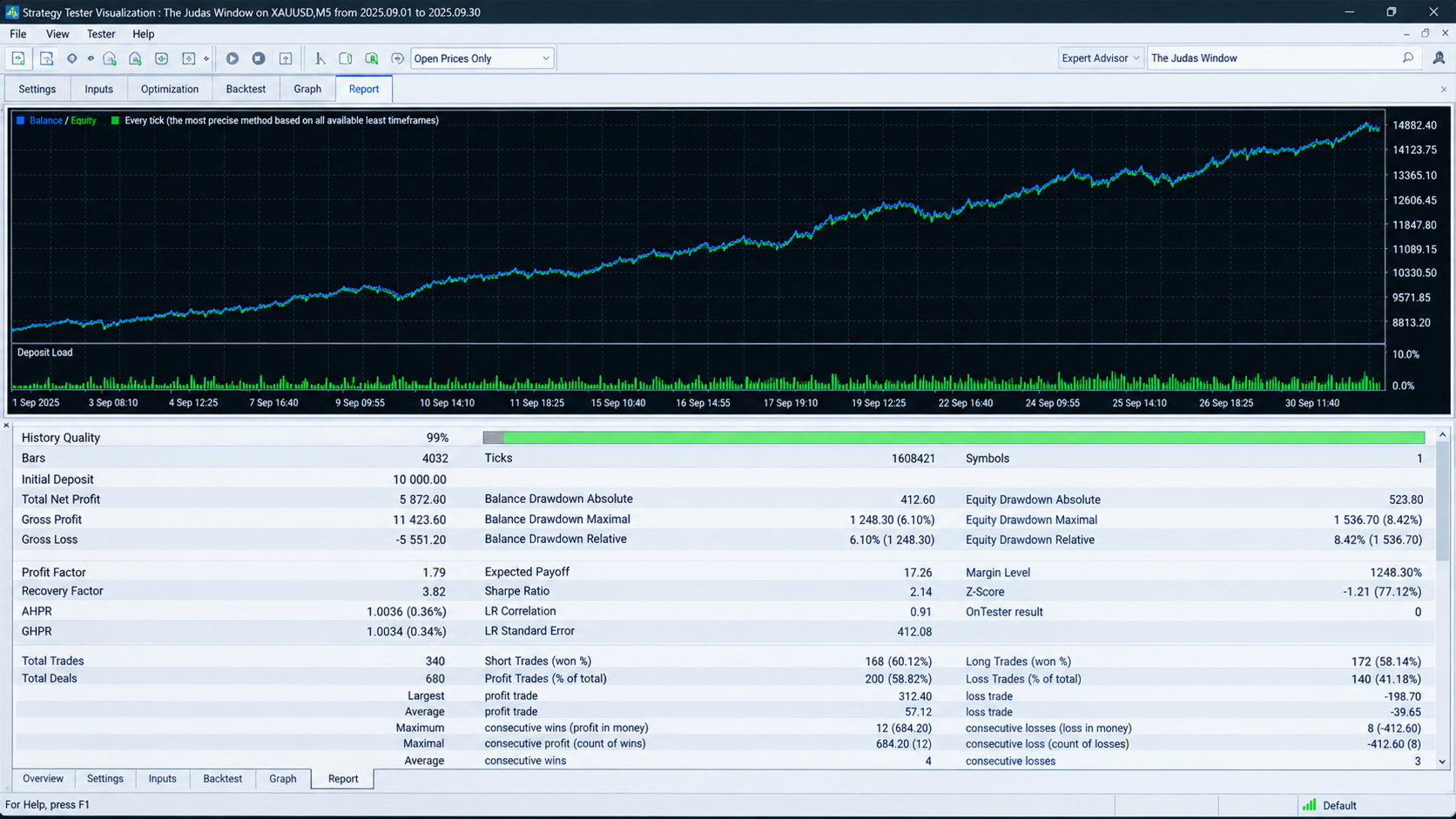
Every decision the EA makes is visible in real time on a professional on-chart dashboard — session state, higher-timeframe bias, the active trading window, confirmations required, trades taken today, live win rate, profit factor, net return, net profit in account currency, maximum drawdown, and whether a news blackout is currently active. Nothing about this EA is a black box. You watch it accumulate, watch it catch the manipulation, watch it wait for confluence, and watch it execute — all without ever needing to open the terminal log.
The Judas Window is built for traders who understand that the first move of a session is rarely the real one, and who want an automated system disciplined enough to wait for the lie before trading the truth.