PivotGrid EA
- Experts
- Versione: 1.2
- Aggiornato: 7 luglio 2026
- Attivazioni: 10

Overview
Pivot Grid EA is a fully automated Expert Advisor that builds a two-sided grid of pending limit orders based on daily Pivot levels.
The EA uses Buy Limit and Sell Limit orders exclusively and never enters the market with market orders. At the beginning of each trading day, it calculates the current daily Pivot levels and automatically creates the trading grid accordingly.
The strategy uses a predefined Martingale lot progression, where each successive grid level doubles the lot size of the previous one.
Important InformationPivot Grid EA is not a "set-and-forget" trading robot.
Important: Due to the Martingale money management system, the strategy requires either a sufficiently funded trading account or a high leverage ratio.
The EA should always be monitored during operation. It is not recommended to leave it running unattended for several hours or days.
One of the key features of the strategy is that the trader can manually terminate the current trading cycle at any time. If the current profit is considered satisfactory, the Take Profit button on the chart can be used to close all open positions and delete all pending orders. After that, the EA will not start a new trading cycle for the remainder of the trading day.
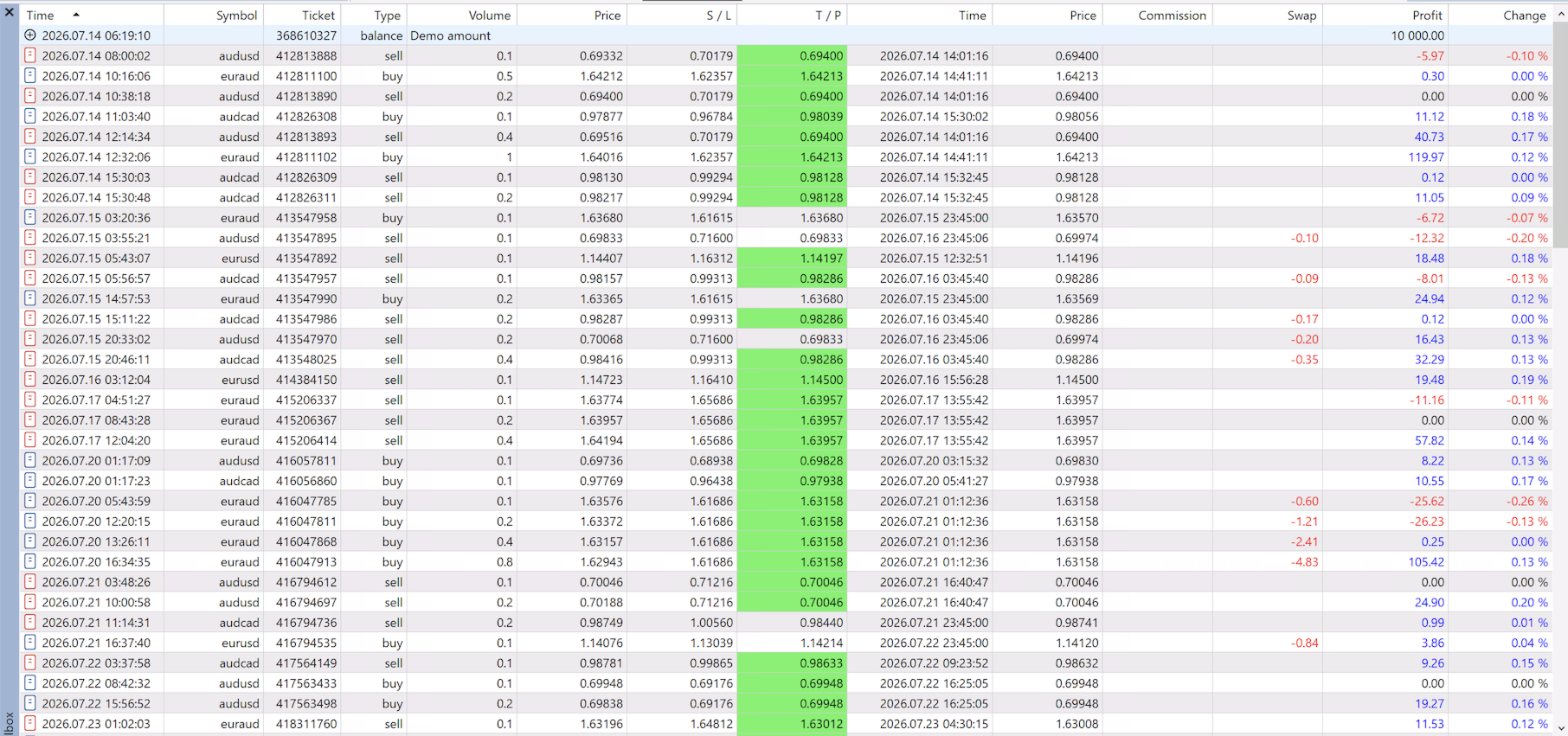
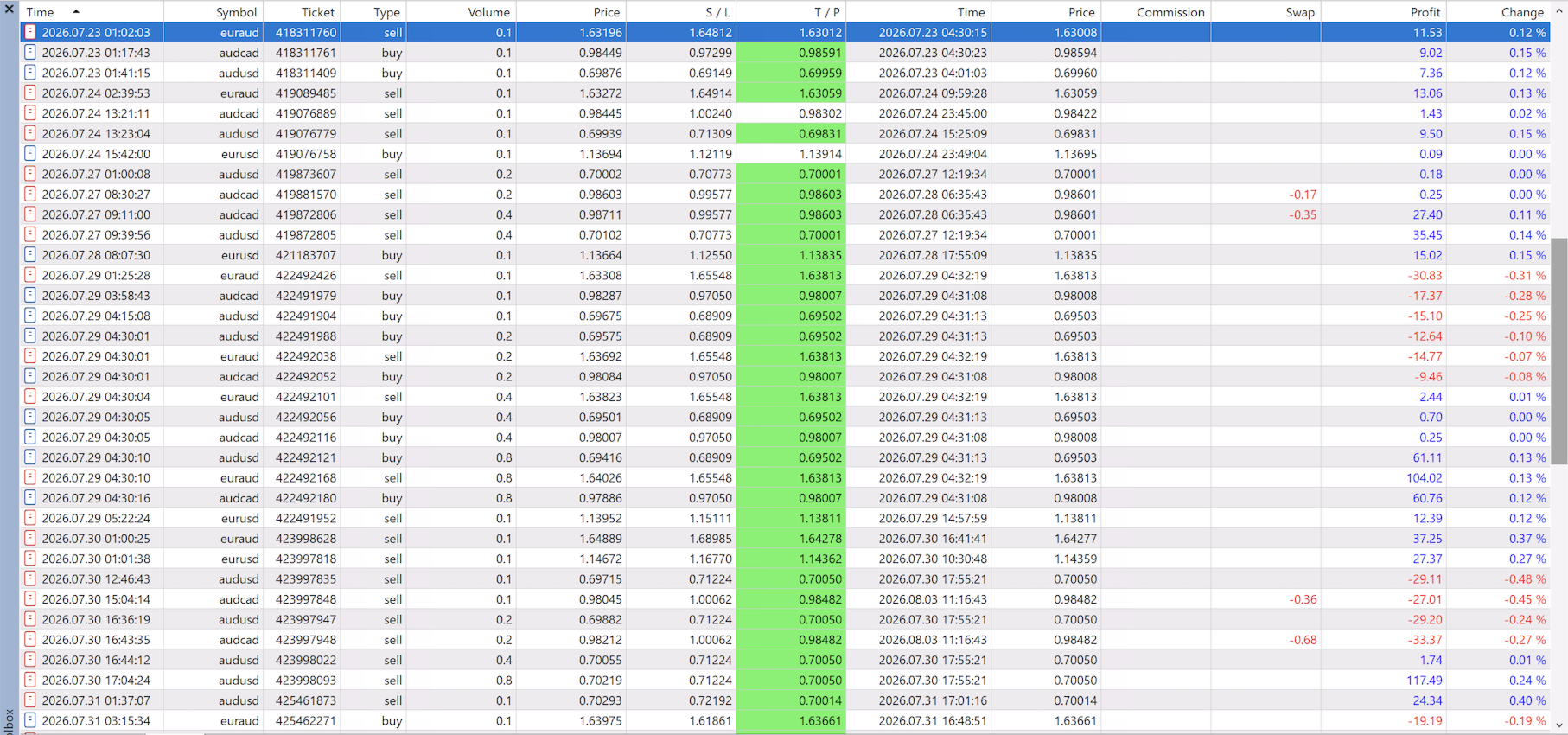
For this reason, Strategy Tester results do not fully represent the EA's real-world performance, as manual intervention is not possible during historical testing.
Recommended Market ConditionsThe strategy is primarily designed for ranging (sideways) markets, where price regularly returns toward the Pivot levels.
Extra caution is advised when trading strongly trending instruments, especially several JPY currency pairs. On such markets, large candles may break through multiple grid levels in a short period of time, significantly increasing trading risk.
Selecting the appropriate trading instrument is one of the most important factors for the strategy's long-term performance.
Instrument SelectionThe EA does not include any optimizable strategy parameters.
The most important decision each trading day is selecting the appropriate trading instrument.
For this purpose, the Pivot All In One indicator is recommended, as it allows you to quickly determine whether an instrument is suitable for Pivot-based intraday trading.
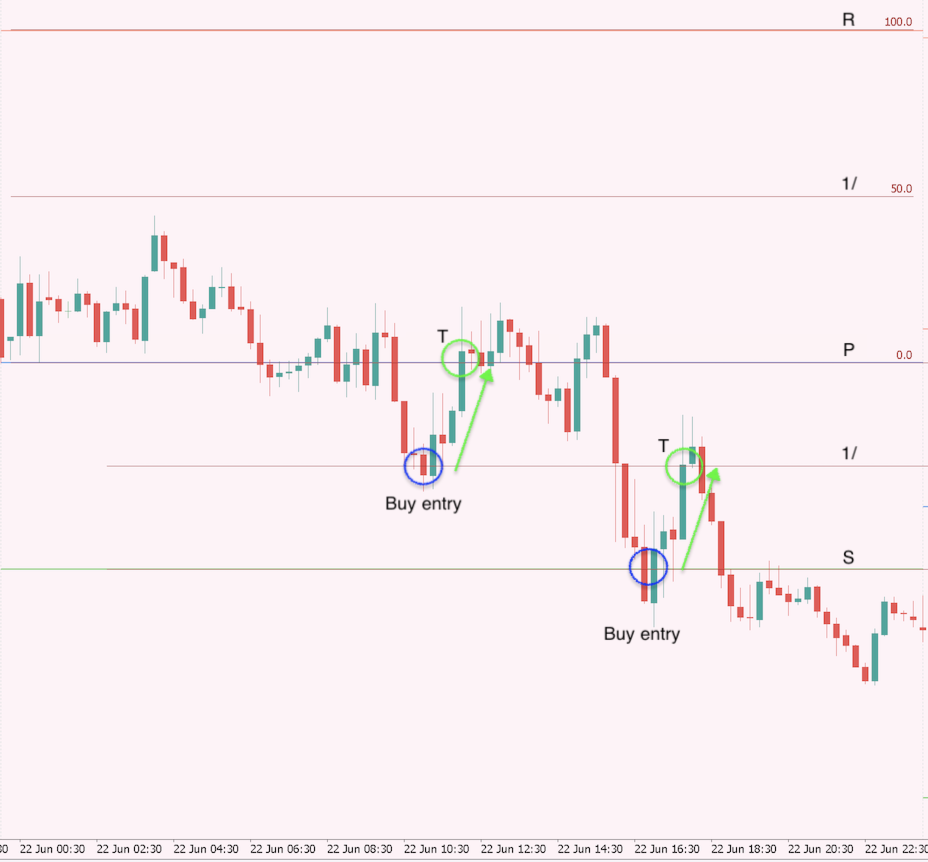
StrategyPivot Grid EA is based on an intraday pullback strategy that uses daily Pivot levels and their intermediate (half) levels as entry points.
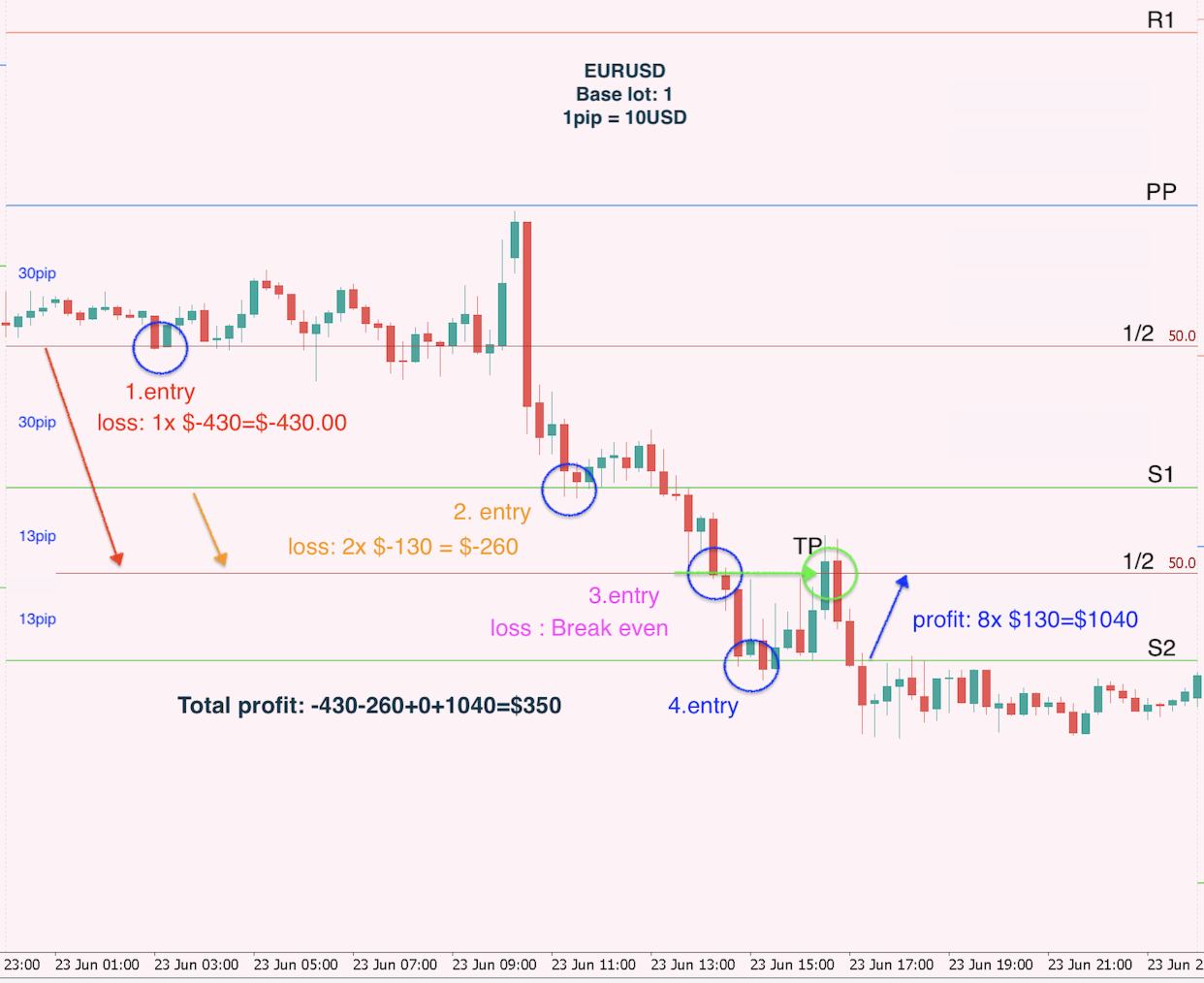
The strategy assumes that a significant price movement is often followed by a pullback toward the previous grid level. Accordingly, the EA places pending limit orders at predefined grid levels, while the Take Profit of every position is always set to the previous grid level.
If price continues moving against the position instead of reversing, the EA may open additional positions at subsequent grid levels according to the Martingale lot progression, up to the selected Max Grid Level. All positions share a common Stop Loss, which is placed at the grid level immediately beyond the last tradable level defined by the selected Max Grid Level.
Lot size calculation starts from the Base Lot value.
At each subsequent grid level, the lot size is doubled according to the Martingale progression.
Example (Base Lot = 0.01):
| Grid Level | Lot Size |
|---|---|
| 1 | 0.01 |
| 2 | 0.02 |
| 3 | 0.04 |
| 4 | 0.08 |
| 5 | 0.16 |
| 6 | 0.32 |
The EA automatically adjusts the calculated lot size to comply with the broker's minimum and maximum allowed trading volume.
Dynamic Active GridSome brokers limit the maximum number of pending orders that can exist simultaneously.
Pivot Grid EA detects this limitation automatically.
If no pending order limit is imposed by the broker, the EA places the complete Buy and Sell grids at the same time.
If a pending order limit exists, only the two nearest Buy and Sell levels are initially placed.
When the first pending order on one side is activated:
- all pending orders on the opposite side are cancelled;
- the remaining levels on the active side are placed automatically.
This allows the strategy to operate with the same trading logic even on brokers with pending order limitations.
Intraday OperationThe strategy is primarily designed for intraday trading.
Daily Pivot levels are recalculated at the beginning of every trading day, therefore positions are intended to be closed within the same trading session whenever possible.
Positions may be carried over to the following trading days if desired. However, it is important to understand that new daily Pivot levels will differ from those of the previous day.
As a result, there is no guarantee that price will return to the previous day's Pivot levels within a short period of time. Holding positions overnight or for multiple days is entirely the trader's own decision and responsibility.
SettingsMagic Number
A unique identifier used by the Expert Advisor.
When running multiple instances of the EA simultaneously, each instance should use a different Magic Number.
Base Lot
Defines the initial lot size.
All subsequent grid lot sizes are calculated from this value.
Daily Profit Limit
Defines the daily profit target.
When the combined closed profit and floating profit reach this value, the EA will:
- close all open positions;
- delete all pending orders;
- stop opening new positions for the remainder of the trading day.
Setting this value to 0 disables the feature.
Max Grid Level
Defines the last grid level where the EA is allowed to open a new position.
For example:
- R1.0 – trading is limited to R1.0 / S1.0.
- R3.0 – all six grid levels are active.
Using a lower value reduces the maximum market exposure and overall trading risk.
Trading Start Time
Defines the time when the EA is allowed to begin placing new pending orders.
Trading End Time
Defines the time after which the EA will no longer place new pending orders.
Minimum Previous Day Range %
Defines the minimum required price range of the previous trading day.
If the previous day's movement is smaller than the specified percentage, the EA will not start a new trading cycle on the current day.
This filter helps reduce risk because a small daily range results in Pivot levels being positioned much closer together, increasing the likelihood that price will reach or activate multiple grid levels within a short period of time.
Close Trades At Session End
If enabled, all open positions will be closed automatically at the end of the trading session.
Close Only Profitable At Session End
This option is available only when Close Trades At Session End is enabled.
When enabled, only profitable positions will be closed at the end of the trading session.
Stop After First Win
If enabled, after the first profitable position is closed, the EA will:
- terminate the current trading cycle;
- delete all remaining pending orders;
- stop opening new positions for the remainder of the trading day.
A new trading cycle can begin only on the next trading day.
Reset Multipliers After Trade Close
This setting determines how the EA calculates the lot multiplier after previously traded levels have been completed.
If disabled, traded grid levels remain inactive for the rest of the trading day, and the next available level keeps its originally assigned lot size. For example, if the next grid level would normally use 0.32 lots, it will continue to use that lot size.
If enabled, every newly opened position starts again from the Base Lot, regardless of which grid level becomes active next.
Information PanelThe on-chart information panel continuously displays:
- today's closed profit;
- current floating profit;
- The Take Profit button allows the trader to close all open positions and delete all pending orders at any time. After doing so, the EA will not start another trading cycle for the remainder of the trading day.
Pivot Grid EA is an automated grid trading system based on daily Pivot levels and pending limit orders.
The EA automatically adapts to broker limitations, supports dynamic pending order management, and allows the trader to manually terminate the current trading cycle whenever necessary.
The strategy's overall performance depends primarily on proper instrument selection, disciplined risk management, and continuous supervision. The EA is designed to automate trade execution—it does not replace the trader's judgment or decision-making.