Hull Moving Avg
- Indicatori
-
Tiago Azevedo Amorim Martins
 I’m an algorithmic trading developer specialized in building automated systems for MetaTrader and Python environments.
My work focuses on developing Expert Advisors, custom indicators, and trading automation tools designed to transform trading strategies into reliable and efficient code. - Versione: 1.0
- Attivazioni: 5
Hull Moving Average (HMA)
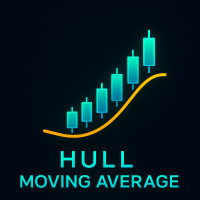
The Hull Moving Average (HMA) is a refined version of the traditional moving average, designed to minimize lag while keeping the line smooth and precise.
Developed by Alan Hull, this indicator provides a faster and more accurate trend signal than standard moving averages such as the SMA or EMA.
How It Works
The Hull Moving Average uses a Weighted Moving Average (WMA) in a special way to reduce delay and smooth price movement.
Its calculation follows three main steps:
- Calculate a WMA with period n/2 and multiply it by 2.
- Subtract a WMA with period n.
- Apply another WMA to the result, with a period equal to the square root of n.
Formula:
HMA(n) = WMA(2 × WMA(n/2) − WMA(n)), √n
This process makes the line much more responsive to recent price changes without the noise common in faster moving averages.
Advantages:
- Reduced Lag: Reacts faster than SMA or EMA, providing earlier signals.
- Smooth and Clean: Eliminates unnecessary noise and false fluctuations.
- Clear Trend Detection: Helps identify both short-term and long-term market direction.
- Versatile: Works well across different timeframes and trading styles.
Typical Usage
The HMA is often used to identify trend direction and potential entry or exit zones:
-
Bullish Trend: Price above the HMA indicates upward momentum.
-
Bearish Trend: Price below the HMA indicates downward momentum.
-
Crossovers: Price crossing the HMA can act as a signal for a possible trend change.
Example Interpretation
-
Uptrend Confirmation: When the HMA curves upward and the price closes above it — bullish strength.
-
Downtrend Confirmation: When the HMA turns downward and the price stays below — bearish continuation.
-
Reversal Detection: A change in HMA slope can warn of an early market reversal.