G Channel Indicator
- Indicatori
- Versione: 1.0
- Attivazioni: 10

Introduction
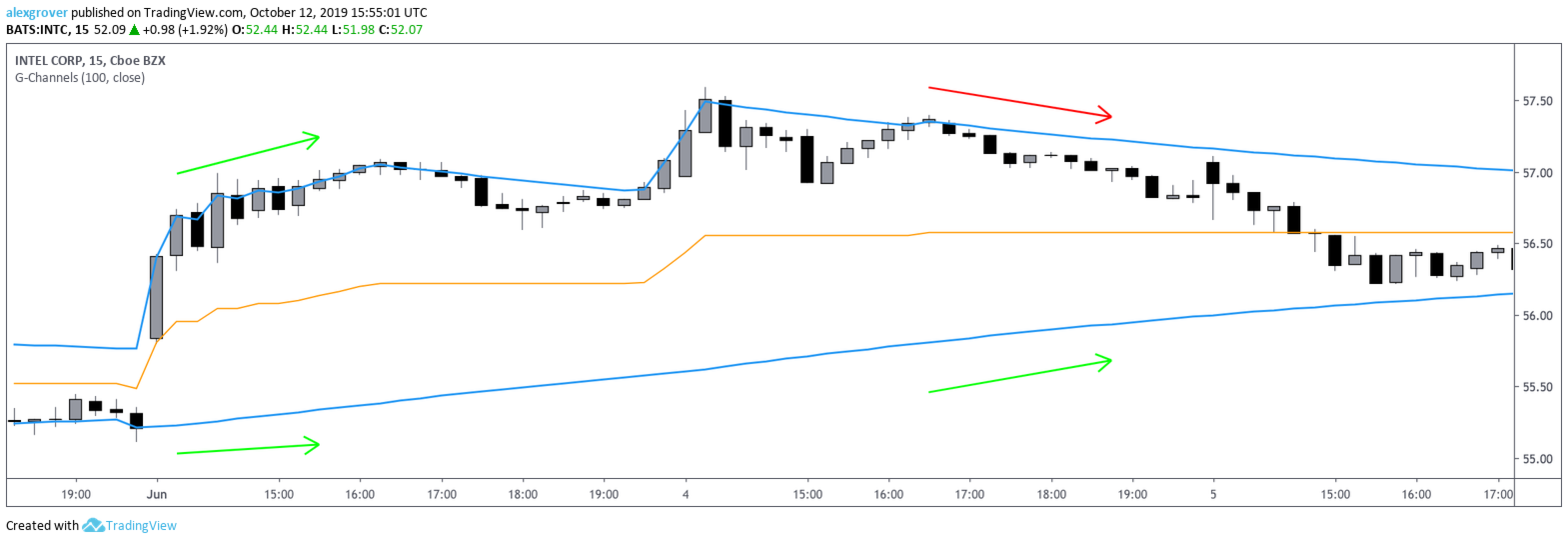
Channel indicators are widely used in technical analysis, offering valuable insights into price movements, trend identification, and volatility. Most channel-based indicators, such as Bollinger Bands and Keltner Channels, rely on a central tendency estimator (e.g., a moving average) combined with a volatility component to define upper and lower bands.
The G Channels indicator takes this concept further by leveraging a highly efficient recursive calculation. This unique approach ensures that the indicator dynamically adapts to market conditions while maintaining computational efficiency. Additionally, the midline of the channel provides a robust central tendency estimator, similar to the average of the highest and lowest prices over a given period.
How It Works – Efficient Calculation
The core efficiency of G Channels comes from its recursive structure, allowing the indicator to use past output values as input. The calculation of the upper band is as follows:
a = max ( s r c , n z ( a ( 1 ) ) ) − n z ( a ( 1 ) − b ( 1 ) ) l e n g t h a = \max(src, nz(a(1))) - \frac{nz(a(1) - b(1))}{length} a=max(src,nz(a(1)))−lengthnz(a(1)−b(1))Where:
- src: Closing price
- a: Upper band
- b: Lower band
This ensures that the upper band never decreases unless corrected by a calculated adjustment factor derived from the difference between a and b. A similar process is applied to the lower band, ensuring both boundaries adapt smoothly to price movements.
For an even more efficient approach, the calculation could be reduced to:
a = max ( s r c , n z ( a ( 1 ) ) ) − n z ( a b s ( c l o s e − a ( 1 ) ) ) l e n g t h a = \max(src, nz(a(1))) - \frac{nz(abs(close - a(1)))}{length} a=max(src,nz(a(1)))−lengthnz(abs(close−a(1)))This method, detailed in the research paper "Recursive Bands – A New Indicator for Technical Analysis", has been successfully applied in other tools like the Adaptive Trailing Stop indicator.
The Central Tendency Estimator & EMA 200 Signal
One of the key innovations in G Channels is its central tendency estimator, which is calculated as the average of the upper and lower extremities. This behaves similarly to the midline in Donchian Channels, offering a clear view of the overall market direction.
Buy & Sell Signal – EMA 200 Cross Strategy
A powerful trading signal is generated when the average band crosses the 200-period Exponential Moving Average (EMA 200):
- Buy Signal: When the average band crosses above the EMA 200, indicating a potential uptrend.
- Sell Signal: When the average band crosses below the EMA 200, signaling a possible downtrend.
This crossover strategy helps traders confirm market direction and improve trade accuracy.
Key Features
- Highly Efficient Calculation – Uses recursion for optimized performance.
- Adaptive Channel Levels – Adjusts dynamically based on price movements.
- Central Tendency Estimator – Provides a reliable midline for trend analysis.
- EMA 200 Crossover Signals – Strong buy/sell confirmations.
- Breakout & Reversal Detection – Helps identify key trading opportunities.
- Support & Resistance Levels – Acts as dynamic zones for price reactions.
How to Use G Channels in Trading
- Trend Following: Buy when price bounces off the lower band in an uptrend, sell when it rejects the upper band in a downtrend.
- Breakout Trading: Enter trades when price closes beyond the channel boundaries.
- EMA 200 Crossover Strategy:
- Buy when the average band crosses above EMA 200.
- Sell when the average band crosses below EMA 200.
- Support & Resistance: Use the bands as dynamic zones to anticipate price reactions.
Conclusion
G Channels introduces an innovative and efficient way to analyze price movements. Its recursive calculation method ensures accuracy while maintaining a lightweight footprint, making it ideal for traders who seek reliable trend confirmation, breakout signals, and adaptive support/resistance levels.
With the EMA 200 crossover strategy, traders can confidently identify buy and sell opportunities based on a widely used trend filter.
Get G Channels today and enhance your market insights!