Jason Smith / Profile
- Information
|
1 year
experience
|
22
products
|
15
demo versions
|
|
2
jobs
|
0
signals
|
0
subscribers
|
The best algorithmic developers aren't just programmers - they're traders who code.
I develop and code custom trading strategies, automation tools and custom software across multiple platforms and languages, including TradingView (Pine Script), MetaTrader 5 (MQL5), Python, C, C++, PHP, JavaScript, Java, and other modern development frameworks.
Looking for a quantitative developer role.
I can turn trading strategies into fully functional systems.
Extensive experience with Linux (Gentoo, Debian) and Unix systems (FreeBSD, OpenBSD)
I’m available for projects.You can ask for me directly on Freelancer
How Observation Changes Outcomes :
In quantum mechanics, when light (or electrons) passes through two slits, it creates an interference pattern on the screen behind them.
Each particle seems to go through both slits at once, existing in a superposition of all possible paths and the resulting pattern reflects the probabilities of where the particle could land.
If you try to measure which slit the particle goes through, the interference pattern disappears.
Observing the particle forces it into a definite state - it goes through one slit or the other.
The act of measurement collapses the wave function and fundamentally changes the outcome.
Before you check a trade, it’s in superposition.
From a statistical perspective, your trade has a probability of winning or losing based on your system but you don’t yet know the outcome.
The trade is evolving naturally, just like a quantum system.
The moment you look at it, your observation collapses the “trade wave function” into a definite state - good or bad, winning or losing.
That observation triggers an emotional reaction — stress, fear, or overconfidence—which can cause you to break your plan, over-leverage, or revenge trade.
Just like in quantum mechanics, the act of measurement affects the system.
If you hadn’t looked, the system would have continued evolving naturally and you would have followed your plan without emotional interference.
This analogy mirrors the quantum concept perfectly - observation changes the outcome, not because the market changed, but because your interaction with it changed your behavior.
In other words, checking too often destroys the natural probabilistic outcome of your system, just like measuring the slit destroys the interference pattern.
The trade itself hasn’t changed; your observation changed how you interact with it, which changes the outcome.
Final Thoughts:
Traders, you know what I’m talking about — in a demo, you can leave your strategy untouched for days, weeks, even months.
The moment it goes live, you start checking too often, micromanaging your trades, and suddenly your observation is affecting the outcome.
I develop and code custom trading strategies, automation tools and custom software across multiple platforms and languages, including TradingView (Pine Script), MetaTrader 5 (MQL5), Python, C, C++, PHP, JavaScript, Java, and other modern development frameworks.
Looking for a quantitative developer role.
I can turn trading strategies into fully functional systems.
Extensive experience with Linux (Gentoo, Debian) and Unix systems (FreeBSD, OpenBSD)
I’m available for projects.You can ask for me directly on Freelancer
How Observation Changes Outcomes :
In quantum mechanics, when light (or electrons) passes through two slits, it creates an interference pattern on the screen behind them.
Each particle seems to go through both slits at once, existing in a superposition of all possible paths and the resulting pattern reflects the probabilities of where the particle could land.
If you try to measure which slit the particle goes through, the interference pattern disappears.
Observing the particle forces it into a definite state - it goes through one slit or the other.
The act of measurement collapses the wave function and fundamentally changes the outcome.
Before you check a trade, it’s in superposition.
From a statistical perspective, your trade has a probability of winning or losing based on your system but you don’t yet know the outcome.
The trade is evolving naturally, just like a quantum system.
The moment you look at it, your observation collapses the “trade wave function” into a definite state - good or bad, winning or losing.
That observation triggers an emotional reaction — stress, fear, or overconfidence—which can cause you to break your plan, over-leverage, or revenge trade.
Just like in quantum mechanics, the act of measurement affects the system.
If you hadn’t looked, the system would have continued evolving naturally and you would have followed your plan without emotional interference.
This analogy mirrors the quantum concept perfectly - observation changes the outcome, not because the market changed, but because your interaction with it changed your behavior.
In other words, checking too often destroys the natural probabilistic outcome of your system, just like measuring the slit destroys the interference pattern.
The trade itself hasn’t changed; your observation changed how you interact with it, which changes the outcome.
Final Thoughts:
Traders, you know what I’m talking about — in a demo, you can leave your strategy untouched for days, weeks, even months.
The moment it goes live, you start checking too often, micromanaging your trades, and suddenly your observation is affecting the outcome.
Friends
131
Requests
Outgoing
Jason Smith
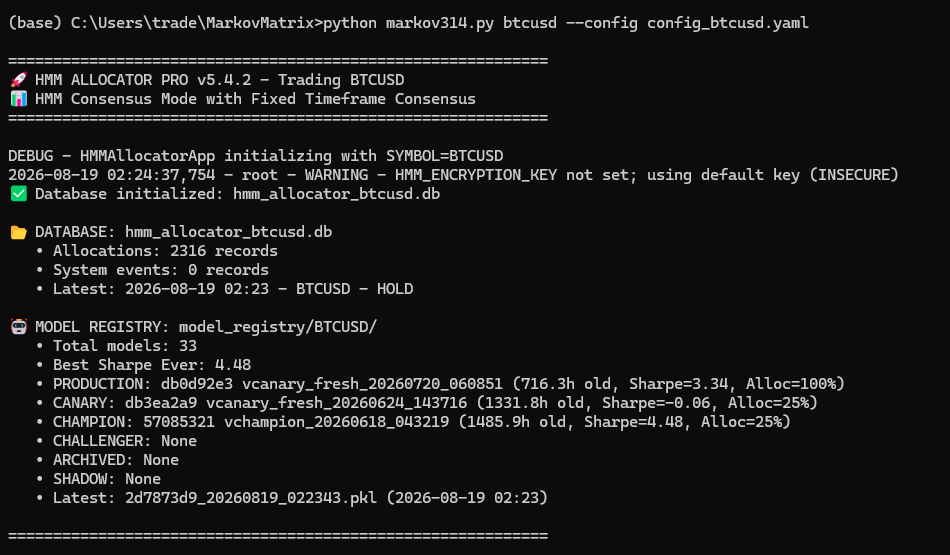
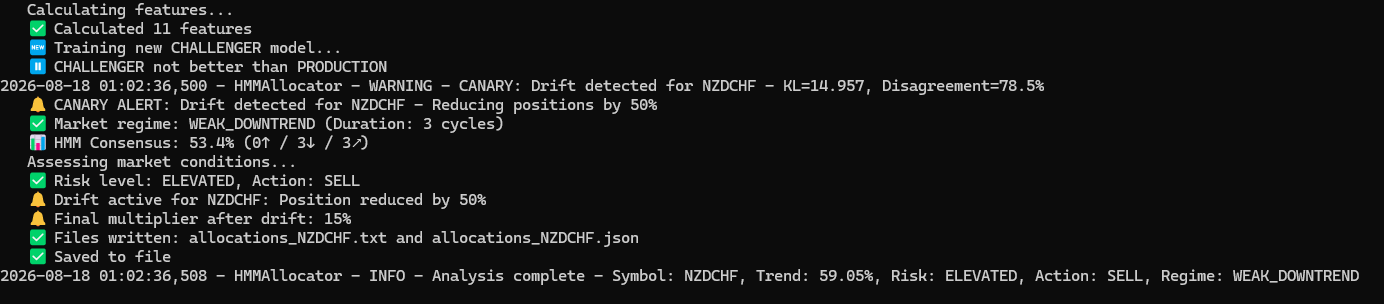
Hidden Markov Model (HMM) -
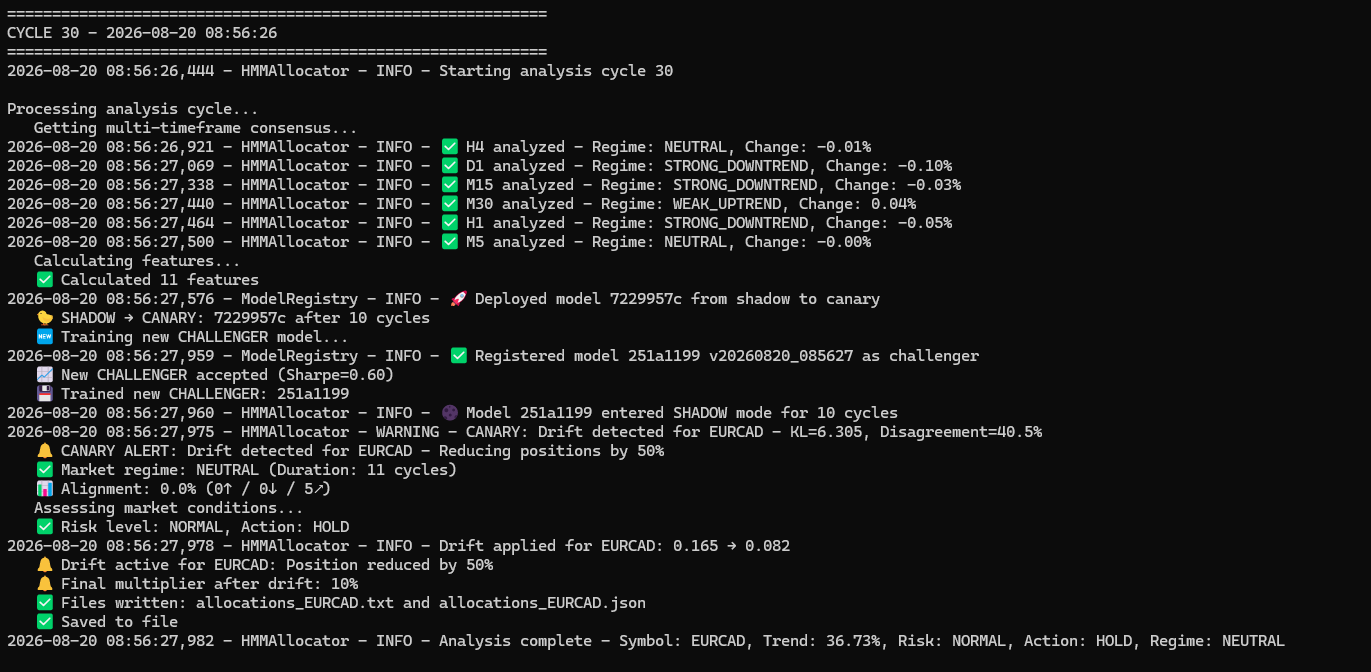
A mathematical model that detects invisible market conditions (trending, ranging, volatile) by analyzing visible data like price moves and volatility.
These are the signals that the Python bot uses to execute trades.
A mathematical model that detects invisible market conditions (trending, ranging, volatile) by analyzing visible data like price moves and volatility.
These are the signals that the Python bot uses to execute trades.
Jason Smith
What the Bot Is
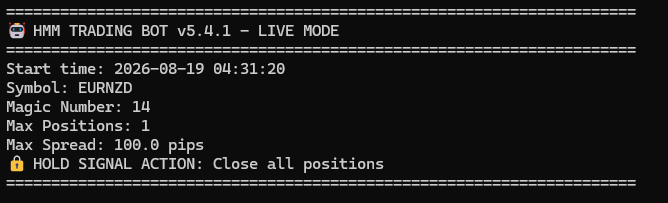
This python bot is running a multi-asset automated trading system powered by Hidden Markov Models (HMM) .
Jason Smith
Jason Smith
2026.03.27
Not sure where Im going with this blog but its going to be built around the Markov Model
Jason Smith
Using a batch file to run multiple commands makes things much easier.
The dashboard, Markov processes, and bots require launching 39 separate shells, each with its own setup, which is very tedious to do manually.
With a batch file, you can simply click once and run everything automatically.This file is for launching the bots.
I have a separate one for running the Markov processes.
The dashboard, Markov processes, and bots require launching 39 separate shells, each with its own setup, which is very tedious to do manually.
With a batch file, you can simply click once and run everything automatically.This file is for launching the bots.
I have a separate one for running the Markov processes.
Jason Smith
2026.03.27
Everything I’m working on is still in beta, so I’m continuously testing, refining, and making improvements as I go.
Jason Smith
Creating Monte Carlo Simulation in Python - Imagine you have a trading strategy.
You backtested it and it made $10,000 over a year.
What if trades happened in a different order?
What if you hit your losing streak first instead of last?
Would you still make $10,000? Would you blow up?
Monte Carlo answers that by replaying your strategy thousands of times, each time shuffling the trades randomly.
Some simulations you get lucky and make $20,000.Some you get unlucky and lose $5,000.
Some you just grind to $12,000.After running all these simulations, you see the full range of what could happen.
You learn your average outcome, your worst case, and most importantly, your risk of going broke.A strategy that looks great in backtest might fail in 30% of Monte Carlo simulations.
That tells you it's too risky. You need to size down or improve the edge.
It's simply a reality check. It strips away the "if everything goes perfectly" fantasy and shows you what will probably happen, what could go wrong, and how bad it might get.No bullshit.
Just probability telling you if your strategy is actually safe to trade.
Monte Carlo Simulation Named after the famous Monte Carlo Casino in Monaco because it relies on randomness and probability.
What It Actually Is Monte Carlo simulation is mathematical risk analysis, not gambling.
Gambling is betting without knowing the odds, while Monte Carlo is calculating the odds before you bet.
Gamblers hope for luck, but traders using Monte Carlo know exactly what bad luck looks like before it happens.
It removes hope and replaces it with probability.
You don’t wonder, “What if I hit a losing streak?” You know, “There’s a 5% chance I lose 10 trades in a row.” You don’t panic when a drawdown hits.
You expected it.
You sized your positions so you survive it.
Despite the casino name, Monte Carlo is one of the most serious, scientific tools in finance.
Professionals use it specifically to avoid gambling with their money.
You backtested it and it made $10,000 over a year.
What if trades happened in a different order?
What if you hit your losing streak first instead of last?
Would you still make $10,000? Would you blow up?
Monte Carlo answers that by replaying your strategy thousands of times, each time shuffling the trades randomly.
Some simulations you get lucky and make $20,000.Some you get unlucky and lose $5,000.
Some you just grind to $12,000.After running all these simulations, you see the full range of what could happen.
You learn your average outcome, your worst case, and most importantly, your risk of going broke.A strategy that looks great in backtest might fail in 30% of Monte Carlo simulations.
That tells you it's too risky. You need to size down or improve the edge.
It's simply a reality check. It strips away the "if everything goes perfectly" fantasy and shows you what will probably happen, what could go wrong, and how bad it might get.No bullshit.
Just probability telling you if your strategy is actually safe to trade.
Monte Carlo Simulation Named after the famous Monte Carlo Casino in Monaco because it relies on randomness and probability.
What It Actually Is Monte Carlo simulation is mathematical risk analysis, not gambling.
Gambling is betting without knowing the odds, while Monte Carlo is calculating the odds before you bet.
Gamblers hope for luck, but traders using Monte Carlo know exactly what bad luck looks like before it happens.
It removes hope and replaces it with probability.
You don’t wonder, “What if I hit a losing streak?” You know, “There’s a 5% chance I lose 10 trades in a row.” You don’t panic when a drawdown hits.
You expected it.
You sized your positions so you survive it.
Despite the casino name, Monte Carlo is one of the most serious, scientific tools in finance.
Professionals use it specifically to avoid gambling with their money.
Jason Smith
I’m available for projects.You can ask for me directly on Freelancer.
I can turn trading strategies into fully functional systems.
Jason Smith
2026.03.26
Monte Carlo Simulation Named after the famous Monte Carlo Casino in Monaco because it relies on randomness and probability. What It Actually Is Monte Carlo simulation is mathematical risk analysis, not gambling. Gambling is betting without knowing the odds, while Monte Carlo is calculating the odds before you bet. Gamblers hope for luck, but traders using Monte Carlo know exactly what bad luck looks like before it happens. It removes hope and replaces it with probability. You don’t wonder, “What if I hit a losing streak?” You know, “There’s a 5% chance I lose 10 trades in a row.” You don’t panic when a drawdown hits. You expected it. You sized your positions so you survive it. Despite the casino name, Monte Carlo is one of the most serious, scientific tools in finance. Professionals use it specifically to avoid gambling with their money.
Jason Smith
No matter what system you use in trading, the edge usually isn’t just strategy. It’s how you control the downside when you’re wrong.
A lot of trader's get stuck obsessing over the perfect strategy, indicators, or timing entries.
But the one who last tend to focus more on how much they risk per trade, how they handle losing streaks, their position sizing, and staying consistent over time.
Even a mediocre strategy can survive, and sometimes even perform well, with solid risk management.
A great strategy can fall apart quickly if risk isn’t controlled.
A simple way to think about it is that the strategy gives you potential edge, while risk management is what allows you to survive and actually compound results over time.
Survival is everything.
You can’t benefit from a good system if you’re wiped out before it has a chance to play out.
A lot of trader's get stuck obsessing over the perfect strategy, indicators, or timing entries.
But the one who last tend to focus more on how much they risk per trade, how they handle losing streaks, their position sizing, and staying consistent over time.
Even a mediocre strategy can survive, and sometimes even perform well, with solid risk management.
A great strategy can fall apart quickly if risk isn’t controlled.
A simple way to think about it is that the strategy gives you potential edge, while risk management is what allows you to survive and actually compound results over time.
Survival is everything.
You can’t benefit from a good system if you’re wiped out before it has a chance to play out.
Show all comments (7)
Jason Smith
2026.03.26
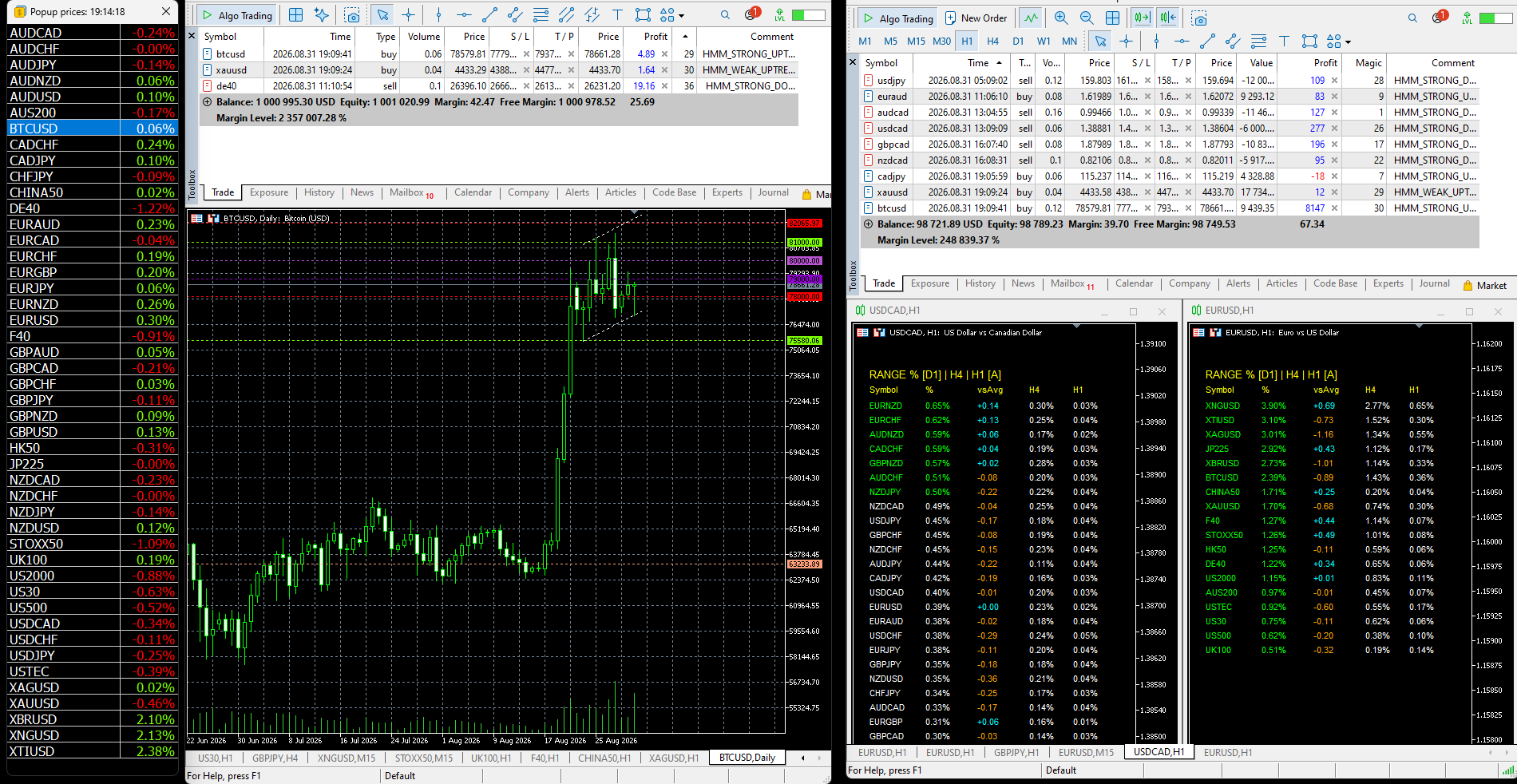
What Ive fundamentally done is add this products feature's to the HMM bot - https://www.mql5.com/en/market/product/149146?source=Site+Market+My+Products+Page
Jason Smith
2026.03.26
This approach is better because it ties both your stop loss and take profit to actual market structure instead of arbitrary values.
By placing the stop loss at the previous H4 (configurable) candle’s low - high, you’re using a level that the market has already respected. If price breaks that level, it’s a reasonable signal that your trade direction is wrong, so you’re getting out based on logic rather than guesswork.
Jason Smith
2026.03.26
The bot now has a feature to trail your stop loss to each new H4 candle's high/low as they form, locking in profits while giving the trade room to breathe!
Jason Smith
MarkovMatrix>python BOT.py --symbol EURUSD --fixed-lots 0.1 --journal eurobot.db --magic 3 --auto-reconnect --mt5-path "C:\Program Files\MetaTrader 7 IC Markets Global\terminal64.exe" --max-positions 2
Jason Smith
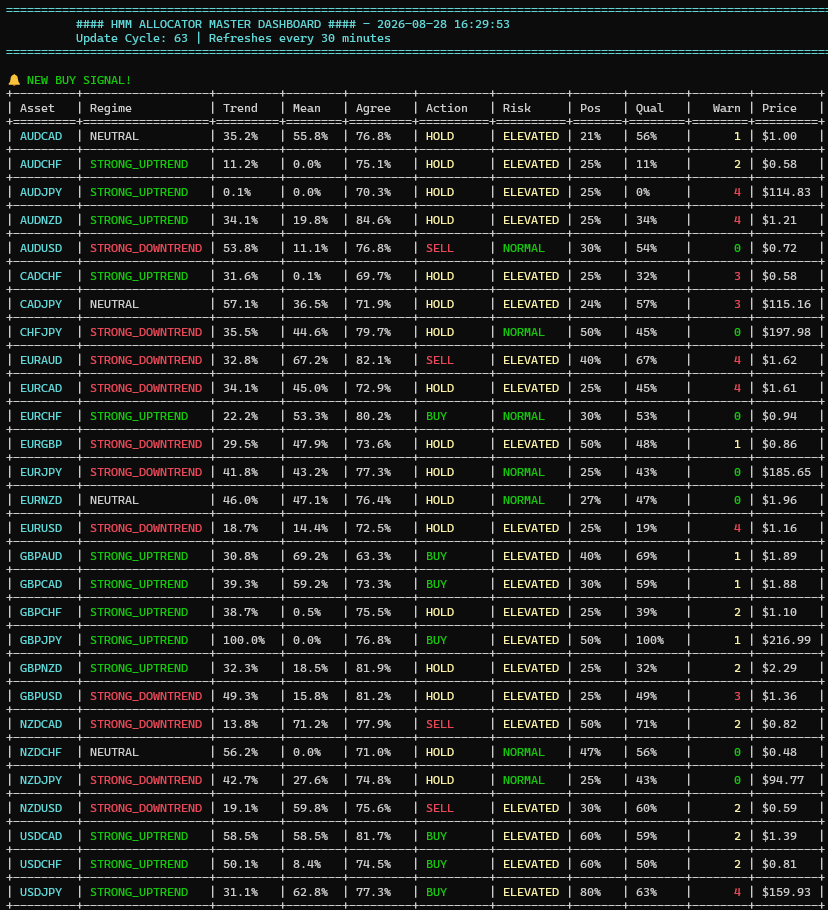
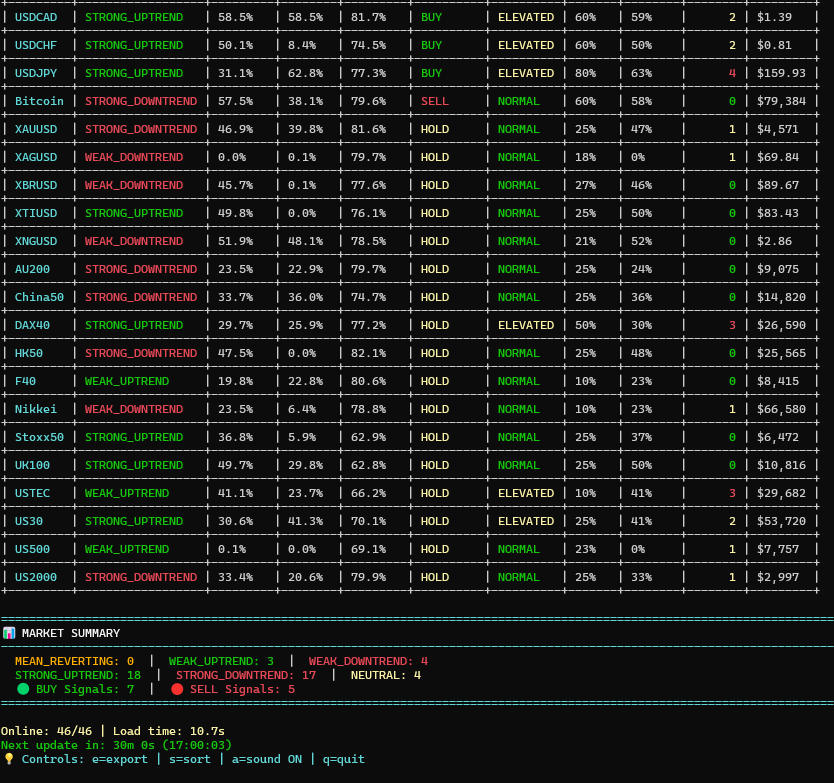
The dashboard gets its data from the Markov API running on locally
Each Markov instance serves JSON at http://localhost:PORT/api/data.
The dashboard fetches from these endpoints every 30 (was 5) minutes and displays the results in a table.
Each Markov instance serves JSON at http://localhost:PORT/api/data.
The dashboard fetches from these endpoints every 30 (was 5) minutes and displays the results in a table.
Jason Smith
2026.03.24
This full system will be available for sale soon.Not sure when.
If you’re interested, feel free to DM me.
Jason Smith
Jason Smith
2026.03.24
Position sizes are different because of the Markov signal size multiplier.
The Markov model assigns higher size multipliers to signals it's more confident in.Stronger signals get larger positions. Weaker signals get smaller positions.
That's exactly how it should work. The bot scales risk based on signal confidence.
The Markov model assigns higher size multipliers to signals it's more confident in.Stronger signals get larger positions. Weaker signals get smaller positions.
That's exactly how it should work. The bot scales risk based on signal confidence.
Jason Smith
2026.03.24
If you run with --fixed-lots 0.1 (1 mini lot = 0.1), the Markov size multiplier scales it:
Symbol Pos % Fixed Lots Calculated Lots Rounded Lots
USDJPY 80% 0.1 × 0.80 = 0.080 0.08
BTCUSD 77% 0.1 × 0.77 = 0.077 0.08
XAUUSD 76% 0.1 × 0.76 = 0.076 0.08
EURUSD 69% 0.1 × 0.69 = 0.069 0.07
AUDUSD 52% 0.1 × 0.52 = 0.052 0.05
Symbol Pos % Fixed Lots Calculated Lots Rounded Lots
USDJPY 80% 0.1 × 0.80 = 0.080 0.08
BTCUSD 77% 0.1 × 0.77 = 0.077 0.08
XAUUSD 76% 0.1 × 0.76 = 0.076 0.08
EURUSD 69% 0.1 × 0.69 = 0.069 0.07
AUDUSD 52% 0.1 × 0.52 = 0.052 0.05
Jason Smith
Thought of the day:
Just because something is different doesn’t mean it isn’t better.
Jason Smith
2026.03.24
It reflects Linus Torvalds (Linux Creator) philosophy on innovation and technology—especially relevant to open-source development—where unconventional approaches can often outperform traditional ones.
Jason Smith
Jason Smith
2026.03.24
The command-line help looks intimidating, but it’s actually much simpler once you break it down. Think of it like a menu of options for running a trading bot. You don’t have to use all of them—just the ones you need.
Jason Smith
2026.03.24
ONE SIGNAL, TWO CHOICES
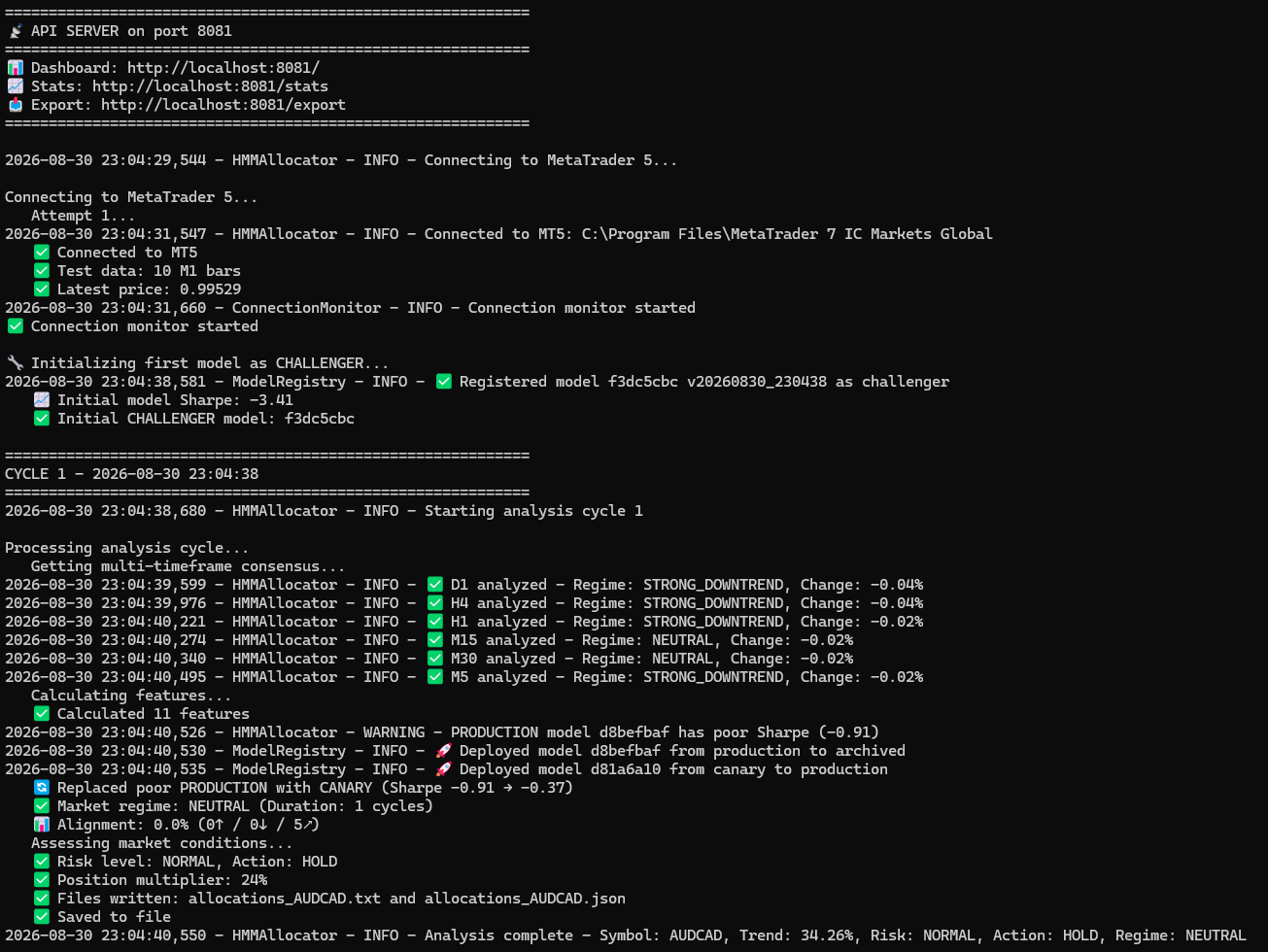
The HMM Python script generates the signals. Those signals are saved to a text file.
You have two different bots that can read that file:
Python Bot – Runs outside MT5. Connects through MT5 API. Places trades. Manages risk. Logs to SQLite.
MT5 EA – Runs inside MT5. Places trades. Does the same job.
Both bots read the same signal file. Both execute the same logic. The results are identical.
You can use either. The HMM doesn't care. The signals are the same. The trades are the same. Pick the bot that fits your workflow.
The HMM Python script generates the signals. Those signals are saved to a text file.
You have two different bots that can read that file:
Python Bot – Runs outside MT5. Connects through MT5 API. Places trades. Manages risk. Logs to SQLite.
MT5 EA – Runs inside MT5. Places trades. Does the same job.
Both bots read the same signal file. Both execute the same logic. The results are identical.
You can use either. The HMM doesn't care. The signals are the same. The trades are the same. Pick the bot that fits your workflow.
Jason Smith
Gold is bleeding billions and Pro15 is right in the middle, turning the sell-off into massive gains.
Jason Smith
2026.03.23
If you can’t afford to buy it right away, you can always rent it for a month to get started, then purchase it later without any time limitations.
DM me for this or any anything else
Jason Smith
Jason Smith
2026.03.23
Rich investors are getting hit hard by this move. A drop from a recent high $5,600 to $4,100 means huge positions lose billions very quickly, especially for funds and large holders who were heavily exposed to gold.
Even if they’re not forced to sell, their portfolios take massive mark-to-market hits, and anyone using leverage can get wiped out fast. So while some money rotates elsewhere, a lot of wealthy players are taking serious losses on paper—and in many cases, real ones too.
Jason Smith
Pro15 last 100 days.
Completely on autopilot with zero intervention.
The bot manages everything, including holding positions overnight and over weekends whenever the strategy requires
Completely on autopilot with zero intervention.
The bot manages everything, including holding positions overnight and over weekends whenever the strategy requires
Jason Smith
2026.03.21
If you had closed all open trades, you would be over $13k in profit in roughly 100 days — all with just 1 micro lot per trade and a maximum of 8 open positions at any given time.
Jason Smith
2026.03.21
Traders, everything I’m showing you is real.
If you think otherwise, let’s debate it.
Jason Smith
Pro15 Magic 66 – Trend Mode (2 modes available)
Performance from Sunday night through Friday night this week:
At the start of the week, some trend-based strategies took a heavy hit.
Price was repeatedly tapping daily highs and lows and then reversing, which is a difficult environment for breakout systems that rely on those levels.
At first glance, the strike rate doesn’t look great.
However, when you consider the overall net for the week along with the floating profit from Friday, the performance is actually very strong.
The bot took a significant drawdown early in the week but recovered and finished over +1k, which is genuinely impressive.
This is likely one of the tougher market conditions the system can face, yet it still delivered solid results.
The key takeaway is discipline — if you stayed consistent and didn’t interfere, the end-of-week outcome speaks for itself.
Performance from Sunday night through Friday night this week:
At the start of the week, some trend-based strategies took a heavy hit.
Price was repeatedly tapping daily highs and lows and then reversing, which is a difficult environment for breakout systems that rely on those levels.
At first glance, the strike rate doesn’t look great.
However, when you consider the overall net for the week along with the floating profit from Friday, the performance is actually very strong.
The bot took a significant drawdown early in the week but recovered and finished over +1k, which is genuinely impressive.
This is likely one of the tougher market conditions the system can face, yet it still delivered solid results.
The key takeaway is discipline — if you stayed consistent and didn’t interfere, the end-of-week outcome speaks for itself.
Jason Smith
2026.03.21
That’s one of the toughest weeks I’ve seen, yet it’s still $1k up — absolutely amazing.
Jason Smith
Thought Of The Day -
Stay disciplined, stay patient.
The less you interfere, the better your results.
Stay disciplined, stay patient.
The less you interfere, the better your results.
: