Jason Smith / Profil
- Bilgiler
|
1 yıl
deneyim
|
22
ürünler
|
15
demo sürümleri
|
|
2
işler
|
0
sinyaller
|
0
aboneler
|
Innovating the Future of Trading with Precision and Strategy
Welcome to my MQL5 profile! I’m TraderSmith, a passionate and results-driven trader committed to developing Expert Advisors (EAs) that transform complex market data into simple, actionable trading decisions.
Through developing trading bots, I aim to eliminate the emotional biases that often lead to impulsive decisions.
Every strategy I design is rooted in robust market analysis, precise risk management, and an understanding of market dynamics, ensuring that each trade has a solid foundation.
I focus on creating tools that are adaptable to a wide range of trading styles and risk profiles.
From high-frequency scalping to trend-following strategies, my EAs are built to execute trades with speed, accuracy, and discipline—freeing you from emotional reactions and enabling you to trade with confidence.
Every Expert Advisor I develop is designed with a clear trading philosophy.
I avoid random, “black-box” approaches and instead focus on precise, rule-based systems that are backtested, validated, and optimized to adapt to current market conditions.
Whether you’re executing strategies with pending orders, focusing on ATR-based risk management, or leveraging complex thresholds, my EAs are built to excel in dynamic market environments.
Comprehensive Support and Education
Trading is a journey, and I’m here to support you along the way.
Not only do I provide customer support to help you with any setup or technical questions, but I also offer educational resources and guidance on how to fully leverage the bots in various market conditions.
My goal is to ensure you not only use the tools effectively but also understand the underlying strategies that drive them.
My Commitment to You
As an active trader, I am constantly analyzing market trends and refining my tools to keep up with the latest advancements in algorithmic trading.
My mission is to give you the edge you need—whether you’re managing a prop account, building a portfolio, or just getting started.
I’m committed to creating robust, high-performance solutions that allow you to trade smarter, not harder.
I believe in building long-term relationships with my clients, so your feedback and success are always important to me.
If you have any questions, need advice, or simply want to discuss strategies, don’t hesitate to reach out. I’m here to ensure your trading journey is as successful as possible.
Thank you for considering my tools for your trading endeavors. I look forward to helping you achieve your trading goals!
Through algorithmic trading, you will develop discipline and patience—core traits for consistent performance. These bots will enforce rule-based execution, removing emotional bias and promoting data-driven decision-making. Over time, you'll learn that edge comes from systematic testing, risk management, and long-term consistency. Each trade, whether a win or a loss, becomes part of a feedback loop that sharpens both your strategy and your mindset. Once you’ve set up the bot, let it work.
Avoid the urge to micromanage every trade. Trust in the strategy and parameters you’ve defined.
Welcome to my MQL5 profile! I’m TraderSmith, a passionate and results-driven trader committed to developing Expert Advisors (EAs) that transform complex market data into simple, actionable trading decisions.
Through developing trading bots, I aim to eliminate the emotional biases that often lead to impulsive decisions.
Every strategy I design is rooted in robust market analysis, precise risk management, and an understanding of market dynamics, ensuring that each trade has a solid foundation.
I focus on creating tools that are adaptable to a wide range of trading styles and risk profiles.
From high-frequency scalping to trend-following strategies, my EAs are built to execute trades with speed, accuracy, and discipline—freeing you from emotional reactions and enabling you to trade with confidence.
Every Expert Advisor I develop is designed with a clear trading philosophy.
I avoid random, “black-box” approaches and instead focus on precise, rule-based systems that are backtested, validated, and optimized to adapt to current market conditions.
Whether you’re executing strategies with pending orders, focusing on ATR-based risk management, or leveraging complex thresholds, my EAs are built to excel in dynamic market environments.
Comprehensive Support and Education
Trading is a journey, and I’m here to support you along the way.
Not only do I provide customer support to help you with any setup or technical questions, but I also offer educational resources and guidance on how to fully leverage the bots in various market conditions.
My goal is to ensure you not only use the tools effectively but also understand the underlying strategies that drive them.
My Commitment to You
As an active trader, I am constantly analyzing market trends and refining my tools to keep up with the latest advancements in algorithmic trading.
My mission is to give you the edge you need—whether you’re managing a prop account, building a portfolio, or just getting started.
I’m committed to creating robust, high-performance solutions that allow you to trade smarter, not harder.
I believe in building long-term relationships with my clients, so your feedback and success are always important to me.
If you have any questions, need advice, or simply want to discuss strategies, don’t hesitate to reach out. I’m here to ensure your trading journey is as successful as possible.
Thank you for considering my tools for your trading endeavors. I look forward to helping you achieve your trading goals!
Through algorithmic trading, you will develop discipline and patience—core traits for consistent performance. These bots will enforce rule-based execution, removing emotional bias and promoting data-driven decision-making. Over time, you'll learn that edge comes from systematic testing, risk management, and long-term consistency. Each trade, whether a win or a loss, becomes part of a feedback loop that sharpens both your strategy and your mindset. Once you’ve set up the bot, let it work.
Avoid the urge to micromanage every trade. Trust in the strategy and parameters you’ve defined.
Arkadaşlar
136
İstekler
Giden
Jason Smith
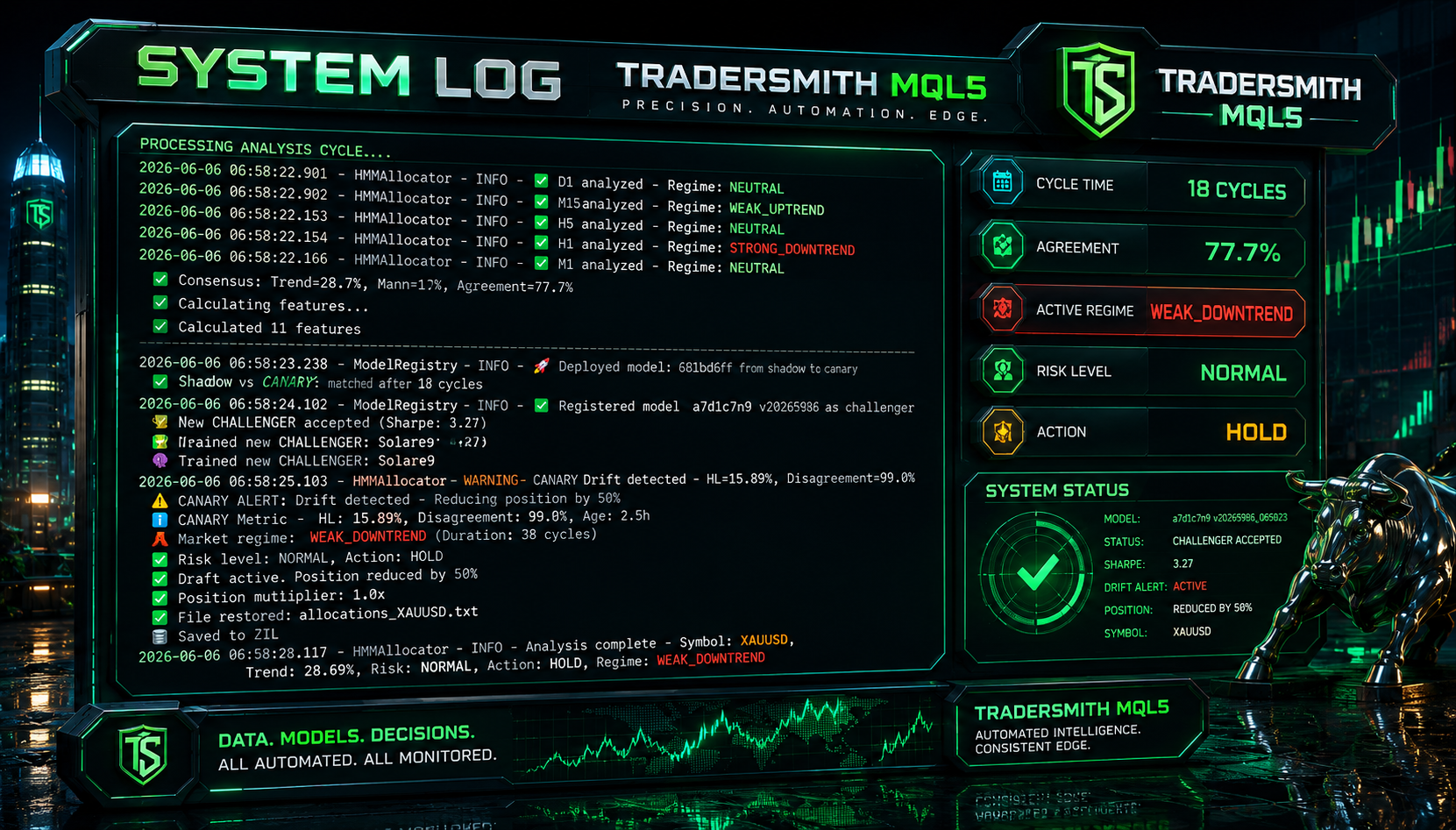
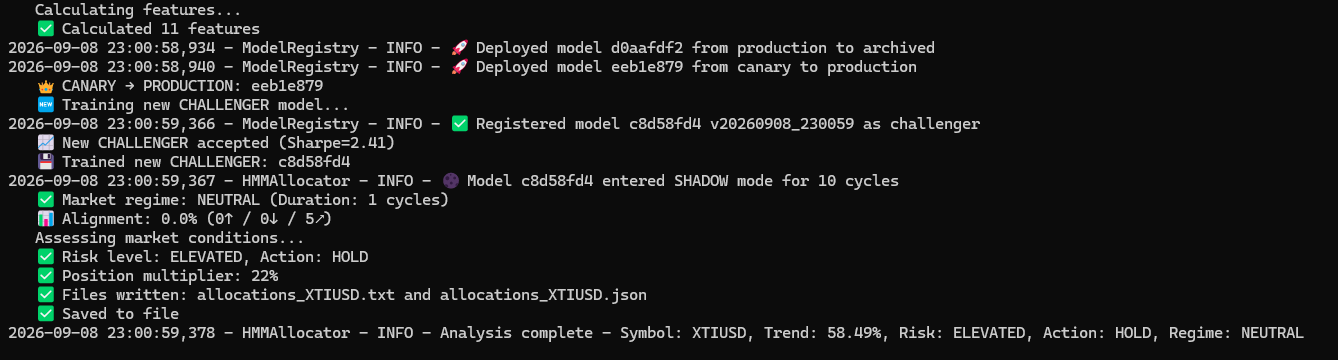
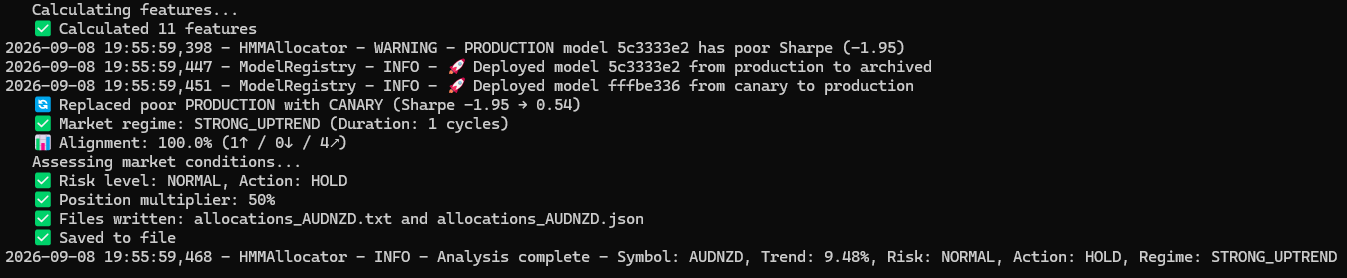
“Canary Drift” meaning
Drift refers to the degradation of a model’s performance over time as market conditions change.
A strategy that once worked well can begin to fail as the underlying data patterns shift in ways the model was not trained on.
The canary model is designed to detect this drift early, before the production system begins to lose money.
It acts as a real-time monitoring layer, running alongside live trading models to identify early signs of instability.
The idea is similar to the “canary in a coal mine.” Miners once used canaries underground as an early warning system for toxic gas.
If dangerous conditions appeared, the canary would be affected first, giving miners time to evacuate before the situation became fatal.
In the same way, the canary model is exposed to the same market data as the production system but is used purely for monitoring rather than trading.
Your production model is the one placing real trades, while the canary continuously “tests the air” on the same inputs.
If the canary’s performance begins to degrade, it signals that market conditions may have shifted.
This allows you to pause trading or roll back to a more stable champion model before real losses occur.
This matters because markets are constantly evolving.
A model that performs well in one regime may fail in another without obvious warning signs in individual predictions.
Drift can take different forms, including data drift, where the input distributions change due to shifts like volatility spikes or new correlations between assets.
It can also appear as concept drift, where the relationship between inputs and outputs changes, such as when previously reliable support and resistance levels break down.
In other cases, prediction drift can occur, where the model’s outputs become systematically biased, for example repeatedly holding positions when trades should actually be taken.
In this setup, the canary is showing “monitoring drift” at the same age as your production and champion models, which indicates they were all trained from the same batch.
The canary is actively checking for any performance degradation.
The alert does not necessarily confirm failure, but it is a warning that performance divergence has begun and should be investigated.
Overall, the canary acts as an early warning system for model decay.
It does not execute trades itself but instead monitors behaviour continuously.
If it detects drift, it provides the signal to pause or roll back the production system, protecting capital before meaningful losses occur.
Drift refers to the degradation of a model’s performance over time as market conditions change.
A strategy that once worked well can begin to fail as the underlying data patterns shift in ways the model was not trained on.
The canary model is designed to detect this drift early, before the production system begins to lose money.
It acts as a real-time monitoring layer, running alongside live trading models to identify early signs of instability.
The idea is similar to the “canary in a coal mine.” Miners once used canaries underground as an early warning system for toxic gas.
If dangerous conditions appeared, the canary would be affected first, giving miners time to evacuate before the situation became fatal.
In the same way, the canary model is exposed to the same market data as the production system but is used purely for monitoring rather than trading.
Your production model is the one placing real trades, while the canary continuously “tests the air” on the same inputs.
If the canary’s performance begins to degrade, it signals that market conditions may have shifted.
This allows you to pause trading or roll back to a more stable champion model before real losses occur.
This matters because markets are constantly evolving.
A model that performs well in one regime may fail in another without obvious warning signs in individual predictions.
Drift can take different forms, including data drift, where the input distributions change due to shifts like volatility spikes or new correlations between assets.
It can also appear as concept drift, where the relationship between inputs and outputs changes, such as when previously reliable support and resistance levels break down.
In other cases, prediction drift can occur, where the model’s outputs become systematically biased, for example repeatedly holding positions when trades should actually be taken.
In this setup, the canary is showing “monitoring drift” at the same age as your production and champion models, which indicates they were all trained from the same batch.
The canary is actively checking for any performance degradation.
The alert does not necessarily confirm failure, but it is a warning that performance divergence has begun and should be investigated.
Overall, the canary acts as an early warning system for model decay.
It does not execute trades itself but instead monitors behaviour continuously.
If it detects drift, it provides the signal to pause or roll back the production system, protecting capital before meaningful losses occur.
Jason Smith
1 saat önce
This is just one feature of many that the HMM has
Jason Smith
Empiricism: Knowledge comes from experience and observation.
A Priori: Knowledge comes from reason and logic, independent of experience.
Imagine a child kept artificially alive from birth, but without any senses — no sight, no hearing, no touch, taste, or smell.
For years, this person grows, completely cut off from the world.
Then, at maturity, the five senses are suddenly given.
The question is striking - would this person have a single thought in their head?
It asks whether all knowledge comes from experience, whether the mind could hold any innate ideas independent of that experience, and how much of thought depends on the senses versus reasoning alone.
It’s a simple yet profound way to reflect on how we become who we are — shaped through experience, perception, and the constant interaction between mind and world.
An empiricist would say the child has no thoughts at first, because all knowledge comes from experience — the mind is a blank slate until the senses provide input.
An a Priori thinker like Immanuel Kant would argue that while the child gains knowledge through experience, certain structures of understanding or concepts are innate, so the mind isn’t completely empty.
We are born with an inherent capacity for logical thinking that is not derived from observation, but is realised through experience.
A Priori: Knowledge comes from reason and logic, independent of experience.
Imagine a child kept artificially alive from birth, but without any senses — no sight, no hearing, no touch, taste, or smell.
For years, this person grows, completely cut off from the world.
Then, at maturity, the five senses are suddenly given.
The question is striking - would this person have a single thought in their head?
It asks whether all knowledge comes from experience, whether the mind could hold any innate ideas independent of that experience, and how much of thought depends on the senses versus reasoning alone.
It’s a simple yet profound way to reflect on how we become who we are — shaped through experience, perception, and the constant interaction between mind and world.
An empiricist would say the child has no thoughts at first, because all knowledge comes from experience — the mind is a blank slate until the senses provide input.
An a Priori thinker like Immanuel Kant would argue that while the child gains knowledge through experience, certain structures of understanding or concepts are innate, so the mind isn’t completely empty.
We are born with an inherent capacity for logical thinking that is not derived from observation, but is realised through experience.
Jason Smith
For sale: the complete HMM (Hidden Markov Model) Allocator package, including the Markov Matrix Python bot, interactive dashboard, source files, and full copyright ownership.
Perfect for anyone looking to deploy advanced algorithmic trading tools immediately.
This complete package is available exclusively on the MQL5 Marketplace.
DM me for more info
Perfect for anyone looking to deploy advanced algorithmic trading tools immediately.
This complete package is available exclusively on the MQL5 Marketplace.
DM me for more info
Jason Smith
2 saat önce
Includes full instructions and ongoing support, along with a comprehensive PDF guide explaining how to use the system and customise it to trade a wide range of assets, including indices, oil, gold, Bitcoin, stocks, and more.
Jason Smith
Markov Matrix HMM bot start up screen (part 1).
A Hmm allocator. (Hidden Markov Model)
A dashboard.
Python bot and an mql5 one.
This complete package is available exclusively on the MQL5 Marketplace. Coming soon !
A Hmm allocator. (Hidden Markov Model)
A dashboard.
Python bot and an mql5 one.
This complete package is available exclusively on the MQL5 Marketplace. Coming soon !
Jason Smith
HMM allocator analyzes market regimes and outputs BUY/SELL/HOLD signals with quality scores and position sizing.
Jason Smith
You’ve already seen the HMM dashboard.
The Python bot that receives signals from Marko also has its own dashboard.
The dashboard is a real-time web interface that lets you monitor and control your trading bot from any browser.
It displays your account balance, equity, daily profit and loss, all open positions with current profit or loss, the most recent HMM signal received, and a live log of bot activity.
You can also pause trading, resume trading, or manually close any open position with a single click.
When you run the bot with the --dashboard flag, it starts a web server on port 5000 (or a port you specify with --dashboard-port), and you access it by opening http://localhost:5000 in your browser.
It updates automatically every two seconds, giving you full visibility and control without needing to touch the command line.
The Python bot that receives signals from Marko also has its own dashboard.
The dashboard is a real-time web interface that lets you monitor and control your trading bot from any browser.
It displays your account balance, equity, daily profit and loss, all open positions with current profit or loss, the most recent HMM signal received, and a live log of bot activity.
You can also pause trading, resume trading, or manually close any open position with a single click.
When you run the bot with the --dashboard flag, it starts a web server on port 5000 (or a port you specify with --dashboard-port), and you access it by opening http://localhost:5000 in your browser.
It updates automatically every two seconds, giving you full visibility and control without needing to touch the command line.
Jason Smith
This dashboard is the viewing center for your entire HMM trading system.
Ive been upgrading the HMM, the python bot and the dashboard.
Dashboard Summary -
This dashboard does NOT pull indicator data from MT5.
Instead, it pulls PRE-ANALYZED TRADING SIGNALS from 28 running HMM allocator instances via their JSON APIs (ports 5001-5028).
Each allocator runs its own HMM model, analyzes market regimes, and outputs decisions like "SELL" with 65% mean allocation.
The dashboard aggregates all 28 outputs into a single table, allowing you to scan the entire forex market in 6 seconds for trading opportunities instead of manually checking 28 separate python tabs.
It's a command center for your HMM system, not an indicator dashboard.
Yes, there is a separate trading bot that reads the exact same JSON files that the dashboard displays and automatically executes the trades.
While the dashboard just visualizes the signals (e.g., "SELL USDJPY with 77% position size"), the trading bot takes those signals and actually places the orders in MT5.
It reads the allocations_USDJPY.json file written by the HMM allocator, calculates the correct lot size based on your risk settings (1% of account, fixed lots, or signal-adaptive), sets stop losses and take profits using methods like candle-based or volatility-based levels, manages open positions with trailing stops and breakeven protection, logs every trade to a SQLite journal with full performance analytics, and provides its own web dashboard for monitoring and manual override.
So the master dashboard shows you what the HMM allocators are thinking, and the trading bot does the actual buying and selling based on those thoughts.
This is a production-ready, multi-asset Hidden Markov Model (HMM) market regime allocator that runs 28 parallel instances across all major forex pairs, each analyzing 5 timeframes (D1 through M5) with weighted consensus to output 7 distinct market regimes (STRONG/UPTREND, DOWNTREND, MEAN_REVERTING, etc.).
What makes this system institutionally unique is its proprietary CANARY drift detection – a shadow HMM that runs alongside the production model, using KL divergence and state disagreement metrics to detect market regime changes in real-time, automatically reducing position sizes by 50% when models disagree.
Unlike typical retail systems that react to price, this HMM anticipates regime shifts before they occur.
What is a Hidden Markov Model (HMM)?
A Hidden Markov Model (HMM) is a sophisticated statistical framework used to model systems that transition between unobserved (hidden) states, where each state generates observable data according to its own probability distribution.
In financial markets, an HMM assumes that the market exists in one of several latent regimes—such as a high-volatility trend, a low-volatility range, or a mean-reverting environment—and that price movements are the observable emissions from these hidden states.
The model continuously calculates the probability of being in each regime based on historical price data and transition probabilities between states.
Unlike traditional lagging indicators that simply react to price, an HMM infers the current market condition probabilistically, allowing it to anticipate regime shifts rather than just confirm them after they occur.
This makes HMMs particularly valuable for adaptive trading systems, as they quantify uncertainty and provide a mathematical foundation for regime-dependent strategy selection.
The model's parameters—state transition matrices, emission distributions, and initial state probabilities—are typically estimated using the Baum-Welch algorithm, while the most likely sequence of hidden states is decoded using the Viterbi algorithm.
For traders, the output is not a simple buy/sell signal but a nuanced probability distribution across market regimes, enabling more informed risk management and position sizing decisions.
Ive been upgrading the HMM, the python bot and the dashboard.
Dashboard Summary -
This dashboard does NOT pull indicator data from MT5.
Instead, it pulls PRE-ANALYZED TRADING SIGNALS from 28 running HMM allocator instances via their JSON APIs (ports 5001-5028).
Each allocator runs its own HMM model, analyzes market regimes, and outputs decisions like "SELL" with 65% mean allocation.
The dashboard aggregates all 28 outputs into a single table, allowing you to scan the entire forex market in 6 seconds for trading opportunities instead of manually checking 28 separate python tabs.
It's a command center for your HMM system, not an indicator dashboard.
Yes, there is a separate trading bot that reads the exact same JSON files that the dashboard displays and automatically executes the trades.
While the dashboard just visualizes the signals (e.g., "SELL USDJPY with 77% position size"), the trading bot takes those signals and actually places the orders in MT5.
It reads the allocations_USDJPY.json file written by the HMM allocator, calculates the correct lot size based on your risk settings (1% of account, fixed lots, or signal-adaptive), sets stop losses and take profits using methods like candle-based or volatility-based levels, manages open positions with trailing stops and breakeven protection, logs every trade to a SQLite journal with full performance analytics, and provides its own web dashboard for monitoring and manual override.
So the master dashboard shows you what the HMM allocators are thinking, and the trading bot does the actual buying and selling based on those thoughts.
This is a production-ready, multi-asset Hidden Markov Model (HMM) market regime allocator that runs 28 parallel instances across all major forex pairs, each analyzing 5 timeframes (D1 through M5) with weighted consensus to output 7 distinct market regimes (STRONG/UPTREND, DOWNTREND, MEAN_REVERTING, etc.).
What makes this system institutionally unique is its proprietary CANARY drift detection – a shadow HMM that runs alongside the production model, using KL divergence and state disagreement metrics to detect market regime changes in real-time, automatically reducing position sizes by 50% when models disagree.
Unlike typical retail systems that react to price, this HMM anticipates regime shifts before they occur.
What is a Hidden Markov Model (HMM)?
A Hidden Markov Model (HMM) is a sophisticated statistical framework used to model systems that transition between unobserved (hidden) states, where each state generates observable data according to its own probability distribution.
In financial markets, an HMM assumes that the market exists in one of several latent regimes—such as a high-volatility trend, a low-volatility range, or a mean-reverting environment—and that price movements are the observable emissions from these hidden states.
The model continuously calculates the probability of being in each regime based on historical price data and transition probabilities between states.
Unlike traditional lagging indicators that simply react to price, an HMM infers the current market condition probabilistically, allowing it to anticipate regime shifts rather than just confirm them after they occur.
This makes HMMs particularly valuable for adaptive trading systems, as they quantify uncertainty and provide a mathematical foundation for regime-dependent strategy selection.
The model's parameters—state transition matrices, emission distributions, and initial state probabilities—are typically estimated using the Baum-Welch algorithm, while the most likely sequence of hidden states is decoded using the Viterbi algorithm.
For traders, the output is not a simple buy/sell signal but a nuanced probability distribution across market regimes, enabling more informed risk management and position sizing decisions.
Jason Smith
Cuma
This system is for sale for Professional Retail Traders Serious individual traders managing accounts who want institutional-grade regime detection without building it themselves. These traders understand that regime identification is more valuable than directional prediction and are willing to pay for a system that provides real edge.
Jason Smith
Cuma
This HMM allocator system is built as a subscription-ready SaaS platform because every
component already supports remote delivery. Each instance exposes a JSON API, the master
dashboard aggregates all pairs into a single browser-viewable table, and adding
authentication (via FastAPI's built-in security) turns it into a paid service accessible
worldwide through ngrok or Cloudflare Tunnel. Subscribers pay a monthly fee ($49–$299) for live regime signals, CANARY drift alerts,
and actionable BUY/SELL recommendations with position sizing—all without installing any
software or MT5. Critically, the asset list is not limited to forex. The system is symbol-agnostic,
meaning the same 28-instance architecture can be redeployed for crypto (BTCUSD, ETHUSD,
SOLUSD), indices (SPX500, NAS100, DAX40, FTSE100), energy (WTI, BRENT, NATGAS),
commodities (XAUUSD, XAGUSD, COPPER), or stocks (AAPL, MSFT, NVDA, TSLA). Each symbol gets its own HMM instance, its own JSON API on a dedicated port, and full
CANARY drift protection. This transforms a single forex system into a multi-asset
subscription business where you sell access to "HMM Signals for Crypto," "HMM Signals for
Indices," or an "All-Asset Premium Pass"—each with its own dashboard and pricing tier,
all powered by the same proven HMM + CANARY engine.
component already supports remote delivery. Each instance exposes a JSON API, the master
dashboard aggregates all pairs into a single browser-viewable table, and adding
authentication (via FastAPI's built-in security) turns it into a paid service accessible
worldwide through ngrok or Cloudflare Tunnel. Subscribers pay a monthly fee ($49–$299) for live regime signals, CANARY drift alerts,
and actionable BUY/SELL recommendations with position sizing—all without installing any
software or MT5. Critically, the asset list is not limited to forex. The system is symbol-agnostic,
meaning the same 28-instance architecture can be redeployed for crypto (BTCUSD, ETHUSD,
SOLUSD), indices (SPX500, NAS100, DAX40, FTSE100), energy (WTI, BRENT, NATGAS),
commodities (XAUUSD, XAGUSD, COPPER), or stocks (AAPL, MSFT, NVDA, TSLA). Each symbol gets its own HMM instance, its own JSON API on a dedicated port, and full
CANARY drift protection. This transforms a single forex system into a multi-asset
subscription business where you sell access to "HMM Signals for Crypto," "HMM Signals for
Indices," or an "All-Asset Premium Pass"—each with its own dashboard and pricing tier,
all powered by the same proven HMM + CANARY engine.
Jason Smith
A Hidden Markov Model dashboard displayed in a web browser with login authentication.
All 28 Forex pairs.
ngrok is a tool that lets you expose a server running on your local machine to the internet securely and temporarily.
In simple terms, it creates a secure tunnel from a public URL to your computer.
So instead of only being able to access your app at something like localhost:3000, ngrok gives you a public web address (for example, https://abc123.ngrok.io ) that forwards traffic to your local server.
All 28 Forex pairs.
ngrok is a tool that lets you expose a server running on your local machine to the internet securely and temporarily.
In simple terms, it creates a secure tunnel from a public URL to your computer.
So instead of only being able to access your app at something like localhost:3000, ngrok gives you a public web address (for example, https://abc123.ngrok.io ) that forwards traffic to your local server.
Jason Smith
Çarşamba
I’m going to provide free access to this dashboard. DM me for login credentials and the ngrok URL.
Jason Smith
Çarşamba
This setup would allow access to a Hidden Markov Model (HMM) subscription without exposing the underlying Python code. A Python trading bot built on the Markov model is available for purchase, while the HMM data itself is provided for free and can be used as a market indicator. If you find the indicator useful, you may choose to upgrade to the full trading bot
Jason Smith
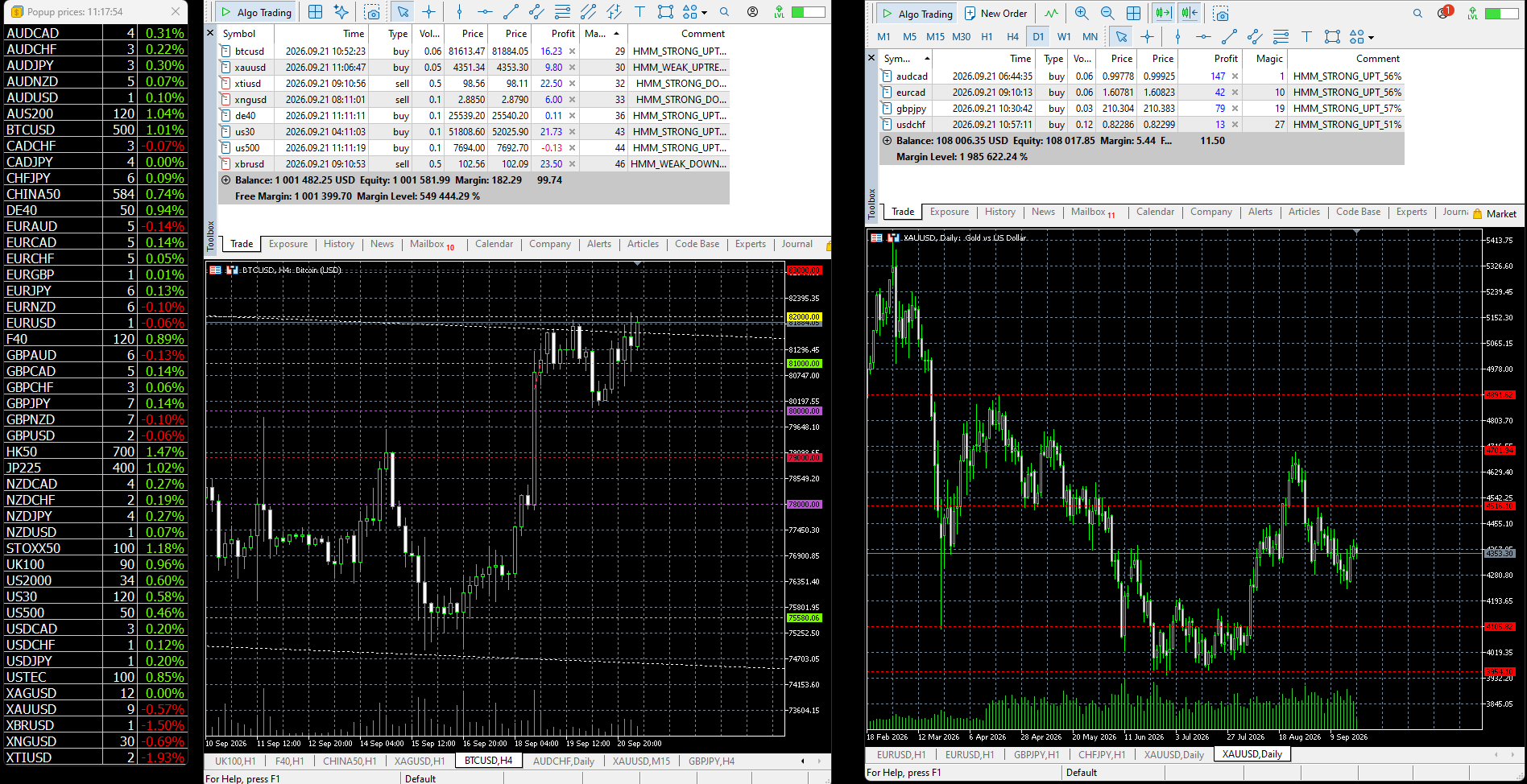
Have you ever seen a full-blown HMM in action — a Hidden Markov Model?
On the left, there are 28 bots operating off the HMM and processing the incoming image data.
On the right, there’s a Python shell running a live dashboard.The dashboard is exposed via an ngrok tunnel, so it can be accessed directly in a browser.
This dashboard your seeing is the actual python shell.
On the left, there are 28 bots operating off the HMM and processing the incoming image data.
On the right, there’s a Python shell running a live dashboard.The dashboard is exposed via an ngrok tunnel, so it can be accessed directly in a browser.
This dashboard your seeing is the actual python shell.
Jason Smith
Pro15 now includes powerful new features. New look. (update coming soon)
This EA automatically generates its own support and resistance (SR) levels, along with marking the daily open and key session start levels.
: