Jason Smith / Profile
- Information
|
1 year
experience
|
22
products
|
15
demo versions
|
|
2
jobs
|
0
signals
|
0
subscribers
|
The best algorithmic developers aren't just programmers - they're traders who code.
I develop and code custom trading strategies, automation tools and custom software across multiple platforms and languages, including TradingView (Pine Script), MetaTrader 5 (MQL5), Python and other modern development frameworks.
Looking for a quantitative developer role.
I can turn trading strategies into fully functional systems.
Extensive experience with Linux (Gentoo, Debian) and Unix systems (FreeBSD, OpenBSD)
I’m available for projects.You can ask for me directly on Freelancer
How Observation Changes Outcomes :
In quantum mechanics, when light (or electrons) passes through two slits, it creates an interference pattern on the screen behind them.
Each particle seems to go through both slits at once, existing in a superposition of all possible paths and the resulting pattern reflects the probabilities of where the particle could land.
If you try to measure which slit the particle goes through, the interference pattern disappears.
Observing the particle forces it into a definite state - it goes through one slit or the other.
The act of measurement collapses the wave function and fundamentally changes the outcome.
Before you check a trade, it’s in superposition.
From a statistical perspective, your trade has a probability of winning or losing based on your system but you don’t yet know the outcome.
The trade is evolving naturally, just like a quantum system.
The moment you look at it, your observation collapses the “trade wave function” into a definite state - good or bad, winning or losing.
That observation triggers an emotional reaction — stress, fear, or overconfidence—which can cause you to break your plan, over-leverage, or revenge trade.
Just like in quantum mechanics, the act of measurement affects the system.
If you hadn’t looked, the system would have continued evolving naturally and you would have followed your plan without emotional interference.
This analogy mirrors the quantum concept perfectly - observation changes the outcome, not because the market changed, but because your interaction with it changed your behavior.
In other words, checking too often destroys the natural probabilistic outcome of your system, just like measuring the slit destroys the interference pattern.
The trade itself hasn’t changed; your observation changed how you interact with it, which changes the outcome.
Final Thoughts:
Traders, you know what I’m talking about — in a demo, you can leave your strategy untouched for days, weeks, even months.
The moment it goes live, you start checking too often, micromanaging your trades, and suddenly your observation is affecting the outcome.
I develop and code custom trading strategies, automation tools and custom software across multiple platforms and languages, including TradingView (Pine Script), MetaTrader 5 (MQL5), Python and other modern development frameworks.
Looking for a quantitative developer role.
I can turn trading strategies into fully functional systems.
Extensive experience with Linux (Gentoo, Debian) and Unix systems (FreeBSD, OpenBSD)
I’m available for projects.You can ask for me directly on Freelancer
How Observation Changes Outcomes :
In quantum mechanics, when light (or electrons) passes through two slits, it creates an interference pattern on the screen behind them.
Each particle seems to go through both slits at once, existing in a superposition of all possible paths and the resulting pattern reflects the probabilities of where the particle could land.
If you try to measure which slit the particle goes through, the interference pattern disappears.
Observing the particle forces it into a definite state - it goes through one slit or the other.
The act of measurement collapses the wave function and fundamentally changes the outcome.
Before you check a trade, it’s in superposition.
From a statistical perspective, your trade has a probability of winning or losing based on your system but you don’t yet know the outcome.
The trade is evolving naturally, just like a quantum system.
The moment you look at it, your observation collapses the “trade wave function” into a definite state - good or bad, winning or losing.
That observation triggers an emotional reaction — stress, fear, or overconfidence—which can cause you to break your plan, over-leverage, or revenge trade.
Just like in quantum mechanics, the act of measurement affects the system.
If you hadn’t looked, the system would have continued evolving naturally and you would have followed your plan without emotional interference.
This analogy mirrors the quantum concept perfectly - observation changes the outcome, not because the market changed, but because your interaction with it changed your behavior.
In other words, checking too often destroys the natural probabilistic outcome of your system, just like measuring the slit destroys the interference pattern.
The trade itself hasn’t changed; your observation changed how you interact with it, which changes the outcome.
Final Thoughts:
Traders, you know what I’m talking about — in a demo, you can leave your strategy untouched for days, weeks, even months.
The moment it goes live, you start checking too often, micromanaging your trades, and suddenly your observation is affecting the outcome.
Friends
142
Requests
Outgoing
Jason Smith
New features added to the HMM python bot -
When the hmm has sell or a buy it can switch to hold: No trade.
These new features let's he bot close on hold. Trail ATR on hold or Zero out on hold
When the hmm has sell or a buy it can switch to hold: No trade.
These new features let's he bot close on hold. Trail ATR on hold or Zero out on hold
Jason Smith
2026.05.06
Still in beta — Goldbot23 will be named Markov when finished
Jason Smith
Thought of the day - Niccolò Machiavelli
Every one sees what you appear to be, few experience what you really are.
Jason Smith
2026.05.06
Once you’ve been found out — truly seen—you don’t get to hide behind appearances anymore.
Jason Smith
Show all comments (4)
[Deleted]
2026.05.06
[Deleted]
Jason Smith
MarkovMarix Update -
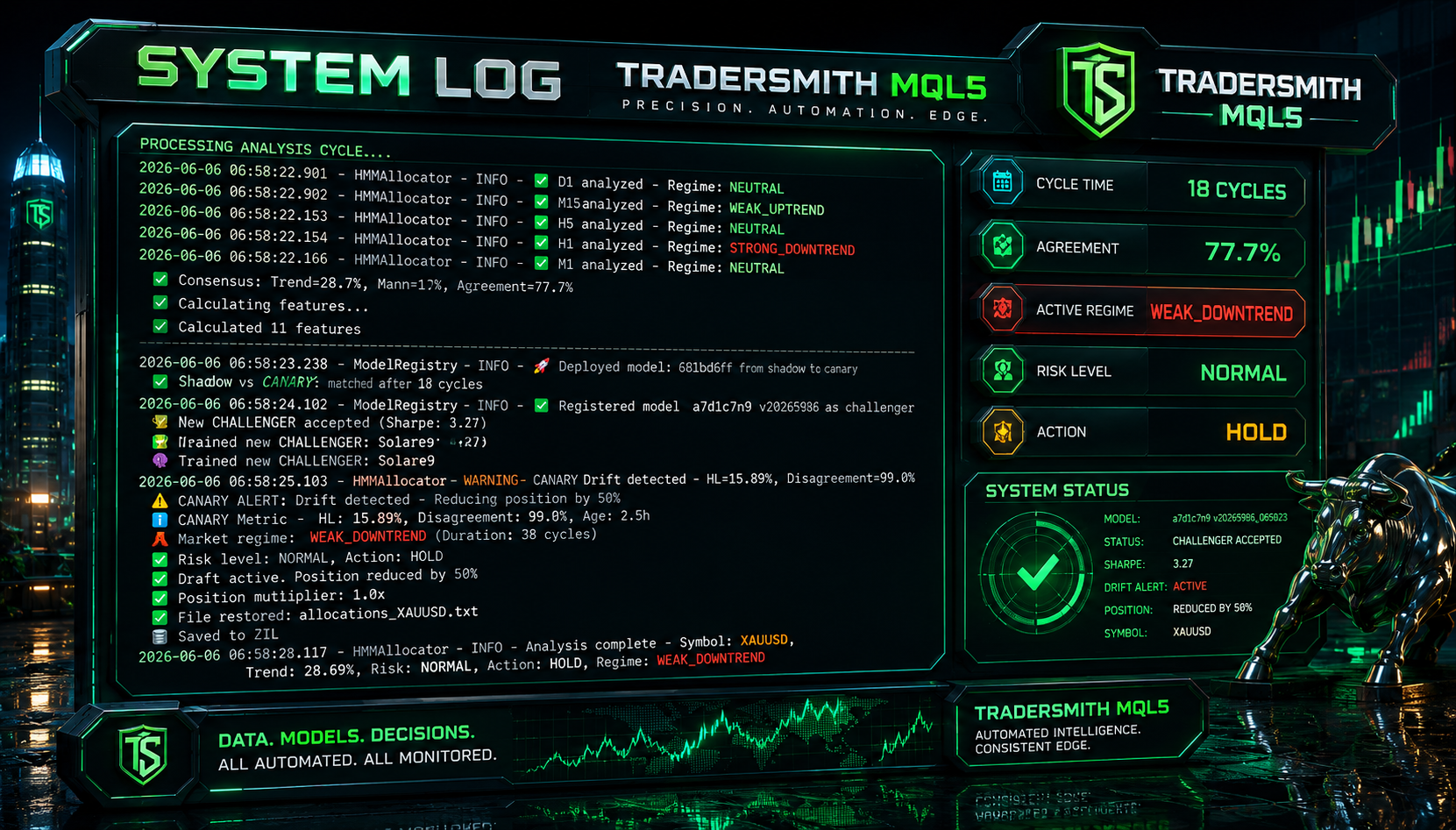
The system is in weekend consolidation mode with only Bitcoin trading. No other markets are open.
There is no fresh data to train new models. Drift is active. Positions are reduced by 50%.
All of this is correct behavior.
What is working perfectly:
The risk manager calculated a base position of roughly 98% based on volatility and market conditions.
The drift reduction cut that to 49%. The math is correct.
The quality score is 53.7%, just below the 55% trade threshold.
The system correctly held instead of forcing a trade.
Multi-timeframe agreement is 89.8%. All timeframes agree on mean reversion.
That is strong consensus.
Sharpe ratio is positive at 0.36.
Risk adjusted returns are healthy.
The production model is 72 hours old and the canary is 45 hours old.
They disagree because the market has changed since Tuesday. That is exactly what drift detection is supposed to catch.
What is acceptable:
The production model age is high. But no new markets are open to train fresh data.
The system cannot fix what has no input. That is not a flaw. That is reality.
The action is HOLD when mean reversion is 53.7% and trend is only 9.2%.
A human trader might take that trade.
This system is more disciplined.
It waits for quality to cross 55%. That discipline will save you over thousands in lost trades.
The verdict -
For a weekend consolidation with only Bitcoin active.
The system is defensive, mathematically correct, and waiting patiently for Monday.
If this were Monday with all markets open and fresh data flowing, you would expect drift to clear and positions to normalize.
But on a quiet weekend, this is exactly what you want to see.
Monday will tell the real story.
The system is in weekend consolidation mode with only Bitcoin trading. No other markets are open.
There is no fresh data to train new models. Drift is active. Positions are reduced by 50%.
All of this is correct behavior.
What is working perfectly:
The risk manager calculated a base position of roughly 98% based on volatility and market conditions.
The drift reduction cut that to 49%. The math is correct.
The quality score is 53.7%, just below the 55% trade threshold.
The system correctly held instead of forcing a trade.
Multi-timeframe agreement is 89.8%. All timeframes agree on mean reversion.
That is strong consensus.
Sharpe ratio is positive at 0.36.
Risk adjusted returns are healthy.
The production model is 72 hours old and the canary is 45 hours old.
They disagree because the market has changed since Tuesday. That is exactly what drift detection is supposed to catch.
What is acceptable:
The production model age is high. But no new markets are open to train fresh data.
The system cannot fix what has no input. That is not a flaw. That is reality.
The action is HOLD when mean reversion is 53.7% and trend is only 9.2%.
A human trader might take that trade.
This system is more disciplined.
It waits for quality to cross 55%. That discipline will save you over thousands in lost trades.
The verdict -
For a weekend consolidation with only Bitcoin active.
The system is defensive, mathematically correct, and waiting patiently for Monday.
If this were Monday with all markets open and fresh data flowing, you would expect drift to clear and positions to normalize.
But on a quiet weekend, this is exactly what you want to see.
Monday will tell the real story.
Jason Smith
Work in progress - This system will be for sale for serious traders.
Been working on my HMM for the past couple of months — a lot of the features were harder to get right than expected.
No point making it look good if the models don’t actually work correctly.
Alongside that, I’ve been putting together a WordPress theme for the launch.
Prop trading firms are potential buyers.
They need automated trader evaluation and risk management.
This HMM system scores trade quality based on regime alignment.
That solves their biggest problem: distinguishing skilled traders from lucky gamblers.
They will pay $2,000 to $5,000 per month for a white-label license.
Hedge funds and quant funds are a target.
They spend millions developing alpha signals.
MarkovMatrix's regime detection and drift monitoring could complement their existing systems.
Buying the source code saves them development time.
They will pay $10,000 to $50,000 for full commercial rights.
They will pay $5,000 to $15,000 for an integration license plus ongoing royalties.
This is work in progress and this system will be for sale. Keep looking here for more info or DM me
Been working on my HMM for the past couple of months — a lot of the features were harder to get right than expected.
No point making it look good if the models don’t actually work correctly.
Alongside that, I’ve been putting together a WordPress theme for the launch.
Prop trading firms are potential buyers.
They need automated trader evaluation and risk management.
This HMM system scores trade quality based on regime alignment.
That solves their biggest problem: distinguishing skilled traders from lucky gamblers.
They will pay $2,000 to $5,000 per month for a white-label license.
Hedge funds and quant funds are a target.
They spend millions developing alpha signals.
MarkovMatrix's regime detection and drift monitoring could complement their existing systems.
Buying the source code saves them development time.
They will pay $10,000 to $50,000 for full commercial rights.
They will pay $5,000 to $15,000 for an integration license plus ongoing royalties.
This is work in progress and this system will be for sale. Keep looking here for more info or DM me
Jason Smith
2026.05.02
This is just a draft to get a feel for the layout and see if I’m happy with it.
Jason Smith
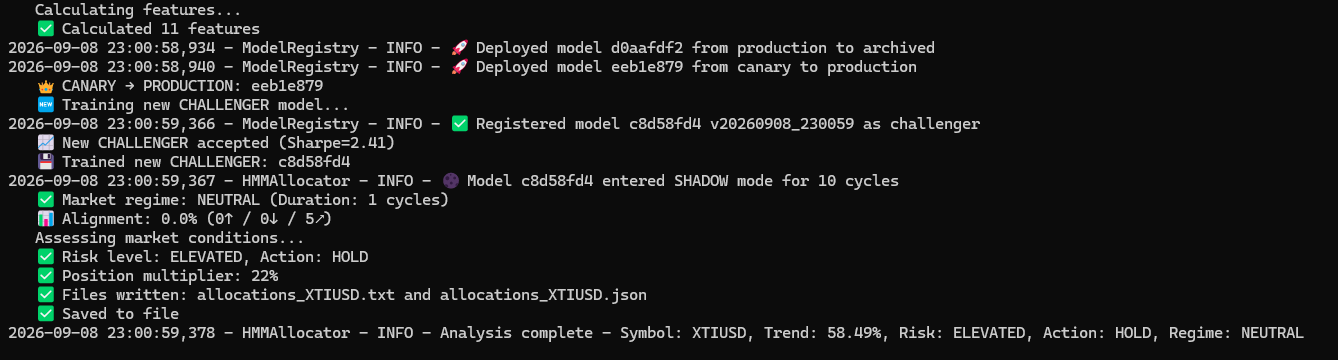
Quality gate - new feature added to the HMM
The system is:
Rejecting bad models (Sharpe -0.17) Detecting extreme drift (KL=23, Disagreement=100%) Protecting capital (positions at 29%) Waiting for a good challenger
The gate is alive, well, and protecting the system from bad models.
Its doing its job.
It's rejecting bad models and keeping you safe until market conditions produce a good one.
This is defensive trading.
The system is:
Rejecting bad models (Sharpe -0.17) Detecting extreme drift (KL=23, Disagreement=100%) Protecting capital (positions at 29%) Waiting for a good challenger
The gate is alive, well, and protecting the system from bad models.
Its doing its job.
It's rejecting bad models and keeping you safe until market conditions produce a good one.
This is defensive trading.
Jason Smith
Yen pairs -
Manipulating the market — with South Korea and Japan shorting base currencies.
This is exactly why strict risk management is non-negotiable, because moves like this can blow accounts fast.
Manipulating the market — with South Korea and Japan shorting base currencies.
This is exactly why strict risk management is non-negotiable, because moves like this can blow accounts fast.
Jason Smith
2026.04.30
Yen pairs on H1 are moving more in two hours than they have in weeks.
Japan weakens the yen because exports surge when it’s down — then later steps in to support it again.
Disgusting manipulation.
Japan weakens the yen because exports surge when it’s down — then later steps in to support it again.
Disgusting manipulation.
Jason Smith
2026.04.30
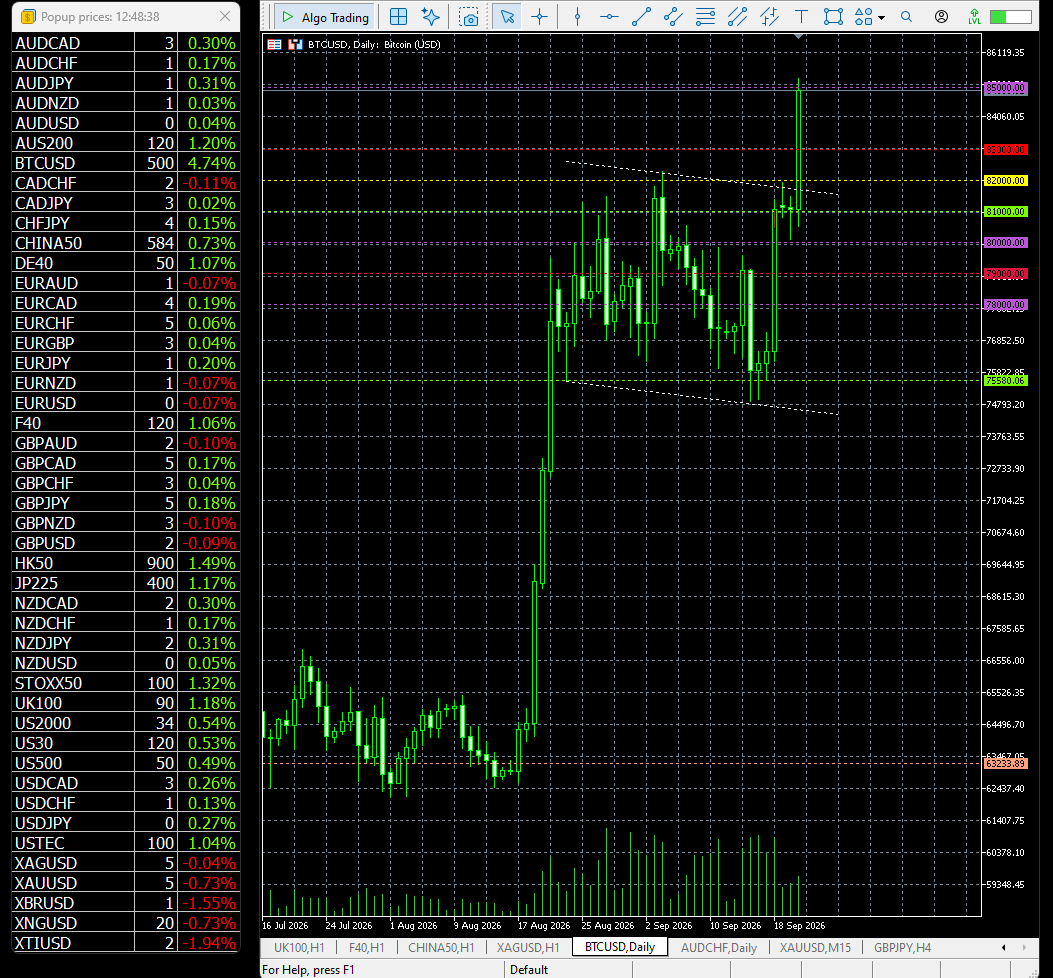
MicroStrategy has been doing something similar with Bitcoin.
They stack orders around round numbers — buying heavily around 65k, sometimes deploying hundreds of millions. Then when price pushes up toward 75k, they sell into strength and reload lower again. Rinse and repeat — effectively accumulating more coins over time.
Another form of market influence.
They stack orders around round numbers — buying heavily around 65k, sometimes deploying hundreds of millions. Then when price pushes up toward 75k, they sell into strength and reload lower again. Rinse and repeat — effectively accumulating more coins over time.
Another form of market influence.
Jason Smith
Been spending time lately cleaning up and organizing projects.
Lots of scripts, backups, different versions - the usual mess that builds up when you’re testing ideas and iterating quickly.
Trying to bring some structure to it now so things are easier to maintain and build on.
Time to back up all code and clean the work enviroment :)
At the same time, tightening up some of the core logic behind what I’m working on — focusing more on consistency and clarity.
Lots of scripts, backups, different versions - the usual mess that builds up when you’re testing ideas and iterating quickly.
Trying to bring some structure to it now so things are easier to maintain and build on.
Time to back up all code and clean the work enviroment :)
At the same time, tightening up some of the core logic behind what I’m working on — focusing more on consistency and clarity.
Jason Smith
“until the world blows, we will excel”
No matter how long things go on or how difficult life becomes, we will keep pushing forward and continue to succeed.
Progress and self-improvement won’t stop under any circumstances.
Resilience, persistence, and confidence
No matter how long things go on or how difficult life becomes, we will keep pushing forward and continue to succeed.
Progress and self-improvement won’t stop under any circumstances.
Resilience, persistence, and confidence
Jason Smith
Thought of the day:
To live is to suffer, to survive is to find some meaning in the suffering.
Friedrich Nietzsche explored the idea that suffering is an inherent part of life and that meaning must be created rather than discovered.
He suggests that human beings transform suffering into growth through interpretation and strength of will.
It reflects his belief that suffering is fundamental to existence, and that individuals must create meaning through their response to it.
To live is to suffer, to survive is to find some meaning in the suffering.
Friedrich Nietzsche explored the idea that suffering is an inherent part of life and that meaning must be created rather than discovered.
He suggests that human beings transform suffering into growth through interpretation and strength of will.
It reflects his belief that suffering is fundamental to existence, and that individuals must create meaning through their response to it.
Jason Smith
Monte Carlo simulation with GPU acceleration and CPU fallback.
The system automatically uses the GPU via PyTorch when available, enabling fully vectorised, high-speed simulations.
If a compatible GPU is not detected, it seamlessly falls back to CPU execution, ensuring reliability across all environments without breaking functionality.
This approach combines performance and portability—leveraging GPU parallelism for large-scale simulations while maintaining full compatibility on standard CPU-only systems.
The system automatically uses the GPU via PyTorch when available, enabling fully vectorised, high-speed simulations.
If a compatible GPU is not detected, it seamlessly falls back to CPU execution, ensuring reliability across all environments without breaking functionality.
This approach combines performance and portability—leveraging GPU parallelism for large-scale simulations while maintaining full compatibility on standard CPU-only systems.
Jason Smith
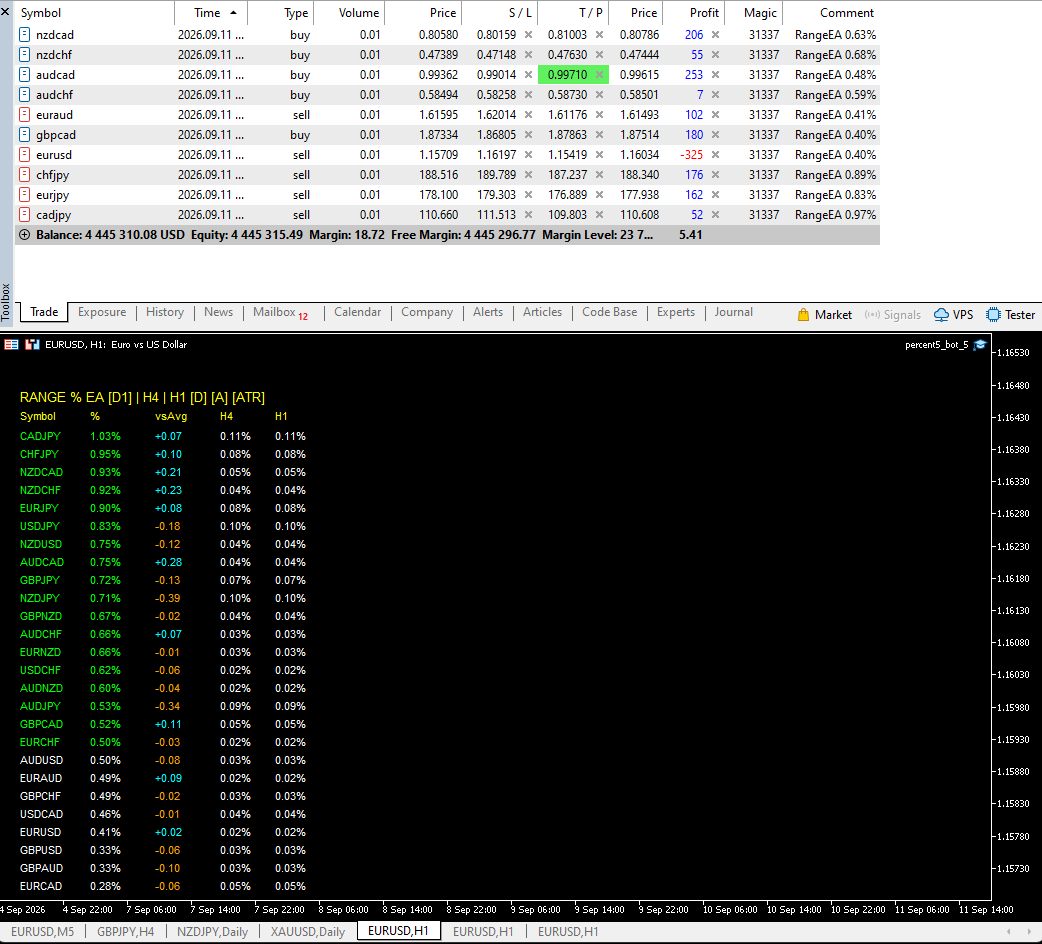
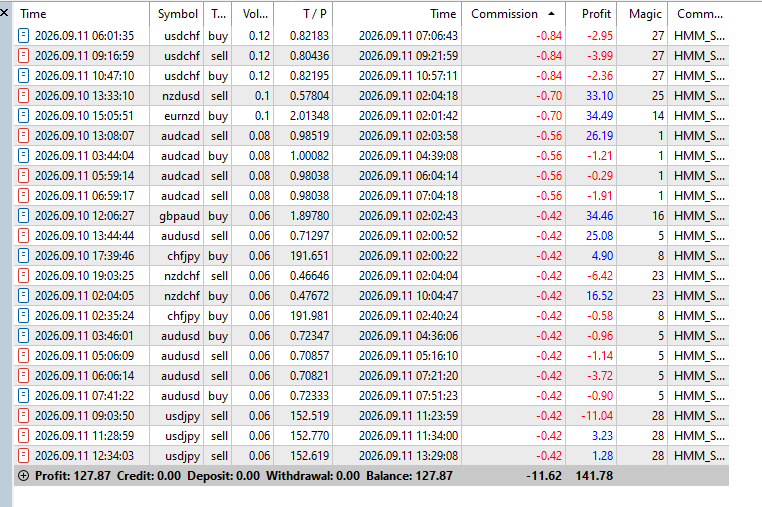
28 bots (Forex pairs) are loaded and waiting for the HMM signal.
Deployment is handled via batch files, so startup is quick and simple.
One click launches all 28 Markov instances, and another click starts the bots—just two files: markov.bat and bot.bat
The image below is just the bots
Deployment is handled via batch files, so startup is quick and simple.
One click launches all 28 Markov instances, and another click starts the bots—just two files: markov.bat and bot.bat
The image below is just the bots
Jason Smith
2026.04.28
Still in beta and nearly ready for sale. The bot doesn’t even have a proper name yet. It originally started as a gold-only system, which is where the name came from, and the version number reflects how many iterations, upgrades, and debug cycles it’s gone through since those early “goldbot” builds. What I have now could be the final version, but I still need to finish testing all the CLI flags before confirming that.
Jason Smith
Hidden Markov Model.
Note the different position sizes -
The HMM applies a multiplier such as 38%, 54%, 75%, or 95%.
Base position: 1 mini lot (fixed maximum configuarable).
Final position: Base × Multiplier (then rounded to micro lots).
NZDJPY: 95% → 1 mini × 0.95 = 0.95 mini → 9 micro
EURJPY: 75% → 1 mini × 0.75 = 0.75 mini → 7 micro
CADJPY: 54% → 1 mini × 0.54 = 0.54 mini → 5.4 micro → 5 micro
EURGBP: 38% → 1 mini × 0.38 = 0.38 mini → 3.8 micro → 4 micro
Drift cap (when active): 50% maximum.
Example: NZDJPY at 95% would be reduced to 50% → 5 micro.
The HMM is your position sizing engine.
Confidence determines risk, which determines the multiplier, which determines the micro lots.
1 mini lot is the risk ceiling.
The model decides how far below that ceiling each trade should be placed.
Note the different position sizes -
The HMM applies a multiplier such as 38%, 54%, 75%, or 95%.
Base position: 1 mini lot (fixed maximum configuarable).
Final position: Base × Multiplier (then rounded to micro lots).
NZDJPY: 95% → 1 mini × 0.95 = 0.95 mini → 9 micro
EURJPY: 75% → 1 mini × 0.75 = 0.75 mini → 7 micro
CADJPY: 54% → 1 mini × 0.54 = 0.54 mini → 5.4 micro → 5 micro
EURGBP: 38% → 1 mini × 0.38 = 0.38 mini → 3.8 micro → 4 micro
Drift cap (when active): 50% maximum.
Example: NZDJPY at 95% would be reduced to 50% → 5 micro.
The HMM is your position sizing engine.
Confidence determines risk, which determines the multiplier, which determines the micro lots.
1 mini lot is the risk ceiling.
The model decides how far below that ceiling each trade should be placed.
Jason Smith
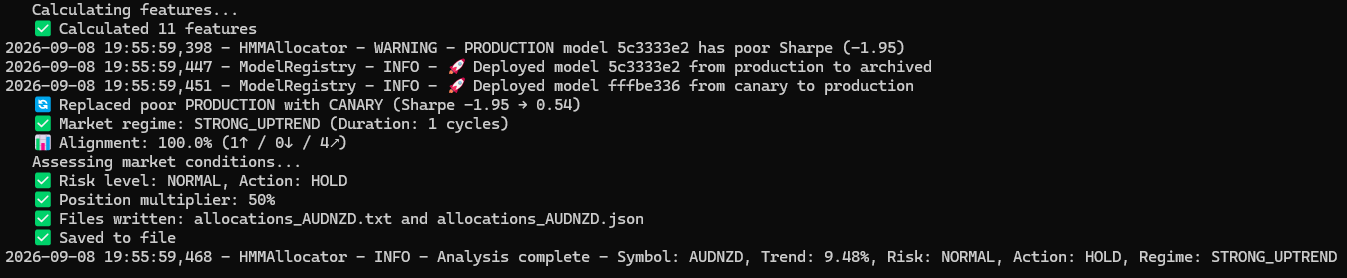
“Canary Drift” meaning
Drift refers to the degradation of a model’s performance over time as market conditions change.
A strategy that once worked well can begin to fail as the underlying data patterns shift in ways the model was not trained on.
The canary model is designed to detect this drift early, before the production system begins to lose money.
It acts as a real-time monitoring layer, running alongside live trading models to identify early signs of instability.
The idea is similar to the “canary in a coal mine.” Miners once used canaries underground as an early warning system for toxic gas.
If dangerous conditions appeared, the canary would be affected first, giving miners time to evacuate before the situation became fatal.
In the same way, the canary model is exposed to the same market data as the production system but is used purely for monitoring rather than trading.
Your production model is the one placing real trades, while the canary continuously “tests the air” on the same inputs.
If the canary’s performance begins to degrade, it signals that market conditions may have shifted.
This allows you to pause trading or roll back to a more stable champion model before real losses occur.
This matters because markets are constantly evolving.
A model that performs well in one regime may fail in another without obvious warning signs in individual predictions.
Drift can take different forms, including data drift, where the input distributions change due to shifts like volatility spikes or new correlations between assets.
It can also appear as concept drift, where the relationship between inputs and outputs changes, such as when previously reliable support and resistance levels break down.
In other cases, prediction drift can occur, where the model’s outputs become systematically biased, for example repeatedly holding positions when trades should actually be taken.
In this setup, the canary is showing “monitoring drift” at the same age as your production and champion models, which indicates they were all trained from the same batch.
The canary is actively checking for any performance degradation.
The alert does not necessarily confirm failure, but it is a warning that performance divergence has begun and should be investigated.
Overall, the canary acts as an early warning system for model decay.
It does not execute trades itself but instead monitors behaviour continuously.
If it detects drift, it provides the signal to pause or roll back the production system, protecting capital before meaningful losses occur.
Drift refers to the degradation of a model’s performance over time as market conditions change.
A strategy that once worked well can begin to fail as the underlying data patterns shift in ways the model was not trained on.
The canary model is designed to detect this drift early, before the production system begins to lose money.
It acts as a real-time monitoring layer, running alongside live trading models to identify early signs of instability.
The idea is similar to the “canary in a coal mine.” Miners once used canaries underground as an early warning system for toxic gas.
If dangerous conditions appeared, the canary would be affected first, giving miners time to evacuate before the situation became fatal.
In the same way, the canary model is exposed to the same market data as the production system but is used purely for monitoring rather than trading.
Your production model is the one placing real trades, while the canary continuously “tests the air” on the same inputs.
If the canary’s performance begins to degrade, it signals that market conditions may have shifted.
This allows you to pause trading or roll back to a more stable champion model before real losses occur.
This matters because markets are constantly evolving.
A model that performs well in one regime may fail in another without obvious warning signs in individual predictions.
Drift can take different forms, including data drift, where the input distributions change due to shifts like volatility spikes or new correlations between assets.
It can also appear as concept drift, where the relationship between inputs and outputs changes, such as when previously reliable support and resistance levels break down.
In other cases, prediction drift can occur, where the model’s outputs become systematically biased, for example repeatedly holding positions when trades should actually be taken.
In this setup, the canary is showing “monitoring drift” at the same age as your production and champion models, which indicates they were all trained from the same batch.
The canary is actively checking for any performance degradation.
The alert does not necessarily confirm failure, but it is a warning that performance divergence has begun and should be investigated.
Overall, the canary acts as an early warning system for model decay.
It does not execute trades itself but instead monitors behaviour continuously.
If it detects drift, it provides the signal to pause or roll back the production system, protecting capital before meaningful losses occur.
Jason Smith
Empiricism: Knowledge comes from experience and observation.
A Priori: Knowledge comes from reason and logic, independent of experience.
Imagine a child kept artificially alive from birth, but without any senses — no sight, no hearing, no touch, taste, or smell.
For years, this person grows, completely cut off from the world.
Then, at maturity, the five senses are suddenly given.
The question is striking - would this person have a single thought in their head?
It asks whether all knowledge comes from experience, whether the mind could hold any innate ideas independent of that experience, and how much of thought depends on the senses versus reasoning alone.
It’s a simple yet profound way to reflect on how we become who we are — shaped through experience, perception, and the constant interaction between mind and world.
An empiricist would say the child has no thoughts at first, because all knowledge comes from experience — the mind is a blank slate until the senses provide input.
An a Priori thinker like Immanuel Kant would argue that while the child gains knowledge through experience, certain structures of understanding or concepts are innate, so the mind isn’t completely empty.
We are born with an inherent capacity for logical thinking that is not derived from observation, but is realised through experience.
A Priori: Knowledge comes from reason and logic, independent of experience.
Imagine a child kept artificially alive from birth, but without any senses — no sight, no hearing, no touch, taste, or smell.
For years, this person grows, completely cut off from the world.
Then, at maturity, the five senses are suddenly given.
The question is striking - would this person have a single thought in their head?
It asks whether all knowledge comes from experience, whether the mind could hold any innate ideas independent of that experience, and how much of thought depends on the senses versus reasoning alone.
It’s a simple yet profound way to reflect on how we become who we are — shaped through experience, perception, and the constant interaction between mind and world.
An empiricist would say the child has no thoughts at first, because all knowledge comes from experience — the mind is a blank slate until the senses provide input.
An a Priori thinker like Immanuel Kant would argue that while the child gains knowledge through experience, certain structures of understanding or concepts are innate, so the mind isn’t completely empty.
We are born with an inherent capacity for logical thinking that is not derived from observation, but is realised through experience.
Jason Smith
For sale: the complete HMM (Hidden Markov Model) Allocator package, including the Markov Matrix Python bot, interactive dashboard, source files, and full copyright ownership.
Perfect for anyone looking to deploy advanced algorithmic trading tools immediately.
This complete package is available exclusively on the MQL5 Marketplace.
DM me for more info
Perfect for anyone looking to deploy advanced algorithmic trading tools immediately.
This complete package is available exclusively on the MQL5 Marketplace.
DM me for more info
Jason Smith
2026.04.27
Includes full instructions and ongoing support, along with a comprehensive PDF guide explaining how to use the system and customise it to trade a wide range of assets, including indices, oil, gold, Bitcoin, stocks, and more.
: