With most markets at historic levels, Gabe Velazquez shares his
thought on why only the Russell 2000 has really good trading
opportunities at current levels. This ties into market timing principles
and the foundation of Supply & Demand theory. Gabe also answers
several listener questions on subjects ranging from stocks to futures.
The duo also take a look at the grain markets, which have been clobbered
recently.
if actual > forecast = good for currency (for USD in our case)
[USD - ADP Non-Farm Employment Change] = Estimated change in the number of employed people during the previous month, excluding the farming industry and government. Job creation is an important leading indicator of consumer spending, which accounts for a majority of overall economic activity.
Trading the News: U.S. Non-Farm Payrolls(adapted from dailyfx)
U.S. Non-Farm Payrolls (NFP) to Increase 200+K for Seventh Consecutive Month.
Would Match the Longest String of 200+K Prints Since 1997.
The EUR/USD may face a further decline over the next 24-hours of trade
as the U.S. Non-Farm Payrolls (NFP) report is expected to show the
world’s largest economy adding another 230K jobs in August while the
jobless rate is expected to narrow to an annualized 6.1% from 6.2% the
month prior.
What’s Expected:
Why Is This Event Important:
Signs of a more robust recovery may further boost interest rate
expectations as the Federal Open Market Committee (FOMC) is expected to
halt its asset-purchase program at the October 29 meeting, and the
bullish sentiment surrounding the U.S dollar may gather pace throughout
the remainder of the year as a growing number of central bank officials
show a greater willing to normalize monetary policy sooner rather than
later.
The pickup in economic activity paired with the highest ISM employment
prints for 2014 may highlight a further expansion in job growth, and an
above-forecast NFP figure may spur fresh monthly lows in the EUR/USD
amid the deviation in the policy outlook.
On the other hand, the recent slowdown in private-sector consumption -
one of the leading drivers of growth - may generate another
weaker-than-expect print, and a soft employment reading may spur a more
meaningful pullback in the greenback as it dampens the outlook for the
world’s largest economy.
How To Trade This Event Risk
Bullish USD Trade: NFPs Climb 230K or Greater While Jobless Rate Slips to 6.1% or Lower
Need red, five-minute candle following the release to consider a short trade on EUR/USD
If market reaction favors a long dollar trade, sell EUR/USD with two separate position
Set stop at the near-by swing high/reasonable distance from entry; look for at least 1:1 risk-to-reward
Move stop to entry on remaining position once initial target is hit; set reasonable limit
Bearish USD Trade: Job Growth Falls Short of Market Forecast
Need green, five-minute candle to favor a long EUR/USD trade
Implement same setup as the bullish dollar trade, just in the opposite direction
Potential Price Targets For The Release EUR/USD Daily
Downside targets remain favored as RSI pushes deeper into oversold territory.
Interim Resistance: 1.3350 (61.8% expansion) to 1.3370 (50.0% retracement)
Interim Support: 1.2870 (50.0% expansion) to 1.2900 (1.618% expansion)
Impact that the U.S. Non-Farm Payrolls report has had on EUR/USD during the previous month
Period
Data Released
Estimate
Actual
Pips Change
(1 Hour post event )
Pips Change
(End of Day post event)
JUL 2014
8/01/2014 12:30 GMT
230K
209K
+ 24
+ 33
July 2014 U.S. Non-Farm Payrolls
EURUSD M5 : 44 pips price movement by USD - Non-Farm Payrolls news event:
AUDUSD M5 : 46 pips price movement by USD - Non-Farm Payrolls news event:
The U.S. economy added 209K jobs in July, following a revised 298K
increase the month prior. The print was below the average estimate of
230K. The jobless rate unexpectedly rose to 6.2% from 6.1% in June as
discouraged workers returned to the labor force. Nevertheless, the
greenback lost ground following the below-forecast print, with the
EUR/USD rallying to a high of 1.3443 going into the European close.
Mark Carney and Haruhiko Kuroda speeches, New Zealand rate decision,
Australian employment data, US Unemployment Claims, Retail sales and
Consumer sentiment are the major events on our calendar for this week.
Here is an outlook on the main market-movers coming our way.
Last week Non-Farm Payrolls declined below the 200,000 level with only a
142,000 job gain in August, considerably lower than the 230,000 gain
expected by analysts. The unemployment rate fell by 0.1%, but was
attributed to a 0.1 drop in the participation rate. Despite a rebound
in economic growth during the second quarter, the recent employment
data suggests the economy shifts to lower gear. Will this trend
continue?
Mark Carney speaks: Tuesday,
8:30. BOE Governor Mark Carney will speak in Liverpool and may speak
about his intentions to raise rates before wages increase. The
International Monetary Fund expects U.K. growth to soar this year.
However wage growth is not expanding according to projections. Carney
stated that the banks have made “substantial progress” in returning to
normal and the expansion trend is gathering momentum.
New Zealand Rate decision: Wednesday,
21:00. The Reserve Bank of New Zealand raised its official Cash Rate
to 3.5% in July from 3.25% in the previous month. This was the fourth
hike in five months amid a growth trend in the economy. The rise was in
line with market forecast but economists believe this was the last
rise in this hike series, after which the Bank will assess the
tightening measures impact on the economy. The Reserve Bank has
previously announced another rate hike of 1.25% by the end of 2014 and
2015 reaching a ‘neutral’ level of 4.5%. The bank said the economy was
expected to expand at an annual pace of 3.7% in 2014. No changes are
forecasted this time.
Australian employment data: Thursday,
1:30. Australia’s unemployment rate soared to a 12-year high of 6.4%
in July from 6.0% in the previous month while economists expected the
rate to remain at 6.0%. The economy contracted 300 jobs following a
15,900 job addition in June. Full-time positions increased by 14,500
while part-time roles declined 14,800. The participation rate,
increased by 0.1% to 64.8%. Economists believe this decline is only a
temporary glitch reflecting the volatility of month-to-month data.
Australia’s job market is expected to gain 15,200 jobs while the
Unemployment rate is expected to decline to 6.3%.
US Unemployment Claims: Thursday,
12:30. The number of jobless claims increased by 4,000 last week to
302,000, a bit higher than the 300,000 expected by analysts. The
four-week moving average of initial claims edged up 3,000 last week to
302,750. The level of continuing claims declined by 64,000 from the
previous week and the level of unadjusted continuing claims fell by
95,339 to 2,306,286. Overall, the level of claims last week was well
below the 4,388,758 posted a year ago. Jobless claims are expected to
increase by 306,000.
Haruhiko Kuroda speaks: Friday,
6:05. BOJ Governor Haruhiko Kuroda will speak at the National Graduate
Institute for Policy Studies in Tokyo. He may talk about the central
bank’s intentions to raise the sales tax again in order to narrow
government deficit. Kuroda remained optimistic about pulling out of
deflation and reaching the 2% inflation target. BOJ Governor is also
positive that Japan’s economy will continue to expand in the months
ahead.
US Retail sales: Friday, 12:30. U.S.
retail sales unexpectedly halted in July, remained unchanged from June,
suggesting some loss of momentum in the economy at the beginning of
the third quarter. However gob growth continued to be positive,
indicating sales activity is bound to strengthen in the coming months.
The main fall occurred in the automobile sector declining 0.2% after a
0.3% fall. Meanwhile, core retail sales, excluding automobiles,
gasoline, building materials and food services inched up 0.1% in July.
Retail sales are predicted to increase 0.3% while core sales are
expected to gain 0.2%.
US Prelim UoM Consumer Sentiment: Friday,
13:55. American consumer confidence unexpectedly dropped in August to a
nine-month low of 79.2 points from 81.8 points in July, missing
predictions for a reading of 82.7. The unexpected fall was led by
concerns over economic outlook as households projected an inflation rate
of 3.4% over the next year, distinctly higher than the 0.4% wage
growth forecasted. This pessimistic projection may impact consumer
spending in the coming months. American consumer confidence is
expected to pick-up to 83.2 this time.
Fundamental Forecast for Australian Dollar: Neutral
AUD/USD Consolidates As Dovish Policy Bets Diminish Amidst Return To Yield
Void of Major Regional Data To Leave ‘Period of Stability’ Rates Scenario Intact
Carry Demand May Support AUD As Traders Look Past Geopolitical Tensions
The Australian Dollar is heading for another relatively flat finish to
the week ahead of the Jackson Hole Symposium. The currency was afforded
some support as RBA policy expectations shifted away from the more
dovish end of the spectrum. This came on the back of a status-quo set
of RBA Meeting Minutes and a relatively optimistic set of comments from
Governor Stevens on the domestic economy. Additionally, a broader
return to high-yielding instruments helped offset some of the negative
cues provided by a deterioration in Chinese economic data.
Looking ahead, RBA policy bets as well as general market risk appetite
remain the dominant themes to monitor for the Aussie. On the policy
front; a void of local economic data is on the calendar heading into
the end of the month. This is likely to leave the ‘period of stability’
baseline scenario for rates intact. Which in turn could keep the
currency supported via its yield spread over its major counterparts.
Of course, the appeal of the currency’s interest rate advantage is
intrinsically linked to broader risk sentiment. Implied volatility
remains near multi-year lows despite a small recovery for the gauge
over the past month. This suggests traders are pricing in a relatively
small probability of major market swings in the near-term. Such an
environment raises the attractiveness of carry trades and bodes well
for the Aussie.
Further, the threat posed to investor optimism by ongoing geopolitical
turmoil appears to have diminished in recent weeks. Storm clouds
continue to loom over Eastern Europe and the Middle East. Yet traders
seem to have become desensitized to the latest flare-ups. This suggests
it would likely take a material escalation in the regional turmoil to
threaten the resilience of the Australian Dollar.
Fundamental Forecast for New Zealand Dollar: Neutral
NZDUSD .8240/60 of Interest for a Low
US Dollar Profit Taking Ensues on Surprise August NFPs Miss
The Reserve Bank of New Zealand (RBNZ) policy meeting on September 10
may heighten the bearish sentiment surrounding NZD/USD should the fresh
batch of central bank rhetoric drag on interest rate expectations.
According to a Bloomberg News survey, all of the 12 economists polled
forecast the RBNZ to keep the benchmark interest rate steady at 3.50%
as Governor Graeme Wheeler adopts a neutral tone for monetary policy,
and the New Zealand dollar may face a further decline in the days ahead
if the central bank head sees a period of interest rate stability
throughout the remainder of 2014. At the same time, Governor Wheeler may
continue to highlight weaker commodity prices to favor a weakened
outlook for the New Zealand dollar, but the recent slide in the
higher-yielding currency may raise the outlook for price growth as it
draws imported inflation.
With that said and given the near-term decline in NZD/USD, the biggest
risk surrounding the RBNZ interest rate decision will be a removal of
the verbal intervention on the kiwi as the central bank sees a more
sustainable recovery in New Zealand. As a result, Credit Suisse
Overnight Index Swaps continue to show expectations for at least one
25bp rate hike over the next 12-months, but dovish remarks from the
RBNZ may push NZD/USD to give back the rally from the February low
(0.8050) as market participants scale back bets for higher borrowing
costs.
Nevertheless, the 0.8250-60 region remains the next key level of
interest as NZD/USD retains the descending channel along with the
downward trend in the Relative Strength Index (RSI), but a lack of
jawboning from the RBNZ may foster a more meaningful recovery in the
New Zealand dollar as the oscillator comes off of oversold territory.
Trading Video: Can the Dollar Sustain its Rally and the S&P 500 its Quiet?(based on dailyfx article)
Despite a boom of volatility in FX markets, sentiment trends and the S&P 500 remain troubling stoic
The most impressive trend lately may also prove the most overdone in the short-term - the Dollar's rally
If there is shift in risk or greenback favor, there are plenty of opportunities; but USDJPY would hit both
Though it falls short of the S&P 500's maturity, the US Dollar's
rally these past two months stands out as one of the financial market's
top themes. An eight-week rally for the USDollar
matches its longest run in 15 years, but the performance is all the
more remarkable for the fundamental drivers backing its progress. Rather
than find its footing through a 'flight to safety' or meaningful
upgrade in policy forecasts, the greenback has drawn strength through
its counterparts' difficulties. The culmination of unique issues for the
Euro, Pound and Yen
make for an effective lever; but it is also one that lacks for
endurance. With equity markets pulsating 'extreme complacency' and the
dollar stretched, we look at market conditions and potential setups for
the week ahead in today's Trading Video.
NZDUSD Doji Ensemble Indicates Caution Near Critical Support(based on dailyfx article)
NZD/USD Technical Strategy: Pending Short
Remains At A Critical Juncture Near 0.8260
Awaiting Downside Break to Open 0.8060
NZD/USD continues to skip across the critical 0.8260 barrier with a
medley of short body candles suggesting caution from traders. A daily
close below the nearby floor would be preferred for entering new short
positions, given the context of a downtrend on the daily.
The Harami noted in the most recent candlesticks report delivered a
short-lived bounce for NZD/USD. The emergence of a Gravestone Doji now
hints at a pullback for the pair over the session ahead. Buying interest
is likely be renewed near the 0.8267 lows.
The NZDUSD starts the week supported going into the US session open.
Currently price resides at range support, near the S3 camarilla pivot
found at .8295. In the event price remains supported for the session,
traders can look for a potential price bounce back towards range
resistance. Currently resistance sits near the R3 pivot point at .8338,
completing the days 43 pip trading range.
A breakout below the S4 pivot would signal a strong reversal back in the
direction of the NZDUSD’s current daily trend. It should be noted that
price has declined as much as 566 pip over the last two months of
trading. Conversely a price break above R4 resistance at .8360, would
indicate momentum shifting towards a higher high. In either of the above
breakout scenarios, the range should be considered invalidated for the
day with traders then positioning themselves with the markets new
direction.
Market Adaptation with Gabe Velazquez
With most markets at historic levels, Gabe Velazquez shares his thought on why only the Russell 2000 has really good trading opportunities at current levels. This ties into market timing principles and the foundation of Supply & Demand theory. Gabe also answers several listener questions on subjects ranging from stocks to futures. The duo also take a look at the grain markets, which have been clobbered recently.

if actual > forecast = good for currency (for USD in our case)
[USD - ADP Non-Farm Employment Change] = Estimated change in the number of employed people during the previous month, excluding the farming industry and government. Job creation is an important leading indicator of consumer spending, which accounts for a majority of overall economic activity.
==========
Trading the News: U.S. Non-Farm Payrolls (adapted from dailyfx)
The EUR/USD may face a further decline over the next 24-hours of trade as the U.S. Non-Farm Payrolls (NFP) report is expected to show the world’s largest economy adding another 230K jobs in August while the jobless rate is expected to narrow to an annualized 6.1% from 6.2% the month prior.
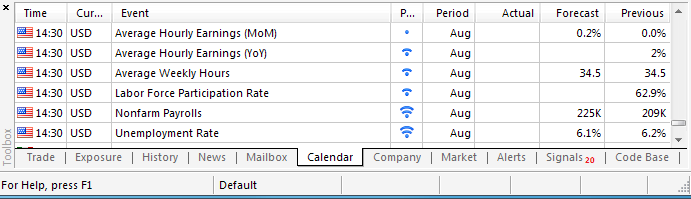
What’s Expected:
Why Is This Event Important:
Signs of a more robust recovery may further boost interest rate expectations as the Federal Open Market Committee (FOMC) is expected to halt its asset-purchase program at the October 29 meeting, and the bullish sentiment surrounding the U.S dollar may gather pace throughout the remainder of the year as a growing number of central bank officials show a greater willing to normalize monetary policy sooner rather than later.
The pickup in economic activity paired with the highest ISM employment prints for 2014 may highlight a further expansion in job growth, and an above-forecast NFP figure may spur fresh monthly lows in the EUR/USD amid the deviation in the policy outlook.
On the other hand, the recent slowdown in private-sector consumption - one of the leading drivers of growth - may generate another weaker-than-expect print, and a soft employment reading may spur a more meaningful pullback in the greenback as it dampens the outlook for the world’s largest economy.
How To Trade This Event Risk
Bullish USD Trade: NFPs Climb 230K or Greater While Jobless Rate Slips to 6.1% or Lower
- Need red, five-minute candle following the release to consider a short trade on EUR/USD
- If market reaction favors a long dollar trade, sell EUR/USD with two separate position
- Set stop at the near-by swing high/reasonable distance from entry; look for at least 1:1 risk-to-reward
- Move stop to entry on remaining position once initial target is hit; set reasonable limit
Bearish USD Trade: Job Growth Falls Short of Market Forecast- Need green, five-minute candle to favor a long EUR/USD trade
- Implement same setup as the bullish dollar trade, just in the opposite direction
Potential Price Targets For The ReleaseEUR/USD Daily
- Downside targets remain favored as RSI pushes deeper into oversold territory.
- Interim Resistance: 1.3350 (61.8% expansion) to 1.3370 (50.0% retracement)
- Interim Support: 1.2870 (50.0% expansion) to 1.2900 (1.618% expansion)
Impact that the U.S. Non-Farm Payrolls report has had on EUR/USD during the previous month(1 Hour post event )
(End of Day post event)
EURUSD M5 : 44 pips price movement by USD - Non-Farm Payrolls news event:
AUDUSD M5 : 46 pips price movement by USD - Non-Farm Payrolls news event:
The U.S. economy added 209K jobs in July, following a revised 298K increase the month prior. The print was below the average estimate of 230K. The jobless rate unexpectedly rose to 6.2% from 6.1% in June as discouraged workers returned to the labor force. Nevertheless, the greenback lost ground following the below-forecast print, with the EUR/USD rallying to a high of 1.3443 going into the European close.
MetaTrader Trading Platform Screenshots
EURUSD, M5, 2014.09.05
MetaQuotes Software Corp., MetaTrader 5, Demo
EURUSD M5 : 39 pips price movement by USD - Non-Farm Employment Change news event
Mark Carney and Haruhiko Kuroda speeches, New Zealand rate decision, Australian employment data, US Unemployment Claims, Retail sales and Consumer sentiment are the major events on our calendar for this week. Here is an outlook on the main market-movers coming our way.
Last week Non-Farm Payrolls declined below the 200,000 level with only a 142,000 job gain in August, considerably lower than the 230,000 gain expected by analysts. The unemployment rate fell by 0.1%, but was attributed to a 0.1 drop in the participation rate. Despite a rebound in economic growth during the second quarter, the recent employment data suggests the economy shifts to lower gear. Will this trend continue?
AUDUSD Fundamentals (based on dailyfx article)
Fundamental Forecast for Australian Dollar: NeutralThe Australian Dollar is heading for another relatively flat finish to the week ahead of the Jackson Hole Symposium. The currency was afforded some support as RBA policy expectations shifted away from the more dovish end of the spectrum. This came on the back of a status-quo set of RBA Meeting Minutes and a relatively optimistic set of comments from Governor Stevens on the domestic economy. Additionally, a broader return to high-yielding instruments helped offset some of the negative cues provided by a deterioration in Chinese economic data.
Looking ahead, RBA policy bets as well as general market risk appetite remain the dominant themes to monitor for the Aussie. On the policy front; a void of local economic data is on the calendar heading into the end of the month. This is likely to leave the ‘period of stability’ baseline scenario for rates intact. Which in turn could keep the currency supported via its yield spread over its major counterparts.
Of course, the appeal of the currency’s interest rate advantage is intrinsically linked to broader risk sentiment. Implied volatility remains near multi-year lows despite a small recovery for the gauge over the past month. This suggests traders are pricing in a relatively small probability of major market swings in the near-term. Such an environment raises the attractiveness of carry trades and bodes well for the Aussie.
Further, the threat posed to investor optimism by ongoing geopolitical turmoil appears to have diminished in recent weeks. Storm clouds continue to loom over Eastern Europe and the Middle East. Yet traders seem to have become desensitized to the latest flare-ups. This suggests it would likely take a material escalation in the regional turmoil to threaten the resilience of the Australian Dollar.
NZDUSD Fundamentals (based on dailyfx article)
Fundamental Forecast for New Zealand Dollar: NeutralThe Reserve Bank of New Zealand (RBNZ) policy meeting on September 10 may heighten the bearish sentiment surrounding NZD/USD should the fresh batch of central bank rhetoric drag on interest rate expectations.
According to a Bloomberg News survey, all of the 12 economists polled forecast the RBNZ to keep the benchmark interest rate steady at 3.50% as Governor Graeme Wheeler adopts a neutral tone for monetary policy, and the New Zealand dollar may face a further decline in the days ahead if the central bank head sees a period of interest rate stability throughout the remainder of 2014. At the same time, Governor Wheeler may continue to highlight weaker commodity prices to favor a weakened outlook for the New Zealand dollar, but the recent slide in the higher-yielding currency may raise the outlook for price growth as it draws imported inflation.
With that said and given the near-term decline in NZD/USD, the biggest risk surrounding the RBNZ interest rate decision will be a removal of the verbal intervention on the kiwi as the central bank sees a more sustainable recovery in New Zealand. As a result, Credit Suisse Overnight Index Swaps continue to show expectations for at least one 25bp rate hike over the next 12-months, but dovish remarks from the RBNZ may push NZD/USD to give back the rally from the February low (0.8050) as market participants scale back bets for higher borrowing costs.
Nevertheless, the 0.8250-60 region remains the next key level of interest as NZD/USD retains the descending channel along with the downward trend in the Relative Strength Index (RSI), but a lack of jawboning from the RBNZ may foster a more meaningful recovery in the New Zealand dollar as the oscillator comes off of oversold territory.
Trading Video: Can the Dollar Sustain its Rally and the S&P 500 its Quiet? (based on dailyfx article)
Though it falls short of the S&P 500's maturity, the US Dollar's rally these past two months stands out as one of the financial market's top themes. An eight-week rally for the USDollar matches its longest run in 15 years, but the performance is all the more remarkable for the fundamental drivers backing its progress. Rather than find its footing through a 'flight to safety' or meaningful upgrade in policy forecasts, the greenback has drawn strength through its counterparts' difficulties. The culmination of unique issues for the Euro, Pound and Yen make for an effective lever; but it is also one that lacks for endurance. With equity markets pulsating 'extreme complacency' and the dollar stretched, we look at market conditions and potential setups for the week ahead in today's Trading Video.
NZDUSD Doji Ensemble Indicates Caution Near Critical Support (based on dailyfx article)
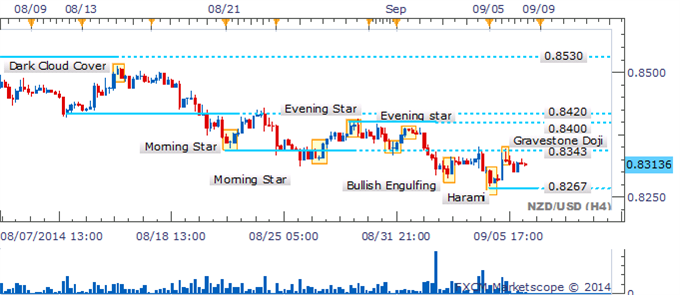
NZD/USD continues to skip across the critical 0.8260 barrier with a medley of short body candles suggesting caution from traders. A daily close below the nearby floor would be preferred for entering new short positions, given the context of a downtrend on the daily.
The Harami noted in the most recent candlesticks report delivered a short-lived bounce for NZD/USD. The emergence of a Gravestone Doji now hints at a pullback for the pair over the session ahead. Buying interest is likely be renewed near the 0.8267 lows.
NZDUSD Technical Analysis (based on dailyfx article)
- NZDUSD is Current Range Bound
- R3 Support Sits at .8295
- Market Breakouts Signaled Under .8274
NZDUSD 30min ChartThe NZDUSD starts the week supported going into the US session open. Currently price resides at range support, near the S3 camarilla pivot found at .8295. In the event price remains supported for the session, traders can look for a potential price bounce back towards range resistance. Currently resistance sits near the R3 pivot point at .8338, completing the days 43 pip trading range.
A breakout below the S4 pivot would signal a strong reversal back in the direction of the NZDUSD’s current daily trend. It should be noted that price has declined as much as 566 pip over the last two months of trading. Conversely a price break above R4 resistance at .8360, would indicate momentum shifting towards a higher high. In either of the above breakout scenarios, the range should be considered invalidated for the day with traders then positioning themselves with the markets new direction.