
The night the bacon burned
This started with a phone call from my mate Jono on the morning of 2 July 2026. Jono has run gold EAs for months. He does not usually ring me before his first coffee.
Jono: Mate. Have you seen the Market forums?
Me: I've seen the inside of my eyelids. What happened?
Jono: Gold grid EAs. Half the forum was running one. Gold went one way overnight and didn't stop, and the grids just… kept adding. Accounts are gone. Not down. Gone. People are posting zero balances.
He wasn't exaggerating. Over the night of 1–2 July, a lot of traders running gold grid EAs watched their accounts go to zero. The forums filled up with screenshots of real-money accounts that had simply stopped existing.
Within a couple of weeks the grids were back: new versions, new settings, new promises.
Then, on the night of 6 October, almost exactly three months later, it happened again. One trader reported a real account going from $2,500 to $20 overnight.
Jono: So that's it then. Grids are dead. Never touching one again.
Me: See, I don't think grids are the problem. Not on their own.
Jono: Marcus. They blew up. Twice.
Me: Sure. But think about it. Those grids won basket after basket for years. The idea works most of the time. What killed those accounts wasn't the grid. It was how big the grid was allowed to get compared to the account. Nobody asked the boring question: what's the worst this thing has ever done, and can this account survive it again?
Jono: That's the most accountant sentence you've ever said.
Me: Thanks. I've been working on it.
That boring question is where the Risk Matrix in Quantis Sovereign came from. This article is our chat about how it works: how it lets you run grid strategies without handing the whole account to the one night gold decides to go mental.
Grids, explained over a beer
Jono: Go on then. Explain a grid like I'm a golden retriever.
Me: Easy. The EA buys gold at, say, 4,000. Price drops to 3,995. Instead of panicking, it buys again, the same size. Now its average price is 3,997.50. Price drops again, it buys again. Each time, the average creeps down towards the current price. Gold only needs to bounce a little above that average and the whole lot closes in profit.
Jono: So it's never wrong.
Me: It's wrong all the time. It just refuses to admit it until gold agrees.
That is why grid EAs have those gorgeous equity curves: hundreds of small wins in a row. Gold wobbles, the basket closes, repeat. The win rate looks like a typo.
Jono: And the catch?
Me: The catch is the night gold doesn't bounce. It just keeps going. Every few dollars the grid adds another position, the loss on paper gets bigger, and there's no stop loss on any single trade, because a stop loss would defeat the point. So the only real limit is your account balance.
Jono: And when the balance runs out…
Me: …your broker closes everything for you. At the worst possible price. With a polite email.
Here is the thing nobody puts on the sales page: every grid has a worst night. For a long-running grid on gold, it's not if, it's when. And the size of that worst night depends on just two things:
| What decides the damage | Who controls it |
|---|---|
| How far price runs against the basket | The market. You don't get a vote. |
| How big each position in the basket is compared to your account | You (or your EA) |
Nobody can control the first one. Every EA could have controlled the second one, and that's the whole game.
The big idea: size every grid from its own worst night
Jono: So how does yours do it? Smaller lots? Because "use smaller lots" is advice my nan could give.
Me: Your nan is right, but "smaller" isn't a number. The question is how much smaller, and the answer is different for every strategy.
Quantis Sovereign runs six grid strategies on gold. Each has its own entry signal, grid step and profit target. So each has its own worst night. I back tested every one of them on its own, at 0.01 lot, and wrote down the single deepest floating loss it ever had: the bottom of its worst basket, before it recovered.
Jono: So you went looking for each strategy's most embarrassing moment.
Me: Its most embarrassing moment, measured to the cent. I call it the strategy's stress figure. Where the history looked too gentle to trust, I multiplied it by a safety margin.
| Grid strategy | Direction | Grid step | Worst basket found (per 0.01 lot) | Safety margin | Stress figure used (per 0.01 lot) |
|---|---|---|---|---|---|
| S03 | Buy | $5.00 | $661.79 (10 positions, 29–30 July 2026) | ×1.00 | $661.79 |
| S08 | Buy | $5.00 | $477.78 (13 positions, 20–22 March 2023) | ×1.00 | $477.78 |
| S07 | Buy | $1.00 | $117.12 | ×2.50 | $292.80 |
| S09 | Buy | $5.00 | about $229 | ×1.25 | $286.25 |
| S10 | Buy | $3.00 | $66.07 | ×4.00 | $264.28 |
| S12 | Sell | $2.00 | $250.00 (11 positions, 15 May 2025) | ×1.00 | $250.00 |
Jono: Hang on, 29–30 July 2026? That's…
Me: Yep. Four weeks after the big blow-up, gold had another nasty night. S03 bought into a fall from about 4,116 down to 4,048 and held ten positions over the daily break, and the reopen spiked even lower. That basket is S03's stress figure. It's baked straight into how big S03 is allowed to trade.
Jono: So the scariest night in the data becomes the measuring stick.
Me: Exactly. Then the lot size is just arithmetic:

Jono: And the target %?
Me: That's the Risk Matrix. Pour another one, this is the good bit.
The Risk Matrix, finally
Me: Every grid strategy gets a risk level. The risk level says: if this strategy's worst night ever happened again tomorrow, how much of the account is it allowed to cost?
| Risk level | Minimal | Cautious | Moderate | Balanced | Assertive | Aggressive | Maximum |
|---|---|---|---|---|---|---|---|
| A repeat of the worst night costs about | 12.5% | 20% | 27.5% | 35% | 45% | 55% | 65% |
Jono: And who picks the level? Me?
Me: You pick one thing: the preset. Conservative, Recommended, Medium or High. The preset then picks a level for every strategy. That grid of choices is the matrix.
| Grid strategy | Conservative | Recommended | Medium | High |
|---|---|---|---|---|
| S03 | Minimal (12.5%) | Cautious (20%) | Moderate (27.5%) | Moderate (27.5%) |
| S07 | Minimal (12.5%) | Cautious (20%) | Assertive (45%) | Assertive (45%) |
| S08 | Cautious (20%) | Balanced (35%) | Assertive (45%) | Aggressive (55%) |
| S09 | Minimal (12.5%) | Cautious (20%) | Cautious (20%) | Balanced (35%) |
| S10 | Cautious (20%) | Assertive (45%) | Assertive (45%) | Maximum (65%) |
| S12 | Minimal (12.5%) | Cautious (20%) | Moderate (27.5%) | Balanced (35%) |
Jono: Why isn't it the same number for everyone?
Me: Because they're not equally scary. A strategy whose worst night is short and shallow, or that recovers quickly, can carry a higher level. One with a nasty tail stays near the bottom however brave the preset is. S09, for example, never goes above Balanced.
A worked example: $10,000 on Recommended
Here's what the EA actually does with each grid strategy on a $10,000 account. Lots are rounded to the broker's 0.01 step, so the last column is a whisker above or below the target.
| Strategy | Risk level | Lot calculation | Lot traded | If the worst night repeats |
|---|---|---|---|---|
| S03 | Cautious, 20% | 10,000 × 20% ÷ 66,179 | 0.03 | about $1,985 (19.9%) |
| S07 | Cautious, 20% | 10,000 × 20% ÷ 29,280 | 0.07 | about $2,050 (20.5%) |
| S08 | Balanced, 35% | 10,000 × 35% ÷ 47,778 | 0.07 | about $3,344 (33.4%) |
| S09 | Cautious, 20% | 10,000 × 20% ÷ 28,625 | 0.07 | about $2,004 (20.0%) |
| S10 | Assertive, 45% | 10,000 × 45% ÷ 26,428 | 0.17 | about $4,493 (44.9%) |
| S12 | Cautious, 20% | 10,000 × 20% ÷ 25,000 | 0.08 | about $2,000 (20.0%) |
(The stress figures in the calculation are per 1.00 lot, so 100 times the per-0.01 figures in the earlier table.)
Jono: So on Recommended, the worst night anyone's ever seen for S03 costs me a fifth of the account. Not all of it.
Me: A fifth. Which is horrible, by the way. I'm not going to pretend 20% is a fun Tuesday. But you're still in the game the next morning, and that's the difference.
Two more details that matter:
- The lot is calculated from your balance or equity, whichever is lower. If something else on the account is in a hole, new baskets get smaller, not bigger.
- Once a basket opens, every position in it uses the same lot. No doubling up. Martingale is not invited to this party.
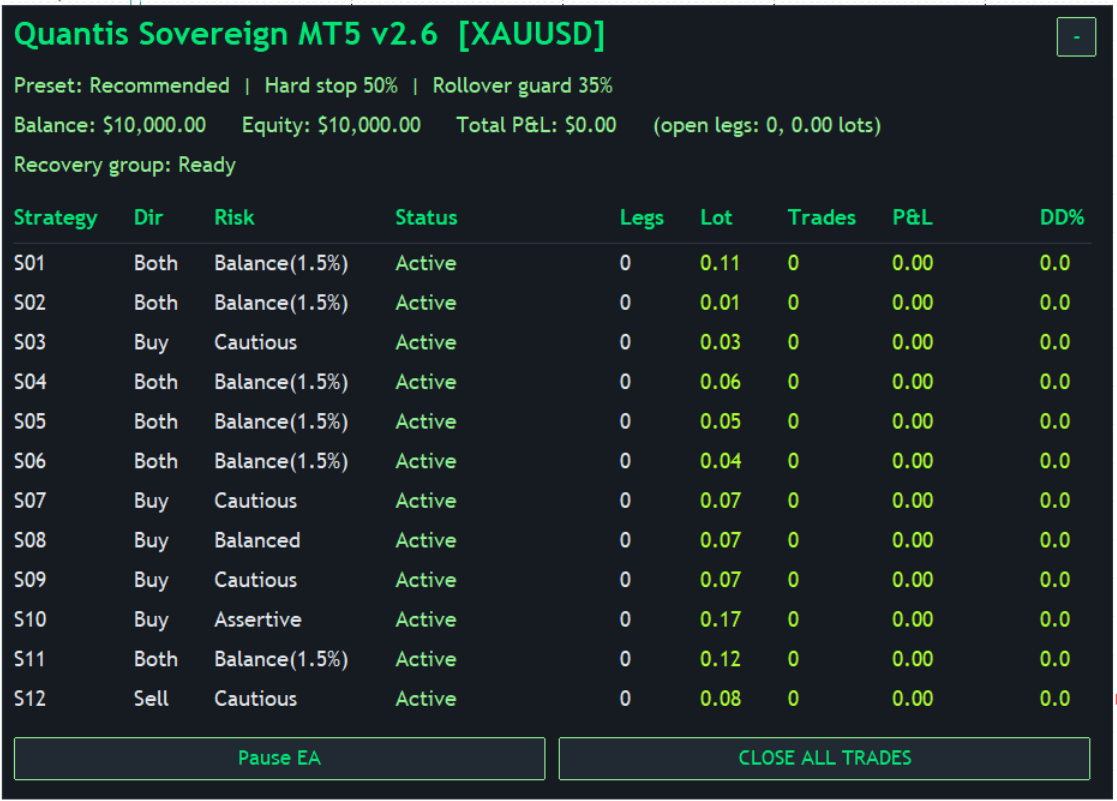
Quantis Sovereign panel on a $10,000 account, Recommended preset, showing the Risk and Lot columns for S03, S07, S08, S09, S10 and S12.
Belt, braces, and a second pair of braces
Jono: OK, so the lots are sensible. What else is in there?
Me: Five more layers. The matrix is the first and the biggest; the rest are there for when the first isn't enough.
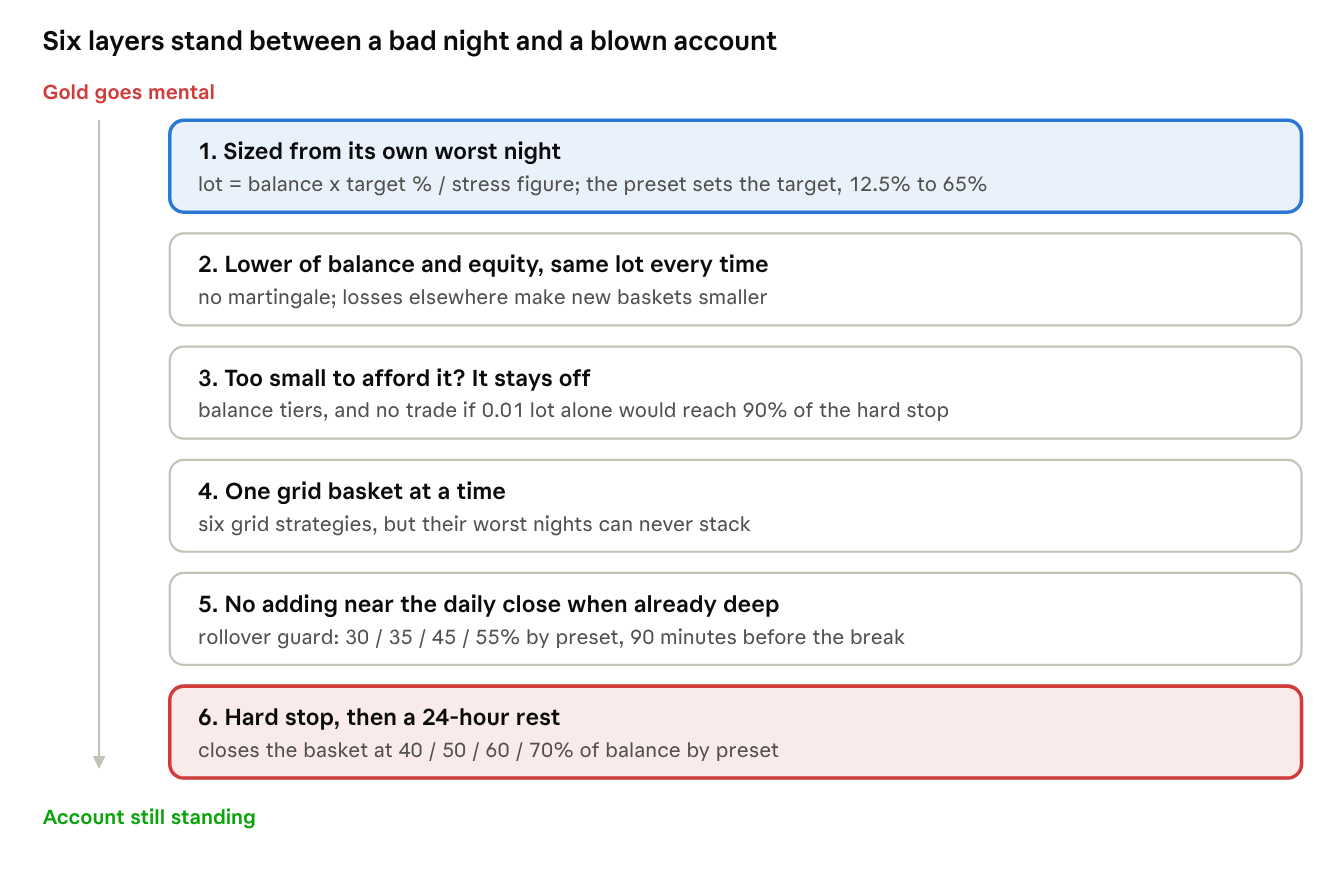
Layer 3 is my favourite, because the EA says "no".
Jono: It refuses to trade? That's a feature?
Me: Best feature in the box. On a small account, even the smallest lot your broker allows, 0.01, can be too big for a strategy's worst night. So the EA checks: if 0.01 lot alone would cost 90% or more of the hard stop, that strategy simply doesn't trade. Combined with each strategy's own balance tier, here's where each grid switches on with the Recommended preset:
| Grid strategy | Balance tier | 0.01 lot affordable from | Starts trading from |
|---|---|---|---|
| S10 | $500 | about $590 | about $590 |
| S08 | $1,000 | about $1,060 | about $1,060 |
| S03 | $1,000 | about $1,470 | about $1,470 |
| S07 | $2,000 | about $650 | $2,000 |
| S12 | $2,000 | about $560 | $2,000 |
| S09 | $3,000 | about $640 | $3,000 |
Jono: So my $600 account runs one grid, not six.
Me: One grid, plus a breakout strategy with a stop loss on every trade. As the account grows, more strategies unlock. Think of it like a learner's licence. You don't get the motorway until you've shown you can park.
Layer 4 is the one I think about on nights like July. Six grid strategies sounds like six chances to blow up. But Quantis Sovereign lets only one grid basket be open at a time. While S08 is busy, the other five sit on their hands. Their worst nights can't pile on top of each other.
Layer 6 is the airbag. If a basket's floating loss ever reaches the hard stop (50% of the balance on Recommended), the EA closes it. Then all grid strategies take a 24-hour breather, so the EA doesn't charge straight back into the market that just bit it.
Jono: And the breakout strategies? They just carry on while a grid is drowning?
Me: No, they step back too. While a grid basket is down 15% on Recommended, no new breakout trade opens. All open breakout trades together are capped at 4% of the account at their stop losses.
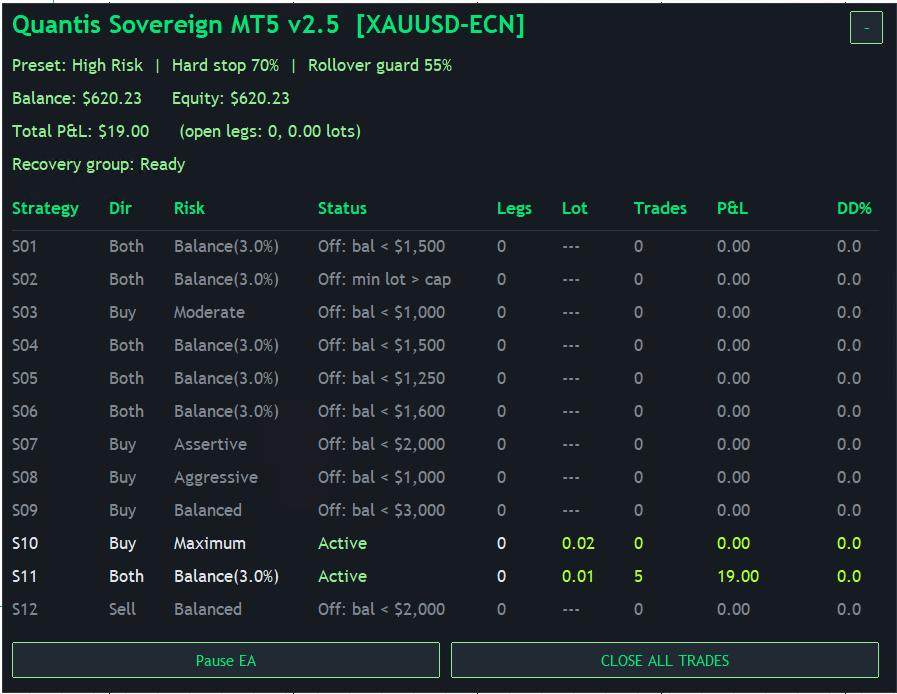
The panel's Status column on a $620 account, with several strategies shown as "Off: bal < …".
What the matrix can't do (the honest bit)
Jono: Right. So it's bulletproof.
Me: No. And anyone who tells you a grid is bulletproof is selling you a grid that's about to explode.
Here's what the Risk Matrix does not do:
- It can't see the future. The stress figures come from history. A night worse than anything in the data will cost more than the target. Then it's the hard stop's turn.
- The hard stop is a real loss, and a big one. 50% on Recommended is half the account. The matrix is built to make that a rare event, not an impossible one.
- Bad luck can repeat. After a hard stop the grid strategies rest for 24 hours, not forever. Two terrible weeks in a row would hurt twice.
- Gaps don't ask permission. If gold jumps over the weekend or at the daily reopen, losses are counted from wherever price lands.
Jono: Has it ever actually happened to you?
Me: Yep. And I'm glad it happened in testing and not on your account.
An earlier version of Quantis Sovereign had a different S01: a grid that sold gold. In a real-tick backtest on a $5,000 Recommended account, gold rallied about $210 on the night of 28–29 January 2026. That basket built up 15 positions and hit the 50% hard stop. Its worst night turned out to be almost four times what its stress figure said.
Jono: So the matrix failed.
Me: The estimate failed. The hard stop did its job: the account lost half, not everything, and kept trading. Then I did the grown-up thing. I took that grid out of S01 completely and replaced it with a breakout strategy that has a stop loss on every trade.
Here are the real-tick results for that same year and account, before and after the change:
| Quantis Sovereign version | Test (real ticks, one broker) | Largest equity drawdown |
|---|---|---|
| 1.0, with the old S01 sell grid | 1 Nov 2025 – 31 Oct 2026, $5,000, Recommended | 53.2% (the January hard stop) |
| 1.5, S01 replaced by a breakout | Same | 24.4% |
| 2.4, current engine | Same | 25.6% |
Jono: A quarter of the account is still a lot.
Me: It is, and I'll keep saying so. That's on Recommended. Conservative is gentler and High is rougher. A backtest is a simulation, not a promise. But a 25% dip you can climb out of is a very different animal to a zero balance and a polite email from your broker.
So, will it save your bacon?
Jono: Give it to me in one sentence. I've had three beers.
Me: Grids don't blow accounts. Grids that are too big for the account do. The Risk Matrix makes sure every grid in Quantis Sovereign is sized so that its worst known night costs a set share of the account, not the whole account.
Jono: That was two sentences.
Me: You've had three beers. You can't count.
The cheat sheet:
- Every grid strategy is sized from its own worst night in the backtests, with a safety margin where the history is thin.
- The preset picks how much that night may cost, from 12.5% to 65%, strategy by strategy. You choose one preset; the EA does the maths.
- Lots follow your balance and equity, whichever is lower. Every position in a basket has the same lot. No martingale.
- One grid basket at a time, so worst nights can't stack.
- A strategy stays off until the account can afford its minimum lot.
- Every basket has a hard stop, and the grids rest for 24 hours after one.
- It isn't magic. Start on Conservative or Recommended, run it on a demo first, and only trade money you can afford to lose.
Jono: And if gold goes properly mental again?
Me: Then it'll hurt. But you'll wake up with an account, a coffee, and something to complain to me about. Which, frankly, is what you do anyway.
If you want to see the Risk Matrix for yourself, Quantis Sovereign has a free demo for the Strategy Tester, and the panel shows every strategy's risk level and lot for your balance. Questions are welcome in the comments.


