
NasCore Scalper
- 专家
- 版本: 2.0

Welcome to the future of algorithmic trading.
The Nascore Scalper EA is a precision-engineered, AI-inspired scalping robot built exclusively for trading NAS100 (US Tech 100 Index). It analyzes smart money footprints, breakout zones, and high-timeframe bias to capture high-probability scalping entries.
Key Features:
-
Optimized for NAS100 (US100) – Fast-moving Nasdaq-based index trading
-
Smart Money Concepts – Integrates structure, breakout logic, and bias
-
Minimal Margin Usage – Ideal for traders with limited capital
-
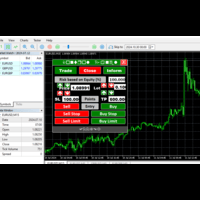
AI-Styled Interface – Visual feedback, blinking indicators, and clean chart setup
-
No Martingale, No Grid, No Hedging – Pure price-action logic
Recommended Settings:
-
Symbol: NAS100 / US100 only
-
Timeframe: H1
-
Recommended Broker: RCG Markets (Low spread & fast execution)
Disclaimer:
This EA is strictly designed for NAS100 trading.
Using it on any other instrument is not supported and may result in poor performance.
Use with RCG Markets or similar low-spread brokers for optimal results.
Past performance does not guarantee future returns. Trade responsibly and always use risk management.











































Review for version 2.0 published 10 May 2025. This almost works for range breakout, except the start/end time settings don't appear to be implemented correctly (or maybe are not named correctly). This EA's end time is the time when pending buy/sell stop orders are placed (so it is actually the start time), and I couldn't quickly figure out the effect of start time (except it must not exceed end time). With defaults where start 10:00, end 21:00, the pending orders are placed at 21:00 and expire at 1:00. When I change these to start 16:30, end 16:30, this appears to cover most of the main Nasdaq session (not just its opening) and it shows almost linear growth on my broker's real ticks for Jan 1, 2026 to Mar 30, which is very impressive. Then the default SL of 20000 points starts being hit frequently, resulting in final equity on Jul 16 almost matching Mar 30's and in recovery factor merely 1.76 for the period Jan 1 to Jul 16. I tried a couple of increased SL values (25000 to be same as TP, 40000 to double the original), but this only hurt overall results. I then tried tiny SL 1000, which obviously hurt the period to Mar 30, but helped achieve some growth in June, resulting in recovery factor 2.39 for Jan 1 to Jul 16, which I also find uncomfortably low for such a lengthy period. I'm sure an optimization run will find a more optimal SL for this dates range, but this may be overfitting not reflecting future performance.