Multi jump
- Experts
- Versão: 2.5

MULTI JUMP — Daily Breakout EA for Crypto, Metals and Indices
Multi Jump waits for the market to leave yesterday's range. Once per day, at a time you choose, it arms a Buy Stop at the previous day's high and a Sell Stop at the previous day's low. If price never reaches a level, nothing is traded that day and the pending orders are removed at the end of the window. If price does break out, the opposite order is cancelled immediately and the position is handed to the management engine.
Everything is measured in ATR, so the same settings adapt to a Bitcoin candle and to a stock index without re-tuning distances by hand.
One chart runs up to three symbols at once. BTCUSD, XAUUSD and US30 are configured out of the box, each with its own risk, filters and trailing settings.
HOW IT WORKS
Entry. One placement attempt per symbol per day, at the first tick inside your trading window. Levels are the previous daily high and low. An order is only sent when the level sits far enough away from the current price — if the market has already run into the breakout level, the day is skipped rather than chased.
Stop and target. Stop-loss distance is a multiple of ATR (H1, period 30 by default). A hard take-profit sits at 5 x ATR as a backstop; in practice most trades are closed by the trailing stop before that level is reached.
Trailing. Once open profit reaches a fraction of the stop distance, the trail arms and then follows the peak price at a fixed offset, never moving backwards.
Dead-trade time stop. If a position is filled but never reaches its trail trigger within a set number of minutes, it is closed. This clears out the false breakouts that drift sideways instead of resolving.
Order slots. Up to three orders per symbol, so you can scale into the same breakout. Each slot has its own trail trigger, and slots 2 and 3 have an optional break-even step.
MULTI-SYMBOL FROM ONE CHART
Attach the EA to a single chart and it runs up to three independent engines. The first slot follows the chart symbol. The second and third are set to XAUUSD and US30 and are switched on with a single input each.
Each symbol carries its own risk percentage, time stop, volatility gate, trail offset and minimum entry distance. They do not share state, and a filter that blocks one symbol does not block the others.
Symbol names are resolved against your broker's actual symbol list, so names such as BTCUSD.r, BTCUSDm, GOLD, #US30, DJ30 and USTEC are matched automatically. If a symbol is genuinely not offered, that slot is disabled with a clear message in the journal instead of failing.
FILTERS AND ACCOUNT PROTECTION
Trading window. Start and finish time in server time, plus per-weekday on/off switches.
Volatility regime gate. Optionally skip the day when ATR is larger than a chosen percentage of price.
Structure gate. Optionally skip a side when the previous day's extreme sits too far inside the recent swing, so the EA is not buying into an established range ceiling.
Loss limits. Optional maximum-loss and daily-loss limits measured on equity. When either is breached, pending orders are deleted, open positions are closed and trading halts. Suited to prop-firm and funded-account rules.
Margin cap. Order volume is reduced to what free margin can actually support, and the order is skipped rather than rejected if even the minimum lot does not fit.
EXECUTION HYGIENE
Much of the work in this version is in the parts you never see:
- Stop-level and freeze-level aware modifications, with a spread-derived cushion for brokers that report a dynamic stops level.
- A minimum trailing step, so the EA does not fire a modify request on every new peak tick.
- A trading-session check, so it does not retry modifications during a symbol's daily break.
- Automatic back-off after a rejected modification instead of an endless retry loop.
- Netting-safe OCO. The opposite stop order is deleted the moment a fill is registered.
- Restart safe. Existing positions are adopted on start-up and the daily placement latch is restored, so a terminal restart does not double up on orders.
- A 15-second internal timer drives management, so the other symbols are handled even when the chart symbol is quiet.
MONEY MANAGEMENT
Fixed lot, or a percentage of balance risked per order, calculated from the actual stop distance and the symbol's tick value. Risk is set per symbol, and the US30 default is deliberately half of the others.
OPTIONAL TRADE LOGGING
A CSV log can be switched on that records every closed trade with its entry context: spread, ATR, bar range, body-to-range ratio, wick sizes, distance to recent swings, candle pattern, session hour and the five preceding bars. One file per symbol, for anyone who wants to analyse results outside the terminal.
GETTING STARTED
1. Attach the EA to a BTCUSD chart. Any timeframe works, as the logic reads daily and H1 data internally.
2. Leave the Symbol 1 name blank to use the chart symbol.
3. To add gold and the Dow, enable Symbol 2 and Symbol 3 and check that the names match your broker.
4. Set the trading window in server time. The defaults assume a GMT+0 server.
5. Choose fixed lot or risk percent, and enable the loss limits if you are on a funded account.
6. Run it on a demo account at your intended broker first. Symbol specifications, spreads and daily session breaks differ between brokers and they change results.
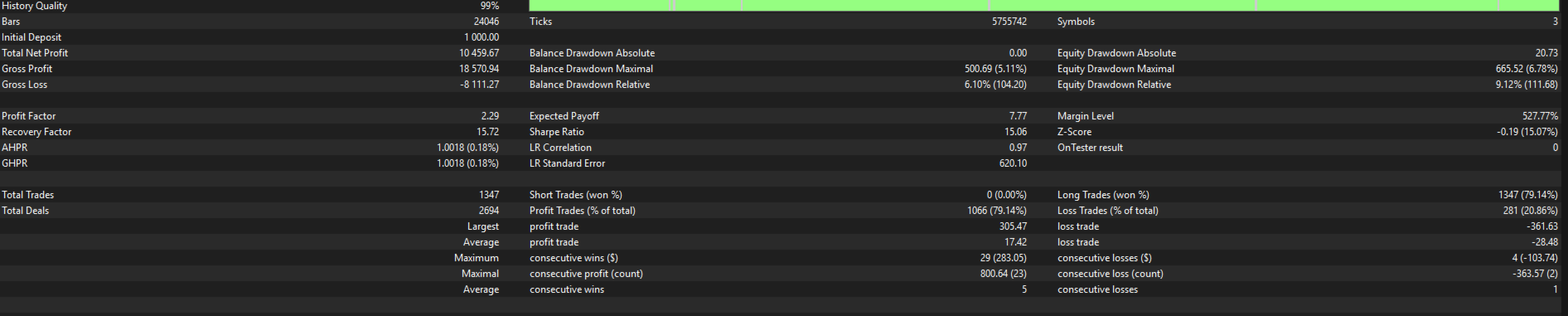
Default settings trade the upside break with a single order slot. Downside breaks and the extra slots are switched on with one input each.
REQUIREMENTS
- MetaTrader 5, hedging or netting account.
- Any chart timeframe. Sufficient daily and H1 history on the traded symbols.
- A VPS or an always-on terminal is recommended, since the daily placement happens at a fixed time.
IMPORTANT
This EA does not use grid, martingale or averaging. Every position carries a stop-loss from the moment it is opened.
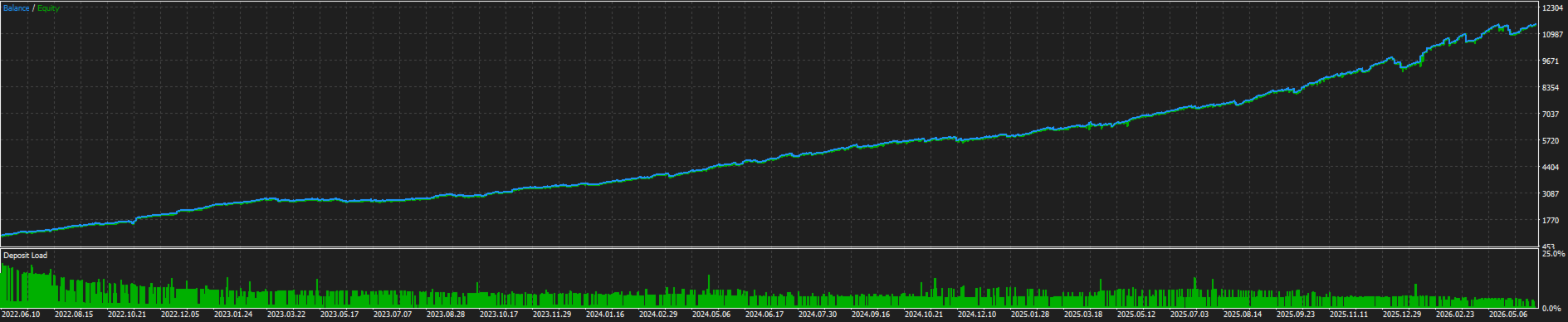
Past and simulated results do not guarantee future performance. Breakout strategies produce long stretches of small losing days between the trending days that pay for them, and results vary with broker spreads, swaps and execution quality. Test on demo before risking capital, and trade only with money you can afford to lose.