Cedora
- エキスパート
- バージョン: 1.10
- アクティベーション: 5

Cedora is built around one idea: the way an account dies is not a bad entry, it is the absence of a limit. So the risk architecture came first and the entry logic was fitted to it.
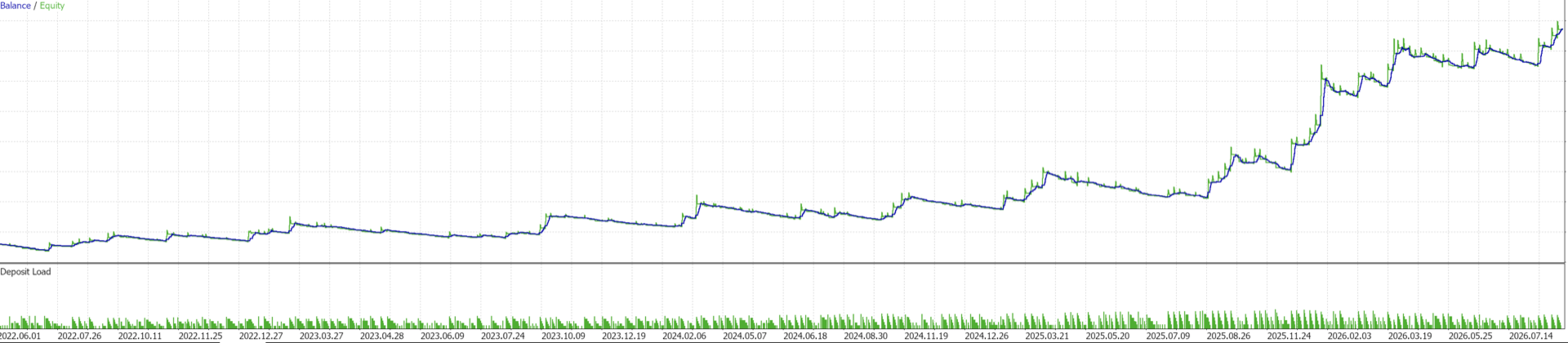
Cedora trades with an established trend and adds to a position only while that position is working. It never adds to a loser. When the trend condition it entered on is gone, it closes the entire position at once — not piece by piece, not on a hope.
What protects your account
- A hard, broker-side stop on every single order. Not a virtual stop held in the EA's memory. If your VPS dies, your power cuts out, or the market gaps over a weekend, the stop is already sitting at the broker.
- A daily loss limit measured on account equity, checked on every tick. Floating losses count — which is how a funded-account daily rule actually works, and why a limit that only watches closed trades is no protection at all.
- A trailing drawdown guard. It measures the fall from your highest recorded equity, flattens when the fall is too large, and then stands down for a cooling-off period before it starts again. This is the control a daily limit cannot give you: a drawdown built up over a run of losing sessions never trips a daily rule, and that is exactly how challenges are failed.
- A profit target that banks the position rather than riding a good trade back to a worse exit.
- Optional break-even stop, session window and Friday-off switch.
What Cedora does not do
No martingale. No grid. No averaging down. No hidden recovery mode. No "it always wins eventually" position that quietly grows until it doesn't. Every position carries a real stop from the moment it opens.
Built for funded accounts
Every money limit is expressed as a percentage of your balance by default, so the same settings behave identically on a small personal account and on a large funded one. One switch converts them to fixed amounts if your firm states its rules that way. Set the daily limit under your firm's daily rule, set the trailing guard under the overall drawdown rule, and the EA enforces both for you.
Settings
Ships with a working default set. Three position-sizing modes: fixed lots, a manual scale-in ladder, or automatic risk-percent sizing. Nine clearly labelled groups — most buyers only need to touch the two risk numbers.
Before you buy
Download the free demo and run it in the Strategy Tester on your symbol, your broker's spread and your account size. The risk settings are yours to set: the defaults are a starting point, not a recommendation. No EA performs the same on every broker, and any seller who tells you otherwise is selling you something else.