PriceForge Pro
- エキスパート
-
Noel Anjao Alube
 Dedicated to developing smart, data-driven trading solutions with a strong focus on performance, risk management, and innovation. Committed to transforming trading ideas into automated strategies.
 - バージョン: 1.10
- アクティベーション: 5
"Structure Doesn't Lie — PriceForge Pro Reads It Before the Market Moves."
NOTE :WILL CONFIGURE THE TELEGRAM NOTIFICATIONS AFTER PURCHASE SINCE WE CANT POST WITH THE BOTTOKEN AND ID
PriceForge Pro is a multi-symbol, pure price-action scanner and execution engine for MetaTrader 5. It runs across a configurable basket of symbols simultaneously (default: EURUSD, GBPUSD, XAUUSD, USDJPY, GBPJPY), building an independent market structure model for each one and only acting when multiple independent forms of confirmation line up.
How It Reads the Market
For every symbol, on every new bar of the structure timeframe, the EA rebuilds a swing-point map using fractal highs and lows. From that swing map it derives three things:
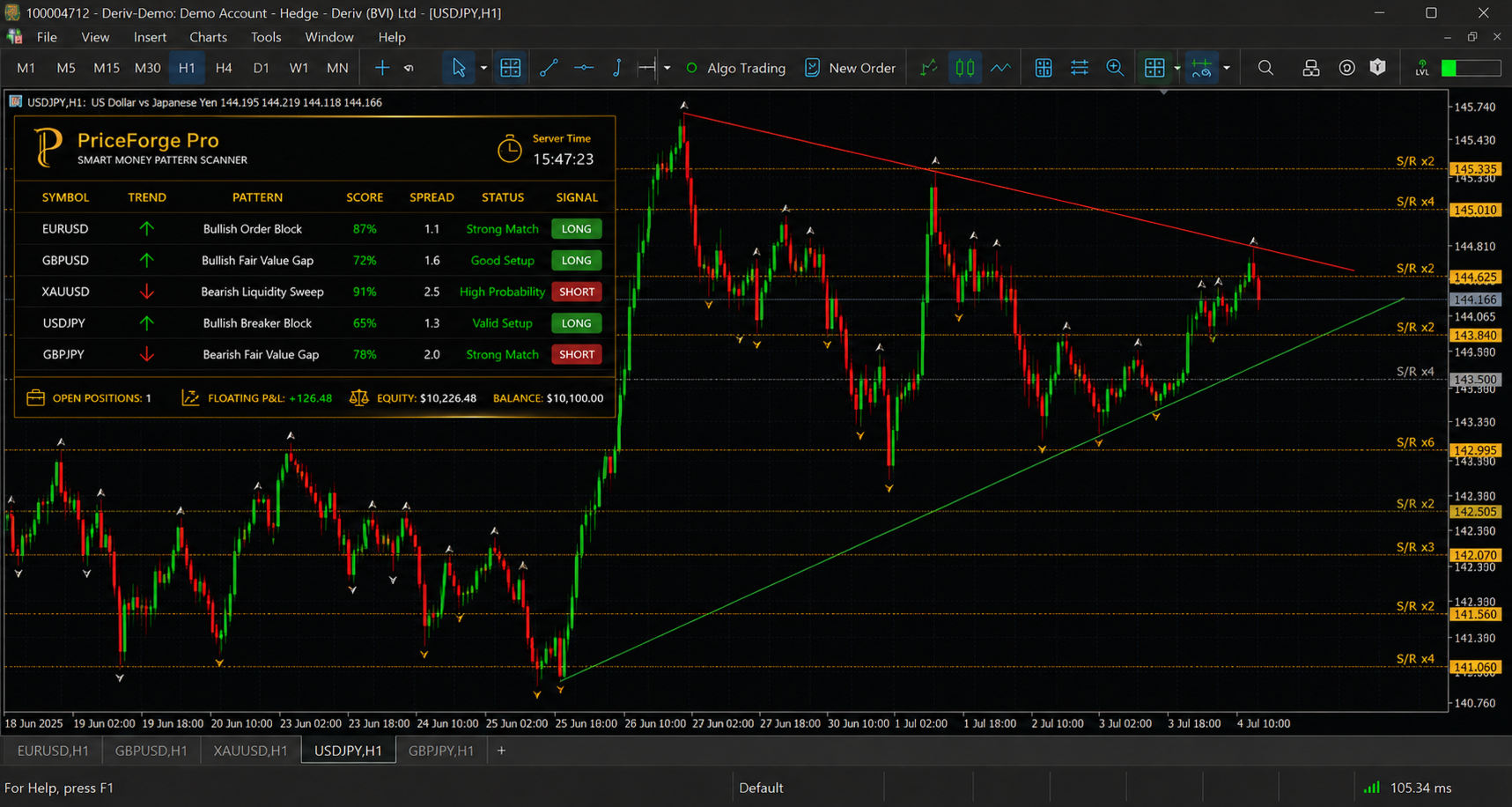
- Trend state — classified as an uptrend, downtrend, or range based on the sequence of higher highs/higher lows or lower highs/lower lows in recent swing points.
- Support and resistance levels — nearby swing points are clustered together (using ATR-based distance) into a small set of ranked levels, weighted by how many times price has reacted from that zone.
- Trendlines — a linear regression fit through the most recent swing lows (support) and swing highs (resistance), projected forward to the current bar.
How It Finds a Setup
On the signal timeframe, the EA scans the most recent candles for classic price-action patterns — engulfing candles, pin bars, outside bars, inside bars, morning/evening star formations, and doji — each scored by how large the pattern is relative to current volatility (ATR), not just whether it technically qualifies.
A candlestick pattern alone is never enough to trade. Before a signal is considered, it must accumulate confluence points from independent conditions:
- A qualifying candlestick pattern in a clear direction
- Trend alignment on the structure timeframe (a long only qualifies in an established uptrend, a short only in a downtrend)
- Proximity to a ranked support/resistance level
- Proximity to a live trendline
- A double top/bottom structural pattern in the same direction
A trade is only considered once the number of confirming factors reaches the configured minimum confluence threshold. This filters out signals that look right in isolation but lack broader structural support.
How It Manages Risk Before Entry
Once a setup qualifies, the EA does not simply fire an order. It runs through a sequence of independent safety checks:
- Spread and session filters reject signals during illiquid or wide-spread conditions.
- ATR sanity checking compares short-period ATR against a longer baseline; if the short reading is disproportionately larger, it's treated as a corrupted or spike reading and the signal is skipped rather than used to size a stop.
- Stop-loss distance is capped as a percentage of price, independent of the ATR calculation, so no single trade's initial risk can ever exceed a defined ceiling regardless of volatility conditions at the time.
- Position sizing is calculated from account risk percentage, then cross-checked against available margin and hard-capped at a maximum lot size, so a single trade can never consume an unsafe share of the account.
- Hedge and duplicate guards prevent opening a new position in a symbol/direction that already has an active position or pending order, and prevent opening opposite-direction trades on the same symbol simultaneously.
How It Executes
Approved signals are re-validated against live bid/ask at the moment of execution — stop and take-profit levels are re-anchored to the current price, re-checked against the broker's minimum stop and freeze levels, and lot size is recalculated from the final, execution-time stop distance rather than the distance calculated at signal time. This avoids submitting orders with stale pricing.
Trades use a two-tier take-profit structure (a nearer and a further target) with a defined risk-reward ratio on each.
How It Manages Open Trades
Once filled, each position is managed independently:
- Breakeven — stop-loss is moved to lock in a small buffer once price reaches a defined multiple of the original risk.
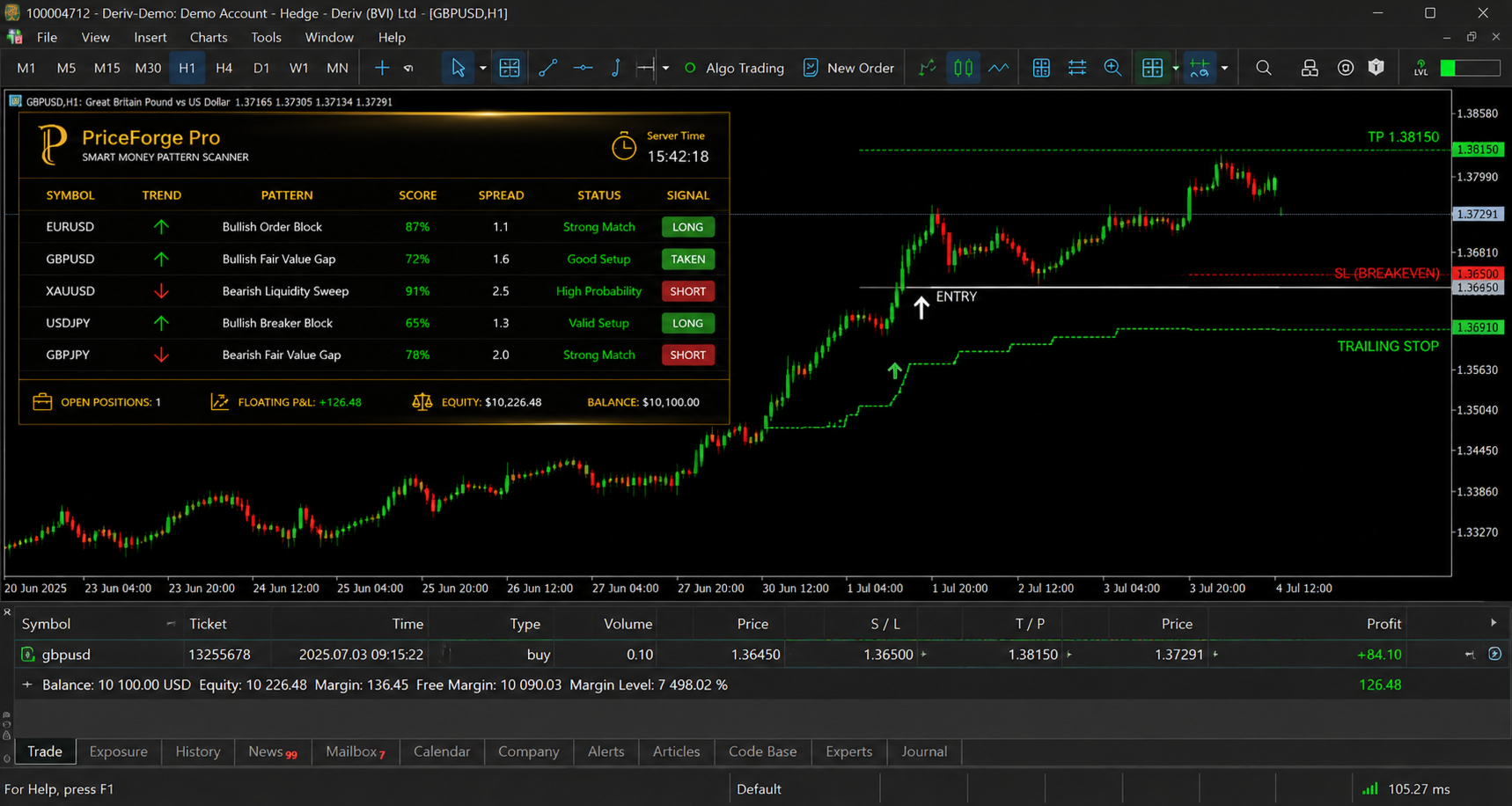
- Trailing stop — after breakeven, the stop trails using a combination of ATR-based distance and a step-based profit-lock ladder, which banks in progressively larger portions of favorable movement as the trade extends.
- Gap protection — every tick, each open position's live price is compared against its own stop-loss level. If price has already traded through that level without the stop order filling (a genuine gap or slippage failure), the position is closed immediately regardless of size, rather than being left to float.
- Margin-level protection — the EA continuously monitors account-wide margin level. New trades are blocked once margin level falls below a safe threshold, and if it drops further into a critical zone, the single worst-performing open position is closed proactively to protect the rest of the account.
- Daily loss and loss-streak limits — trading pauses automatically for the remainder of the day once a maximum daily loss percentage or a maximum number of consecutive losing trades is reached, resetting at the next trading day.
Monitoring
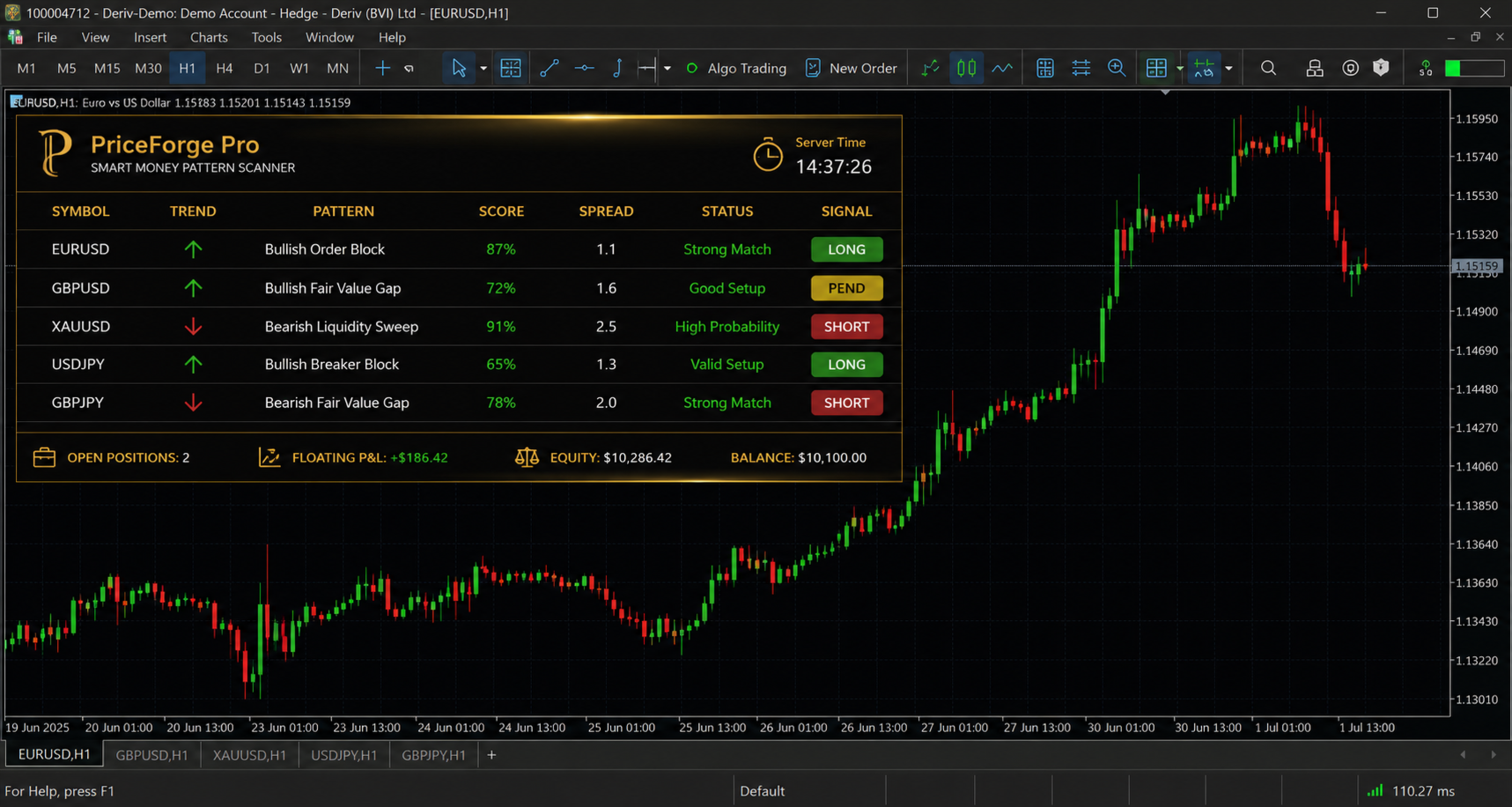
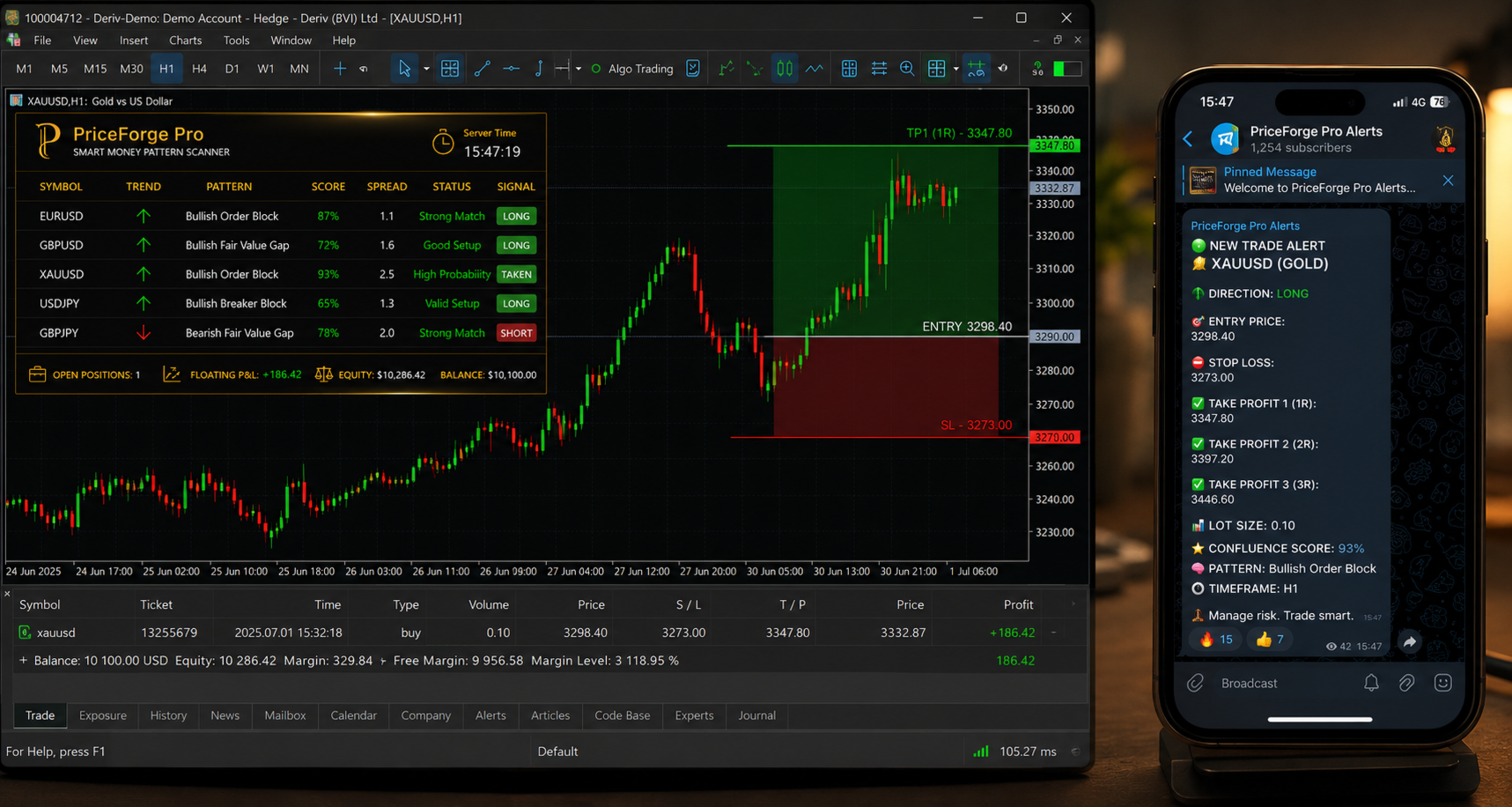
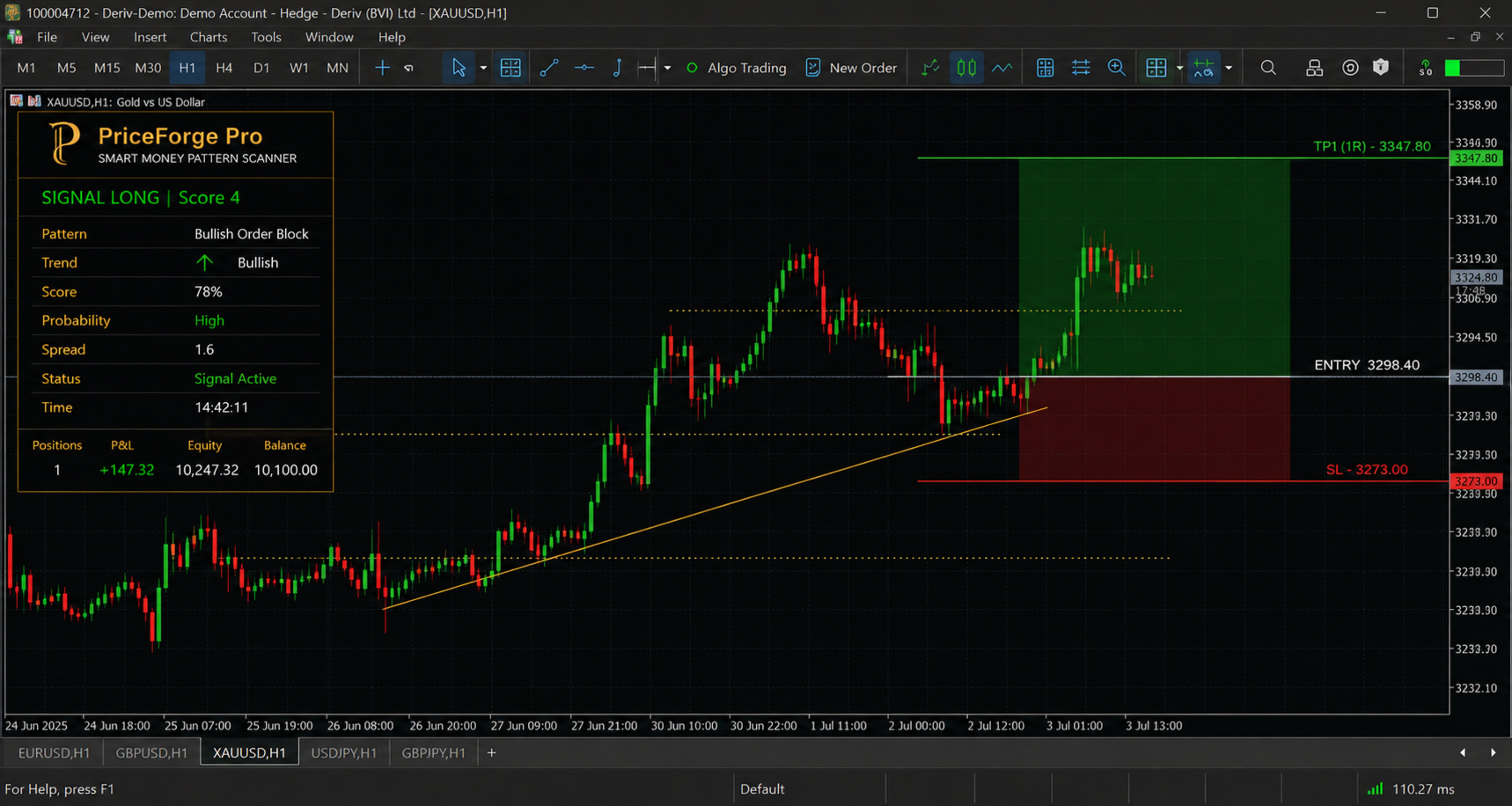
A live on-chart dashboard shows, per symbol: current trend, last detected pattern and its strength, live spread, current trade status (watching, pending, taken, missed, or filtered), and open long/short state. Account-level stats — daily P/L, consecutive losses, floating exposure, equity, and balance — are shown continuously. Optional Telegram alerts mirror every signal, fill, close, and protective action in real time.