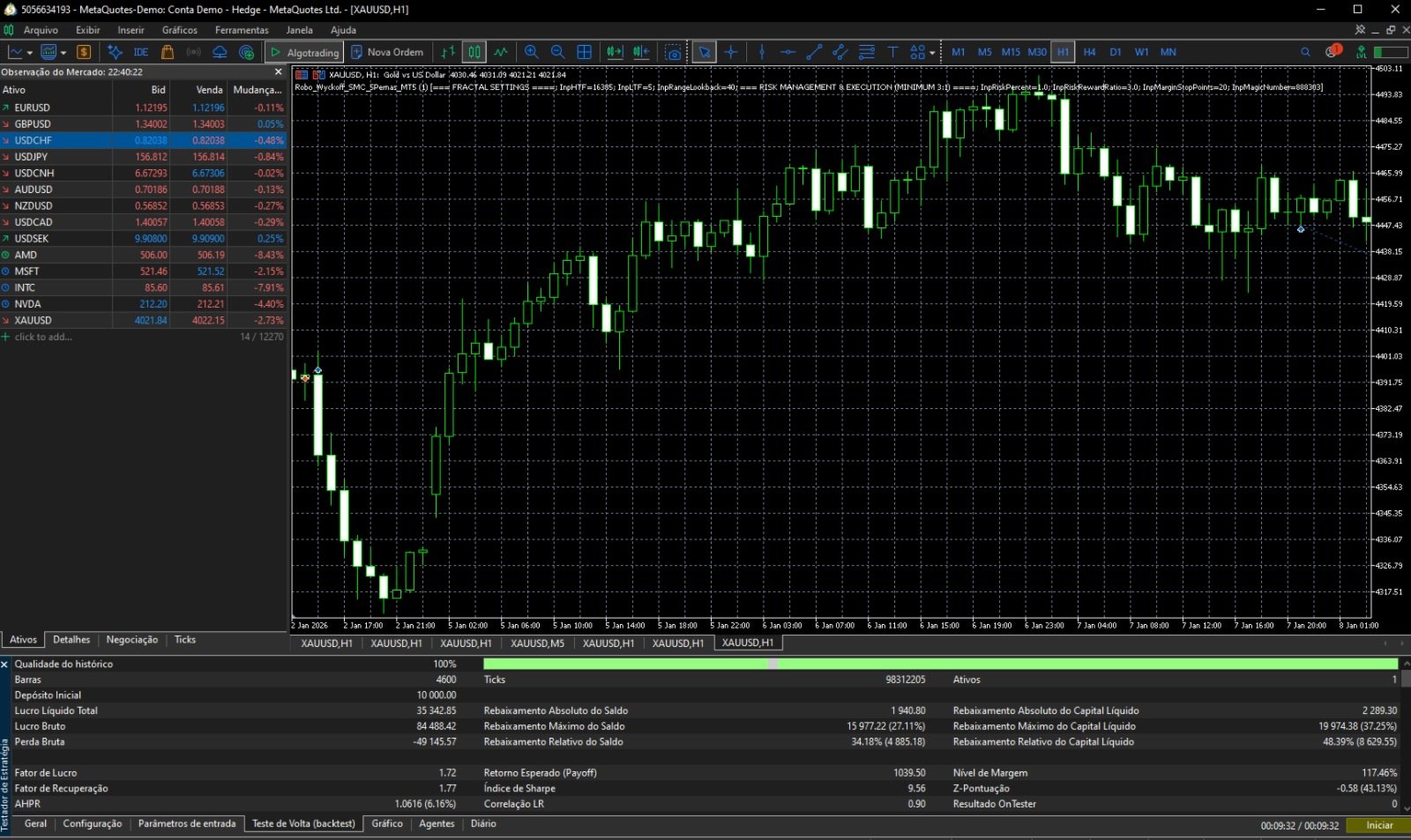
Gold Wyckoff SMC
- Experts
- Versione: 3.0
- Attivazioni: 5

5-Leg Continuation Pattern with Inducement, Retest, and a Minimum 3:1 Risk-to-Reward Ratio
This document details the logical architecture, execution flow, and mathematical foundations of the trading robots developed for Profit Pro (B3 – NTSL) and MetaTrader 5 (Forex – MQL5).
1. Overview of the Institutional Trading Logic
The strategy is designed to trade strictly in alignment with major market participants (banks and market makers), avoiding common liquidity traps that trigger retail traders' stop-loss orders.
The trading cycle consists of three main phases:
-
Macro Context: Identification of the Wyckoff Trading Range following an exhaustion phase (Selling Climax for long positions or Buying Climax for short positions).
-
Liquidity Sweep: A false breakout beyond the trading range boundaries (Spring at the bottom or UTAD at the top), capturing liquidity from late breakout traders and triggering premature stop-loss orders.
-
5-Leg Structural Pattern with Inducement and Retest: Formation of a confirmation microstructure that induces retail traders into making a second mistake before expanding in the true institutional direction.
2. Anatomy of the 5-Leg Pattern (Bullish Scenario)
After the price executes a Spring (the lowest point of the liquidity sweep, referred to as Point Zero) and closes back inside the Wyckoff Trading Range, the system begins tracking the formation of five price legs:
-
Leg 1 (Initial Impulse): An upward movement originating from the liquidity sweep low. It establishes the first local high (vTopoPerna1).
-
Leg 2 (Primary Correction): A bearish corrective pullback that forms an intermediate low (vFundoPerna2). This low must remain strictly above the liquidity sweep low (Point Zero).
-
Leg 3 (Continuation Expansion): A strong bullish impulse that breaks above the high of Leg 1 (vTopoPerna3 > vTopoPerna1). Retail traders identify a classic bullish pivot and place their stop-loss orders just below the low of Leg 2.
-
Leg 4 (Inducement / Internal Liquidity Hunt): A precise bearish corrective movement. Fundamental Rule: Leg 4 breaks below the low of Leg 2 (vFundoPerna4 < vFundoPerna2), triggering long traders' stop-loss orders and attracting new breakout sellers, while respecting and not breaking the low of Leg 1 / the liquidity sweep low.
-
Leg 5 (Definitive Break of Structure / BOS): A powerful institutional bullish expansion that breaks and closes above the high of Leg 3 (Close > vTopoPerna3), confirming the absorption of selling pressure.
[High 3] [High 5] (New High / BOS) /\ /\ [High 1] / \ / \ /\ / \ / \ [BUY TRIGGER ON RETEST] / \ / \ / \---------> * Touches the structure / [Low 2] \ / / \ [Low 4] / <--- Inducement: breaks Low 2, \ /\ / respects Low 0 \ / \ / (Technical Stop-Loss Level) \_/ \ / \/ [Low 0 - Spring] (Wyckoff Trading Range Liquidity Sweep)
3. Entry Point, Stop Loss, and Take Profit
-
Entry Trigger (Retest): The robot does not chase the high of Leg 5. Instead, it waits for the price to return and test the confluence zone of the validated structure (the Leg 1 high / Leg 4 order block area). When the price touches this level, a market buy order is triggered.
-
Technical Stop Loss: Placed strictly below the low of Leg 4 (vFundoPerna4 minus a safety buffer). This level defines the continuation structure: if the price breaches this low, the accumulation pattern is invalidated.
-
Mandatory Minimum 3:1 Risk-to-Reward Ratio: The distance between the entry price and the Stop Loss is multiplied by at least 3.0 to determine the minimum profit target. For example:
-
Mini Ibovespa Futures (WIN): 120-point Stop Loss → Minimum 360-point profit target.
-
Forex (EUR/USD): 15-pip Stop Loss → Minimum 45-pip profit target.
-
4. Symmetrical Bearish Scenario (UTAD / Distribution)
In an institutional distribution scenario:
-
UTAD: The price breaks above the upper boundary of the Wyckoff Trading Range and closes back below resistance.
-
Leg 1: A bearish movement establishes the first local low.
-
Leg 2: A bullish correction that respects the liquidity sweep high.
-
Leg 3: A bearish displacement that establishes a new low below Leg 1.
-
Leg 4 (Inducement): An upward movement that breaks above the high of Leg 2 (triggering short traders' stop-loss orders), while respecting the liquidity sweep high.
-
Leg 5: A strong bearish movement that breaks below the low of Leg 3.
-
Retest: A sell order is executed when the price returns to test the structural zone, with the Stop Loss positioned above the high of Leg 4 and a minimum 3:1 risk-to-reward target.