ChronosNasdaq
- Experts
- Versione: 1.0
- Attivazioni: 15

ChronosNasdaq — USTEC (Nasdaq) H1 Trend-Following EA
A disciplined Nasdaq breakout system with a split exit: lock in gains on half the position, let the other half run with the trend. No martingale, no grid — validated on real MT5 history including a real bear-market stretch, beating buy-and-hold on both return and risk.
Description
ChronosNasdaq is a fully systematic Expert Advisor for **USTEC (Nasdaq 100 index/CFD) on the H1 timeframe**. It trades a **Donchian breakout** (long-only): it enters when price clears a rolling high with a volatility-adjusted confirmation buffer and a dual moving-average regime filter, then manages the exit in two halves instead of one fixed target.
**This is NOT a martingale or grid system.** Position size is a fixed fraction of account equity, recalculated fresh at every entry — it never doubles, averages into losers, or scales up after a win or a loss. Every trade risks the same amount, independent of what happened on the previous one.
How the exit works (the core idea)
Most breakout systems face a trade-off: a tight fixed target locks in consistent wins but caps the big trends; a pure trend-following exit captures the big trends but gives back more on the average trade. ChronosNasdaq splits the difference directly:
- **Half the position** closes at a fixed target (a multiple of ATR) — this is what drives the high win rate and Profit Factor.
- **The other half** stays open with a trend-following exit (a breakout of the recent low) — this is what captures the occasional large trending move that a fixed target would have cut short.
- **A single protective stop-loss**, set once at entry as a broker-native stop (survives platform restarts), covers both halves.
What makes it robust
- **Dual-timeframe regime filter**: entries only fire when the medium-term trend (moving average) is up — this keeps the system out of the choppy, range-bound stretches where breakout systems typically bleed out.
- **ATR-adaptive entry buffer**: the breakout level must be cleared by a multiple of ATR, not just touched — this filters out marginal, noise-driven breakouts.
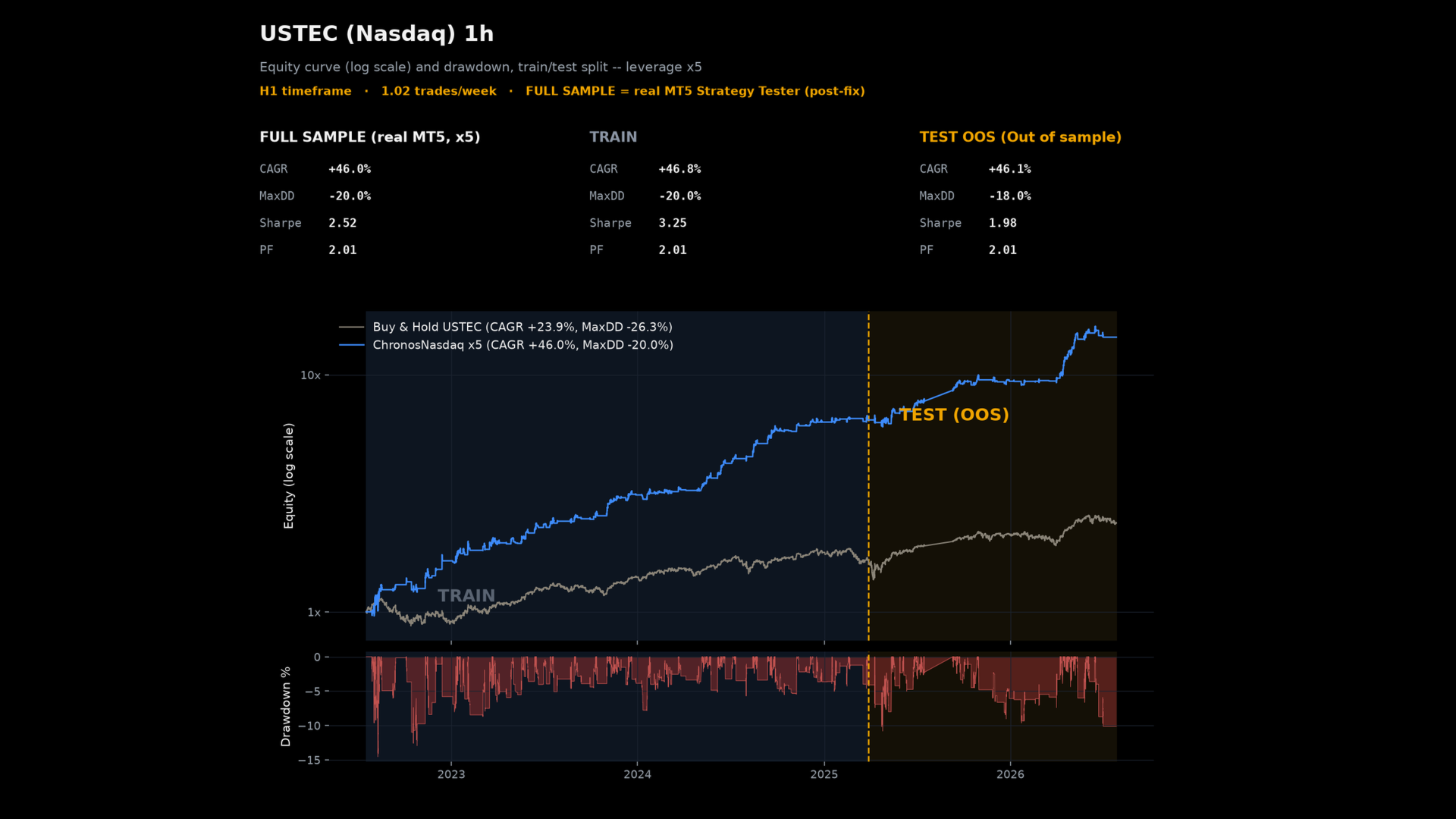
- **Train/test validated on REAL broker history**: parameters were chosen on a 70% in-sample window and confirmed on the untouched 30% out-of-sample window before being finalized. Critically, the validation history includes a real corrective/bear stretch for the index, not just a one-directional bull run — a system that only ever saw an uptrend can't tell you how it survives a drawdown.
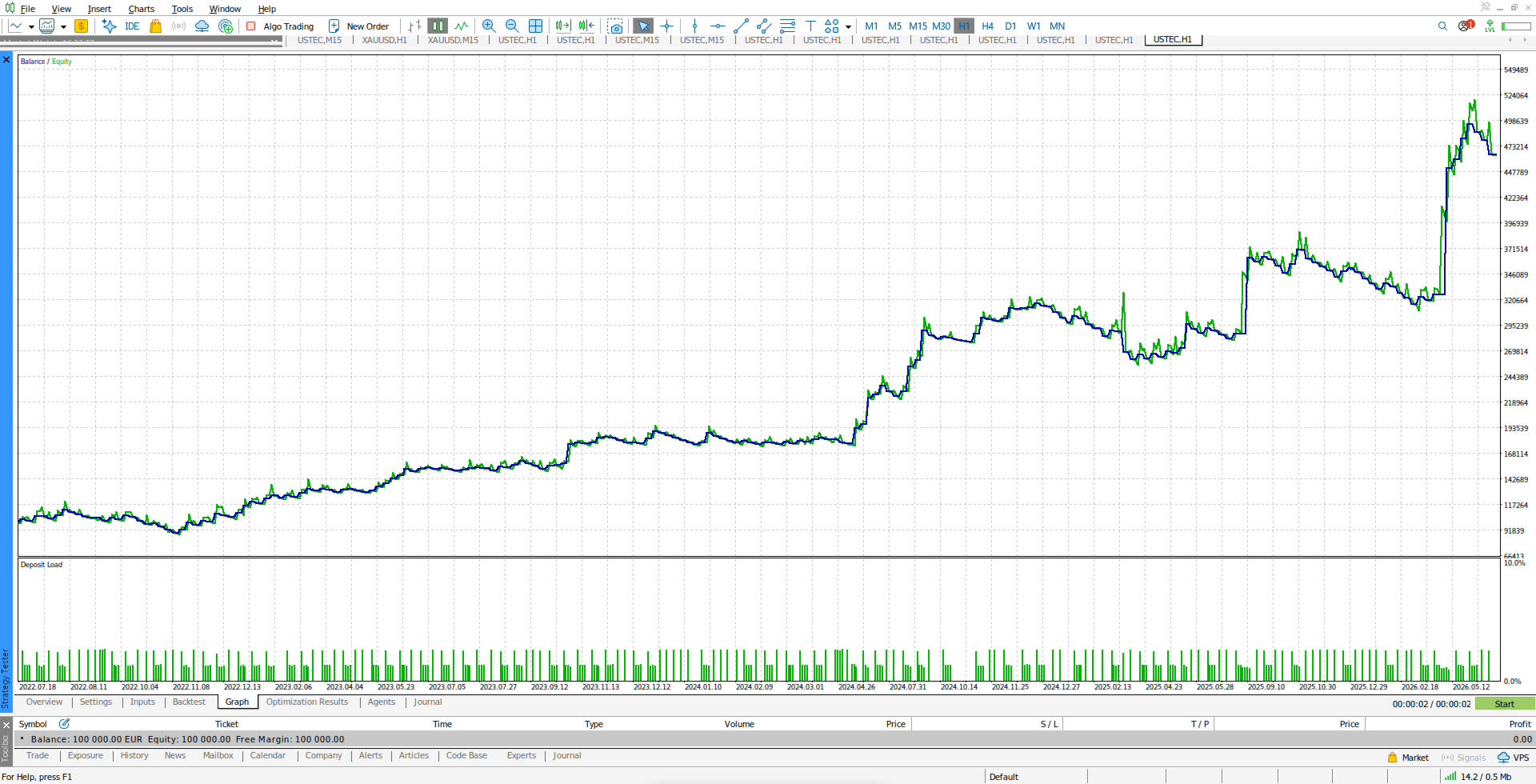
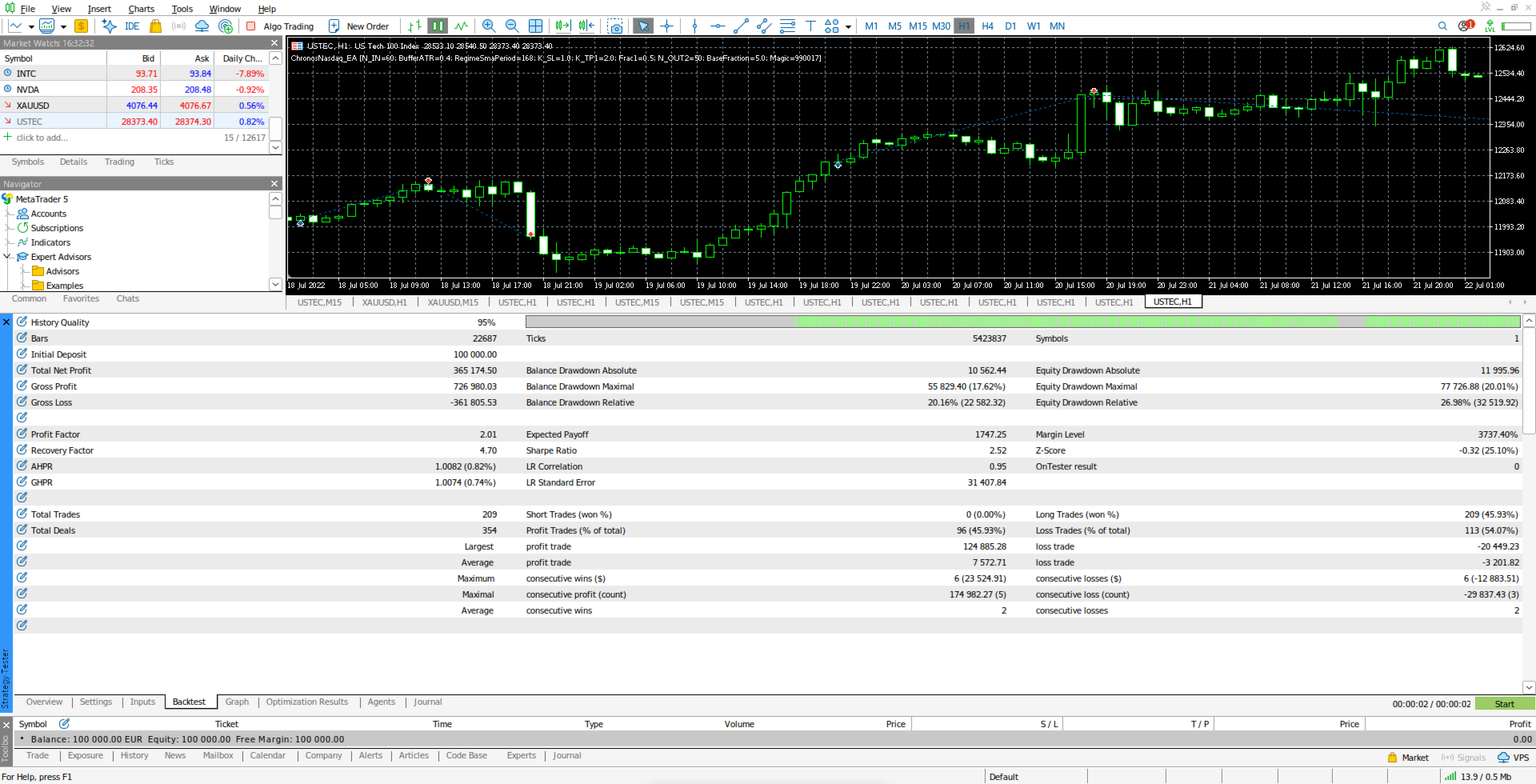
ChronosNasdaq roughly doubles the buy-and-hold return while taking meaningfully *less* drawdown — the position sizing is tuned so the strategy's own edge (not just leverage) is what drives the outperformance.
Key features
- Long-only Donchian breakout, H1, tuned specifically for the Nasdaq index
- Dual moving-average regime filter
- ATR-based breakout confirmation buffer
- **Split exit**: partial fixed target + trend-following runner on the remainder
- Fixed-fraction position sizing (no martingale, no grid, no averaging)
- Broker-native stop-loss (persists across EA/platform restarts)
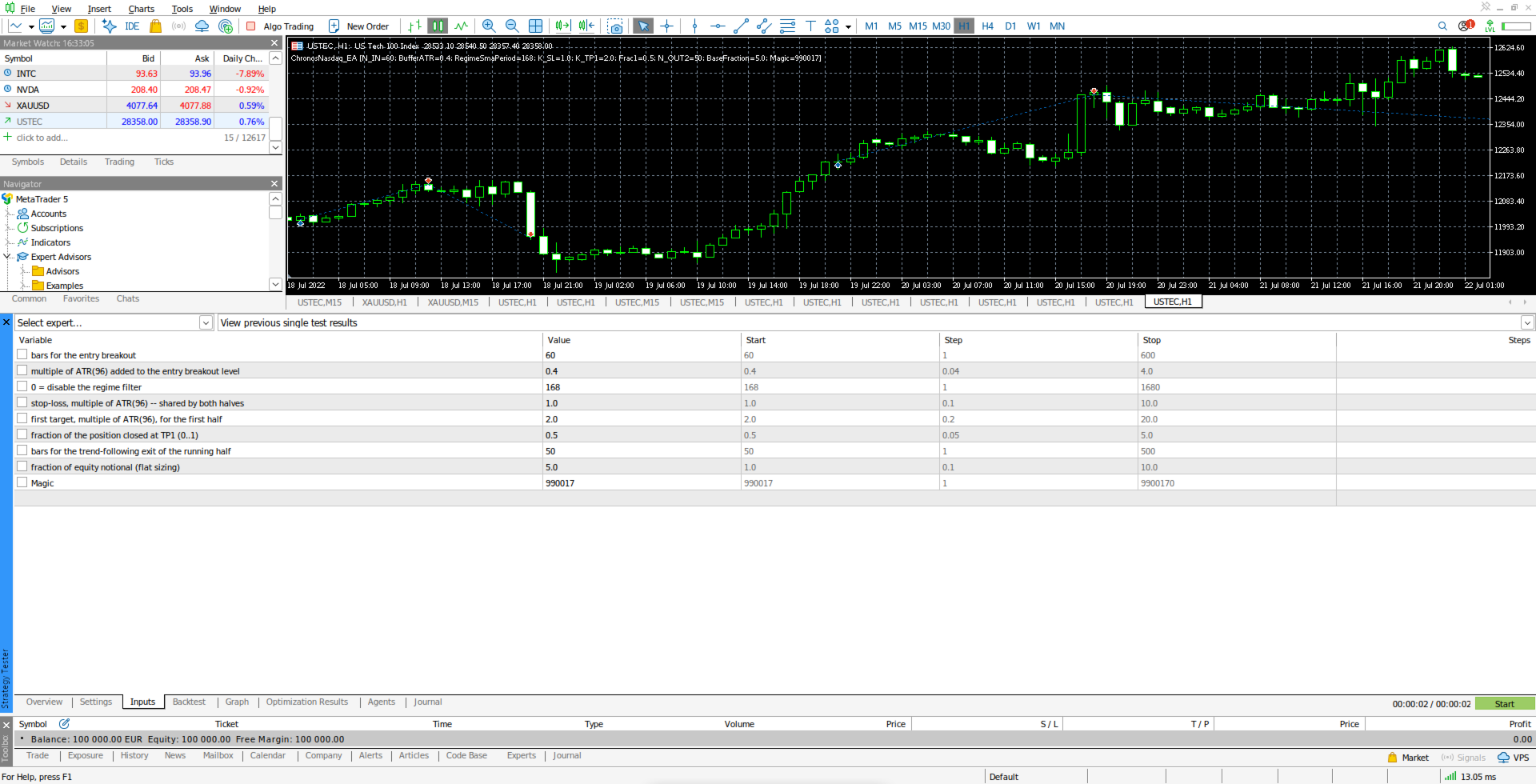
- Fully parametrized inputs (breakout lookback, regime filter period, ATR buffer, target/stop multiples, split ratio, risk fraction)
- Netting- and hedging-account compatible; single-position logic (never layers overlapping tickets)
Recommended use
- Symbol: USTEC (or your broker's Nasdaq 100 CFD/index equivalent)
- Timeframe: H1
- Account type: any (hedging or netting)
- Start conservative: lower the risk fraction input and confirm behavior in the Strategy Tester or on demo before scaling up or trading live capital.
Honest disclaimer
Past backtest performance, including the figures above, does not guarantee future results. Index volatility regimes change over time, and any trend-following system will have losing streaks and drawdown periods — this backtest includes one such stretch, but a longer or different future downturn could behave differently. This EA is a risk-management tool, not a guarantee — position sizing should always match your own risk tolerance. Recommended: validate on a demo account before committing real capital.
A disciplined Nasdaq breakout system with a split exit: lock in gains on half the position, let the other half run with the trend. No martingale, no grid — validated on real MT5 history including a real bear-market stretch, beating buy-and-hold on both return and risk.
Description
ChronosNasdaq is a fully systematic Expert Advisor for **USTEC (Nasdaq 100 index/CFD) on the H1 timeframe**. It trades a **Donchian breakout** (long-only): it enters when price clears a rolling high with a volatility-adjusted confirmation buffer and a dual moving-average regime filter, then manages the exit in two halves instead of one fixed target.
**This is NOT a martingale or grid system.** Position size is a fixed fraction of account equity, recalculated fresh at every entry — it never doubles, averages into losers, or scales up after a win or a loss. Every trade risks the same amount, independent of what happened on the previous one.
How the exit works (the core idea)
Most breakout systems face a trade-off: a tight fixed target locks in consistent wins but caps the big trends; a pure trend-following exit captures the big trends but gives back more on the average trade. ChronosNasdaq splits the difference directly:
- **Half the position** closes at a fixed target (a multiple of ATR) — this is what drives the high win rate and Profit Factor.
- **The other half** stays open with a trend-following exit (a breakout of the recent low) — this is what captures the occasional large trending move that a fixed target would have cut short.
- **A single protective stop-loss**, set once at entry as a broker-native stop (survives platform restarts), covers both halves.
What makes it robust
- **Dual-timeframe regime filter**: entries only fire when the medium-term trend (moving average) is up — this keeps the system out of the choppy, range-bound stretches where breakout systems typically bleed out.
- **ATR-adaptive entry buffer**: the breakout level must be cleared by a multiple of ATR, not just touched — this filters out marginal, noise-driven breakouts.
- **Train/test validated on REAL broker history**: parameters were chosen on a 70% in-sample window and confirmed on the untouched 30% out-of-sample window before being finalized. Critically, the validation history includes a real corrective/bear stretch for the index, not just a one-directional bull run — a system that only ever saw an uptrend can't tell you how it survives a drawdown.
ChronosNasdaq roughly doubles the buy-and-hold return while taking meaningfully *less* drawdown — the position sizing is tuned so the strategy's own edge (not just leverage) is what drives the outperformance.
Key features
- Long-only Donchian breakout, H1, tuned specifically for the Nasdaq index
- Dual moving-average regime filter
- ATR-based breakout confirmation buffer
- **Split exit**: partial fixed target + trend-following runner on the remainder
- Fixed-fraction position sizing (no martingale, no grid, no averaging)
- Broker-native stop-loss (persists across EA/platform restarts)
- Fully parametrized inputs (breakout lookback, regime filter period, ATR buffer, target/stop multiples, split ratio, risk fraction)
- Netting- and hedging-account compatible; single-position logic (never layers overlapping tickets)
Recommended use
- Symbol: USTEC (or your broker's Nasdaq 100 CFD/index equivalent)
- Timeframe: H1
- Account type: any (hedging or netting)
- Start conservative: lower the risk fraction input and confirm behavior in the Strategy Tester or on demo before scaling up or trading live capital.
Honest disclaimer
Past backtest performance, including the figures above, does not guarantee future results. Index volatility regimes change over time, and any trend-following system will have losing streaks and drawdown periods — this backtest includes one such stretch, but a longer or different future downturn could behave differently. This EA is a risk-management tool, not a guarantee — position sizing should always match your own risk tolerance. Recommended: validate on a demo account before committing real capital.