 MetaTrader 5
 Sistemi Esperti
 Indicatori
 Script
 Librerie
 Archiviazione
Unisciti alla nostra fan page

Cointegration: ADF, Engle-Granger and Johansen tests with a pair scanner - libreria per MetaTrader 5

Cosa faccio:
- Trasformo la tua strategia, il tuo script TradingView o le tue regole scritte in un Expert Advisor MT5 pulito
- Visualizzazioni:
- 55
- Pubblicato:
-
 Ti stai perdendo delle opportunità di trading:
- App di trading gratuite
- Oltre 8.000 segnali per il copy trading
- Notizie economiche per esplorare i mercati finanziari
Registrazione AccediAccetti la politica del sito e le condizioni d’uso
Se non hai un account, registrati -
 Hai bisogno di un robot o indicatore basato su questo codice? Ordinalo su Freelance
Vai a Freelance
Cointegration.mqh tests whether price series share a long-run relation, the condition behind pairs and spread trading. It has the augmented Dickey-Fuller unit root test, the Engle-Granger test for two to six series, and the Johansen trace and maximum eigenvalue tests, with p-values and critical values, plus the spread, its half-life of mean reversion and its z-score. No DLL.
Usage
#include <Cointegration\Cointegration.mqh>

vector a, b;                                   // log prices of two symbols on the same bars
// ... fill a and b ...
matrix x(a.Size(), 1);
x.Col(b, 0);
SEngleGrangerResult eg;
vector coef;                                   // hedge ratio, then the constant
if(CCointegration::EngleGranger(a, x, eg, coef) && eg.pvalue < 0.05)
  {
   vector spread = CCointegration::Spread(a, x, coef);
   double half = CCointegration::HalfLife(spread);   // periods
   double z = CCointegration::ZScore(spread, 60);
  }

SAdfResult adf;
CCointegration::Adf(a, adf, COINT_TREND_CONSTANT, COINT_LAGS_AIC);   // adf.stat, adf.pvalue, adf.lags

matrix prices(a.Size(), 2);
prices.Col(a, 0);
prices.Col(b, 1);
CJohansenResult jo;
CCointegration::Johansen(prices, 0, 1, jo);    // constant, 1 lagged difference
int rank = jo.Rank();                          // number of relations by the trace test at 95%
What is in it
- Adf: no constant, constant, linear trend or quadratic trend; the number of lags is fixed or chosen by AIC, BIC or the t-statistic of the last lag, with the default maximum of statsmodels (12 (n/100)^(1/4)). The lag search uses a single QR factorization for every lag length.
- EngleGranger: least squares of the first series on the others and the trend, then ADF without constant on the residuals, with the p-values and critical values for cointegration (they depend on the number of series).
- Johansen: no deterministic term, constant or linear trend, any number of lagged differences; eigenvalues, cointegrating vectors (normalized so that v' Skk v = 1, or with the first element 1 by Vector()), trace and maximum eigenvalue statistics, critical values at 90%, 95% and 99% for up to 12 series, and the rank. The eigenproblem is solved as a symmetric one after a Cholesky factorization.
- MacKinnonP and MacKinnonCrit: approximate p-values (MacKinnon 1994) and finite-sample critical values (MacKinnon 2010), usable for any Dickey-Fuller type statistic.
- Ols: least squares by Householder QR with t-statistics.
Example
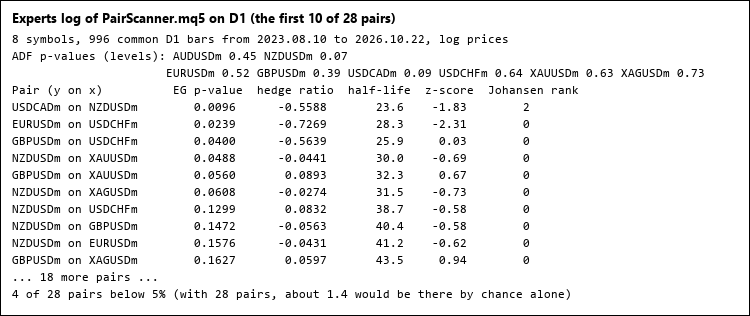
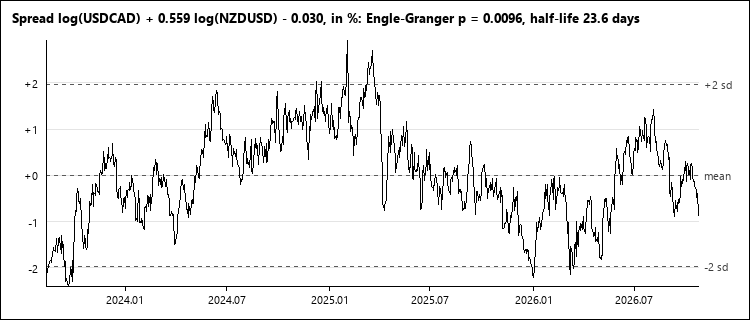
The script PairScanner.mq5 takes a list of symbols (the broker suffix is found by itself), keeps the bars they all have, prints the ADF p-value of each one, then tests every pair in both directions and prints them sorted by Engle-Granger p-value, with the hedge ratio, the half-life, the z-score of the spread and the Johansen rank (picture 1). It also says how many pairs would pass at 5% by chance: with 28 pairs, about 1.4. The spread of the best pair can be written to a CSV file (picture 2).
A Johansen rank of 2 for a pair means that both series look stationary on their own (here NZDUSD and USDCAD have ADF p-values of 0.07 and 0.09), not that the pair has two relations.
Checked
Against statsmodels 0.15 (adfuller, coint, coint_johansen, mackinnonp, mackinnoncrit) on six data sets: three simulated systems with 0, 1 and 2 cointegrating relations, two stationary series, gold and silver, and USDJPY and GBPJPY on H4:
- 240 ADF tests (4 trends x 4 lag rules): the same lags and number of observations, statistics within 1e-11, critical values identical;
- 72 Engle-Granger tests: statistics within 1e-11, coefficients within 6e-11;
- 72 Johansen tests (3 deterministic terms x 4 lags): eigenvalues, statistics and vectors within 1e-9, the same ranks;
- with a quadratic trend, the regression of statsmodels uses t^2 up to 9 million and is badly conditioned: its statistics differ by up to 5e-8. Cointegration.mqh scales the trend inside, and matches an exact well-conditioned computation within 1e-12.
On the pair of picture 2, the p-value, hedge ratio, half-life and z-score are the same as those of statsmodels on the same prices. An ADF test of 2 000 values takes about 1.5 ms, a Johansen test 0.5 ms.
Files
Cointegration.mqh and CointegrationTables.mqh go to MQL5\Include\Cointegration, PairScanner.mq5 to MQL5\Scripts\Cointegration.
Kalman: exact diffuse Kalman filter, local level and time-varying hedge ratio
Kalman filter and smoother with an exact diffuse start, missing values and maximum likelihood: local level, local linear trend and a regression whose hedge ratio drifts.
RegimeHMM: market regimes with a hidden Markov model
Gaussian hidden Markov model fitted by Baum-Welch: regime probabilities without look-ahead, most likely path, expected durations and regime forecasts.
 Accelerator Oscillator (AC)
The Acceleration/Deceleration Indicator (AC) measures acceleration and deceleration of the current driving force.
MACD Signals
Indicator edition for new platform.