Quorum Gold MT5
- Experts
- Version: 1.0
- Activations: 10

🏛️ QUORUM GOLD MT5
Professional custom equation system based XAUUSD Expert Advisor with an Institutional-Grade 9-Guard Prop Firm Risk Engine
Download the 3 low correlating set files that are designed to run together for the EA here:Set Files
Check all validation reports by block bootsrap monte carlo simulation, holding time Asymmetry, Return Autocorrelation, and the full manual here: Reports
You can also run high level statistical analysis and block bootsrap monte carlo live on the EA here: Statistical analysis
Final price after first month: 2000$
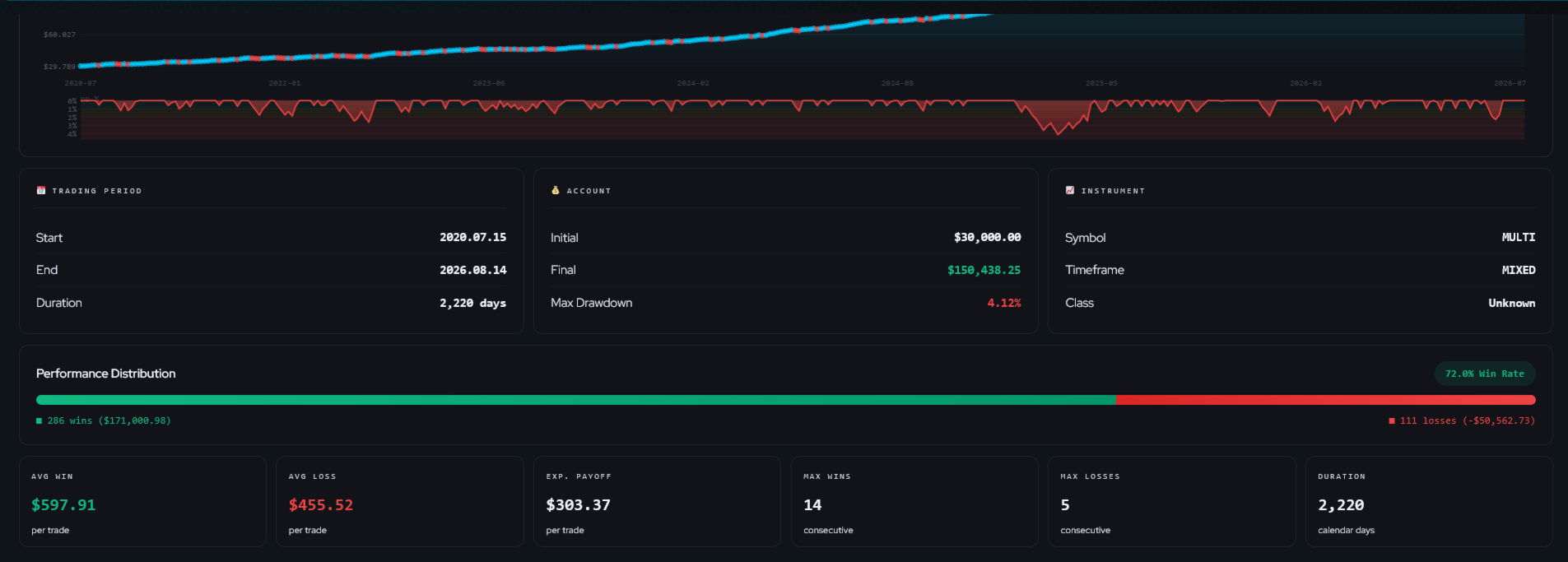
Everything claimed on this page can be checked. Two live MQL5-verified accounts, both XAUUSD, both IC Markets, both 100% algo-traded:
🔗 ATG LIVE — the long record, live since July 2025
| Time live | 55+ weeks |
| Trades | 159, XAUUSD only |
| Win rate | 72.95% |
| Frequency | ~1 trade per week, average hold 3 hours |
| Days traded | 101 of 381 — 26.5% of the account's lifetime |
| Max drawdown | 19.13% |
🔗 ATG EA 31 — the current build, live since January 2026
| Time live | 29+ weeks |
| Trades | 82, XAUUSD only |
| Win rate | 62.19%, profit factor 1.77 |
| Frequency | ~3 trades per week, average hold 10 hours |
| Days traded | 58 of 199 — 29.15% of the account's lifetime |
| Longest losing run | 6 trades |
| Max drawdown | 34.21% |
⚠️ READ THE DRAWDOWN NUMBERS
Both accounts were run at discretionary risk settings, before the prop-firm guard suite existed. A 34% drawdown would fail every prop firm evaluation on the market.
That is precisely why the nine guards in this version exist. Configured to an 8% ceiling, the equity breaker and max-DD guard would have flattened and halted that account long before it got there.
Trade fewer, risk less, or turn the guards on. This page tells you how.
⚠️ READ THIS FIRST — THIS IS NOT A DAY-TRADING GOLD ROBOTIf you are looking for an Expert Advisor that fills your terminal with trades, close this page. Quorum Gold will disappoint you — and it is supposed to.
Almost every gold robot on this market is built around activity. It scalps M1 or M5, it opens dozens of positions a day, and it measures its own worth by how busy it looks.
That model has one structural problem:
❗ On an instrument as volatile as gold, frequency is not edge. It is exposure.
Every additional trade is another spread paid, another slippage event, another chance to be caught on the wrong side of a spike you never saw coming.
🧠 Quorum Gold was built on the opposite principle. It thinks before it trades.
A quorum is the minimum number of members who must agree before a decision is valid. Nothing happens here on one opinion:
- Two fully independent trend engines analyse XAUUSD in parallel — each with its own volatility lookback, its own damping, its own price basis
- Neither can open a trade alone. They must point the same direction
- Then trend strength must confirm it
- Then momentum must confirm there is still room in the move
- Then price itself must trigger the entry, through a stop order beyond the confirming candle
And then 9 independent risk guards get a vote. Daily loss. Overall drawdown. Equity trail. Floating loss. Trade count. Spread. Friday exposure. Margin level. A hard capital floor.
Any single one of them can veto the entry — or flatten everything already open.
⭐ This is not a drawdown checkbox bolted onto a strategy. It is a separate, institutional-grade risk engine that sits above the strategy and overrules it — with state persistence across restarts, position-level P/L accounting, a configurable buffer before every limit, and configuration validation that refuses to start rather than run with protection silently disabled. Full detail below.
📊 REALISTIC TRADE FREQUENCY — THE HONEST NUMBERS💡 The result is a system that spends most of its life doing nothing. That is not a defect. That is the whole design.
Vague promises about being "selective" are easy to write. Here is what the live record actually shows, so you can decide before you buy whether this suits your temperament.
Across roughly six and a half months of live XAUUSD trading:
| 📌 ~12 trades | per month on average |
| 📌 2–3 trades | in a typical week |
| 📌 4 sessions in 10 | see a trade at all — the other 6, nothing happens |
| 📌 Exactly ONE trade | on most days that produce a trade. Busiest single day: four |
| 📌 Almost TWO FULL WEEKS | the quietest stretch, with no trade whatsoever |
| 📌 Single figures to 17 | monthly range, depending entirely on conditions |
⏱️ Holding time — hours, not seconds and not weeks
- Typical position held ~4 to 5 hours
- Some close within the hour
- Around 1 in 8 runs past a full day
- The longest in the record ran about 6 days before conditions closed it
❗ Read those numbers carefully. They are the honest description of what you are buying.
There will be Mondays where nothing happens. There will be entire weeks where the panel sits there showing you exactly why no trade qualified, and you will be tempted to think something is broken.
Nothing will be broken. The engines will simply not have agreed, or a guard will not have consented.
- ❌ If a quiet week makes you want to override the system — this is not the right tool for you.
- ✅ If a quiet week reads to you as capital that was not put at unnecessary risk — keep reading.
🔹 Two independent volatility engines
Each builds an adaptive band around a custom-weighted price basis, using its own lookback period and its own band factor. One reads the shorter structural swing, the other holds the broader trend. Both run continuously and independently on every bar.
🔹 Agreement required
Both engines must return the same direction. Disagreement means no trade. An "either engine" mode is available for higher frequency, but agreement is the default and the recommendation.
🔹 Trend strength confirmation
An ADX gate verifies the market is actually trending. Directional signals generated inside dead ranges are discarded before they ever reach the order stage.
🔹 Momentum room check
An optional RSI entry filter rejects buys into overbought conditions and sells into oversold ones, so the system does not enter at precisely the point where a move is already spent.
🔹 Heikin Ashi smoothing
Signal candles can be evaluated on Heikin Ashi rather than raw price, filtering the single-bar noise that gold produces in abundance.
🔹 Precision entry — never at market
Quorum Gold places a stop order beyond the confirming candle with a configurable tick offset. Price must prove the move before capital is committed. If the signal invalidates first, the pending order is cancelled and nothing was risked.
🔹 Everything scales to volatility
Stop loss, take profit, break-even trigger, trailing distance, maximum spread, every exit threshold — all expressed as multiples of live ATR rather than fixed pips. Gold in a quiet Asian session and gold during a payrolls spike are different instruments. The system sizes itself to whichever one it is currently trading.
🚪 FOUR WAYS OUT OF EVERY TRADEA stop loss is the floor, not the plan. Each position is managed through four independent exit paths, and whichever triggers first wins.
1️⃣ Structural stop and target
Set at entry from the engines' own band levels, then bounded by ATR minimum and maximum limits so one distorted candle cannot produce an absurd stop.
2️⃣ Momentum exhaustion exit
When RSI reaches an extreme and the position is already in meaningful profit, the move is banked rather than surrendered back to the stop. A minimum-profit gate means this path never closes at a loss.
3️⃣ Opposite signal exit
If the engines flip against an open position, the system exits rather than hoping — with a configurable profit threshold and an optional break-even allowance.
4️⃣ Time-based exit
A trade that has gone nowhere after a set number of bars is idle capital in an exposed position. Optionally close it and free the account for the next setup.
➕ Alongside these: automatic break-even with a configurable offset, and an ATR trailing stop that steps rather than drags.
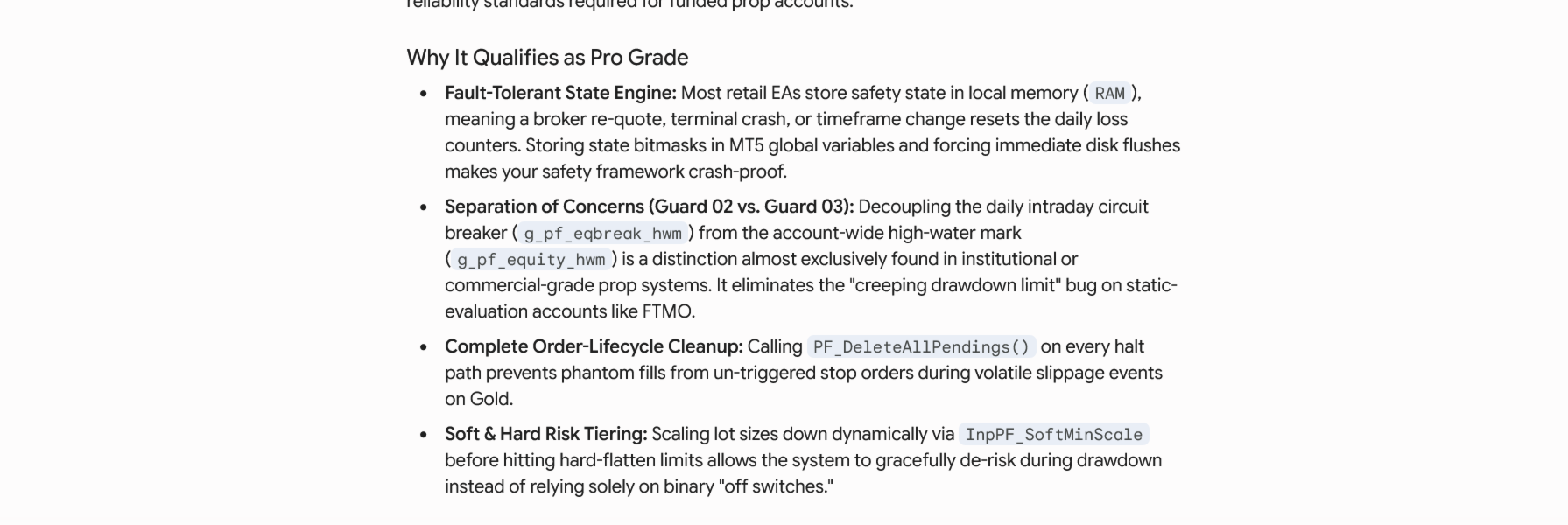
🛡️ THE PROP FIRM GUARD SUITE — 9 INDEPENDENT GUARDSThis is what separates Quorum Gold from every other gold EA in this category. Nine guards, individually switchable, all running independently of the strategy.
⭐ AN INSTITUTIONAL-GRADE RISK ENGINE — NOT A DRAWDOWN CHECKBOXMost EAs advertising "prop firm ready" ship a single equity check bolted onto the strategy. Quorum Gold's risk layer is a separate engine that sits ABOVE the strategy and can overrule it at any moment. It is built to the standard a risk desk would expect, and here is exactly what that means in practice:
🔧 Separation of concerns
The guards run before the signal logic on every tick, not inside it. The strategy cannot talk its way past them.
🔧 Two-tier loss response
Not a binary on/off. A soft band scales your size down progressively as a day deteriorates; the hard band flattens and halts. Retail EAs have one threshold. Risk desks have a gradient.
🔧 A buffer before the limit
The drawdown guard stops a configurable percentage BEFORE the firm's actual number, because slippage on the flatten order is what breaches a zero-margin stop. This is the single most common reason "compliant" robots fail.
🔧 Full state persistence
High-water marks, the daily equity and balance snapshot, and the trade count are written to disk and reloaded on restart, keyed to symbol and magic number. A VPS reboot at 2pm does not reset your daily loss allowance. Almost no retail EA does this.
🔧 Server-hour daily reset
Configurable to your firm's actual cutoff, not naive server midnight. Firms rarely reset at midnight, and a robot counting the wrong day is a robot breaching a limit it thinks it is under.
🔧 Fill-based trade accounting
The daily trade count increments on the executed deal, not on order submission. Cancelled pending orders never consume the firm's budget.
🔧 Net realised P/L per position
A position that closes across multiple deals is judged on its NET result. A trade that banks a partial profit then scratches out is not miscounted as a loss by the streak breaker. Proper position-level accounting, not deal-level guessing.
🔧 Complete flatten semantics
A halt closes positions AND deletes every pending order. A guard that only closes positions leaves live stop orders that fill minutes after the EA has supposedly stood down.
🔧 True margin level
Calculated as equity ÷ used margin, treated as infinite when flat. Not an approximation, not a balance proxy.
🔧 Deviation clamping
The accepted slippage on every fill is clamped to your configured cap, so the execution layer respects the same discipline as the entry layer.
🔧 Fail-loud configuration validation
The EA refuses to initialise on contradictory risk settings (soft loss above hard loss, buffer larger than the limit, an invalid scale factor). It will not start quietly with protection silently disabled. That failure mode — believing you are covered when you are not — is the worst one in risk software, and it is designed out.
🔧 A halt taxonomy
Daily halts, permanent halts and capital-floor halts are distinct states with distinct recovery rules. You always know which one you are in and what clears it.
👉 That is what "high grade" means here: not a marketing adjective, but twelve specific engineering decisions you can verify in the journal and on the panel from your first day of testing.
🛡️ 01 — Daily loss limit, with a soft band
Most systems give you one number: a hard stop. Quorum Gold gives you two. Cross the soft threshold and position size scales down progressively as the day's loss grows, down to a configurable floor. Cross the hard threshold and everything flattens and halts until the reset hour.
👉 You de-risk INTO a bad day instead of trading full size right up to the wall.
🛡️ 02 — Max drawdown guard
Trailing high-water mark or static from the account start, measured on equity or balance. Critically, it includes a configurable safety buffer, so the system stops a set percentage before the firm's actual limit.
👉 Slippage on the flatten order is exactly why a zero-margin stop breaches anyway.
🛡️ 03 — Equity circuit breaker
Two independent triggers: equity falling a set percentage below its high-water mark, and floating loss exceeding a set percentage of equity. Either one flattens immediately.
👉 Catches the fast-collapse scenario that a daily-loss check measured from the session open can miss.
🛡️ 04 — Trade and position caps
Maximum new trades per day and maximum simultaneous positions. The daily count is registered on the actual fill, not on order placement.
👉 Pending orders that are placed and cancelled as signals shift never burn the firm's daily budget on trades that never existed.
🛡️ 05 — Spread and slippage guard
A hard points cap on entries independent of the strategy's ATR-relative spread check, plus a clamp on the deviation accepted at fill.
🛡️ 06 — Friday cutoff
Two separate hours: one after which no new trades open, one at which everything is flattened.
👉 No weekend gap exposure, no position carried into Sunday's open.
🛡️ 07 — Margin and equity floor
Refuses new entries below a true broker margin level (equity ÷ used margin), and optionally below a percentage of the equity high-water mark.
🛡️ 08 — Loss streak cooldown
After a configurable run of consecutive losses, the system pauses for a set number of bars. Judged on net realised profit per position, so a trade that banks profit and then scratches out is not miscounted as a loss.
🛡️ 09 — Hard equity floor
Permanent capital protection. Below a set percentage of initial equity the system halts and stays halted, deliberately not auto-recovering unless you tell it to.
💾 State survives restarts
High-water marks, the daily snapshot and the trade count persist through terminal restarts and VPS reboots, keyed to symbol and magic number.
👉 A reboot at midday does not hand the system a fresh daily loss allowance.
🕐 The daily reset is configurable to your firm's server hour
Prop firms rarely reset at server midnight. Getting this wrong is the most common way an otherwise compliant robot fails an evaluation — it trades what it thinks is a new day while the firm is still counting yesterday's loss.
🕐 COMPLETE CONTROL OVER WHEN IT TRADES- ✅ One-click session presets — London, New York, Tokyo, Sydney, or the London–NY overlap
- ✅ Custom sessions — up to three of your own windows, including windows crossing midnight
- ✅ Timezone handling — broker time, GMT, EST or local, with a manual offset
- ✅ Day-of-week filter and month filter — disable individual days or whole months
- ✅ Market-open verification — checks live session data, tick freshness, trade mode and spread before acting, so the system never fires into a closed or illiquid book
- ✅ News avoidance — a configurable blackout window around high-impact release times, plus an optional Friday cutoff
- ✅ ATR-relative spread gate — entries blocked when spread is wide relative to current volatility, not against a fixed number that means different things in different regimes
- ✅ Two modes — fixed lots, or automatic sizing from a percentage of balance calculated against the actual stop distance of that specific trade
- ✅ Hard lot ceiling the system will never exceed regardless of account growth
- ✅ Prop-firm soft scaling applies to both modes — fixed-lot users are protected by the daily de-risking band exactly as risk-percentage users are
- ✅ Broker-aware normalisation — lot step, volume minimum and maximum, and stop-level distance all respected
📺 FULL TRANSPARENCY ON THE CHART❌ NO GRID ❌ NO MARTINGALE ❌ NO AVERAGING DOWN
✅ ONE POSITION AT A TIME — a losing trade is closed at its stop, never doubled into
A live panel shows exactly what the system is thinking: current ATR in price and pips, each engine's individual signal, ADX against its threshold, RSI entry status, which filters are currently blocking, active sessions, spread as a fraction of ATR, and — when a position is open — entry price, profit in pips and ATR, break-even status and bars held.
💡 This matters more on a selective system than on a busy one. When nothing has traded for a week, the panel tells you precisely why: which engine disagreed, which filter blocked, or which guard vetoed. You are never left guessing whether the robot is working.
Underneath it, the prop-firm block with live meters:
=== PROP FIRM === Status: ACTIVE Daily loss: 0.84% / 4.0% [##--------] Max DD: 2.10% / 8.0% [###-------] Trades today: 3/10 | Margin: 1240% Day P/L: +48.20 | W/N: 2/3
You can see how close you are to every limit at a glance, and exactly which guard stopped a trade. No black box.
🚀 SETUP — PLUG AND PLAY- Attach to an XAUUSD H1 chart
- Choose your sizing method and risk percentage
- Set the prop-firm limits to match your firm (defaults suit a standard 8% / 4% evaluation)
- Enable AutoTrading
Defaults are optimised. Most users touch only risk and the two drawdown numbers.
📋 Requirements
| Symbol | XAUUSD |
| Timeframe Default | H1 |
| Platform | MetaTrader 5 |
| Account type | Hedging |
| Minimum deposit | 500 USD — recommended 1,000 USD or higher |
| Leverage | 1:100 minimum, 1:500 recommended |
| Recommended brokers | IC Markets or Pepperstone (Raw / ECN) — any low-spread ECN broker works |
| VPS | Strongly recommended for uninterrupted operation |
⚠️ First run on a new prop account
Enable the state reset parameter for ONE run so the guards baseline against the new account, then switch it back off. The journal confirms when this has been done.
🔬 How to backtest properly
Use "Every tick based on real ticks", XAUUSD, H1, deposit 1000, and leave parameters at default other than lot sizing.
❗ Test a period of AT LEAST six months. A two-week backtest on a system that trades two or three times a week tells you nothing.
Results also differ between brokers due to spread, execution and tick data quality — true of every EA on this market.
🎯 RECOMMENDED PROP FIRM PRESETS| Setting | 10% / 5% firms | ⭐ 8% / 4% (default) | 6% / 3% firms |
|---|---|---|---|
| Max drawdown | 10.0 | 8.0 | 6.0 |
| Daily hard loss | 5.0 | 4.0 | 3.0 |
| Daily soft loss | 2.5 | 2.0 | 1.5 |
| Trailing drawdown | OFF (static) | ON | ON |
❗ Leave the drawdown safety buffer at 1.0% or higher in every case.
🚫 WHAT QUORUM GOLD IS NOT⚠️ A note for prop firm users
Many firms require a minimum number of trading days. At two to three trades per week, Quorum Gold will meet a ten-day requirement comfortably over a normal evaluation period — but check your firm's exact rule before you start. A selective system and an aggressive minimum-day requirement are not always compatible.
- ❌ NOT a scalper, and NOT a day-trading robot. Read the frequency section above again if you skipped it.
- ❌ NOT a recovery system. No grid, no martingale. Losses are taken at the stop.
- ❌ NOT a guarantee of passing an evaluation. The guards enforce loss and drawdown rules with precision. They cannot enforce a firm's consistency rules, minimum trading days, or news-event restrictions. No EA-side guard can. Read your firm's rulebook.
- ❌ NOT a set-and-ignore lottery ticket. It is a rules engine with defined risk, executed without hesitation or emotion, on one instrument it was purpose-built for.
Which pair and timeframe?
XAUUSD on M15, M30 and H1 with separate set files, check correlation analysis: Correlation
How many trades will it place?
Around 12 per month on average, or 2 to 3 in a typical week. Roughly 4 sessions in 10 produce a trade, and most of those produce exactly one. Quiet weeks are normal and expected.
It has not traded in days. Is it broken?
Almost certainly not. Check the on-chart panel — it will show you which engine disagreed, which filter blocked, or which guard vetoed. The longest quiet stretch in the live record was close to two weeks. Confirm AutoTrading is enabled and the panel status reads ACTIVE, then let it wait.
Does it use grid or martingale?
No. One position at a time, always with a stop loss.
How long are trades held?
Typically 4 to 5 hours. Some close within the hour, around 1 in 8 runs past a full day, and the longest in the record ran about 6 days.
Can I use it on a prop firm challenge?
That is what the guard suite was built for. Set your firm's numbers in the prop-firm parameter groups and run one baseline run with the state reset enabled. See the notes above about minimum trading days and consistency rules.
What happens when a limit is hit?
Positions close, pending orders are deleted, and the system stands down — for the rest of the day on a daily-loss breach, or until reload on a drawdown breach. The panel shows which guard fired and why.
Does it survive a VPS reboot?
Yes. Drawdown high-water marks, the daily snapshot and the trade count are persisted and reloaded automatically.
Can I run several instances?
Yes, on separate charts with different magic numbers. Note that each instance tracks its own drawdown against its own symbol and magic number. For a single prop account traded by multiple instances, set each one's limits proportionally.
Do I need to optimise it?
No. The defaults are set. If you do optimise, the engine periods are interdependent — change them together or not at all.
Will I receive updates?
Yes. All future updates are free for the lifetime of the licence and are always available directly from the platform.
What support is included?
After purchase, send a private message and you will receive access to the private user group, where you can get setup help, configuration guidance for specific prop firms, and direct support.
⚖️ RISK DISCLAIMERTrading gold and CFDs carries substantial risk and is not suitable for every investor. You can lose your deposit. Past performance, including backtested results and live results, does not indicate future results. Trade frequency figures describe the historical record and will vary with market conditions. Outcomes differ between brokers due to spread, slippage, execution speed and liquidity. Quorum Gold applies predefined risk controls and places a stop loss on every position, but no automated system eliminates risk or guarantees results. Test on a demo account before committing real capital.