Nice article. The Prediction Graph on Testing Data is disappointing. You might as well skip all that DNN modeling/training and simply use a prediction of the next price equal to the last know price. I bet the prediction accuracy of such trivial model will be higher that using your DNN model. I suggest to compare those two accuracies and show them here. In general, using DNN to predict prices is a bad idea. They are better suited for classification of the price patterns (e.g., buy, sell, hold). Also, the number of weights in your DNN is astronomical. It must be overfitting.
Vladimir #: Nice article. The Prediction Graph on Testing Data is disappointing. You might as well skip all that DNN modeling/training and simply use a prediction of the next price equal to the last know price. I bet the prediction accuracy of such trivial model will be higher that using your DNN model. I suggest to compare those two accuracies and show them here. In general, using DNN to predict prices is a bad idea. They are better suited for classification of the price patterns (e.g., buy, sell, hold). Also, the number of weights in your DNN is astronomical. It must be overfitting.
Thank you Vladimir. Just for discussion, when time permitted, I would modify this model to do classification for comparison.
Hello MQL5 community, I've been trying to follow this tutorial on how to use ONNX in your EA's. In the tutorial a neural network was the model of choice, I've used a gradient boosted tree.
I built the model using the InterpretML Python package, and exported it to ONNX using ebm2onnx.
I'll summaries the process by which the model was trained.
1) The model was trained on 5 inputs, OHLC and Height, Height is calculated as ((H + L) / 2) - C.
2) The model is a binary classifier, aiming to classify the next candle as either UP (1) or DOWN (0).
The data used to train the model.
3) The model was then exported to ONNX format
ONNX model representation.
To get the model to work, I deviated from the code in the tutorial and kept editing the code to try make the ONNX model work, but now I really don't know what I'm doing wrong. I keep getting an error that the handle for the model is invalid.
I have attached the MQL5 code below.
I'll now summaries the steps that I took in my code that deviate from what is in the tutorial, and I'll explain why I deviated from the tutorial as well
1) LINE 57: Setting Model Input Shape. In the tutorial 3 dimensions were used to set the input and output shape i.e. {1,SAMPLE_SIZE,1}; However when I followed that approach I kept getting an error, specifically error 5808. After the usual trail and error process I realized that if I used only 1 dimension, the number of inputs, the error went away.
2) LINE 68: Setting Model Output Shape.
Same logic as above.
The other deviations I made do not affect the model, for example I kept track of time using logic I found more intuitive than the logic implemented in the tutorial. I didn't need to normalize inputs because it's a tree-based model.
If you can spot other errors I have made , I'd appreciate your insight.
//+------------------------------------------------------------------+//| ONNX.mq5 |//| Copyright 2023, MetaQuotes Ltd. |//| https://www.mql5.com |//+------------------------------------------------------------------+//Meta properties#property copyright"Gamuchirai Zororo Ndawana"#property link"https://www.mql5.com"#property version"1.00"//Trade Library#include <Trade\Trade.mqh>
//Reading our ONNX model and storing it into a data array#resource "\\Files\\Python\\Volatility_75_EBM.onnx"asuchar ExtModel[]
//Custom keyword definitions#define SAMPLE_SIZE 998#define PRICE_UP 1#define PRICE_DOWN 0//Global variableslong ExtHandle = INVALID_HANDLE;
int ExtPredictedClass = -1;
datetime ExtNextBar = 0;
datetime ExtNextMinute =0;
float ExtMin = 0;
float ExtMax = 0;
double min_volume;
CTrade ExtTrade;
//Inputsintinput lot_mutliple = 1; //How many time greater than minimum lot should we enter?intOnInit()
{
//Check if the symbol and time frame conform to training conditionsif(_Symbol != "Volatility 75 Index" || _Period != PERIOD_M1)
{
Comment("Model must be used with the Volatility 75 Index on the 1 Minute Chart");
return(INIT_FAILED);
}
//Create an ONNX model from our data array
ExtHandle = OnnxCreateFromBuffer(ExtModel,ONNX_DEFAULT);
Print("ONNX Create from buffer status ",ExtHandle);
//Checking if the handle is validif(ExtHandle == INVALID_HANDLE)
{
Comment("ONNX create from buffer error ", GetLastError());
return(INIT_FAILED);
}
//Set input shapelong input_count = OnnxGetInputCount(ExtHandle);
constlong input_shape[] = {input_count};
Print("Total model inputs : ",input_count);
if(!OnnxSetInputShape(ExtHandle,0,input_shape))
{
Comment("ONNX set input shape error ", GetLastError());
OnnxRelease(ExtHandle);
return(INIT_FAILED);
}
//Set output shapelong output_count = OnnxGetOutputCount(ExtHandle);
constlong output_shape[] = {output_count};
Print("Total model outputs : ",output_count);
if(!OnnxSetOutputShape(ExtHandle,0,output_shape))
{
Comment("ONNX set output shape error ", GetLastError());
OnnxRelease(ExtHandle);
return(INIT_FAILED);
}
//Get the minimum trading volume allowed
min_volume = SymbolInfoDouble(_Symbol,SYMBOL_VOLUME_MIN);
return(INIT_SUCCEEDED);
//---return(INIT_SUCCEEDED);
}
//+------------------------------------------------------------------+//| Expert deinitialization function |//+------------------------------------------------------------------+voidOnDeinit(constint reason)
{
//---if(ExtHandle != INVALID_HANDLE)
{
OnnxRelease(ExtHandle);
ExtHandle = INVALID_HANDLE;
}
}
//+------------------------------------------------------------------+//| Expert tick function |//+------------------------------------------------------------------+voidOnTick()
{
//---//Time trackersstaticdatetime time_stamp;
datetime time = iTime(_Symbol,PERIOD_M1,0);
//Check new barif(time_stamp != time)
{
time_stamp = time;
PredictedPrice();
Print("Predicted class: ",ExtPredictedClass);
if(ExtPredictedClass == PRICE_UP || ExtPredictedClass == PRICE_DOWN)
if(PositionSelect(_Symbol))
CheckForClose();
if(PositionsTotal() == 0)
CheckForOpen();
}
}
//+------------------------------------------------------------------+void CheckForOpen(void)
{
ENUM_ORDER_TYPE signal = WRONG_VALUE;
//Check signalsif(ExtPredictedClass == PRICE_DOWN)
{
signal = ORDER_TYPE_SELL;
}
elseif(ExtPredictedClass == PRICE_UP)
{
signal = ORDER_TYPE_BUY;
}
if(signal != WRONG_VALUE && TerminalInfoInteger(TERMINAL_TRADE_ALLOWED))
{
double price, sl = 0 , tp = 0;
double bid = SymbolInfoDouble(_Symbol,SYMBOL_BID);
double ask = SymbolInfoDouble(_Symbol,SYMBOL_ASK);
if(signal == ORDER_TYPE_SELL)
{
price = bid;
}
else
{
price = ask;
}
Print("Opening a new position: ",signal);
ExtTrade.PositionOpen(_Symbol,signal,min_volume,price,0,0);
}
}
void CheckForClose(void)
{
bool bsignal = false;
long type = PositionGetInteger(POSITION_TYPE);
if(type == POSITION_TYPE_BUY && ExtPredictedClass == PRICE_DOWN)
bsignal = true;
if(type == POSITION_TYPE_SELL && ExtPredictedClass == PRICE_UP)
bsignal = true;
if(bsignal && TerminalInfoInteger(TERMINAL_TRADE_ALLOWED))
{
ExtTrade.PositionClose(_Symbol,3);
CheckForOpen();
}
}
void PredictedPrice(void)
{
vectorf output_data(1);
float open = float(iOpen(_Symbol,PERIOD_M1,1));
float high = float(iHigh(_Symbol,PERIOD_M1,1));
float low = float(iLow(_Symbol,PERIOD_M1,1));
float close = float(iClose(_Symbol,PERIOD_M1,1));
float height = float((((high + low) / 2) - close));
Print("Current open ",open);
Print("Current high ",high);
Print("Current low ",low);
Print("Current close ",close);
Print("Current height ",height);
vectorf input_data = {open,high,low,close,height};
Print("Input vector: ",input_data);
if(!OnnxRun(ExtHandle,ONNX_NO_CONVERSION,input_data,output_data))
{
Print("ONNX run error : ",GetLastError());
OnnxRelease(ExtHandle);
}
int predicted = int(output_data[0]);
Print("Model prediction: ",predicted);
Print(output_data);
if(predicted == 1)
{
ExtPredictedClass = PRICE_UP;
}
elseif(predicted == 0)
{
ExtPredictedClass = PRICE_DOWN;
}
Comment("Model Prediction: ", ExtPredictedClass);
}
Hello MQL5 community, I've been trying to follow this tutorial on how to use ONNX in your EA's. In the tutorial a neural network was the model of choice, I've used a gradient boosted tree.
I built the model using the InterpretML Python package, and exported it to ONNX using ebm2onnx.
I'll summaries the process by which the model was trained.
1) The model was trained on 5 inputs, OHLC and Height, Height is calculated as ((H + L) / 2) - C.
2) The model is a binary classifier, aiming to classify the next candle as either UP (1) or DOWN (0).
The data used to train the model.
3) The model was then exported to ONNX format
ONNX model representation.
To get the model to work, I deviated from the code in the tutorial and kept editing the code to try make the ONNX model work, but now I really don't know what I'm doing wrong. I keep getting an error that the handle for the model is invalid.
I have attached the MQL5 code below.
I'll now summaries the steps that I took in my code that deviate from what is in the tutorial, and I'll explain why I deviated from the tutorial as well
1) LINE 57: Setting Model Input Shape. In the tutorial 3 dimensions were used to set the input and output shape i.e. {1,SAMPLE_SIZE,1}; However when I followed that approach I kept getting an error, specifically error 5808. After the usual trail and error process I realized that if I used only 1 dimension, the number of inputs, the error went away.
2) LINE 68: Setting Model Output Shape.
Same logic as above.
The other deviations I made do not affect the model, for example I kept track of time using logic I found more intuitive than the logic implemented in the tutorial. I didn't need to normalize inputs because it's a tree-based model.
If you can spot other errors I have made , I'd appreciate your insight.
Thank you for sharing Sitan, I've applied what you pointed out but the error is still there
One batch of input_count inputs.
Set input to double
Error message.
It seems that MQL5 does not (or rather ONNXMLTools does not) yet support EBM's ONNX:
If you refer to the ONNX attachments (especially model.eurusd.D1.10.class.onnx which uses 4 inputs) from https://www.mql5.com/en/articles/12484; and use Netron (web version) to visualise the onnx files you will see the differences.
I think the following two articles would help you understand further too:
Object-oriented programming enables creation of a more compact code that is easy to read and modify. Here we will have a look at the example for three ONNX models.
We are trying to use a keras neural network with 11 predictors at one point in time (batch size 32) to make predictions on the XauUsd (where the output is a singular number between 0 and 1). Firstly, we load in from OnnxCreatefrombuffer (because OnnxCreate itself doesn't work for us), then we always get an error on the OnnxRun stage, where I have attached both errors below. Any help on what dimension to reshape to for the input, what format to put our predictor vector in (if it should be a vector at all?), or just any help or suggestions with syntax to help tackle these errors would be amazing. We have tried reshaping to all sorts of combinations of 32,1,11 vectors and no luck and really no idea with the next steps.. Thanks so much for anyone who can help !! Ben.
' error 5808'
' ONNX: input parameter #0 tensor has wrong dimension [0], try to use OnnxSetInputShape'
Can anyone help me, because at the end of the process in python, the following error comes up: AttributeError: 'Sequential' object has no attribute 'output_names'. I don't know much about python or programming. So any help would be appreciated! Thank you.
Can anyone help me, because at the end of the process in python, the following error comes out: AttributeError: 'Sequential' object has no attribute 'output_names'. I don't know much about Python or programming. So any help will be welcome! Thanks.
Alberto Henrique Tacoronte #: Hello gentlemen. Can anyone help me, because at the end of the python process, the following error comes up: AttributeError: 'Sequential' object has no attribute 'output_names'. I don't know much about python or programming. So any help would be appreciated! Thank you.
Nice article. The Prediction Graph on Testing Data is disappointing. You might as well skip all that DNN modeling/training and simply use a prediction of the next price equal to the last know price. I bet the prediction accuracy of such trivial model will be higher that using your DNN model. I suggest to compare those two accuracies and show them here. In general, using DNN to predict prices is a bad idea. They are better suited for classification of the price patterns (e.g., buy, sell, hold). Also, the number of weights in your DNN is astronomical. It must be overfitting.
Thank you Vladimir.
Just for discussion, when time permitted, I would modify this model to do classification for comparison.
Please let me know if you have ideas.
The tutorial gives a input of one batch SAMPLE_SIZE number of close inputs, you want one batch of input_count inputs.
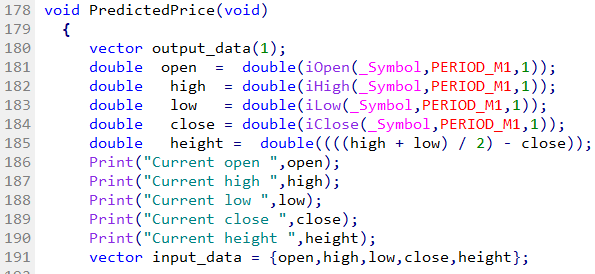
Also your model doesn't use floats as inputs, but doubles,
Moderator's note: This post is out of sequence due to posts below been moved from another topic. Please see post below.
Hello MQL5 community, I've been trying to follow this tutorial on how to use ONNX in your EA's. In the tutorial a neural network was the model of choice, I've used a gradient boosted tree.
I built the model using the InterpretML Python package, and exported it to ONNX using ebm2onnx.
I'll summaries the process by which the model was trained.
1) The model was trained on 5 inputs, OHLC and Height, Height is calculated as ((H + L) / 2) - C.
2) The model is a binary classifier, aiming to classify the next candle as either UP (1) or DOWN (0).
The data used to train the model.
3) The model was then exported to ONNX format
ONNX model representation.
To get the model to work, I deviated from the code in the tutorial and kept editing the code to try make the ONNX model work, but now I really don't know what I'm doing wrong. I keep getting an error that the handle for the model is invalid.
I have attached the MQL5 code below.
I'll now summaries the steps that I took in my code that deviate from what is in the tutorial, and I'll explain why I deviated from the tutorial as well
1) LINE 57: Setting Model Input Shape.
In the tutorial 3 dimensions were used to set the input and output shape i.e. {1,SAMPLE_SIZE,1}; However when I followed that approach I kept getting an error, specifically error 5808. After the usual trail and error process I realized that if I used only 1 dimension, the number of inputs, the error went away.
2) LINE 68: Setting Model Output Shape.
Same logic as above.
The other deviations I made do not affect the model, for example I kept track of time using logic I found more intuitive than the logic implemented in the tutorial. I didn't need to normalize inputs because it's a tree-based model.
If you can spot other errors I have made , I'd appreciate your insight.
Forum on trading, automated trading systems and testing trading strategies
Discussion of article "How to use ONNX models in MQL5"
Stian Andreassen, 2023.12.08 20:51
The tutorial gives a input of one batch SAMPLE_SIZE number of close inputs, you want one batch of input_count inputs.
Also your model doesn't use floats as inputs, but doubles,
Thank you for sharing Sitan, I've applied what you pointed out but the error is still there
One batch of input_count inputs.

Set input to double
Error message.
Hello MQL5 community, I've been trying to follow this tutorial on how to use ONNX in your EA's. In the tutorial a neural network was the model of choice, I've used a gradient boosted tree.
I built the model using the InterpretML Python package, and exported it to ONNX using ebm2onnx.
I'll summaries the process by which the model was trained.
1) The model was trained on 5 inputs, OHLC and Height, Height is calculated as ((H + L) / 2) - C.
2) The model is a binary classifier, aiming to classify the next candle as either UP (1) or DOWN (0).
The data used to train the model.
3) The model was then exported to ONNX format
ONNX model representation.
To get the model to work, I deviated from the code in the tutorial and kept editing the code to try make the ONNX model work, but now I really don't know what I'm doing wrong. I keep getting an error that the handle for the model is invalid.
I have attached the MQL5 code below.
I'll now summaries the steps that I took in my code that deviate from what is in the tutorial, and I'll explain why I deviated from the tutorial as well
1) LINE 57: Setting Model Input Shape.
In the tutorial 3 dimensions were used to set the input and output shape i.e. {1,SAMPLE_SIZE,1}; However when I followed that approach I kept getting an error, specifically error 5808. After the usual trail and error process I realized that if I used only 1 dimension, the number of inputs, the error went away.
2) LINE 68: Setting Model Output Shape.
Same logic as above.
The other deviations I made do not affect the model, for example I kept track of time using logic I found more intuitive than the logic implemented in the tutorial. I didn't need to normalize inputs because it's a tree-based model.
If you can spot other errors I have made , I'd appreciate your insight.
Thank you for sharing Sitan, I've applied what you pointed out but the error is still there
One batch of input_count inputs.
Set input to double
Error message.
It seems that MQL5 does not (or rather ONNXMLTools does not) yet support EBM's ONNX:
https://www.mql5.com/en/docs/onnx/onnx_conversion
If you refer to the ONNX attachments (especially model.eurusd.D1.10.class.onnx which uses 4 inputs) from https://www.mql5.com/en/articles/12484; and use Netron (web version) to visualise the onnx files you will see the differences.
I think the following two articles would help you understand further too:
Regression models of the Scikit-learn Library and their export to ONNX
Classification models in the Scikit-Learn library and their export to ONNX
Hi everybody,
We are trying to use a keras neural network with 11 predictors at one point in time (batch size 32) to make predictions on the XauUsd (where the output is a singular number between 0 and 1). Firstly, we load in from OnnxCreatefrombuffer (because OnnxCreate itself doesn't work for us), then we always get an error on the OnnxRun stage, where I have attached both errors below. Any help on what dimension to reshape to for the input, what format to put our predictor vector in (if it should be a vector at all?), or just any help or suggestions with syntax to help tackle these errors would be amazing. We have tried reshaping to all sorts of combinations of 32,1,11 vectors and no luck and really no idea with the next steps.. Thanks so much for anyone who can help !! Ben.
' error 5808'
' ONNX: input parameter #0 tensor has wrong dimension [0], try to use OnnxSetInputShape'
'ONNX: invalid input parameter #0 size, expected 1408 bytes instead of 480'
Hi, I try to use the
OnnxModelInfo.mq5file script, but can't make it work, what am I doing wrong? this cant be so complicated!
I copy pasted the OnnxModelInfo script, and saved into de Files folder
I have a onnx model (attached)
and when I compilate the script, 21 errors appear.
Can some one help me with this? Please
New article Using ONNX models in MQL5 has been published:
Author: MetaQuotes
Hello gentlemen.
Can anyone help me, because at the end of the process in python, the following error comes up: AttributeError: 'Sequential' object has no attribute 'output_names'. I don't know much about python or programming. So any help would be appreciated! Thank you.
Hi Alberto, please post the part of your code[using theCODE button(Alt -S)] where the error is occurring so that someone who knows Python(MetaTrader for Python | ONNX Models) can point out the solution...