Things are getting better for Australian
businesses, with confidence still at elevated levels and trading
conditions on the improve.
The National Australia Bank business survey for the March quarter found business confidence fell two points to six points.
A reading above zero indicates optimists outweigh pessimists.
Despite
a dip in confidence in the first three months of the year, it was still
a positive result, NAB chief economist Alan Oster said.
"Confidence has been generally trending higher across the board and is still positive for most industries," he said.
"Mining is still the only sector to have a negative confidence index.
"An
anticipated decline in many commodity prices, coinciding with rising
global supplies and a moderating demand outlook for China, is weighing
on mining firms."
Business conditions rose to their highest levels in 18 months, up two index points to zero.
Mr Oster said business conditions were still soft however, despite gradual improvement.
"Forward
indicators point to further modest improvements over coming months, but
still indicate below trend rates of growth and soft demand for labour,"
he said.
"Despite a lift in trading conditions, weak demand
continues to be the biggest constraint on output, with almost 60 per
cent of firms reporting a want of sales and orders.
"This may start to ease over coming quarters with firms starting to report improving forward orders."
Quarterly Business Survey – March 2014 Business confidence eased from its recent high but remained elevated in the March quarter. Business conditions were soft, but are now much better than 6-months earlier. Forward indicators point to further modest improvements over coming months. > Read More Monthly Business Survey – February 2014...
Japanese Yen Outperformed on Nikkei 225 Drop, Kuroda Comments in Asia
US Dollar, Euro Look for Cues in German PPI and US Jobless Claims Data
Protective Profit-Taking May Drive Volatility in Pre-Holiday Trading Hours
The Japanese Yen outperformed in overnight trade as the Nikkei 225 benchmark stock index declined, boosting demand for the safe-haven currency. Comments from Bank of Japan Governor Haruhiko Kuroda
likewise helped. The central bank chief said policymakers’ easing
effort is having the intended impact, with the economy moving toward the
2 percent inflation target. The remarks hinted the BOJ may not be quick
to expand its easing effort, a move that has been the subject of heavy
speculation as softening economic data and April’s 3 percent increase in
the sales tax threatened the central bank’s deflation-fighting goals.
The March set of German PPI
figures headlines an otherwise uneventful economic calendar in European
hours. The pace of wholesale deflation is expected to moderate a bit,
with the gauge posting a year-on-year drop of 0.7 percent compared with a
0.9 drawdown in the prior month. While the PPI print is typically not
very market-moving, the absence of alternative catalysts may see the
report generate some interest, particularly given the pickup in ECB
stimulus expansion bets recently. With that in mind, a disappointing
print is likely to weigh on the Euro amid a swell in easing expectations, and vice versa.
The US economic calendar is rather light as well, with the weekly set of Jobless Claims
numbers on tap. Economists are penciling in mild increases in initial
and continuing applications for unemployment benefits. US data flow has
started to show notable signs of improvement relative to expectations
over the past two weeks, opening the door for an upside surprise. A
sizeable-enough positive deviation from consensus forecasts may further
erode doubts about the continuity of the Fed’s QE “tapering” cycle,
bolstering yield-based support for the US Dollar.
Seasonal considerations are likewise important to bear in mind. Most major financial markets will be closed for the Good Friday holiday,
meaning today marks the end of the trading week for a considerable
share of investors. In fact, key exchanges in Europe as well as Hong
Kong and Australia will be closed through Monday of next week. That
means a period of protective profit-taking ahead of the long gap normal
trading conditions may be a meaningful driver of volatility in the hours
ahead, opening the door for reversals in prevalent trends. Ebbing
pre-holiday liquidity may amplify such moves, warning those traders
still holding open exposure to tread cautiously in the near term.
Commodity-backed loans and bypassing capital control could include gold as well as copper.
USD/CNH movements could be quick in any broad based liquidation of risk assets.
Reference rate out of China for the USDollar to Yuan (CNH) continues to move higher.
In March we touched on the fact that China
(consuming half of copper trade per annum) was using 80% of their
imports as pure loan collateral and/or to get around capital controls.
When the People’s Central Bank of China began to widen the Yuan band in
the face of slowing growth and as to target some shadow financing
vehicles, we saw heavy selling of copper as some highly leveraged commodity backed loans were unwound. The recent run-up in gold prices
combined with the highest USD/CNY fixing rates in months may have
forced the unwinding of some extremely overleveraged positions. Although
the systems of financing are often complex as we saw with copper, gold
has been used for some even more complex and lucrative structures
surrounding the skirting of capital controls. Yesterday, USD/CNH hit its
highest level since February of 2012.
In regards to the depreciating Yuan, political
pressure continues to build with Treasury officials warning the Chinese
not to weaken the Yuan for their economic benefit. Meanwhile, the daily
reference rates out of the PBoC continue to move higher toward the
ominous 6.25 mark. That is said to be the level where a large concentration of leveraged financial vehicles may experience some serious stresses.
A run towards and through that mark could be quick and does provide
trading opportunities for those who keep tabs on Chinese credit markets
during these volatile and uncertain times.
Note: USD/CNH vs. USD/CNY
“CNH is an offshore version of the RMB introduced by
the Hong Kong Monetary Authority and People's Bank of China which
allows investors outside of mainland China to gain exposure to the RMB.”
Copper Prices are widely followed in the commodity sector. Copper is an essential industrial metal used worldwide. Copper prices are followed in financial markets around the globe and the metal is growing in popularity. Copper is widely used in construction and because of its electrical properties is found in wires and circuit boards. Copper is...
Trading the News: Canada Consumer Price Index(based on dailyfx article)
Canada Headline & Core Inflation to Rebound in March.
Consumer Price Index (CPI) has Held Above 1.0% for Last Three-Months.
A rebound in Canada’s Consumer Price Index (CPI) may spur a near-term
pullback in the USD/CAD as it dampens bets of seeing the Bank of Canada
(BoC) further embark on its easing cycle.
What’s Expected:
Event Important:
Heightening price pressures may keep the BoC on the sidelines as it
limits the threat for deflation, and Governor Stephen Poloz may endorse a
more neutral tone for monetary policy as the central bank head sees a
‘soft landing’ in the Canadian economy.
Rising input costs paired with the pickup in private sector consumption
may encourage Canadian firms to boost consumer prices, and a marked
uptick in the CPI may spur a near-term pullback in the USD/CAD as it
limits the threat for deflation.
However, the headline reading for inflation may continue to undershoot
amid the slowing housing market along with the downturn in business
sentiment, and a weaker-than-expected CPI print may heighten the bearish
sentiment surrounding the Canadian dollar as it puts increased pressure
on the BoC to further embark on its easing cycle.
How To Trade This Event Risk
Bullish CAD Trade: Price Growth Climbs 1.4% or Greater
Need red, five-minute candle after the CPI report to consider short USD/CAD entry
If the market reaction favors a bullish Canadian dollar trade, establish short with two position
Set stop at the near-by swing high/reasonable distance from cost; use at least 1:1 risk-to-reward
Move stop to entry on remaining position once initial target is hit, set reasonable limit
A rebound in Canada’s Consumer Price Index (CPI) may spur a near-term pullback in the USD/CAD as it dampens bets of seeing the Bank of Canada (BoC) further embark on its easing cycle. Heightening price pressures may keep the BoC on the sidelines as it limits the threat for deflation, and Governor Stephen Poloz may endorse a more neutral tone...
New jobless claims applications in the U.S. remained close to the levels
last seen before the recession in the week ending April 12, while
factory production in the Mid-Atlantic region gained this month,
indicating the economy is recovering from the negative effect of the
extreme winter weather.
Fresh applications for state unemployment benefits rose 2,000 to 304,000
last week, reported the Labor Department on Thursday, though they still
hovered near a 6 ½ -year low that was recorded the previous week. It
was also lower than the economists’ prediction of 315,000 fresh
applications, according to a Reuters survey.
"The data add further evidence to the notion that the economy has
exerted positive momentum at the start of the second quarter," Sam
Bullard, a Charlotte, North Carolina-based senior economist at Wells
Fargo Securities told Reuters.
The claims survey covered nonfarm payrolls. Nonetheless, despite
surging last week, fresh unemployment claims have declined 19,000
between March and April, indicating that the labor market is improving.
The average job growth per month in February and March was 195,000 per
month, while the unemployment rate held steady at 6.7 percent.
An improving job market may raise the possibility that the Fed will
hike benchmark interest rates, which have hovered near zero since
December 2008.
Separately, the Philadelphia Federal Reserve Bank announced that the
state’s business activity index rose to 16.6 in April, compared to 9.0
in March. The reading, which exceeded economists’ estimates of an
increase to 10.0, was the strongest in 7 months. A figure above zero
shows the state’s manufacturing industry, which straddles Delaware,
southern New Jersey and eastern Pennsylvania, has expanded.
New shipments and orders also rose, while factory hiring rose and workers worked more hours than in March.
Reuters) - New claims for jobless benefits hovered near their pre-recession levels last week and manufacturing in the Mid-Atlantic region accelerated in April, suggesting an upswing in economic activity after a brutally cold winter. Coming on the heels of fairly bullish data on retail sales and industrial production, Thursday's reports also...
An index measuring tertiary industrial activity in Japan was down a
seasonally adjusted 1.0 percent on month in February, the Ministry of
Economy, Trade and Industry said on Friday - standing at 100.6.
That was well shy of forecasts for an increase of 0.2 percent following the 0.9 percent jump in January.
Among
the individual components of the survey, activity was down for
accommodations, finance, transportation, wholesale trade, real estate
and health care.
Activity was up for communications and utilities; learning support was flat.
Sleep apnea may be linked to poor bone health, according to a new study which shows that people who suffer from the sleep disorder may be at an increased risk of developing osteoporosis. The study, published in the Journal of Clinical Endocrinology & Metabolism, shows that people with sleep apnea were 2.7 times more likely to be diagnosed with...
Wal-Mart intends to offer a money transfer service in a bid to keep its customers buying more from its store.
The largest retailer in the world announced a new money transfer service
today, which it says will reduce fees by as much as 50% compared with
competition. Dubbed Walmart-2-Walmart, the service will be implemented
in conjunction with Ria Money Transfer, a Euronet Worldwide subsidiary.
According to Bloomberg, shares of similar money transfer firms MoneyGram and Western Union plunged almost immediately on the developments.
Wal-Mart customers will be able to start using the service on April 24.
The service allows them to move as much as $900 to and from the
retailer’s US stores, which are more than 4,000.
The move is quite significant and could be something of a paradigm shift
in the industry, potentially triggering a pricing battle.
With the service, up to $50 is transferable for a $4.50 service fee while it will cost $9.50 to move $900.
Wal-Mart said that other similar service providers may charge up to $70 to aid the transfer of less than $1000.
As USA Today
reports, Western Union’s New York transfer fees for $900 as indicated
on the firm’s website are in the range of $20 if a bank account is used
and $85 using a credit or debit card.
The latest developments expand Wal-Mart’s financial provisions for its
customers, especially the unbanked. The firm’s other financial services
include tax preparation and prepaid debit cards.
MoneyGram wasn’t immediately available for comment. However, Western
Union told The Associated Press via an email statement that, “Our retail
product and service offerings today are already quite diverse. The
company is well positioned in the U.S. domestic money transfer space,
having offered a fee of $5 for $50 since 2009.”
Wal-Mart is trying to bolster foot traffic to its brick and mortar stores.
Wal-Mart Stores Inc. (WMT)’s plan to start a money transfer business sent shares of Western Union Co. and other services lower on the threat of competition from the world’s largest retailer. Walmart-2-Walmart Money Transfer Service will let customers transfer money to and from more than 4,000 stores in the U.S., the Bentonville, Arkansas-based...
Many global financial centers will be offline for the final trading session of the week
This liquidity drain only further depresses extremely quiet markets - which may expedite the reversion
If a rebound in activity clears tech barriers and activates fundamentals, plenty of opportunity awaits
Great trading opportunity lies ahead, but expectations must be
reasonable for when and where we can act. The final trading day of this
week will be drained of liquidity due to the observation of a market
holiday for many regions, and the subsequent conditions curb the
necessary developments we need to instigate the seismic shift that we
are inevitably heading towards. In today's trading video, we discuss why
short-term trade setups are ill-advised but why medium-term setups for
the likes of EURUSD, GBPUSD and others offer considerable opportunity.
EUR/USD - This is the most popular currency pair in the world, representing the world's two largest economies. The Euro was created to facilitate cross-border trade of European trading partners. Since its inception in 1999, the pair has faced considerable volatility as the world has faced multiple events of volatility such as the tech boom...
The Australian Dollar declined as expected against its US counterpartafter
the pair put in a Shooting Star candlestick below the 0.95 figure. The
pair is now testing support at 0.9325, the 23.6% Fibonacci retracement,
with a break downward on a daily closing basis initially exposing the
38.2% level at 0.9242. Alternatively, a move above trend line
support-turned-resistance at 0.9429 aims for the April 10 highat 0.9460.
Prices are trading too close to relevant support to
make a short trade attractive from a risk/reward perspective. We will
continue to stand aside for now, waiting for an actionable opportunity
to present itself.
The Australian Dollar represents the economy of Australia and is the fifth most commonly traded currency in the world. The Australian Dollar had a fixed exchange rate until 1983 when the Australian Labor government floated the currency. The Australian Dollar was part of the Bretton Woods system from 1946 to 1971 with which the Australian...
2014-04-17 01:30 GMT (or 03:30 MQ MT5 time) | [AUD - NAB Business Confidence]
if actual > forecast = good for currency (for AUD in our case)
==========
Business confidence still high, says NAB
Things are getting better for Australian businesses, with confidence still at elevated levels and trading conditions on the improve.
The National Australia Bank business survey for the March quarter found business confidence fell two points to six points.
A reading above zero indicates optimists outweigh pessimists.
Despite a dip in confidence in the first three months of the year, it was still a positive result, NAB chief economist Alan Oster said.
"Confidence has been generally trending higher across the board and is still positive for most industries," he said.
"Mining is still the only sector to have a negative confidence index.
"An anticipated decline in many commodity prices, coinciding with rising global supplies and a moderating demand outlook for China, is weighing on mining firms."
Business conditions rose to their highest levels in 18 months, up two index points to zero.
Mr Oster said business conditions were still soft however, despite gradual improvement.
"Forward indicators point to further modest improvements over coming months, but still indicate below trend rates of growth and soft demand for labour," he said.
"Despite a lift in trading conditions, weak demand continues to be the biggest constraint on output, with almost 60 per cent of firms reporting a want of sales and orders.
"This may start to ease over coming quarters with firms starting to report improving forward orders."
Seasonal Forces May Overshadow German PPI, US Claims Data
The Japanese Yen outperformed in overnight trade as the Nikkei 225 benchmark stock index declined, boosting demand for the safe-haven currency. Comments from Bank of Japan Governor Haruhiko Kuroda likewise helped. The central bank chief said policymakers’ easing effort is having the intended impact, with the economy moving toward the 2 percent inflation target. The remarks hinted the BOJ may not be quick to expand its easing effort, a move that has been the subject of heavy speculation as softening economic data and April’s 3 percent increase in the sales tax threatened the central bank’s deflation-fighting goals.
The March set of German PPI figures headlines an otherwise uneventful economic calendar in European hours. The pace of wholesale deflation is expected to moderate a bit, with the gauge posting a year-on-year drop of 0.7 percent compared with a 0.9 drawdown in the prior month. While the PPI print is typically not very market-moving, the absence of alternative catalysts may see the report generate some interest, particularly given the pickup in ECB stimulus expansion bets recently. With that in mind, a disappointing print is likely to weigh on the Euro amid a swell in easing expectations, and vice versa.
The US economic calendar is rather light as well, with the weekly set of Jobless Claims numbers on tap. Economists are penciling in mild increases in initial and continuing applications for unemployment benefits. US data flow has started to show notable signs of improvement relative to expectations over the past two weeks, opening the door for an upside surprise. A sizeable-enough positive deviation from consensus forecasts may further erode doubts about the continuity of the Fed’s QE “tapering” cycle, bolstering yield-based support for the US Dollar.
Seasonal considerations are likewise important to bear in mind. Most major financial markets will be closed for the Good Friday holiday, meaning today marks the end of the trading week for a considerable share of investors. In fact, key exchanges in Europe as well as Hong Kong and Australia will be closed through Monday of next week. That means a period of protective profit-taking ahead of the long gap normal trading conditions may be a meaningful driver of volatility in the hours ahead, opening the door for reversals in prevalent trends. Ebbing pre-holiday liquidity may amplify such moves, warning those traders still holding open exposure to tread cautiously in the near term.
USD/CNH: Chinese Yuan Depreciation to Blame on Gold Selloff?
In March we touched on the fact that China (consuming half of copper trade per annum) was using 80% of their imports as pure loan collateral and/or to get around capital controls. When the People’s Central Bank of China began to widen the Yuan band in the face of slowing growth and as to target some shadow financing vehicles, we saw heavy selling of copper as some highly leveraged commodity backed loans were unwound. The recent run-up in gold prices combined with the highest USD/CNY fixing rates in months may have forced the unwinding of some extremely overleveraged positions. Although the systems of financing are often complex as we saw with copper, gold has been used for some even more complex and lucrative structures surrounding the skirting of capital controls. Yesterday, USD/CNH hit its highest level since February of 2012.
In regards to the depreciating Yuan, political pressure continues to build with Treasury officials warning the Chinese not to weaken the Yuan for their economic benefit. Meanwhile, the daily reference rates out of the PBoC continue to move higher toward the ominous 6.25 mark. That is said to be the level where a large concentration of leveraged financial vehicles may experience some serious stresses. A run towards and through that mark could be quick and does provide trading opportunities for those who keep tabs on Chinese credit markets during these volatile and uncertain times.
Note: USD/CNH vs. USD/CNY
“CNH is an offshore version of the RMB introduced by the Hong Kong Monetary Authority and People's Bank of China which allows investors outside of mainland China to gain exposure to the RMB.”
Trading the News: Canada Consumer Price Index (based on dailyfx article)
A rebound in Canada’s Consumer Price Index (CPI) may spur a near-term pullback in the USD/CAD as it dampens bets of seeing the Bank of Canada (BoC) further embark on its easing cycle.
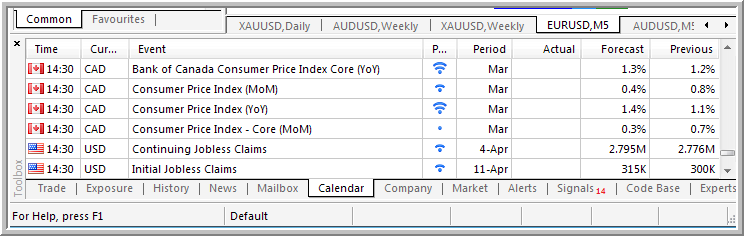
What’s Expected:
Event Important:
Heightening price pressures may keep the BoC on the sidelines as it limits the threat for deflation, and Governor Stephen Poloz may endorse a more neutral tone for monetary policy as the central bank head sees a ‘soft landing’ in the Canadian economy.
Rising input costs paired with the pickup in private sector consumption may encourage Canadian firms to boost consumer prices, and a marked uptick in the CPI may spur a near-term pullback in the USD/CAD as it limits the threat for deflation.
However, the headline reading for inflation may continue to undershoot amid the slowing housing market along with the downturn in business sentiment, and a weaker-than-expected CPI print may heighten the bearish sentiment surrounding the Canadian dollar as it puts increased pressure on the BoC to further embark on its easing cycle.
How To Trade This Event Risk
Bullish CAD Trade: Price Growth Climbs 1.4% or Greater
- Need red, five-minute candle after the CPI report to consider short USD/CAD entry
- If the market reaction favors a bullish Canadian dollar trade, establish short with two position
- Set stop at the near-by swing high/reasonable distance from cost; use at least 1:1 risk-to-reward
- Move stop to entry on remaining position once initial target is hit, set reasonable limit
Bearish CAD Trade: Canada Consumer Prices Disappoint- Need green, five-minute candle following the release to look at a long USD/CAD trade
- Carry out the same setup as the bullish loonie trade, just in reverse
Potential Price Targets For The ReleaseUSD/CAD Daily
USDCAD M5 : 55 pips price movement by CAD - CPI news event :
2014-04-17 12:30 GMT (or 14:30 MQ MT5 time) | [CAD - CPI]
if actual > forecast = good for currency (for CAD in our case)
==========
U.S. Jobless Claims Remain Steady, Pointing to Recovering Labor Market
New jobless claims applications in the U.S. remained close to the levels last seen before the recession in the week ending April 12, while factory production in the Mid-Atlantic region gained this month, indicating the economy is recovering from the negative effect of the extreme winter weather.
Fresh applications for state unemployment benefits rose 2,000 to 304,000 last week, reported the Labor Department on Thursday, though they still hovered near a 6 ½ -year low that was recorded the previous week. It was also lower than the economists’ prediction of 315,000 fresh applications, according to a Reuters survey.
"The data add further evidence to the notion that the economy has exerted positive momentum at the start of the second quarter," Sam Bullard, a Charlotte, North Carolina-based senior economist at Wells Fargo Securities told Reuters.
The claims survey covered nonfarm payrolls. Nonetheless, despite surging last week, fresh unemployment claims have declined 19,000 between March and April, indicating that the labor market is improving. The average job growth per month in February and March was 195,000 per month, while the unemployment rate held steady at 6.7 percent.
An improving job market may raise the possibility that the Fed will hike benchmark interest rates, which have hovered near zero since December 2008.
Separately, the Philadelphia Federal Reserve Bank announced that the state’s business activity index rose to 16.6 in April, compared to 9.0 in March. The reading, which exceeded economists’ estimates of an increase to 10.0, was the strongest in 7 months. A figure above zero shows the state’s manufacturing industry, which straddles Delaware, southern New Jersey and eastern Pennsylvania, has expanded.
New shipments and orders also rose, while factory hiring rose and workers worked more hours than in March.
Japan Tertiary Industry Index Plunges In February
An index measuring tertiary industrial activity in Japan was down a seasonally adjusted 1.0 percent on month in February, the Ministry of Economy, Trade and Industry said on Friday - standing at 100.6.
That was well shy of forecasts for an increase of 0.2 percent following the 0.9 percent jump in January.
Among the individual components of the survey, activity was down for accommodations, finance, transportation, wholesale trade, real estate and health care.
Activity was up for communications and utilities; learning support was flat.
Wal-Mart Ventures Into Money Transfer Service
Wal-Mart intends to offer a money transfer service in a bid to keep its customers buying more from its store.
The largest retailer in the world announced a new money transfer service today, which it says will reduce fees by as much as 50% compared with competition. Dubbed Walmart-2-Walmart, the service will be implemented in conjunction with Ria Money Transfer, a Euronet Worldwide subsidiary.
According to Bloomberg, shares of similar money transfer firms MoneyGram and Western Union plunged almost immediately on the developments.
Wal-Mart customers will be able to start using the service on April 24. The service allows them to move as much as $900 to and from the retailer’s US stores, which are more than 4,000.
The move is quite significant and could be something of a paradigm shift in the industry, potentially triggering a pricing battle.
With the service, up to $50 is transferable for a $4.50 service fee while it will cost $9.50 to move $900.
Wal-Mart said that other similar service providers may charge up to $70 to aid the transfer of less than $1000.
As USA Today reports, Western Union’s New York transfer fees for $900 as indicated on the firm’s website are in the range of $20 if a bank account is used and $85 using a credit or debit card.
The latest developments expand Wal-Mart’s financial provisions for its customers, especially the unbanked. The firm’s other financial services include tax preparation and prepaid debit cards.
MoneyGram wasn’t immediately available for comment. However, Western Union told The Associated Press via an email statement that, “Our retail product and service offerings today are already quite diverse. The company is well positioned in the U.S. domestic money transfer space, having offered a fee of $5 for $50 since 2009.”
Wal-Mart is trying to bolster foot traffic to its brick and mortar stores.
Trading Video: Liquidity Delays EURUSD, GBPJPY, Yen Setups
Great trading opportunity lies ahead, but expectations must be reasonable for when and where we can act. The final trading day of this week will be drained of liquidity due to the observation of a market holiday for many regions, and the subsequent conditions curb the necessary developments we need to instigate the seismic shift that we are inevitably heading towards. In today's trading video, we discuss why short-term trade setups are ill-advised but why medium-term setups for the likes of EURUSD, GBPUSD and others offer considerable opportunity.
AUDUSD Technical Analysis (adapted from this article)
The Australian Dollar declined as expected against its US counterpartafter the pair put in a Shooting Star candlestick below the 0.95 figure. The pair is now testing support at 0.9325, the 23.6% Fibonacci retracement, with a break downward on a daily closing basis initially exposing the 38.2% level at 0.9242. Alternatively, a move above trend line support-turned-resistance at 0.9429 aims for the April 10 highat 0.9460.
Prices are trading too close to relevant support to make a short trade attractive from a risk/reward perspective. We will continue to stand aside for now, waiting for an actionable opportunity to present itself.