China's trade surplus more than doubled in October, boosted by a
stronger-than-expected rebound in exports, data from the General
Administration of Customs showed Friday, suggesting that the economic
recovery is gaining traction.
The positive data will encourage
Chinese leaders, gathering in Beijing this weekend for a key Communist
Party meeting, to accelerate efforts to unlock another wave of economic
reforms.
The trade surplus jumped to $31.1 billion in October
from $15.21 billion in September. Economists expected an increase to
$24.8 billion.
Officers of Shatoujiao Customs House (affiliated to Shenzhen Customs District) said they had seized a smuggling case in which 1,497 undeclared hard disks hidden in car were seized. Officers said they had found a secret compartment under the back seat of a car. The case involved a value of more than RMB 450,000, according to Customs officers...
When we have a deeply distressed stock, and a bulldog investor that owns
a huge stake in the stock, our chances of a positive outcome increases
dramatically.
In running our screens for the first week of November, the following
five stocks have hit our radar as high potential, deep value candidates,
plus they all have the presence of a huge private equity firm:
1) Dice Holdings, Inc. (DHX) has a current share price $7.49.
The $15 billion dollar private equity firm General Atlantic, LLC owns
more than 15% of this stock.
2) Noranda Aluminum Holding Corp (NOR) has a current share price
$3.04. Apollo Global Management, the $22 billion dollar private equity
firm, owns more than 48% of NOR.
3) Red Lion Hotels Corporation (RLH) has a current share price of $6.00. The private equity firm Columbia Pacific Advisors owns more than 28% of this stock.
4) Sun Bancorp Inc. (SNBC) has a current share price $3.20. The private equity firm Invesco Private Capital owns more than 24%.
5) Exco Resources Inc. (XCO) has a current share price $5.41.
The $15 billion dollar private equity firm Oaktree Capital Management
owns more than 16% of this stock.
When we have a deeply distressed stock, and a bulldog investor that owns a huge stake in the stock, our chances of a positive outcome increases dramatically.
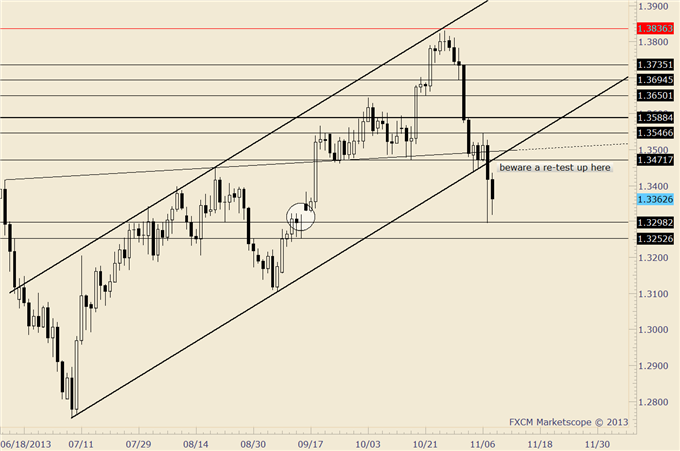
EURUSD has broken the trend channel that defines action from the July low.
Significant levels (the channel in the current situation) are
sometimes re-tested from the opposite side of the market. The underside
of the channel crosses about 1.3475 to 1.3510 next week.
The previously uncovered 9/13 close was filled on Thursday and the
EURUSD made an inside day on Friday. This combination is short term
bullish.
Trading Strategy: I do not have a position at the moment. A week or so
of upside into 1.3475-1.3510 might offer an opportunity to get short
though.
Significant levels (the channel in the current situation) are sometimes re-tested from the opposite side of the market. The underside of the channel crosses about 1.3475 to 1.3510 next week. -USDJPY traded above 99 (Oct high) and into the previously uncovered 9/20 close on Thursday. There is an uncovered close from the 10/25 close at 97.37...
AUDUSD has followed through on the reversal that ended the week of
10/25. 10/23 was the day of the top and an outside day reversal formed
that day.
Bigger picture, the market broke from a symmetrical triangle the week
that ended 5/17/2013. The recent top is just pips from that close level
(with an outside day reversal on 10/23) and right at channel
resistance.
The rally from the June low forms 2 converging lines and can be
called a pennant. These patterns are often seen in the early stages of
large bear markets.
Trading Strategy: Currently short. Original stop was .9550. Stop has
been lowered to .9375. .9190-.9300 could produce consolidation /
corrective activity.
Significant levels (the channel in the current situation) are sometimes re-tested from the opposite side of the market. The underside of the channel crosses about 1.3475 to 1.3510 next week. -USDJPY traded above 99 (Oct high) and into the previously uncovered 9/20 close on Thursday. There is an uncovered close from the 10/25 close at 97.37...
The Australian Dollar faces heavy weekend event risk as over 300 Chinese leaders including President Xi Jinping and Premier Li Keqiang gather for the third Plenum, a sit-down of the ruling party’s top brass that typically focuses on economic policy. Comments from Yu Zhengsheng, the number-four ranked politician in the current administration...
Point blank – you don’t know the future. Neither does any other person on the planet Earth.
This doesn’t mean that you can’t forecast price movements; millions of
people do this every day through banks, hedge funds, and as retail
traders. But rather, you have to see each trade as an idea, or an
opportunity; and like many opportunities in life, this idea simply may
not work and you have to be able to do the correct thing when you get to
that point.
And the only correct thing to do when you realize you are wrong is to
cease being wrong and start being right! The way to be right is to close
the position.
I know this can be difficult to close a trade that's already eaten into
you; after all – if you liked the idea at your entry price, and it moves
against you – the idea might look even better at a cheaper price!
The only thing that a trader can ever really be assured of is the fact that they are going to take losses. It’s an inevitable part of the game. Most new traders try to avoid this, and they try to manage their losing positions in the hope that the trade might come back to break-even – if only so that they don’t have to see a loss. But...
Losing properly may sound somewhat oxymoronic to the new trader; but I
assure you, it is a necessary trait that WILL be learned by anyone that
will eventually find trading success.
Otherwise, the potential to hit a land mine with that one idea that just
doesn’t work out is always there; and eventually the trader will hit
that land mine and blow up multiple small winning trades with just one
big loser… just like we saw in The Number One Mistake FX Traders Make.
The only thing that a trader can ever really be assured of is the fact that they are going to take losses. It’s an inevitable part of the game. Most new traders try to avoid this, and they try to manage their losing positions in the hope that the trade might come back to break-even – if only so that they don’t have to see a loss. But...
The thesis of the number one mistake traders make is also the first step in losing properly. Always set a stop.
Anytime you open a position, setting the stop should take place directly
after that. This should become automatic. Open a position – set the
stop.
This means that you don’t have to scramble to decide where to cut the
bleeding when you’ve realized your idea is wrong, which is never really a
fun, positive experience.
This also allows you to set your risk at the outset of the trade. You
can draw your proverbial ‘line in the sand,’ so that if your idea is
proven wrong, you can cut it before the loss becomes unbearable.
This means that when entering the position, you can specify the maximum
amount you would like to risk on this one idea. You can use a percentage
of your equity, such as saying ‘I’m willing to risk 1% of my equity on
this trade.’
You can then multiple your equity by ‘.01’ and that gives you a ‘stop
amount.’ You can then take the stop amount, and divide this by your pip
cost – and this gives you a stop based in number of pips from your
entry.
The only thing that a trader can ever really be assured of is the fact that they are going to take losses. It’s an inevitable part of the game. Most new traders try to avoid this, and they try to manage their losing positions in the hope that the trade might come back to break-even – if only so that they don’t have to see a loss. But...
After you’ve set your stop on the trade, you’ve defined the maximum that you are willing to lose on this idea.
After doing this, the trader’s job is to hold the line. That means that
if prices move towards your stop, you DO NOT move it further against
yourself, hoping that miraculously the extra stop distance you’re giving
the position makes the difference between winning and losing.
If you move your stop deeper against you (giving the trade more ‘room’
to work), you’re essentially throwing more good money after an idea that
has already shown you unfavorable results.
Why would you do this? You can easily employ that capital that you’re
risking on the wider stop into an entirely new trade idea that has not
yet shown you failure.
I see this time and again from new trader, simply unwilling to admit
that they were wrong and it rarely works out favorably. Even if it does
work out favorably once, or twice, the same thing in our initial example
will eventually happen: The position will move against the trader
until, eventually, the trader’s capital is exhausted on ONE BAD TRADE.
A further point to this is adding to positions. Many traders will add
another position to an already losing position under the presumption
that they are ‘scaling in.’
This is not scaling in. This is throwing good money after bad.
Scaling in is planned beforehand; and is strategic. In most cases, many
professional traders are ONLY scaling into winning positions. I covered
this type of logic in How to Scale in to Positions. This is position
trading, and in my and many other trader’s opinions – this is the only
way to properly build a position.
Traders want to look to scale in to winning positions :
The only thing that a trader can ever really be assured of is the fact that they are going to take losses. It’s an inevitable part of the game. Most new traders try to avoid this, and they try to manage their losing positions in the hope that the trade might come back to break-even – if only so that they don’t have to see a loss. But...
So, even after you learn how to lose – it is still going to stink. But
eventually you become numb to the feeling. It always stinks, but after
you gain some experience you begin to realize that it’s inevitable and
just a cost of doing business.
One way that losing can be mitigated is through trade management.
A primary reason that so many traders would take such small gains and
such large losses in The Number One Mistake Forex Traders Make is
default human nature. Human beings are, for the most part, scared to
lose.
Just think about the last time you were in a trade. If the position
moved against you, many people think ‘well, I’ll let this one work to
see if it can come back to my entry price. I’ll hang on for just a
little bit longer, and if it gets to even a 5 pip gain I’ll close it out
quickly.’
This is greed – when in fact the trader should be fearful (the position has, up to that point, been a failure).
On the other hand, think of opening your platform in the morning and
realizing you have a small gain that didn’t quite hit your profit
target. Most people will look at that and say ‘well, I’ll close it out
just so this thing doesn’t move against me, and becomes a loser.’
This is fear – when, in fact, the trader should be greedy. This position
has shown you success! You’ve been proven right! These are the
situations where you want to let the trade work with the goal of taking
more profits out of the market.
This way, if the trade moves against you, you can be taken out for no
gain, and no loss. This can save you the amount you had initially put up
to risk on the position.
Further, this can allow the trade to work while you carry a clean
conscious that, at the very least, your initial equity is no longer
exposed on the position.
The only thing that a trader can ever really be assured of is the fact that they are going to take losses. It’s an inevitable part of the game. Most new traders try to avoid this, and they try to manage their losing positions in the hope that the trade might come back to break-even – if only so that they don’t have to see a loss. But...
2013-11-08 02:38 GMT (or 03:38 MQ MT5 time) | [CNY - Trade Balance]
if actual > forecast = good for currency (for CNY in our case)
==========
China Trade Surplus Rises Sharply As Exports Rebound
China's trade surplus more than doubled in October, boosted by a stronger-than-expected rebound in exports, data from the General Administration of Customs showed Friday, suggesting that the economic recovery is gaining traction.
The positive data will encourage Chinese leaders, gathering in Beijing this weekend for a key Communist Party meeting, to accelerate efforts to unlock another wave of economic reforms.
The trade surplus jumped to $31.1 billion in October from $15.21 billion in September. Economists expected an increase to $24.8 billion.
Five Stocks Loved By Private Equity Firms
When we have a deeply distressed stock, and a bulldog investor that owns a huge stake in the stock, our chances of a positive outcome increases dramatically.
In running our screens for the first week of November, the following five stocks have hit our radar as high potential, deep value candidates, plus they all have the presence of a huge private equity firm:
1) Dice Holdings, Inc. (DHX) has a current share price $7.49. The $15 billion dollar private equity firm General Atlantic, LLC owns more than 15% of this stock.
2) Noranda Aluminum Holding Corp (NOR) has a current share price $3.04. Apollo Global Management, the $22 billion dollar private equity firm, owns more than 48% of NOR.
3) Red Lion Hotels Corporation (RLH) has a current share price of $6.00. The private equity firm Columbia Pacific Advisors owns more than 28% of this stock.
4) Sun Bancorp Inc. (SNBC) has a current share price $3.20. The private equity firm Invesco Private Capital owns more than 24%.
5) Exco Resources Inc. (XCO) has a current share price $5.41. The $15 billion dollar private equity firm Oaktree Capital Management owns more than 16% of this stock.
Technical Analysis - EURUSD (adapted from dailyfx article)
EURUSD has broken the trend channel that defines action from the July low.
Trading Strategy: I do not have a position at the moment. A week or so of upside into 1.3475-1.3510 might offer an opportunity to get short though.
Technical Analysis - AUDUSD (adapted from dailyfx article)
AUDUSD has followed through on the reversal that ended the week of 10/25. 10/23 was the day of the top and an outside day reversal formed that day.Trading Strategy: Currently short. Original stop was .9550. Stop has been lowered to .9375. .9190-.9300 could produce consolidation / corrective activity.
AUDUSD Weekly :
Australian Dollar Looks to China Plenum to Inform RBA Outlook
Fundamental Forecast for Australian Dollar: Neutral
Point blank – you don’t know the future. Neither does any other person on the planet Earth.
This doesn’t mean that you can’t forecast price movements; millions of people do this every day through banks, hedge funds, and as retail traders. But rather, you have to see each trade as an idea, or an opportunity; and like many opportunities in life, this idea simply may not work and you have to be able to do the correct thing when you get to that point.
And the only correct thing to do when you realize you are wrong is to cease being wrong and start being right! The way to be right is to close the position.
I know this can be difficult to close a trade that's already eaten into you; after all – if you liked the idea at your entry price, and it moves against you – the idea might look even better at a cheaper price!
How to Lose Properly (adapted from How to Lose Properly article)
Losing properly may sound somewhat oxymoronic to the new trader; but I assure you, it is a necessary trait that WILL be learned by anyone that will eventually find trading success.
Otherwise, the potential to hit a land mine with that one idea that just doesn’t work out is always there; and eventually the trader will hit that land mine and blow up multiple small winning trades with just one big loser… just like we saw in The Number One Mistake FX Traders Make.
Always Use a Stop (adapted from How to Lose Properly article)
The thesis of the number one mistake traders make is also the first step in losing properly. Always set a stop.
Anytime you open a position, setting the stop should take place directly after that. This should become automatic. Open a position – set the stop.
This means that you don’t have to scramble to decide where to cut the bleeding when you’ve realized your idea is wrong, which is never really a fun, positive experience.
This also allows you to set your risk at the outset of the trade. You can draw your proverbial ‘line in the sand,’ so that if your idea is proven wrong, you can cut it before the loss becomes unbearable.
This means that when entering the position, you can specify the maximum amount you would like to risk on this one idea. You can use a percentage of your equity, such as saying ‘I’m willing to risk 1% of my equity on this trade.’
You can then multiple your equity by ‘.01’ and that gives you a ‘stop amount.’ You can then take the stop amount, and divide this by your pip cost – and this gives you a stop based in number of pips from your entry.
Never throw good money after bad (adapted from How to Lose Properly article)
After you’ve set your stop on the trade, you’ve defined the maximum that you are willing to lose on this idea.
After doing this, the trader’s job is to hold the line. That means that if prices move towards your stop, you DO NOT move it further against yourself, hoping that miraculously the extra stop distance you’re giving the position makes the difference between winning and losing.
If you move your stop deeper against you (giving the trade more ‘room’ to work), you’re essentially throwing more good money after an idea that has already shown you unfavorable results.
Why would you do this? You can easily employ that capital that you’re risking on the wider stop into an entirely new trade idea that has not yet shown you failure.
I see this time and again from new trader, simply unwilling to admit that they were wrong and it rarely works out favorably. Even if it does work out favorably once, or twice, the same thing in our initial example will eventually happen: The position will move against the trader until, eventually, the trader’s capital is exhausted on ONE BAD TRADE.
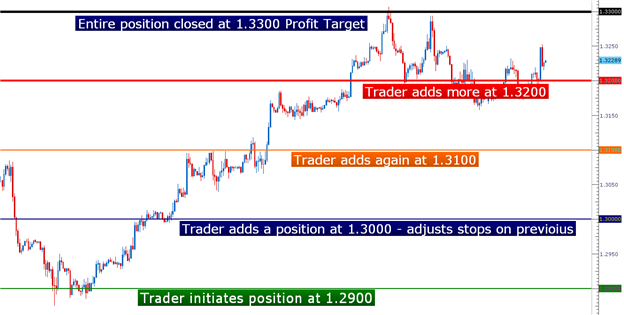
A further point to this is adding to positions. Many traders will add another position to an already losing position under the presumption that they are ‘scaling in.’
This is not scaling in. This is throwing good money after bad.
Scaling in is planned beforehand; and is strategic. In most cases, many professional traders are ONLY scaling into winning positions. I covered this type of logic in How to Scale in to Positions. This is position trading, and in my and many other trader’s opinions – this is the only way to properly build a position.
Traders want to look to scale in to winning positions :
Utilize Break-Even Stops (adapted from How to Lose Properly article)
So, even after you learn how to lose – it is still going to stink. But eventually you become numb to the feeling. It always stinks, but after you gain some experience you begin to realize that it’s inevitable and just a cost of doing business.
One way that losing can be mitigated is through trade management.
A primary reason that so many traders would take such small gains and such large losses in The Number One Mistake Forex Traders Make is default human nature. Human beings are, for the most part, scared to lose.
Just think about the last time you were in a trade. If the position moved against you, many people think ‘well, I’ll let this one work to see if it can come back to my entry price. I’ll hang on for just a little bit longer, and if it gets to even a 5 pip gain I’ll close it out quickly.’
This is greed – when in fact the trader should be fearful (the position has, up to that point, been a failure).
On the other hand, think of opening your platform in the morning and realizing you have a small gain that didn’t quite hit your profit target. Most people will look at that and say ‘well, I’ll close it out just so this thing doesn’t move against me, and becomes a loser.’
This is fear – when, in fact, the trader should be greedy. This position has shown you success! You’ve been proven right! These are the situations where you want to let the trade work with the goal of taking more profits out of the market.
This way, if the trade moves against you, you can be taken out for no gain, and no loss. This can save you the amount you had initially put up to risk on the position.
Further, this can allow the trade to work while you carry a clean conscious that, at the very least, your initial equity is no longer exposed on the position.