 MetaTrader 5
 Experts
 Indicators
 Scripts
 Libraries
 Storage
Join our fan page

KCI Standard: A Pure Kinematic Computing Engine for Market Singularity Detection - indicator for MetaTrader 5

- Views:
- 19270
- Rating:
- Published:
- Updated:
-
 You are missing trading opportunities:
- Free trading apps
- Over 8,000 signals for copying
- Economic news for exploring financial markets
Registration Log inYou agree to website policy and terms of use
If you do not have an account, please register -
 Need a robot or indicator based on this code? Order it on Freelance
Go to Freelance
Need a robot or indicator based on this code? Order it on Freelance
Go to Freelance
Abstract
The Kinetic Compression Index (KCI) is a custom oscillator designed to detect market exhaustion and localized compression events. By calculating its kinematic metrics internally rather than relying on external standard indicator handles, the KCI reduces overhead and simplifies buffer management for Expert Advisor (EA) integration. This article details the mathematical foundation, system architecture, buffer mapping, and practical integration guides for developers looking to implement this tool in MetaTrader 5.Introduction
In algorithmic trading, reducing dependency on multiple external indicator handles can streamline an Expert Advisor's architecture. Calling multiple iCustom or standard indicator handles (like moving averages and standard deviations) can sometimes complicate buffer management and initialization processes.
The KCI is engineered to process price and volume data natively within a single file. By identifying rapid deceleration in price movement combined with volume drops, it aims to pinpoint exhaustion events—points where a local mean-reversion is statistically probable.
Problem Statement
The primary goals of the KCI architecture are to:
-
Reduce Handle Dependency: Calculate moving averages and deviations natively inside the indicator loop to minimize the use of external handles.
-
Provide Reproducible Metrics: Expose clean, transparent mathematical metrics (Velocity, Deviation, and Dispersion) to EAs.
-
Ensure Asynchronous Safety: Build signal buffers that only validate on closed bars, protecting the EA from intrabar repainting and asynchronous tick data delays.
Theory & Mathematical Foundation
KCI is built upon four fundamental metrics. To ensure full reproducibility, the core formulas are defined as follows (where $n$ is the BasePeriod ):
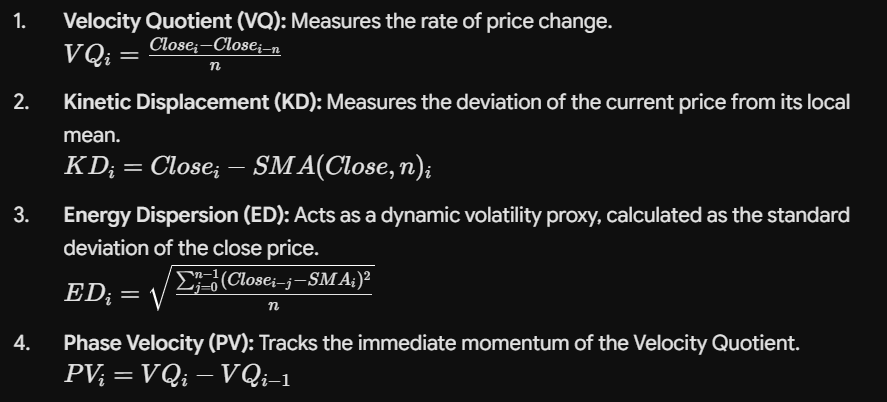
Text Figure :
1. **Velocity Quotient (VQ)** – Measures the rate of price change.
VQ_i=\frac{Close_i-Close_{i-n}}{n}
Where:
- \(Close_i\) = current closing price
- \(Close_{i-n}\) = closing price \(n\) bars ago
- \(n\) = lookback period

2. **Kinetic Displacement (KD)** – Measures the deviation of the current price from its local mean.
KD_i=Close_i-SMA(Close,n)_i
Where:
- \(SMA(Close,n)_i\) = Simple Moving Average of the closing price over the last \(n\) periods.
3. **Energy Dispersion (ED)** – Acts as a dynamic volatility proxy, calculated as the standard deviation of the closing price.
ED_i=\sqrt{\frac{\sum_{j=0}^{n-1}\left(Close_{i-j}-SMA_i\right)^2}{n}}
Where:
- \(SMA_i\) = local Simple Moving Average at bar \(i\).

4. **Phase Velocity (PV)** – Tracks the immediate momentum of the Velocity Quotient.
PV_i=VQ_i-VQ_{i-1}
Where:
- \(VQ_i\) = current Velocity Quotient
- \(VQ_{i-1}\) = previous Velocity Quotient

// Or

1. Velocity Quotient (VQ)
VQ(i) = (Close(i) - Close(i-n)) / n

2. Kinetic Displacement (KD)
KD(i) = Close(i) - SMA(Close, n)

3. Energy Dispersion (ED)
                n-1
               -----
               \
ED(i) = sqrt(  /    (Close(i-j) - SMA(i))² / n )
               -----
               j=0

4. Phase Velocity (PV)
PV(i) = VQ(i) - VQ(i-1)
Z-Score Normalization: Because these four metrics have different scales (e.g., price points vs. pure rates), they are normalized using a rolling Z-Score over a defined ZScorePeriod before being summed into the Raw_KCI .
System Architecture & Unified Buffer Map
To prevent the common "Index Out of Bounds" or mismatched buffer errors during CopyBuffer() calls, the KCI strictly adheres to the following unified buffer map. This mapping is consistent across #property declarations, SetIndexBuffer() , and EA integration.| Buffer Index | Buffer Name | Type | Purpose |
| 0 | KCI_Main | INDICATOR_DATA | Visual Polarized Oscillator line |
| 1 | KCI_Color | INDICATOR_COLOR_INDEX | Dynamic color mapping for the main line |
| 2 | Signal_Buy | INDICATOR_DATA | Buy Signal (1.0 = Buy, 0.0 = Neutral) |
| 3 | Signal_Sell | INDICATOR_DATA | Sell Signal (1.0 = Sell, 0.0 = Neutral) |
| 4 | Internal_VQ | INDICATOR_CALCULATIONS | Velocity Quotient array |
| 5 | Internal_KD | INDICATOR_CALCULATIONS | Kinetic Displacement array |
| 6 | Internal_ED | INDICATOR_CALCULATIONS | Energy Dispersion array (used for SL/TP) |
| 7 | Internal_PV | INDICATOR_CALCULATIONS | Phase Velocity array |
| 8 | Raw_KCI | INDICATOR_CALCULATIONS | Sum of normalized matrices |
Code Walkthrough: EA Integration & Risk Management
When calling KCI from an EA, the code must handle the indicator's handle lifecycle, verify that CopyBuffer successfully retrieved the data, and normalize all price calculations for Stop Loss (SL) and Take Profit (TP) according to the symbol's digits.
Here is the corrected, robust EA integration template:
#include <Trade\Trade.mqh>
CTrade trade;

int handle_kci;
datetime last_bar_time = 0;
double buf_buy[], buf_sell[], buf_ed[];

int OnInit()
{
    // Initialize KCI Handle
    handle_kci = iCustom(_Symbol, _Period, "KCI", 50, 2.0, 14);

    if(handle_kci == INVALID_HANDLE)
    {
        Print("Failed to create KCI handle!");
        return(INIT_FAILED);
    }

    ArraySetAsSeries(buf_buy, true);
    ArraySetAsSeries(buf_sell, true);
    ArraySetAsSeries(buf_ed, true);

    return(INIT_SUCCEEDED);
}

void OnDeinit(const int reason)
{
    if(handle_kci != INVALID_HANDLE)
        IndicatorRelease(handle_kci);
}

void OnTick()
{
    datetime current_time = (datetime)SeriesInfoInteger(_Symbol, _Period, SERIES_LASTBAR_DATE);
    if(current_time == last_bar_time) return;

    // Basic filter: only one position per symbol
    if(PositionsTotal() > 0)
    {
        for(int i = PositionsTotal() - 1; i >= 0; i--)
        {
            if(PositionGetSymbol(i) == _Symbol) return;
        }
    }

    // Retrieve Data (Buffer 2 = Buy, Buffer 3 = Sell, Buffer 6 = ED)
    if(CopyBuffer(handle_kci, 2, 1, 1, buf_buy) <= 0) return;
    if(CopyBuffer(handle_kci, 3, 1, 1, buf_sell) <= 0) return;
    if(CopyBuffer(handle_kci, 6, 1, 1, buf_ed) <= 0) return;

    // Lock the time ONLY after data is successfully copied
    last_bar_time = current_time;

    double dynamic_volatility = buf_ed[0];
    if(dynamic_volatility == 0) return;

    double point = SymbolInfoDouble(_Symbol, SYMBOL_POINT);
    int digits = (int)SymbolInfoInteger(_Symbol, SYMBOL_DIGITS);
    double ask = SymbolInfoDouble(_Symbol, SYMBOL_ASK);
    double bid = SymbolInfoDouble(_Symbol, SYMBOL_BID);

    // Execution Logic with Normalized Dynamic Volatility Stop Loss
    if(buf_buy[0] == 1.0)
    {
        double sl = NormalizeDouble(ask - (dynamic_volatility * 1.5), digits);
        double tp = NormalizeDouble(ask + (dynamic_volatility * 3.0), digits);
        trade.Buy(0.01, _Symbol, ask, sl, tp, "KCI Buy");
    }

    if(buf_sell[0] == 1.0)
    {
        double sl = NormalizeDouble(bid + (dynamic_volatility * 1.5), digits);
        double tp = NormalizeDouble(bid - (dynamic_volatility * 3.0), digits);
        trade.Sell(0.01, _Symbol, bid, sl, tp, "KCI Sell");
    }
}
Performance & Limitations
To ensure realistic expectations, developers must account for the following structural limitations:
-
Tick Volume Dependency: For Forex/CFDs, tick_volume represents the frequency of price changes, not actual liquidity. The volumetric compression metric may behave differently on centralized exchanges (Stocks/Futures) where real volume is available.
-
Mean-Reversion Vulnerability: As a bounded oscillator, KCI aims to catch exhaustion. In a strong, trending market, it may generate consecutive premature reversal signals. It should be paired with a higher-timeframe trend filter (e.g., EMA 200).
-
Low Timeframe Noise: Using this indicator on M1 or M5 exposes the logic to micro-structure noise. Z-Score normalization requires stable distribution, which is better found on M15 and above.
Conclusion
The Kinetic Compression Index provides a transparent, natively calculated alternative to stacking multiple standard indicators. By exposing both directional signals on closed bars and a dynamic volatility proxy (Energy Dispersion) through a unified buffer map, it serves as a reliable structural component for MQL5 Expert Advisors.Implementation on Chart : (KCI Custom)

Market Structure SMC: Swings, BOS/CHoCH, Order Blocks, FVG, QML
SMC/ICT market-structure indicator for MT5: swing highs/lows, BOS (continuation) and CHoCH (reversal) confirmed on close, Order Blocks, Fair Value Gaps, and QML (Quasimodo) levels. Every feature is toggle-able, with adjustable swing sensitivity and colors. Works on any symbol and timeframe.
 Trade Journal Exporter - closed positions to CSV
Exports your closed positions for a configurable period to a CSV file for journal analysis in Excel or Google Sheets: entry and exit time and price (volume-weighted over partial fills), volume, result in points, commission, swap, net profit and trade duration.
 EA KCI Embeded Sniper
The KCI Embedded Sniper is an algorithmic trading solution designed for high-precision reversal entries. Unlike conventional Expert Advisors that rely on external indicator dependencies (which often suffer from thread desynchronization and latency), this EA features a fully embedded Kinetic Compression Index (KCI) engine. By transplanting the entire mathematical framework of the KCI—calculating Velocity Quotients, Kinetic Displacement, Energy Dispersion, and Phase Velocity—directly into the EA’s core logic, we have eliminated "asynchronous lag." The result is a lightning-fast sniper engine that validates market exhaustion (Singularity) and momentum extremes (Williams %R) with micro-second precision, operating solely on completed bars to ensure zero-repaint performance.
Execution Cost Sensitivity Analyzer
A pure-MQL5 script that measures how robust a strategy's edge is to execution costs. It reads a Date,Profit,Volume CSV of closing deals and models each deal's cost as a fixed part plus a per-lot part. It prints the breakeven cost per deal, the cushion (the multiple of an assumed realistic cost at which the net profit reaches zero), the net profit and profit factor re-priced at the assumed cost, the share of winners the cost turns into losers, and a composite A+ to F cost-robustness score with recommendations. If no file is present it generates a reproducible sample and analyzes it, so the output is visible on the first run. No external libraries, no Python, no AI.