
Scroll through the Expert Advisors section of the MQL5 Market and one thing stands out: it’s almost all gold. Gold scalpers, gold breakout systems, gold “neural networks”. Gold has moved beautifully in recent years, and backtests on it look impressive. But this approach has a simple problem: your entire result depends on a single market. When gold goes into a long range or changes the way it moves, your whole EA portfolio suffers with it, because in practice it’s the same portfolio.
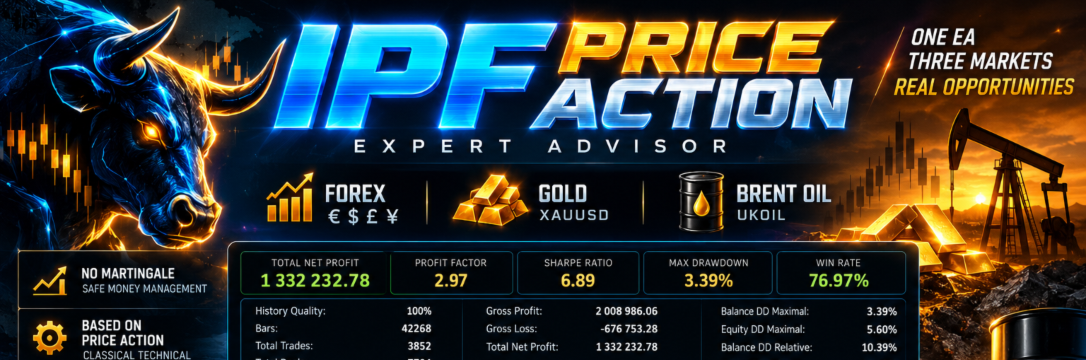
I built IPF Price Action around a different idea. It isn’t another gold bot. It’s a portfolio Expert Advisor: 9 strategies on 6 instruments, all traded from a single chart.
What it trades
- EURUSD
- GBPUSD
- GBPJPY
- USDJPY
- XAUUSD (Gold)
- XBRUSD (Brent oil)
Four currency pairs, a metal and an energy market. They have different drivers, different sessions and different volatility. When gold stalls, the yen or the pound may be moving. When currencies are stuck in a tight range, oil may take off. That’s the point of diversification: not guessing which market will fire, but being ready on several at once.
The logic: pivot levels and breakouts
All nine strategies share one simple, time-tested idea: price respects its extremes, and a break of a significant level often leads to a move.
1. Finding the levels. On H4 and D1 the EA looks for pivot highs and pivot lows: turning points confirmed by bars on both sides. It only takes a level that is the extreme of its area and sits far enough from the current price. Random small swings are filtered out.
2. Breakout orders on both sides. A Buy Stop goes above the pivot high, a Sell Stop below the pivot low. The EA doesn’t try to guess direction. The market decides which side triggers.
No indicators. Just levels, orders and arithmetic. Every decision the EA makes can be checked by hand on a chart.
The strategy portfolio
| # | Symbol | Level timeframe | Character |
|---|---|---|---|
| 1 | EURUSD | D1 | daily pivot levels, short TP |
| 2 | EURUSD | H4 | wide pivot levels, TP larger than SL |
| 3 | GBPUSD | H4 | variant A |
| 4 | GBPUSD | H4 | variant B, different pivot geometry |
| 5 | GBPJPY | H4 | volatile cross, long TP |
| 6 | USDJPY | D1 | daily pivot levels |
| 7 | USDJPY | H4 | fast trailing |
| 8 | XAUUSD | H4 | gold, price-scaled distances |
| 9 | XBRUSD | H4 | Brent oil |
Each strategy has its own magic number and its own money management. Any of them can be switched off individually, for example if you don’t want to trade oil or your broker doesn’t offer one of the instruments.
Position management
The entry is only half the job. The real work starts after it, and the EA checks every position once a minute:
- Hard Stop Loss and Take Profit from the moment the trade opens. No trade ever runs without a stop.
- Break-even after a set move in your favor.
- Trailing stop to capture strong moves.
- Fake-breakout exit. This is one of the key details. If the very first M1 candle after entry closes against the position and beyond the entry price, the EA closes the trade immediately instead of waiting for the full stop. A false breakout usually shows itself right away, and there’s no reason to pay the full risk for it.
- Emergency close if price jumps past the stop on a gap or slippage.
For Gold, Brent and EURUSD, SL, TP and trailing distances are recalculated from the current price level. Gold has moved from around 1,500 to very different levels over the past few years, and a fixed stop in points tuned at one price becomes either too tight or too wide at another. Price scaling solves that.
OneChart Setup: one chart instead of six
Multi-symbol trading usually looks like this: six charts, six copies of the EA, each with its own settings. It’s easy to make a mistake, and easy to forget a chart after a terminal restart.
IPF Price Action keeps it simple. Attach the EA to any one chart on any timeframe, switch on OneChart, and it trades every enabled instrument by itself.
The only thing to check is your broker’s symbol names. They vary a lot: EURUSD.m , EURUSD+ , GOLD , UKOIL , BRENT . The settings give you:
- a common prefix and suffix applied to all symbols at once;
- a separate name field for each instrument;
- automatic lookup through known synonyms and the server’s symbol list, with currency checks so that, for example, EURUSDT or GOLDEUR are never picked by mistake.
Example on Vantage Markets: EURUSD+ , GBPUSD+ , GBPJPY+ , USDJPY+ , XAUUSD+ , UKOUSD . On a cent account at the same broker: EURUSD.pc , GBPUSD.pc and so on. Note that oil on the standard account has no “+”, so here it’s easier to enter each name separately than to rely on a common suffix.
An on-chart panel shows which symbol is mapped to what, how many strategies are active, whether the market is open, and whether a news block is in effect. One glance tells you everything is running.
Money management
Three lot modes:
- fixed lot;
- balance step (for example 0.01 per every $N);
- risk percent of balance based on distance to the stop, the recommended mode.
You can use one global money management setting for all strategies or a separate one for each, with its own lot multiplier. There is also a custom balance for fixed-risk trading without compounding, a per-trade margin cap, free margin checks and broker volume limit checks.
Prop Firm module
For prop account traders, a full protection module is built in:
- Daily and total drawdown limits, in percent or money.
- Early trigger. By default at 90% of the limit. When positions are closed, spread and slippage still take their share, and if you wait for the exact limit it’s easy to breach it. The 10% buffer handles that.
- Pause until the next day. When triggered, all positions are closed, pending orders are removed and saved, and trading pauses until the next server day, after which the orders are restored.
- State survives a terminal restart. If your VPS reboots in the middle of the day, the daily drawdown counter doesn’t reset. It’s an important detail, and many EAs get it wrong.
- Cluster risk limit. A new order isn’t placed if the combined “all stops hit” risk in one direction would exceed the set limit.
- Randomization of entry, SL, TP and trailing by a few points, so trades don’t look like identical copies.
- Drawdown watchdog that doesn’t depend on incoming ticks.
News filter
The filter uses the built-in MT5 economic calendar and only considers high-impact events. The key difference is that it works per currency of each symbol. GBPJPY reacts to both pound and yen news. Gold and Brent react to dollar news. EURUSD won’t stop trading because of Japanese data.
During news, pending orders are removed or frozen and restored after the window with their original parameters.
Other details
- Friday cutoff: pending orders are removed on Friday evening and restored at the start of the new week, per instrument session.
- Real or virtual pending orders. Virtual orders are invisible to the broker and survive restarts.
- Session awareness. During session breaks, such as gold’s daily pause, the EA doesn’t send requests to the server.
- Works on hedging and netting accounts.
What IPF Price Action is not
I write this section for every EA I release, because the Market is full of promises that can’t be kept.
- No AI. No neural networks, no “self-learning”, no models “trained on 20 years of ticks”. This is deterministic level-based logic.
- No martingale. A loss is a loss. The EA never doubles the lot to “win it back”.
- No grid, no averaging. One idea, one position, one stop.
- No indicators.
- No date filters tuned to polish a backtest. A strategy has to work over the long run, not on a convenient stretch of history.
Quick start
- Open any chart. The timeframe doesn’t matter (H1 for a clean look).
- Drag IPF Price Action onto the chart and enable AutoTrading.
- If your broker uses a symbol suffix, enter it in the suffix field. If a symbol has a different name, type it into that instrument’s name field.
- Choose the “Risk %” lot mode and set your risk.
- Check the on-chart panel: all symbols found, strategies active.
For a prop account, enable the Prop Firm module and enter your firm’s limits.
Risk recommendations
- Deposit: from $500. The exact minimum depends on your broker’s minimum lot for Gold and Brent.
- Account: Raw / ECN with low spreads is preferred.
- VPS: the terminal should run around the clock.
- Risk: nine strategies on six markets means several positions can be open at the same time. 1% per trade for the full portfolio is aggressive. A conservative start is 0.3–0.5%.
As with any trading system, start on a demo account or with low risk and scale up once you’ve seen how the EA behaves on your broker. Past performance does not guarantee future results.
Who it’s for
- Traders who want a diversified portfolio on one terminal and one chart.
- Prop traders who need drawdown protection that survives a restart.
- Traders who already run several gold EAs and want to add something that doesn’t depend on gold.
- Anyone looking for logic without martingale, grids or fairy tales.
Bottom line
IPF Price Action isn’t an attempt to build yet another bot that draws a pretty curve on gold. It’s a portfolio of simple, transparent strategies across different markets: pivot levels, breakouts, disciplined position management. When one market is quiet, the others keep working.
🛒 Product page: https://www.mql5.com/en/market/product/201727
🎁 Bonus: special access to FX Monitor with your purchase