Can Time Alone Be a Trading Strategy? – My Journey to TH Systems Time Invest

The basic idea behind TH Systems Time Invest is not new.
Time-based trading strategies, where a market is bought at a specific time and sold again later, have existed for many years. The concept is particularly interesting for stock indices, as many of these markets have shown a positive long-term drift.
I had been interested in this approach for some time and originally just wanted to build my own Expert Advisor for MetaTrader 5 around this concept.
The goal was not to invent a completely new trading strategy.
Instead, I wanted to find out:
Can this well-known and very simple principle be turned into an automated Multi-Index EA that I can use and monitor myself over the long term?
That personal project eventually became TH Systems Time Invest.
I Wanted to Keep It Simple
In many trading systems, a lot of work goes into entry signals, market movements, filters and combinations of different conditions.
With Time Invest, I deliberately wanted to take a different approach.
No complicated signal chain.
No attempt to predict every small market movement.
Instead, I wanted to preserve the simplicity of the original idea:
Buy a market on specific weekdays at a specific time and close the position later at a predefined time.
It almost sounds too simple.
But that is exactly what interested me about the strategy.
If a simple set of rules works, why turn it into a complicated system with ten additional filters?
From One Market to a Portfolio
During development, I did not want to focus on just one index.
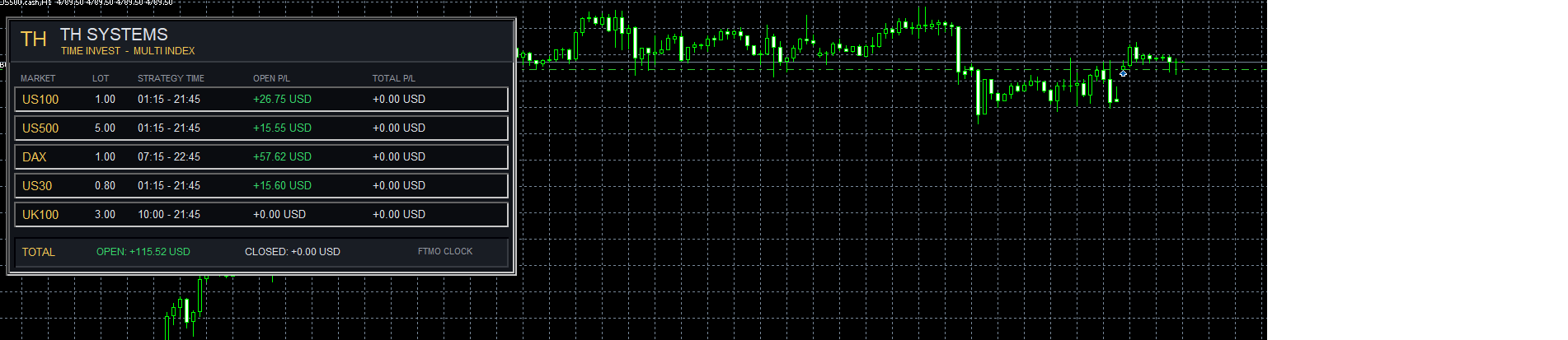
I therefore examined several major stock indices and eventually created a portfolio consisting of five markets:
| Market | Entry | Exit | Trading Days |
|---|---|---|---|
| US100 | 01:15 | 21:45 | Monday, Tuesday, Wednesday |
| US500 | 01:15 | 21:45 | Monday, Tuesday, Wednesday |
| DAX | 07:15 | 22:45 | Monday, Tuesday, Wednesday, Thursday |
| US30 | 01:15 | 21:45 | Monday, Tuesday, Wednesday, Friday |
| UK100 | 10:00 | 21:45 | Monday, Tuesday, Wednesday, Thursday |
The strategy itself remains very simple.
It trades Long only.
There is no RSI, no EMA entry filter, no ATR trigger and no complicated candlestick pattern.
There is also no Grid, Martingale or Recovery system.
Essentially, the EA only needs to know:
Which market? Which weekday? When to buy? When to sell? What position size?
It Was Originally Just Supposed to Be My Own EA
At the beginning, my intention was simply to automate this strategy for myself.
If I have a fixed set of rules, I do not want to manually remember every day that a position has to be opened at a certain time and closed again later.
That is exactly what Expert Advisors are made for.
During development, however, the project became more than just a small EA for one market.
I wanted all markets to be managed centrally by a single EA.
Today, only one instance of Time Invest needs to be attached to one chart.
From there, the EA automatically searches for US100, US500, DAX, US30 and UK100 and manages the corresponding positions.
My Portfolio Backtest So Far
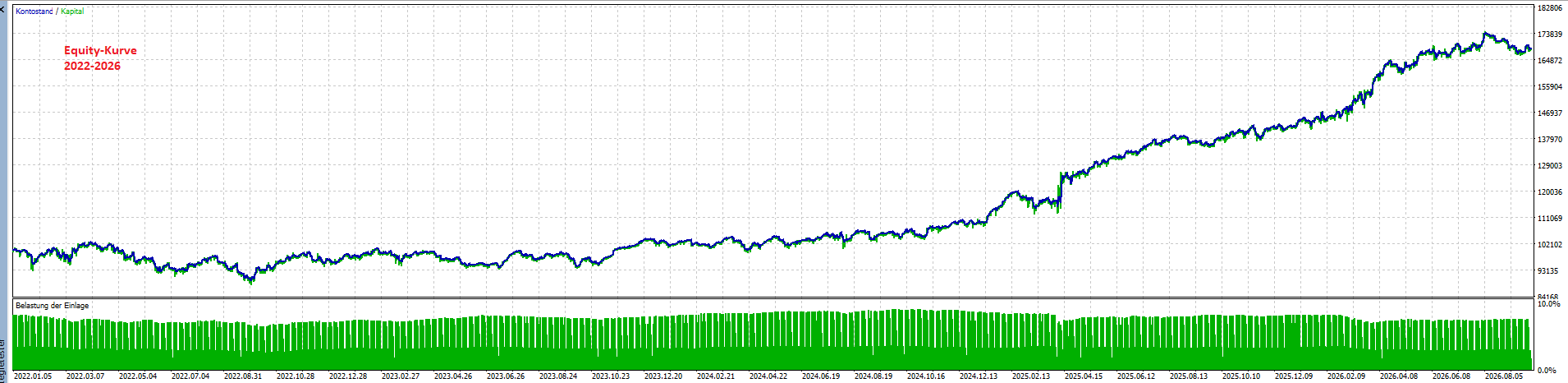
Naturally, I wanted to see how the idea would have performed historically as a complete portfolio.
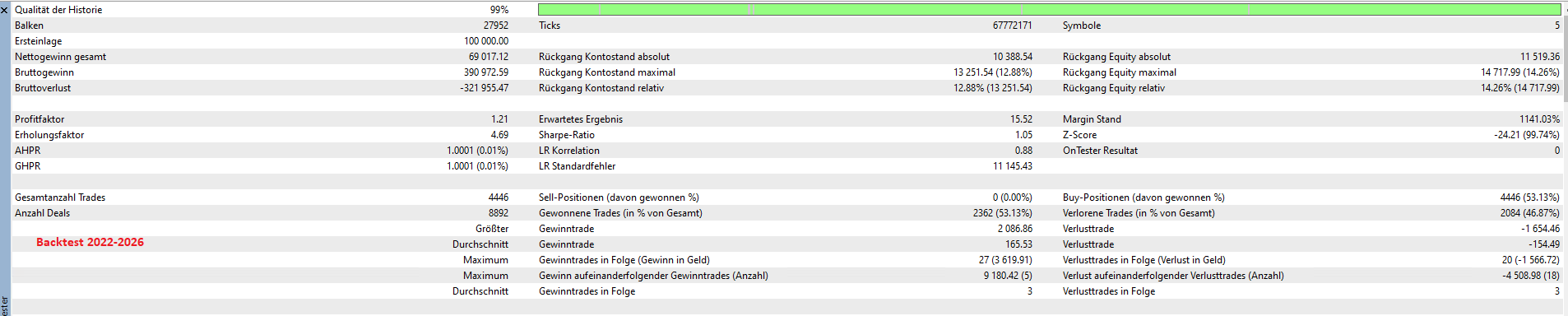
For my long-term test, I used a starting balance of €100,000.
The results:
| Metric | Result |
|---|---|
| Starting Balance | €100,000 |
| Net Profit | +€69,017 |
| Total Return | approx. +69% |
| Maximum Equity Drawdown | approx. 14.3% |
| Profit Factor | 1.21 |
| Trades | 4,446 |
| Winning Trades | 53.13% |
| Losing Trades | 46.87% |
For me, the Profit Factor of 1.21 also illustrates something important:
This is not a system where almost every trade wins.
The idea is instead to see whether a relatively small statistical edge can persist over a large number of trades and across several markets.
That is exactly what makes the strategy interesting to me.
Simple Does Not Automatically Mean Robust
Just because a strategy has only a few rules does not automatically make it robust.
Trading times and weekdays can also be fitted to historical data and therefore over-optimized.
A good backtest is not proof that the same results will continue in the future.
This applies to Time Invest just as much as it does to any other Expert Advisor.
What interests me most is therefore how the system performs outside the original historical data and under future market conditions.
No Conventional Stop Loss
There is another important characteristic of the strategy that should be clearly mentioned:
Time Invest does not use a conventional Stop Loss as part of its normal trading logic.
Positions are closed according to their predefined Exit time.
This means that larger intraday fluctuations can occur between Entry and Exit.
Position sizing is therefore an important part of the system.
For a reference account size of 100,000, I use:
| Market | Lot |
|---|---|
| US100 | 1.00 |
| US500 | 5.00 |
| DAX | 1.00 |
| US30 | 0.80 |
| UK100 | 3.00 |
The EA can automatically scale these lot sizes for different account sizes.
Increasing the position size naturally increases both the potential return and the potential risk and drawdown.
Broker Time Became an Important Issue
During development, one practical problem with time-based strategies quickly became obvious:
Different brokers use different server times.
For many signal-based EAs, a difference of one hour may be less important.
For a strategy whose entire logic is based on specific times, it is critical.
For this reason, I added a simple manual time adjustment to the EA:
Time Adjustment Hours
0 represents my original TH Systems reference time.
If a broker's server time differs by one hour, for example, all trading times can be shifted forward or backward together.
This setting works both in the Strategy Tester and in live trading.
Symbol Names Are Also Different Between Brokers
The second challenge for a Multi-Index EA is that brokers use different symbol names.
For example, the Nasdaq 100 may be called US100, NAS100, USTEC or something completely different depending on the broker.
The same issue exists for the other indices.
For this reason, I have already included many different symbol names directly in the EA.
However, it is impossible for me to know every broker and every possible symbol name.
If Time Invest does not recognize a market at your broker, simply send me a message via MQL5.
Ideally, send me:
Broker + exact symbol name + current MT5 server time.
I can then check the issue and, if necessary, add missing symbol names in a future update.
The same applies if the EA does not trade at all or if you are unsure about the correct time adjustment. Just send me a message.
Why Am I Making the EA Available for Free?
As mentioned earlier, I originally built Time Invest for myself.
But once the project developed into a complete Multi-Index EA, I decided to make it available for free on the MQL5 Market.
I think that fits this strategy particularly well.
The basic concept is neither secret nor new.
What is interesting is the actual implementation and the question of how such a simple system performs over the long term.
Anyone can therefore download the EA, test it using their own broker data and form their own opinion.
For me, it is also interesting to see how the strategy behaves across different brokers and under different market conditions.
Conclusion
TH Systems Time Invest was not created as an attempt to invent a new trading theory.
The basic concept of time-based Long strategies already existed.
I found the idea interesting and initially just wanted to turn it into an EA for my own trading.
Over time, that small project developed into a complete Multi-Index system covering five markets.
And the simplicity is still what I like most about it:
Market. Weekday. Entry Time. Exit Time. Position Size.
Now the more interesting part begins:
Not the development of the EA itself, but the question of how this simple strategy will perform under future market conditions over the long term.
Disclaimer: The results shown above are based on historical backtests. Historical results do not guarantee future performance. Results may vary depending on broker, historical price data, spreads, execution, contract specifications and server time.