Grid Smoothed Moving Average EA
- Uzmanlar
- Sürüm: 3.15
- Etkinleştirmeler: 5

Try it first, free of risk: open Grid Smoothed Moving Average EA in the MetaTrader 5 Strategy Tester, switch on visual mode, and watch the grid wait patiently until a closed candle crosses the slow smoothed line at the very moment that line itself starts to turn.
THE SLOW LINE THAT DOES NOT FLINCH.
Most moving averages jump at every noisy candle. The Smoothed Moving Average is built to stay calm: each new value keeps most of the previous value and lets the newest close move it only a little, so the line glides through spikes and wicks and turns only when the market has truly changed direction. Grid Smoothed Moving Average EA uses that patient line to decide when a new move has begun, and then passes control to a complete grid management engine that keeps reducing the oldest exposure, one group closure and one partial slice at a time.
At a glance
• A BUY cycle can begin only when a bar closes above the SMMA after the bar before it closed at or below it; a SELL cycle needs the mirror cross below. Closed bars only, so nothing repaints.
• New in this product: the Smoothed Bend Guard. Because the SMMA is slow, a candle can easily poke through it while the line is still flat. The EA therefore asks the line itself to have moved in the trade direction over the last three closed bars by a minimum number of ATR, so a cycle starts only when the slow trend is genuinely bending your way.
• The Cross Depth Guard is kept: a cross that only touches the line is ignored as noise, and a cross that lands far beyond it on one violent candle is ignored as a spike.
• A slope rule keeps every entry in step with the line: a BUY only while the SMMA rises, a SELL only while it falls.
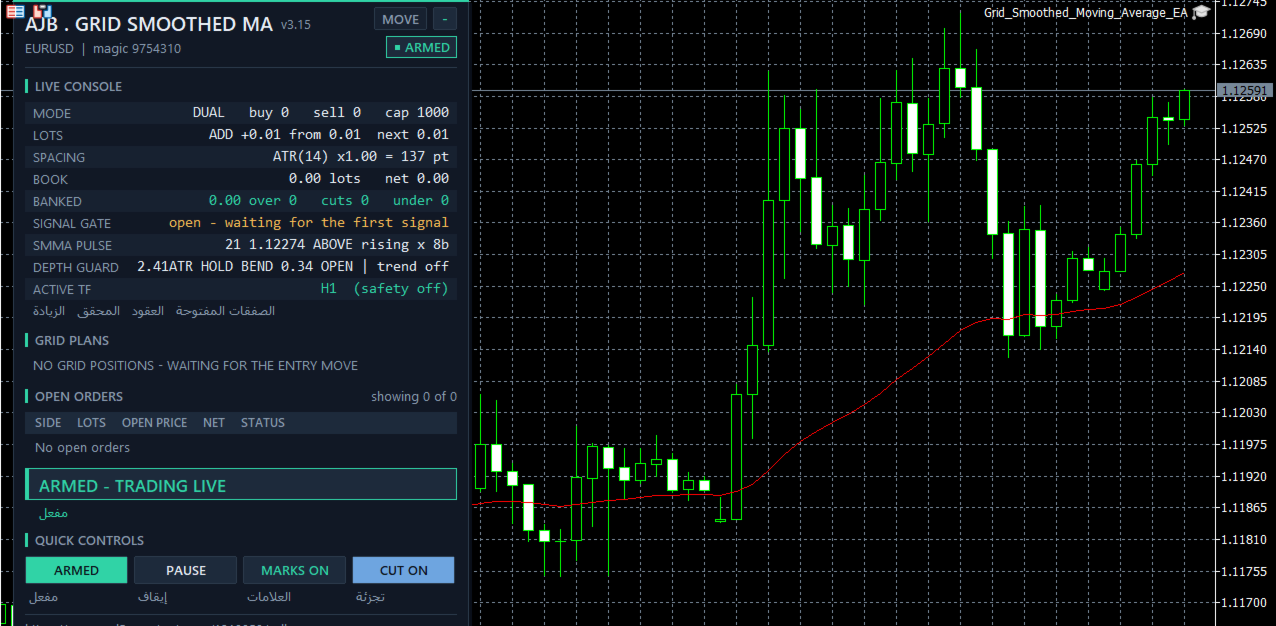
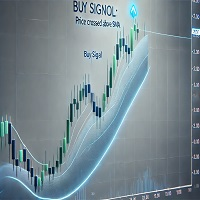
• The SMMA is drawn on the live chart in the main window, and arrows mark every candle where a cycle was armed.
• Profits are banked by groups of the oldest and newest orders, and a heavy old order is retired in partial slices instead of waiting for a full return.
• No stop loss and no forced close-all. When a limit is reached, new levels are refused while the existing book keeps being managed.
• Hedging and netting accounts are both supported, and every limit is a visible input.
FIRST STEPS
Begin on EURUSD H1 or XAUUSD D1 with the default 0.01 lot and the additive ladder. For the first session set RunMode to Scan only: the panel then shows every plan the EA would make without sending a single order, and one button switches it to Armed when you are ready. Run the Strategy Tester on your own broker's data first, because spreads, swaps and commissions differ from broker to broker. On a smaller balance keep the starting lot and let the tester show you how deep the book can grow on your symbol.
Why a smoothed average
The SMMA is the same calm average that Welles Wilder used inside RSI and ATR. With a period of 21, each new value is the previous value times 20, plus the newest price, divided by 21. Nothing ever drops out of a window with a sudden jump, so the line has no steps and no false kinks, and its memory reaches far back while fading gently. For a grid this matters in a simple way: every new cycle adds exposure, so a signal line that refuses to react to every twitch means fewer cycles started inside noise and more cycles started at real turns.
The improvement in this release
The Smoothed Bend Guard is this EA's own addition. A slow line has one weakness: price can cross it many times while the line itself barely moves, and each of those crosses looks like a signal. On every cross the EA measures how far the SMMA has travelled over the last three closed bars, divides that distance by the ATR so one setting fits currencies, gold and indices, and signs it by the trade direction. A BUY needs the line to have risen by at least your minimum, a SELL needs it to have fallen by the same amount. A cross through a flat or opposite-leaning line is skipped. Set the minimum to 0 to switch the guard off. The panel shows the live bend next to the depth reading, with OPEN or HOLD for each guard. Margin-level timeframe safety is included and is off by default.
One cycle, step by step
1. The read. On every closed bar the EA reads the built-in MetaTrader 5 Moving Average in smoothed mode. The forming candle is never used, so history shows exactly what the EA saw.
2. The cross. A BUY is considered when the bar closes above the SMMA after the previous bar closed at or below it; a SELL is the mirror below.
3. The slope rule. By default the SMMA must be rising for a BUY and falling for a SELL.
4. The Cross Depth Guard. The close must sit between your minimum and maximum distance from the line, measured in ATR.
5. The Smoothed Bend Guard. The SMMA must have moved in the trade direction over the last three bars by your minimum ATR fraction.
6. The optional trend filter. A slow EMA can confirm the side: trade only with it, only against it as a fade, or leave it off.
7. The rhythm. A quiet gap of bars between accepted signals keeps a choppy session from starting one cycle after another, and a signal stays valid for a few bars if a level cannot be placed at once.
8. The ladder. Levels are spaced by fixed points or by ATR, with a floor, an upper limit and an option to freeze the distance for the whole cycle. BUY and SELL grids can run side by side or in one direction only.
9. The harvest. The closer searches for groups of the oldest and newest orders and closes a group as soon as its combined result, after swap and commission, beats your target. When the oldest order is still too heavy, only a slice of it is closed, paid for with profit already on the table.
10. The safety checks. A reopen guard blocks any closure that would reopen the same level straight away. Every leg is checked against the deal history, failed legs go into a retry queue, and a plan is dropped if the book changes between the scan and the send.
11. The optional hedge cycle. Off by default. When switched on it holds a balanced pair on a symbol you choose and retires it in equal slices, paid for by a small surcharge on closures the grid is already making.
The panel
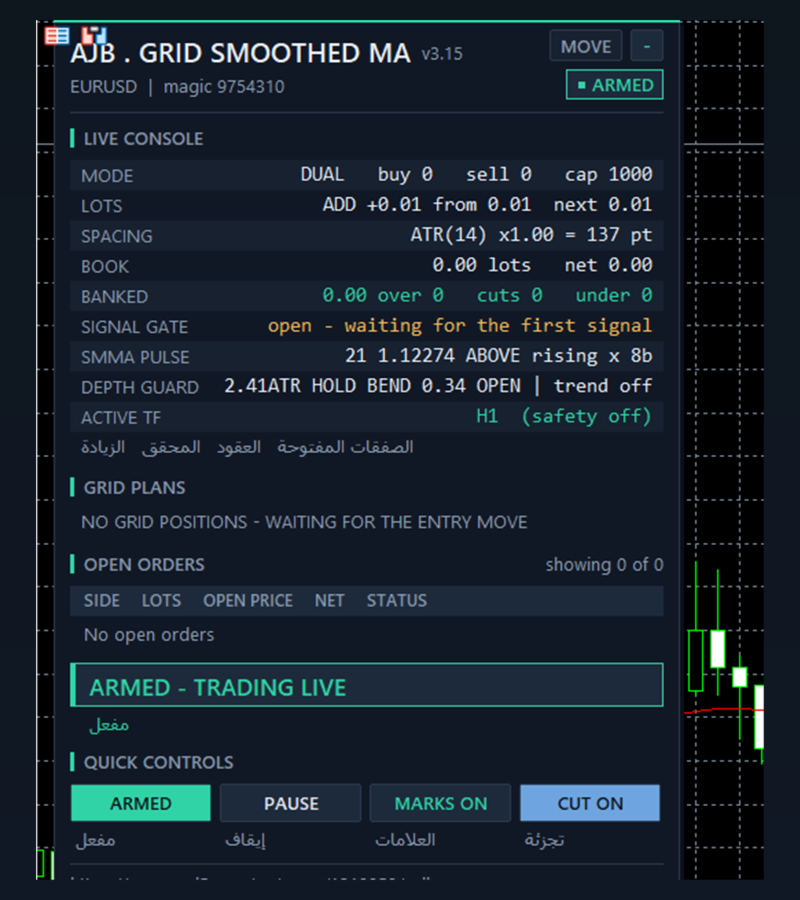
The panel sits on the left of the chart and leaves the right side and the price scale free. It shows the symbol and magic number, a status pill (ARMED, SCAN ONLY or PAUSED), grid mode, lot step, spacing, banked profit, the book in lots with its net result, the closing plan for each side with its own close button, and the order list. The SMMA PULSE row shows the period and live value of the line, whether price is above or below it, whether it is rising or falling and how many bars ago the last cross happened. The DEPTH GUARD row shows the live distance in ATR with its state, the live bend of the line with its state, and the trend filter. Buttons switch Armed / Scan only, Pause / Resume, chart marks and slicing. The Hedge Vault card is docked directly under the main panel and follows it when you drag or minimise. The panel scales with the screen and draws nothing in a non-visual backtest, so optimisation stays fast.
Protection you control
No stop loss and no forced close-all. A reached limit stops new levels; it never dumps the book at a bad moment.
Before each order the money check asks one plain question: is there enough free margin, with a safety buffer, for this order?
Limits on levels per grid, orders per side and lot per order keep the ladder bounded, and the lot ladder stops growing at the level limit.
On netting accounts the margin of the merged position is capped as a percentage of equity.
Optional margin-level timeframe safety moves the signal and the spacing to a higher timeframe when the margin level falls to your chosen levels, and moves back only after margin recovers past a cushion. Off by default.
Every copy isolates itself by symbol and magic numbers, so several charts never touch each other's orders or saved state.
Scan only mode shows every decision without sending any order.
Who it suits, and who it does not
It suits traders who prefer a calm, slow line as the single visible reason for every new cycle, who like many small closures more than one distant target, and who are ready to size the lot for their own account. It does not suit anyone who needs a stop loss on every order, a promised monthly figure, or a set-and-forget robot running large lots on a tiny balance.
Quick answers
Does it repaint? No. Signals come from closed bars only.
How is the SMMA different from a simple average? A simple average drops its oldest bar in one step, which can bend the line for no reason; the SMMA never drops anything suddenly, so it moves more smoothly and lags a little more.
Is it the same as an EMA? It is close to an EMA of roughly twice the period, but the classic Wilder formula is what MetaTrader 5 uses, so values match the built-in indicator exactly.
Can I make the line faster or slower? Yes. A shorter period reacts sooner and gives more crosses; a longer one gives fewer, calmer crosses.
Can I use it on gold or indices? Yes. It runs on any symbol and timeframe; ATR spacing and both ATR based guards adapt to the symbol.
Can I run it on several charts? Yes. Give each copy its own magic numbers and they stay fully separate.
Can I make it trade more or less often? Yes. Lower SignalBarsDelay or the guard minimums for more cycles; raise them, use a longer period, or switch on the trend filter for fewer.
Every setting explained
Grid - how levels are opened
TradeMode - dual grid by default (BUY and SELL side by side), or one direction only.
GridSpacePoints - fixed distance between levels in points when ATR spacing is off (25).
GridSpaceMultiplier - 1.0 keeps levels evenly spaced; a higher value spreads deeper levels further apart.
MaxGridLevels - the most levels one grid may hold (1000).
UpDirectionIsBuy - decides which side an upward move belongs to.
EAMagicNumber - the ID written on this EA's grid orders (9754310).
GridOrderComment - the comment on each grid order (GSMMA).
OneOrderPerBar - no more than one new level per bar.
Lot ladder
InitialLotSize - volume of the first level (0.01).
LotSizingMode - additive by default, or multiply.
LotMultiplier - in multiply mode, each level is the previous lot times this value (1.25).
LotAddStep - in additive mode, the volume added at each level (0.01; 0 means the starting lot).
MaxOrderVolume - the largest lot any single order may use (1.0).
UseAutoLot - scales the starting lot with the balance (off).
AutoLotBaseBalance - the balance that matches the starting lot (1000).
AutoLotAllowDecrease - lets auto lot go below the starting lot (off).
ATR spacing
GridSpacingMode - ATR by default, or fixed points.
ATRTimeframe - the timeframe volatility is measured on (current chart).
ATRPeriod - ATR length (14).
ATRSpacingFactor - spacing equals ATR times this value (1.0).
ATRBarShift - 1 uses the last closed bar.
ATRMinSpacingPts - the smallest allowed spacing in points (50; 0 means none).
ATRMaxSpacingPts - the largest allowed spacing in points (5000; 0 means none).
ATRFreezeOnStart - keeps one spacing for the whole cycle (off).
Profit target
DesiredProfitPerClosure - the base target in account currency (2.0).
ProfitMultiplier - scales the final target between 1.00 and 2.00.
ProfitTargetMode - scaled by default, so a bigger and deeper book must earn a bigger result.
ProfitVolumePower - how strongly closing volume lifts the target (1.0; 0 turns it off).
ProfitDepthBonus - extra target for each additional open level (0.10).
ProfitMaxMultiple - the cap on the scaled target as a multiple of the base (50).
ProfitMaxReachFraction - keeps the target within a fraction of one grid step so it stays reachable (0.50).
Fragment scanner
UseMultiLegScan - tests combinations of several orders before the simple pair (on).
MaxOldestLegs - the most oldest orders allowed in one closure (3).
MaxNewestLegs - the most newest orders allowed in one closure (6).
ScanPriority - how qualifying groups are ranked; most orders first by default.
NeverBankLessThanPair - a group must also beat the plain pair target (on).
RequireCloseVolumeExceedsTarget - the newest volume must outweigh the oldest volume (on).
MinCloseVolumeRatio - minimum ratio of closing volume to target volume (1.5).
Target slicing - partial closes
EnableTargetSlicing - closes a slice of the oldest order when the whole lot cannot be paid off yet (on).
FragProfitWeightPower - how profit is weighted per closing lot (1.5).
FragMinSlicePercent - the smallest slice as a percent of the target order (20).
FragAllowMultiCloser - lets several newest orders pool their profit to pay for one slice (on).
FragPreferFullClosure - a full closure wins over a slice whenever both qualify (on).
Reopen guard
ReopenGuard - blocks closures that would immediately reopen a level (step based).
ReopenGuardCushion - the safe distance as a fraction of one grid step (0.90).
Account protection
MinMarginLevelPercent - no new levels below this margin level percent (0 = off).
MaxAccountRiskPercent - no new levels above this floating loss as a percent of balance (0 = off).
NetMaxMarginPercent - on netting accounts, the largest margin of the net position as a percent of equity (5.0).
MaxTotalOrders - absolute cap on grid orders per side (1000).
Execution and verification
RunMode - Armed or Scan only; Scan only is the gentle first step.
CloseSequence - the order in which legs are sent; oldest first by default.
MaxSlippagePoints - maximum slippage (30 points).
MaxSpreadPoints - trading pauses above this spread (7500 points).
MinSecondsBetweenClosures - minimum pause between two closures on the same side (5 seconds).
CloseAttemptsPerLeg - send attempts before a leg moves to the retry queue (3).
VerifyTimeoutSeconds - how long a stuck leg keeps being checked (90 seconds).
DeferWhenMarketClosed - waits for the session instead of halting when the market is closed (on).
MarketClosedRetrySeconds - retry interval while the broker refuses orders (30 seconds).
AutoResumeAfterSeconds - clears a halt by itself after this many seconds (300; 0 waits for the panel button).
NoPartialRetryMinutes - tries partial closes again this many minutes after a broker refusal (15; 0 never).
AbortIfBookChanged - drops a plan if a leg changed between the scan and the send (on).
UseFullCommission - counts commission for both sides of a trade (on).
CommissionPerLot - fallback commission when history has none (0 reads it from history).
CloseOrderComment - the comment on closing deals.
Hedge cycle
EnableHedgeCycle - off by default.
HedgeSymbols - comma-separated list of hedge symbols; repeating one gives it more turns (XAGUSD).
HedgeSymbolRotation - how the next cycle's symbol is picked (per cycle).
HedgeMaxSymbolsInTester - limits rotation in the Strategy Tester only (2; 0 means no limit).
HedgeCycleLots - lots on each side of the balanced pair (0.01).
HedgeSliceLots - lots retired from each side per slice (0.01).
HedgeFragmentBonus - extra amount added on top of the slice cost (100).
HedgeBonusIsPercent - the bonus is a percent of the slice cost; false makes it a fixed amount (on).
HedgeMaxSurcharge - money cap on what one closure may be surcharged (0 = no cap).
HedgeMaxSurchargePercent - the most the hedge may raise any closure target, in percent (50).
HedgeMagicNumber - the hedge legs' ID; it must differ from the grid's (9754311).
HedgeReopenOnFinish - opens a fresh cycle when one finishes (on).
HedgeStartRequiresTrade - waits for the grid to open something before the first cycle (on).
HedgeIntegritySeconds - how often both legs are checked to be equal (5 seconds).
HedgeAutoRepair - repairs a lone leg automatically (on).
HedgeNakedAction - what to do with a lone leg; re-hedge by default.
HedgeMaxSpreadPoints - no hedge orders above this spread (0 = off).
HedgeSlippagePoints - maximum slippage on hedge orders (30 points).
HedgeAttemptsPerLeg - send attempts per hedge leg (3).
HedgeVerifyTimeout - how long a stuck hedge leg keeps being checked (90 seconds).
HedgeCommissionPerLot - fallback hedge commission (0 reads it from history).
HedgeOrderComment - the comment on hedge deals.
Weekly cash day
WeeklyCashDay - no new hedge cycle and no slice during your withdrawal window (off).
CashDayOfWeek - 0 Sunday, 1 Monday and so on (1).
CashCutoffHour - server hour after which no new slice is fired (21).
Panel and chart
ShowPanel - shows or hides the panel.
PanelX and PanelY - panel offsets from the chart edges (12 and 15).
PanelFontSize - base font size (9).
ShowArabic - adds an Arabic line under the English on the panel (on).
ShowChartMarks - draws plans and levels on the chart (on).
MaxTableRows - order rows shown per grid (13).
PanelCorner - the chart corner the panel is anchored to.
Entry trigger
EntryTriggerMode - the SMMA strategy arms the first level by default.
SignalBarShift - 1 means the last closed bar.
SignalBarsDelay - bars that must pass between accepted signals (30; 0 accepts every signal).
SignalValidBars - a signal stays usable for this many bars (3).
SignalAllowBuy and SignalAllowSell - turn each direction on or off separately.
SignalReverse - inverts the direction (off).
Smoothed Moving Average - the signal
InpSMMAPeriod - the SMMA length (21).
InpSMMAPrice - the price the SMMA is built on (close).
InpSMMASlopeAgree - a BUY only while the SMMA is rising and a SELL only while it is falling (on).
InpSMMABendMinATR - Smoothed Bend Guard: how far the SMMA itself must have moved in the trade direction over the last 3 closed bars, in ATR (0.05; 0 = off).
InpSMMADepthMinATR - Cross Depth Guard: the smallest distance between the close and the SMMA on the cross bar, in ATR (0.10; 0 = off).
InpSMMADepthMaxATR - Cross Depth Guard: the largest accepted distance in ATR, so over-stretched spike crosses are skipped (2.00; 0 = off).
InpSMMAGuardATR - the ATR length both guards use to measure distance (14).
InpSMMATrendFilter - 0 off, 1 trade with the EMA side, 2 trade against it as a fade.
InpSMMATrendMAPeriod - the trend EMA length (200).
InpShowSignalArrows - arrows on the candles where a cycle was armed (on).
InpShowSMMAOnChart - draws the SMMA line in the main chart window of the live chart (on; no extra sub-window, so the panel keeps the full chart height).
Debug
DebugMode - detailed journal logging (off).
Margin timeframe safety
UseMarginTFSafety - off by default.
Level1MarginPct and Level1TF - at or below 6000 percent margin level, work on M15.
Level2MarginPct and Level2TF - at or below 5000 percent, work on H1.
MarginTFHysteresisPct - how far margin must recover above a level before stepping back (500).
Honest expectations
A grid manages a position; it cannot see the future. Grid Smoothed Moving Average EA is patient about when a cycle begins and works steadily to keep each cycle short and each old order shrinking, but a market can cross a bending line and still reverse hard, keeping the book open for a long time. Choose a lot your account can carry through that, test on your own broker first, and let the Strategy Tester show you how it behaves before you trade it live. It runs on any symbol and timeframe and needs no DLLs and no extra files.
If it earns a place on your charts, a short and honest review of how it behaved on your account, good or bad, helps other traders make their choice.