Drakor
- Experts
-
Oguzhan Senturk
 Systems Architect & Algorithmic Trader
Engineering fully autonomous execution systems, institutional risk engines, and bespoke trading software.
ABOUT ME & PHILOSOPHY - 버전: 1.0
- 활성화: 10
DRAKOR is a MetaTrader 5 Expert Advisor operating independent BTCUSD and USDJPY engines from one chart. Both use completed H1 price data and broker-side protective stops. The EA contains no grid, martingale, averaging, recovery sizing, news feed, DLL or external data file.
WHAT MAKES DRAKOR DIFFERENT
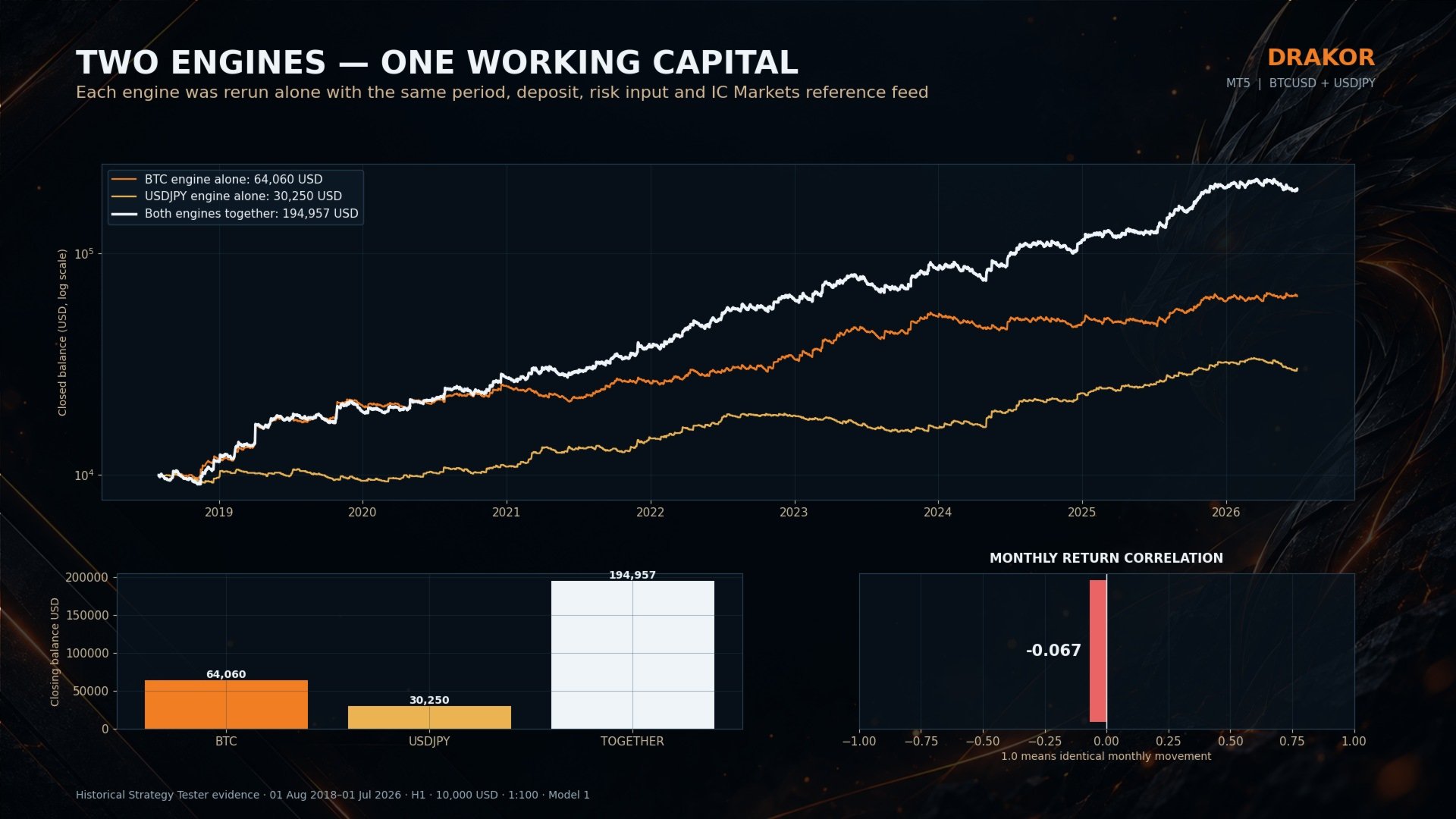
Two unrelated markets, two separate engines, one account. A crypto market and a major currency pair are traded by engines that share no signal, no position and no risk budget. Their monthly results moved almost independently of each other across the whole measured period, so a difficult stretch in one is not automatically a difficult stretch in the other. That is diversification inside a single EA, not two copies of the same idea on two charts.
Measured on two brokers, not one. Every figure on this page was reproduced on a second, independent price feed with the same settings. Both results are published side by side, including the weaker one, so you can see what happened when the same product met different quotes, different spreads and different execution.
You decide how much of the account it may use. DRAKOR sizes from a working-capital allocation you set, not from your whole balance. Assign it 5,000 on a 50,000 account and its lots, its drawdown brake and its panel all follow that 5,000. It can run beside your own trading instead of taking over the account.
The binary you download is the binary that was tested. The published file is the exact one exercised by the final full-period run, not a later recompile, and its checksum is recorded. Every number here is regenerated from the platform's own saved reports rather than typed in by hand.
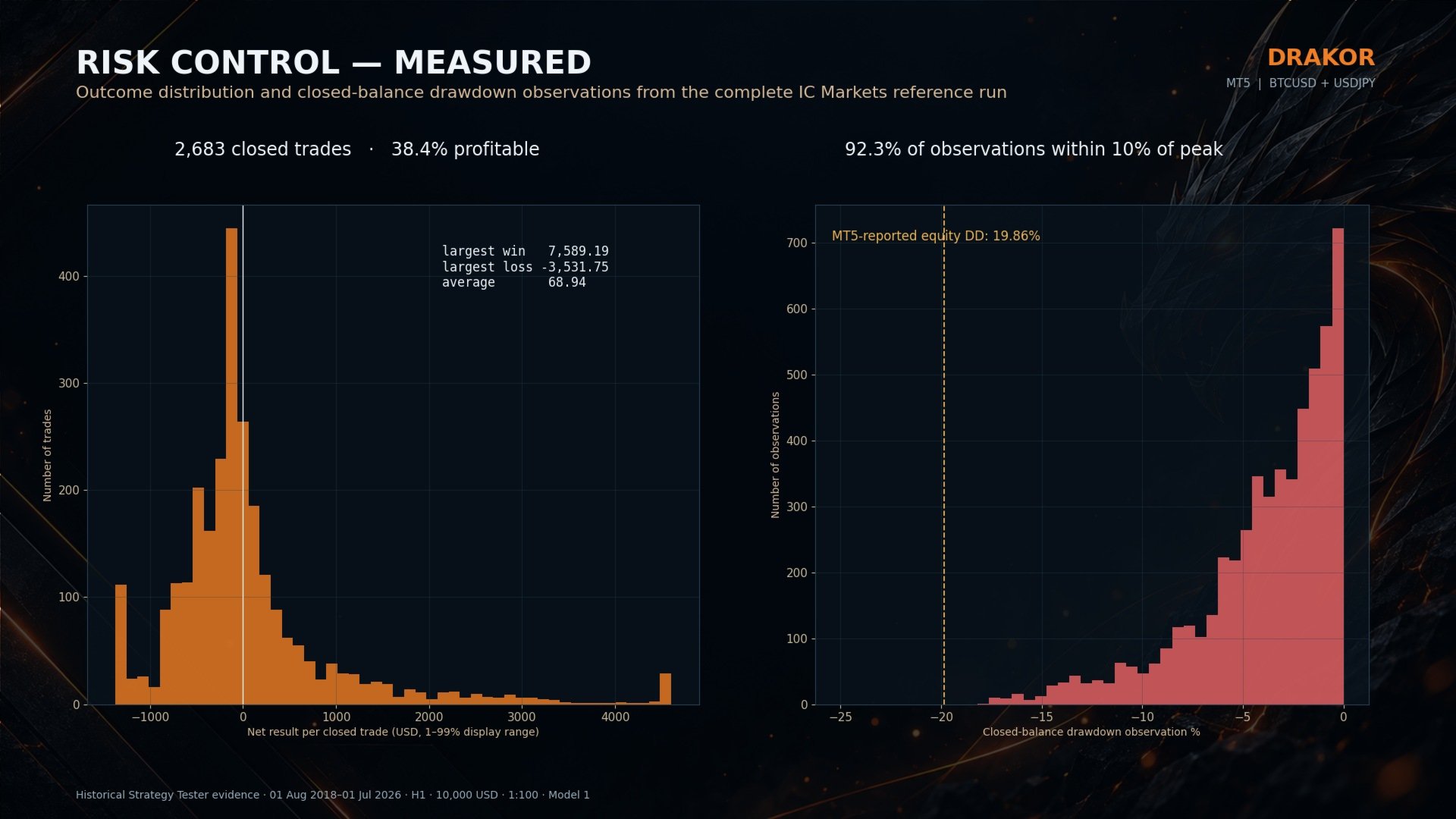
The uncomfortable numbers are published too. This page states the share of losing trades, the longest losing streak, the longest period with no new position and the point at which broker capacity — not the strategy — limits large accounts. A system you cannot evaluate honestly is a system you cannot size correctly.
INTRODUCTORY PRICING
DRAKOR is released at an introductory price of $99. The price is planned to rise by $50 after each completed sale, toward a planned regular price of $799, so the earliest buyers pay the lowest price this product will carry.
A one-month rental at $49 is available for the first 20 rentals, for traders who would rather run it on their own account for a month before deciding.
HISTORICAL REFERENCE TESTS
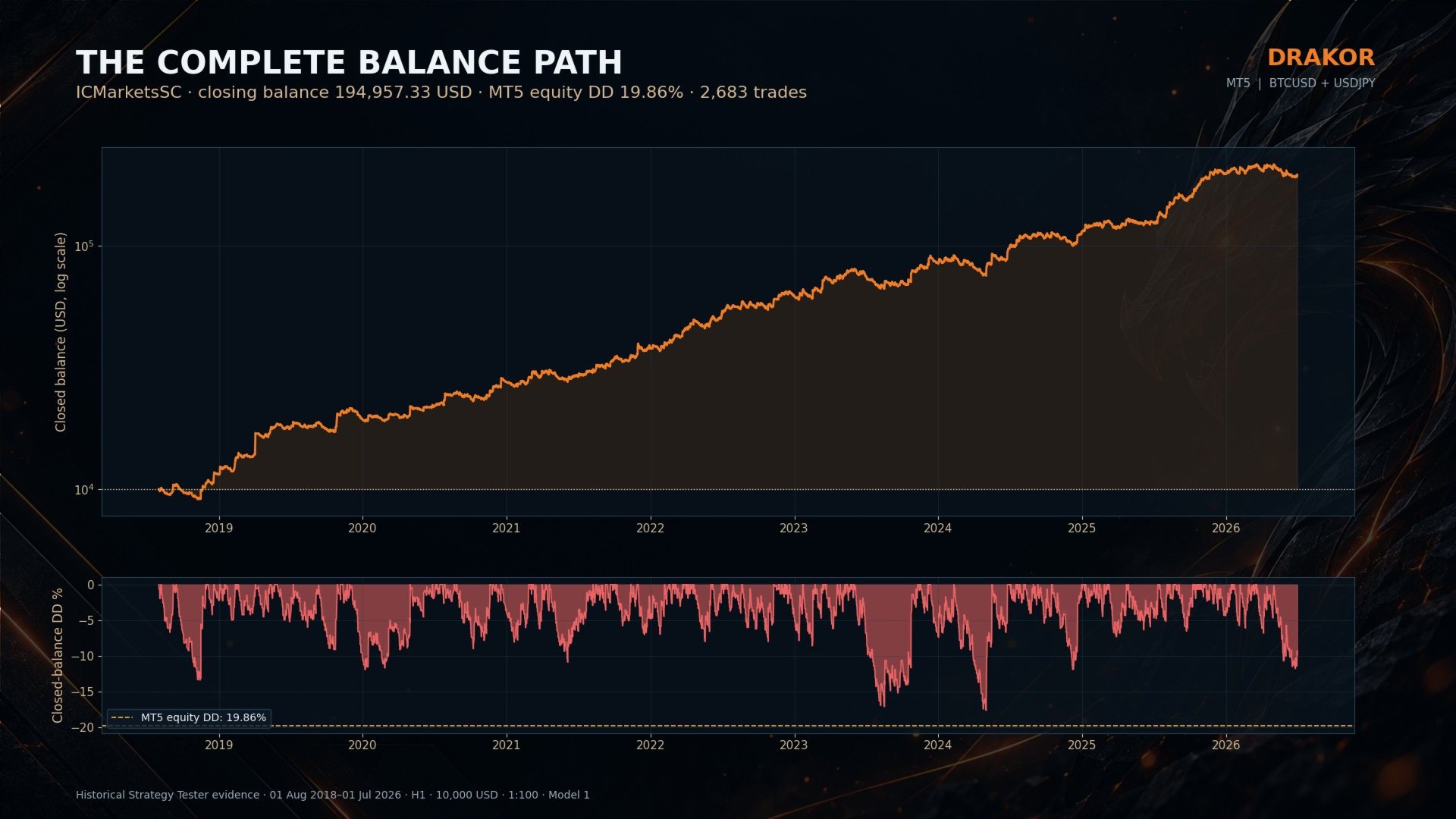
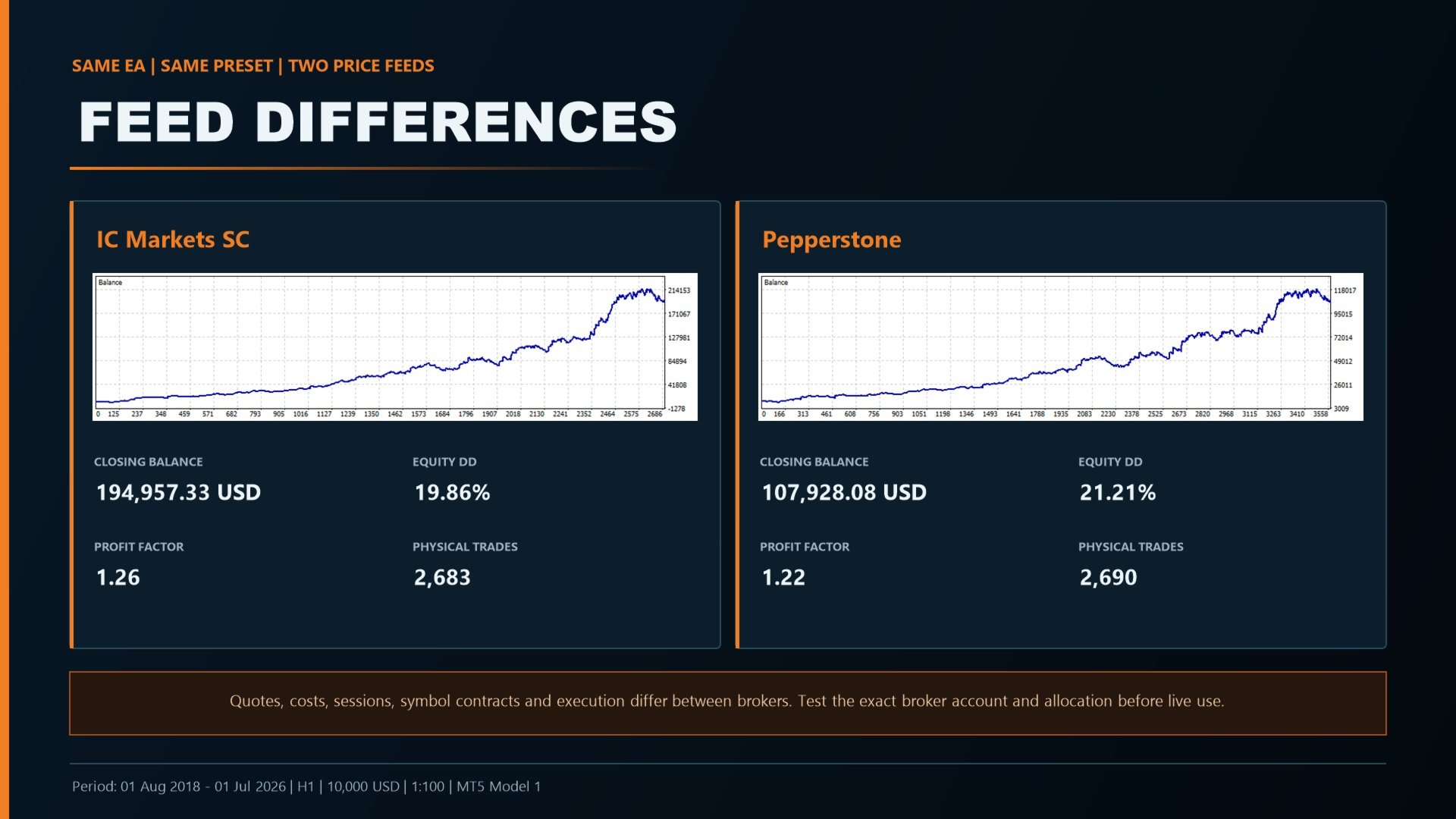
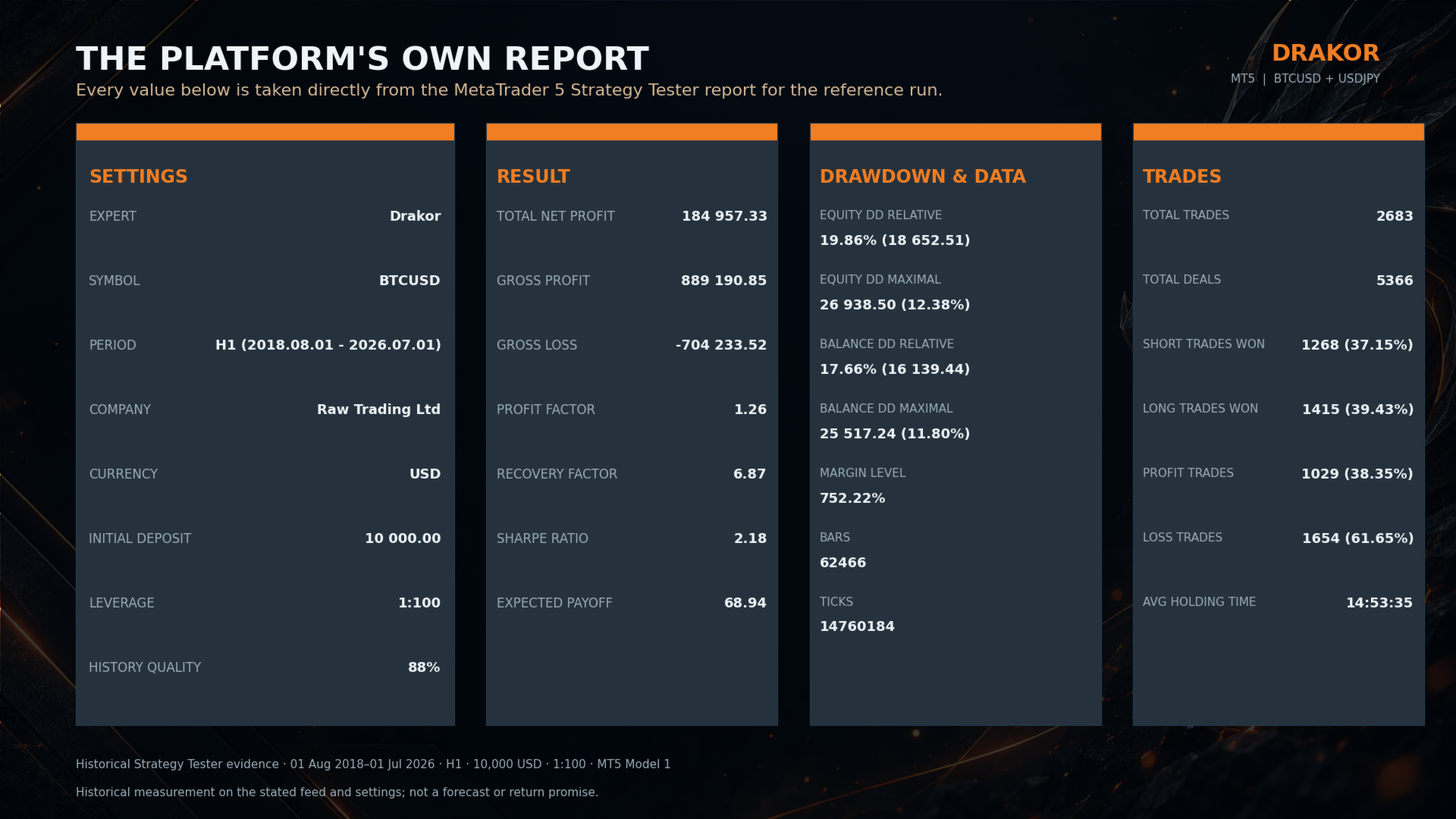
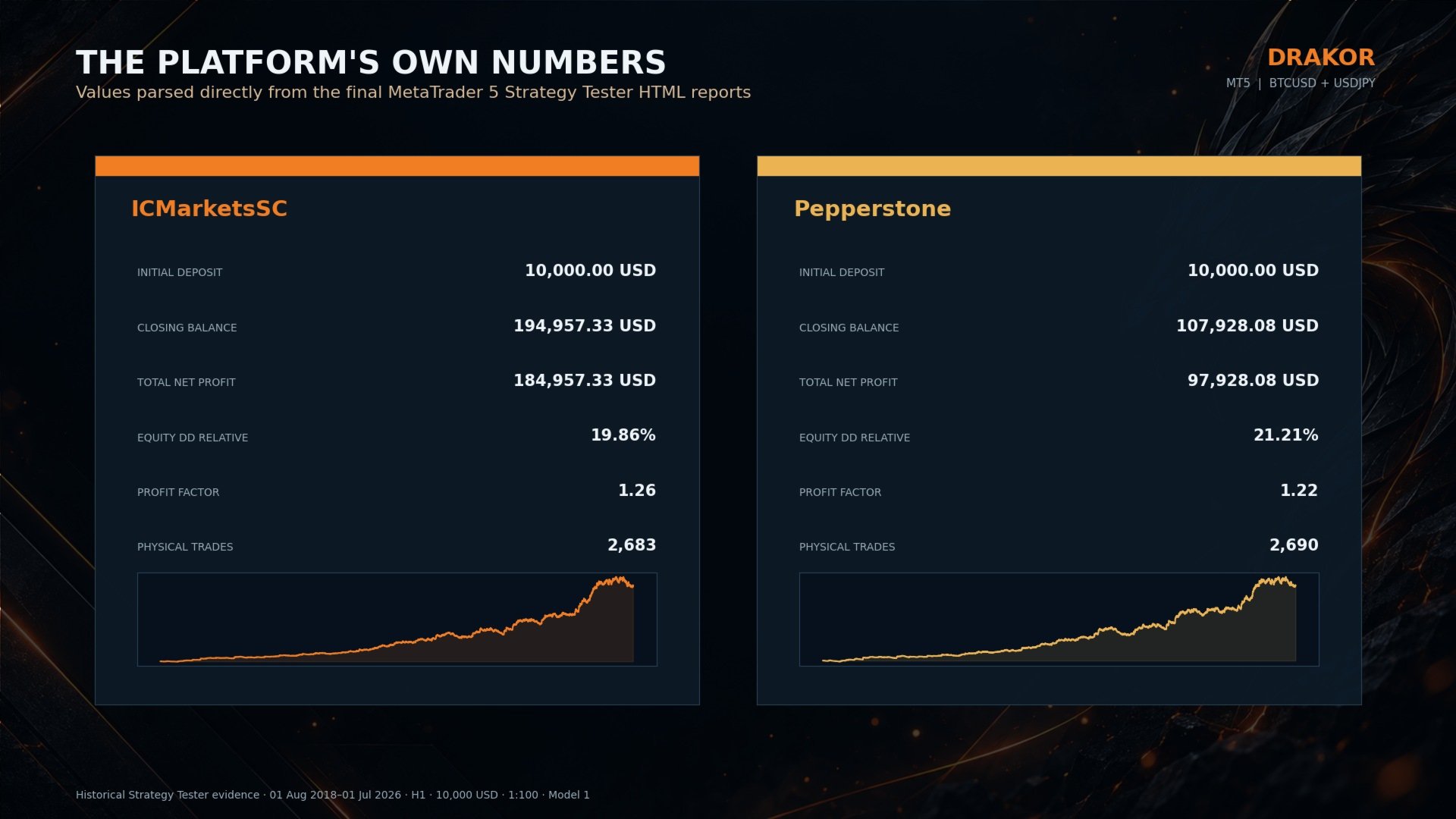
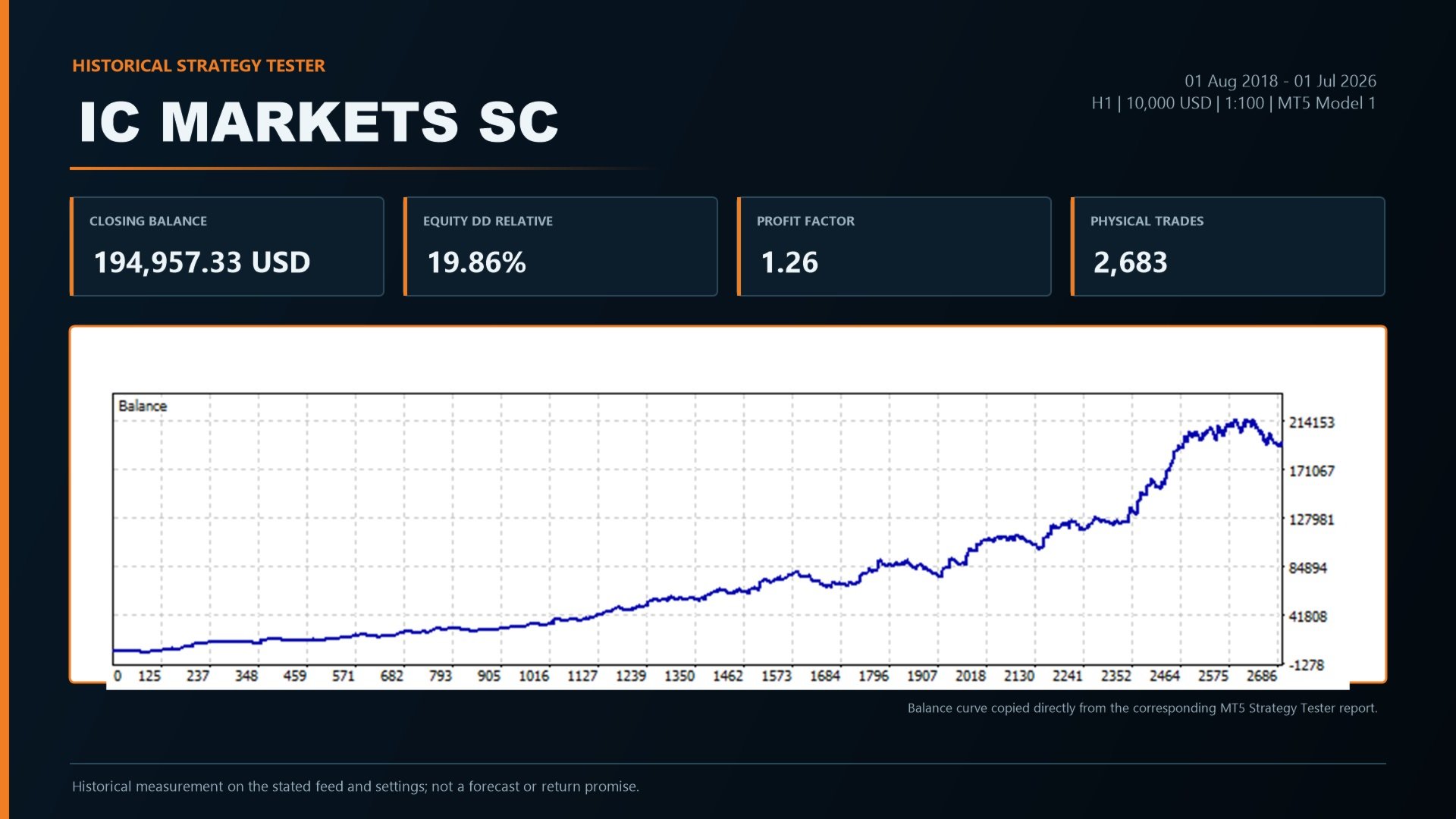
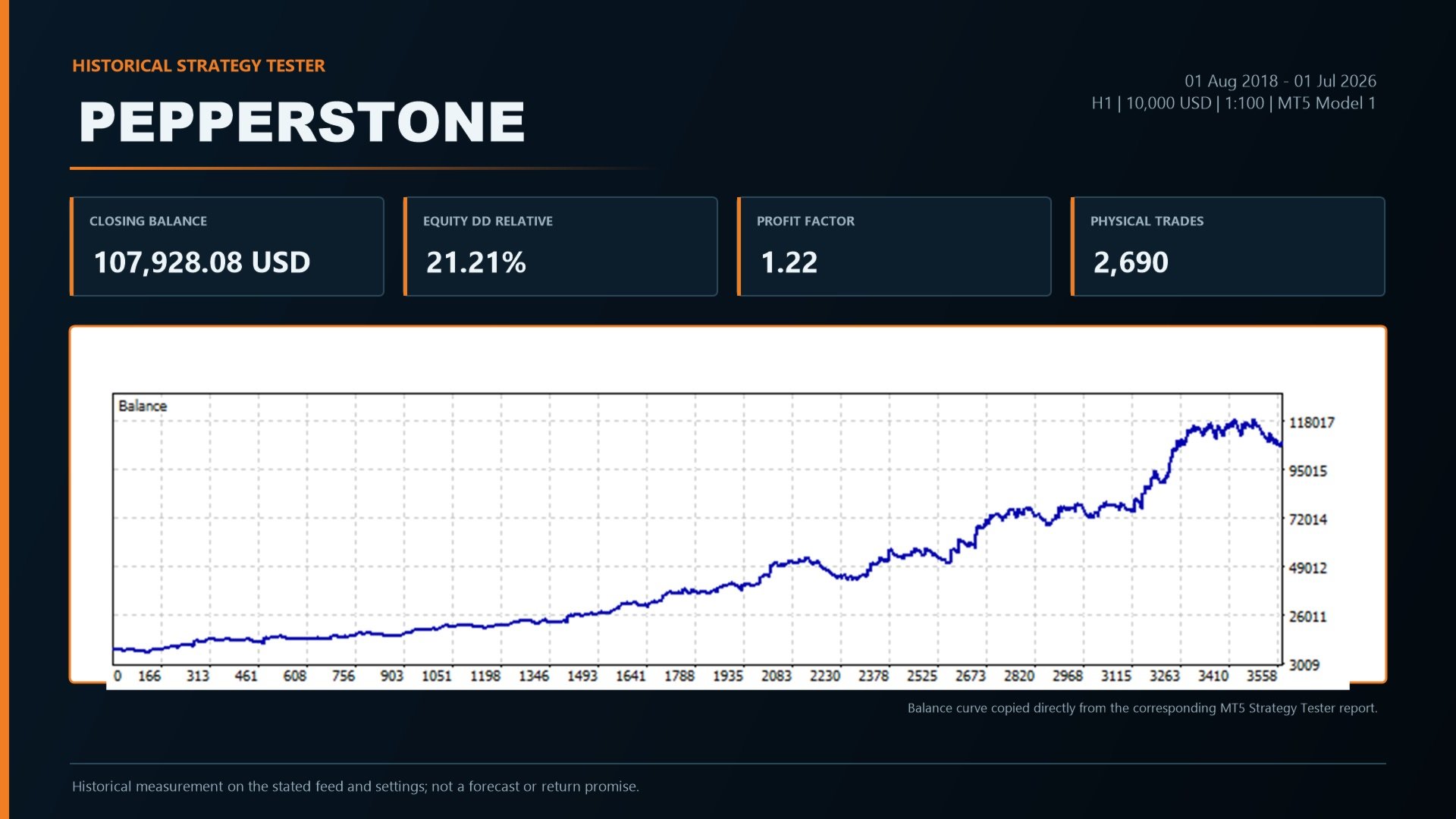
Both tests used the same DRAKOR settings, H1, 10,000 USD initial deposit, 1:100 leverage, MT5 Model 1 and the period 01 August 2018–01 July 2026.
| Reference feed | Closing balance | Equity DD Relative | Profit factor | Physical trades |
| IC Markets SC | 194,957.33 USD | 19.86% | 1.26 | 2,683 |
| Pepperstone | 107,928.08 USD | 21.21% | 1.22 | 2,690 |
These are historical Strategy Tester measurements on the two feeds named above, not forecasts or promises.
What your broker needs to provide
| Requirement | Why it matters |
| BTCUSD and USDJPY, both tradeable | Each engine trades its own market. If one symbol is missing or closed to trading, that engine cannot work. Suffixed names such as BTCUSD.a are supported — enter the exact Market Watch name. |
| H1 history for both symbols | Both engines read completed hourly bars. Partial history produces fewer trades and a different curve. |
| Competitive BTCUSD spread (Raw/ECN preferred) | This is the dominant cost. Across the two reference feeds the average BTCUSD ticket cost differed by roughly a factor of 2.6, and that difference alone materially changed the result. A wide-spread standard account is the single most likely reason for underperformance. |
| Leverage 1:100 or higher | Used in every published test. Lower leverage can block entries through margin rather than through the strategy. |
| Hedging or netting account | Both are supported. DRAKOR contains no code that behaves differently between them. |
| 2,500 account-currency minimum | Below this the broker minimum lot exceeds the configured risk and most entries are skipped by design. |
Quotes, spread, commission, swap, sessions, symbol contracts and execution differ between brokers and will change your result. Run the demo in your own broker's Strategy Tester before live use.
A note on History Quality
MetaTrader reports a History Quality percentage for every test. On the reference run it is 88%, which is normal for a basket containing a crypto symbol: BTCUSD tick history simply does not reach as far back as a major currency pair's, so the platform fills the earliest gaps from bar data.
To confirm this does not flatter the result, the same period was re-run on the coarser 1-minute OHLC model, which uses far less tick detail. It produced a higher closing balance and a slightly lower drawdown than the figures published above. The numbers on this page are therefore the more conservative of the two, and the outcome does not depend on fine tick sequencing. Expect your own broker to report its own quality percentage; use the highest-quality model it offers.
TEST THE DEMO YOURSELF — EXACT SETTINGS
The Market demo runs in Strategy Tester only. These are the exact settings used to produce the table above, so you can reproduce the same test on your own broker's data:
- Open View → Strategy Tester and select DRAKOR.
- Symbol BTCUSD, timeframe H1. In Market Watch, confirm the exact names of both BTCUSD and USDJPY. If your broker adds a suffix, enter the exact name in the EA inputs (for example BTCUSD.a or USDJPY.pro).
- Date range 2018.08.01 – 2026.07.01, deposit 10,000 USD, leverage 1:100.
- Modelling: Every tick based on real ticks, or the highest-quality model your broker provides.
- Leave the inputs at their defaults, which are the published reference settings, and set InpWorkingCapital to 10,000 for a like-for-like comparison.
- Let the terminal download the full H1 history for both symbols before starting. Partial history produces fewer trades and a different curve.
- In the report, read the Equity Drawdown Relative row rather than the absolute drawdown, and compare the trade count with the table above.
Your broker's result will not match these numbers exactly, and it is not meant to. What matters is whether the behaviour and the drawdown profile hold on the data and costs you will actually trade. If you want a smaller test first, any 1–2 year window works; expect proportionally fewer trades.
RISK AND EXECUTION
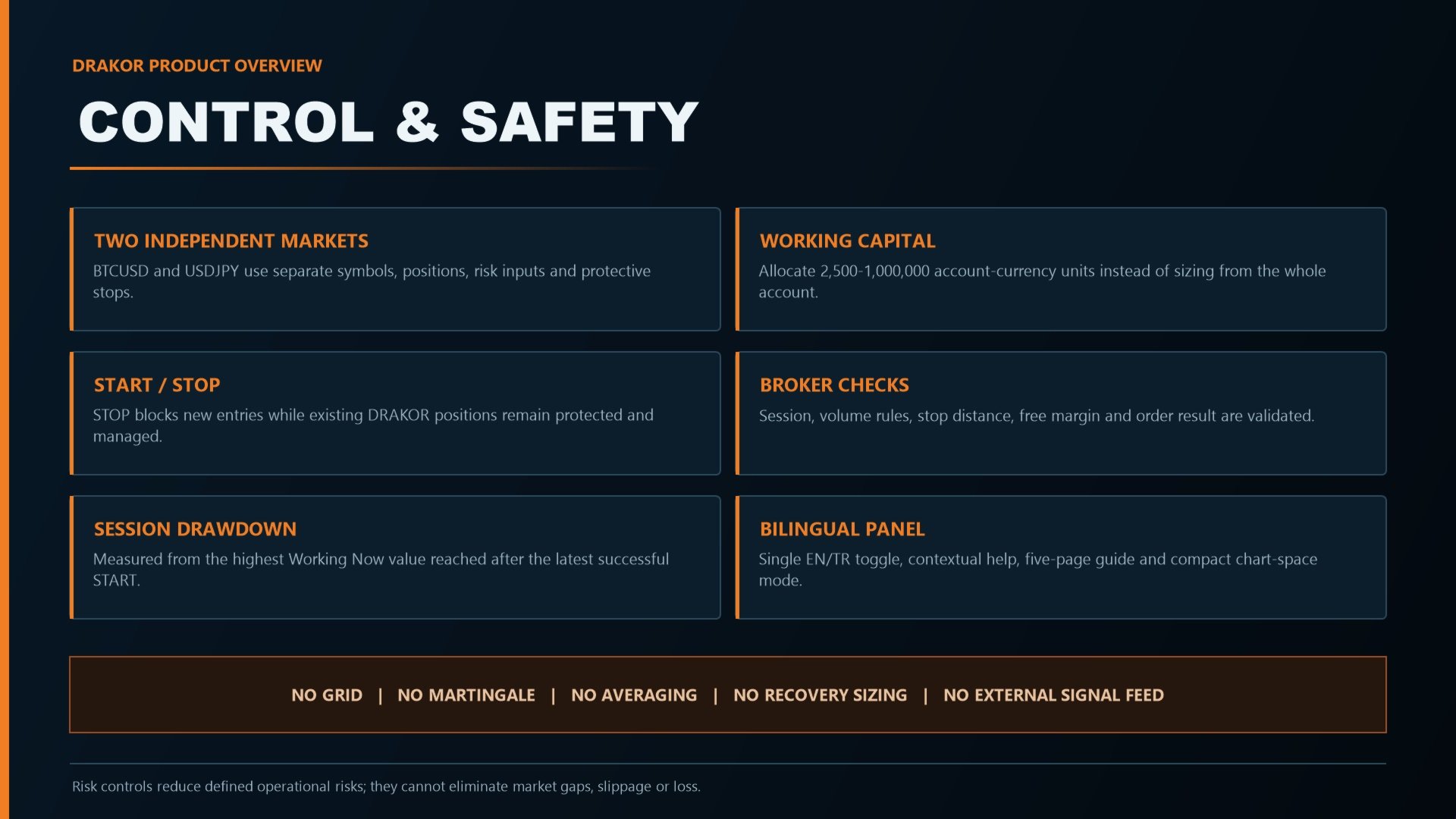
- Separate BTCUSD and USDJPY symbols, positions and risk inputs.
- Every accepted entry is submitted with a broker-side stop loss.
- Volume is calculated from DRAKOR Working Now and the selected risk; it is never rounded upward. If the minimum lot would exceed the configured risk, the trade is skipped instead.
- Symbol session, volume step and limits, stop distance, free margin and order result are checked before execution.
- DRAKOR manages only positions carrying its own magic numbers, so manual trades and other EAs are left untouched.
- Optional session-drawdown, daily-loss and spread brakes can stop new entries.
WORKING CAPITAL
InpWorkingCapital is the amount you assign to DRAKOR. It is not your deposit: on a larger account you can hand DRAKOR 5,000 and leave the rest untouched, and every lot and safety brake is then calculated from that 5,000 alone.
| Allocation | What was measured |
| 2,500 (minimum) | Works on both reference feeds. On Pepperstone, eight entries were skipped because the broker minimum lot would have exceeded the configured risk. Skipping is the intended safety behaviour, not an error. |
| 10,000 (reference) | The allocation used for every published number on this page. |
| Up to 1,000,000 | Supported input maximum. On IC Markets sizing stayed near-linear to 1,000,000. On Pepperstone it did not: above roughly 60,000 the broker's BTCUSD volume cap began blocking full target size. |
Below 2,500 the minimum lot becomes too large for the risk setting and most entries are skipped. Above 60,000 the limit is your broker's volume rules, not the EA — check the BTCUSD maximum volume in your own contract specification.
PANEL AND OPERATION
DRAKOR starts in a safe waiting state. START permits new entries after safety checks; STOP blocks new entries while existing DRAKOR positions remain protected and managed until closure. The panel shows both engines, resolved symbols, position state, spread, account equity, allocated capital, Working Now and session drawdown.
English is the default. One EN/TR control changes the interface language. The - / + control collapses or restores the panel without changing operation. Contextual help and the five-page guide open in a separate panel.
Applying an MT5 chart template unloads the EA attached to that chart. Reattach DRAKOR after changing a template; its saved runtime state is restored. Attaching DRAKOR to a second chart transfers ownership and prevents two active copies on the same account.
SETUP
- Confirm the exact BTCUSD and USDJPY symbol names in Market Watch.
- Attach DRAKOR once to an actively updating chart; the configured BTCUSD chart is recommended.
- Set Working Capital and enable MT5 AutoTrading.
- Run the reference preset in your broker's Strategy Tester.
- Press START only after reviewing the panel status.
The primary engine is reference-tested on BTCUSD. If the configured BTC symbol does not exist on a terminal, DRAKOR uses the host chart symbol instead of failing initialization and displays the resolved symbol on the panel. No performance claim is made for another primary symbol.
PLATFORM AND RUNNING CONDITIONS
Broker-side requirements are listed in the table under the reference tests above. These are the remaining practical points:
- Platform: MetaTrader 5. MT4 is not supported.
- Timeframe: both engines read completed H1 bars regardless of the chart you attach DRAKOR to, so the host chart's timeframe does not change the signals.
- Recommended allocation: 10,000 account-currency units, the reference figure on this page. The supported range is 2,500 to 1,000,000.
- VPS: recommended, not mandatory. Open positions carry broker-side stops and survive a disconnection, but timed exit management only runs while DRAKOR is attached and the terminal is online.
- One instance per account: attaching DRAKOR to a second chart transfers ownership to it and the previous copy removes itself, so two active copies cannot run against the same account.
WHAT TO EXPECT IN NORMAL OPERATION
DRAKOR does not trade continuously. In the reference run it averaged roughly 28 entries per month across both engines, with a quietest month of 18 and a busiest of 37. The longest stretch without any new position was just under six days, and no month passed without trades. Quiet stretches are the rule working as intended, not a malfunction.
Losing trades are frequent by design: in the reference run 38.35% of trades closed positive, and the system relies on the average win being larger than the average loss rather than on a high hit rate. A run of consecutive losses is a normal state for this kind of system — the reference run contained a sequence of 15.
SUPPORT
Questions are answered directly by the developer. When reporting an issue, include your broker and server name, account type, the exact symbol names, a screenshot of the Inputs tab and the relevant Journal lines — that is usually enough to resolve it in one reply.
HOW DRAKOR WAS DEVELOPED
DRAKOR is what remained after a long research programme, not a first idea that happened to backtest well. The table describes the process and the standards applied, without disclosing the trading rules themselves.
| Stage | What was done |
| Candidate search | Roughly six and a half thousand measured tests across equities, indices, metals, energy, currencies and crypto. Fourteen whole families of ideas were opened and closed on measurement. A written record of every rejected family is kept, so a dead end is never quietly reopened later. |
| Statistical significance | Surviving edges were tested by permutation: the signal's direction labels were shuffled across the same bars one to two thousand times, and the real result had to sit far outside that distribution. An edge that chance could reproduce was discarded. |
| Random-trigger controls | Each engine was re-run with its signal replaced by random triggers of identical frequency and direction, across several independent seeds. A single favourable seed was never accepted as evidence; the real signal had to beat the whole control distribution by a wide margin. |
| Look-ahead auditing | Every candidate was audited for subtle use of future information. One engine that had looked strong for weeks was deleted outright when auditing proved its entry timing depended on data not yet published at that moment. It is not in this product. |
| Overlap and independence | Overlapping observations inflate apparent significance, so results were re-measured on non-overlapping samples. The monthly returns of the two shipped engines were correlated and their joint tail behaviour examined, to confirm the diversification is real rather than assumed. |
| Block bootstrap | A drawdown figure is a single observation, so a one-off improvement proves nothing. Portfolio comparisons were resampled with block bootstrapping over thousands of iterations, to separate a genuine gain from a coin flip. |
| A/B and neighbour testing | A setting was accepted only where a plateau of neighbouring values behaved similarly, never a single sharp cell. Whenever a core input changed, every threshold was re-tuned from scratch instead of being inherited from an earlier version. |
| Cost and slippage stress | Results were re-measured under added commission, widened spread and forced slippage, with costs deducted from tester equity through a timestamped ledger instead of being estimated. Costs were also scaled tenfold as a unit-error check. Configurations that only worked at low cost were rejected. |
| Second-feed verification | Every published figure was reproduced on a second, independent broker feed. Entry signals were logged before execution on both feeds and compared, so feed dependence became a measured number rather than an assumption. |
| Data-model verification | The reference period was re-run on a coarser price model to confirm the outcome does not depend on fine tick sequencing. The figures published here are the more conservative of the two runs. |
| Capital and capacity | Allocations from 2,500 to 1,000,000 were tested to find where broker minimum lot, volume caps and margin — not the strategy — become the binding limit, and skipped entries were counted at each level. |
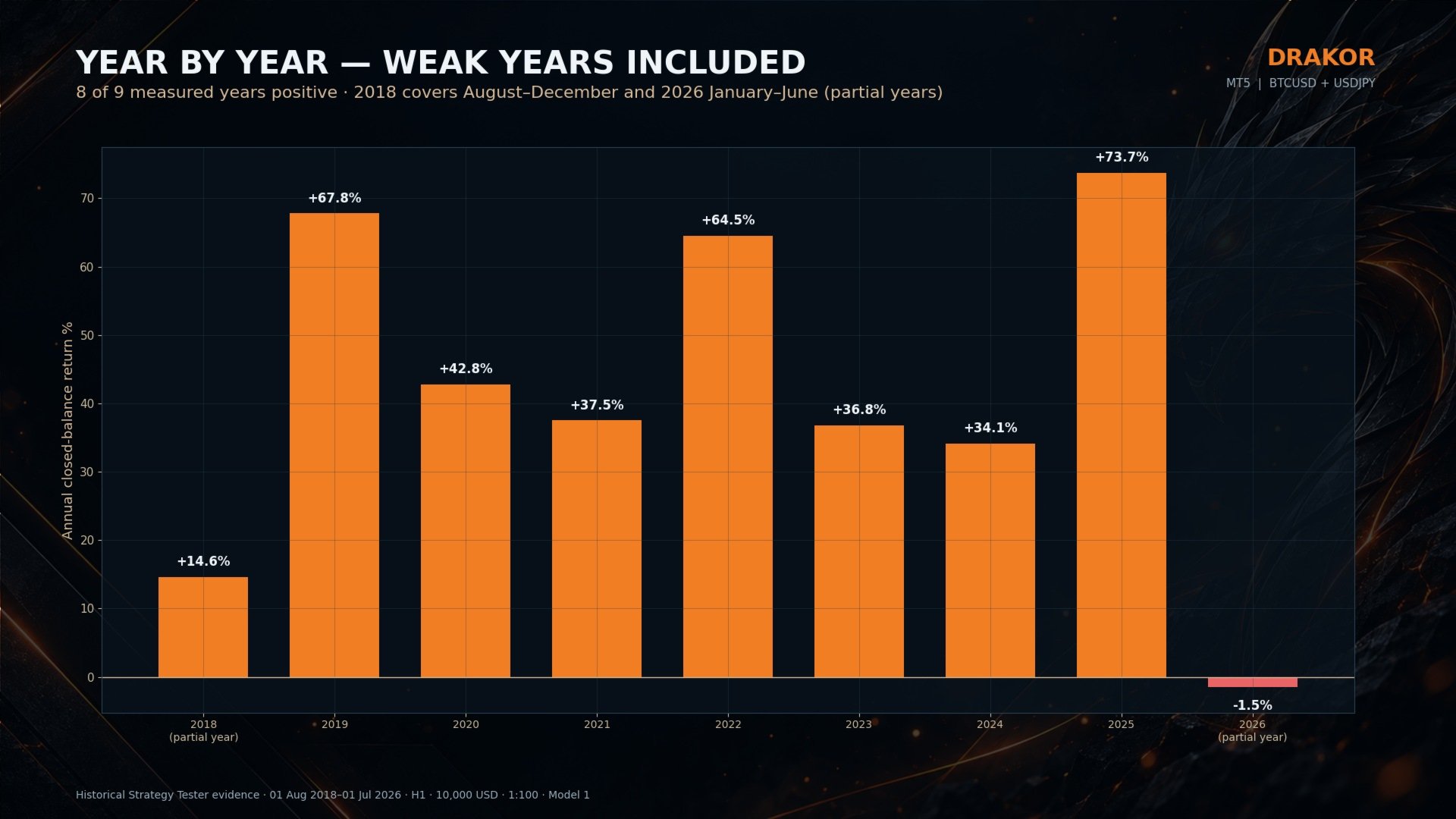
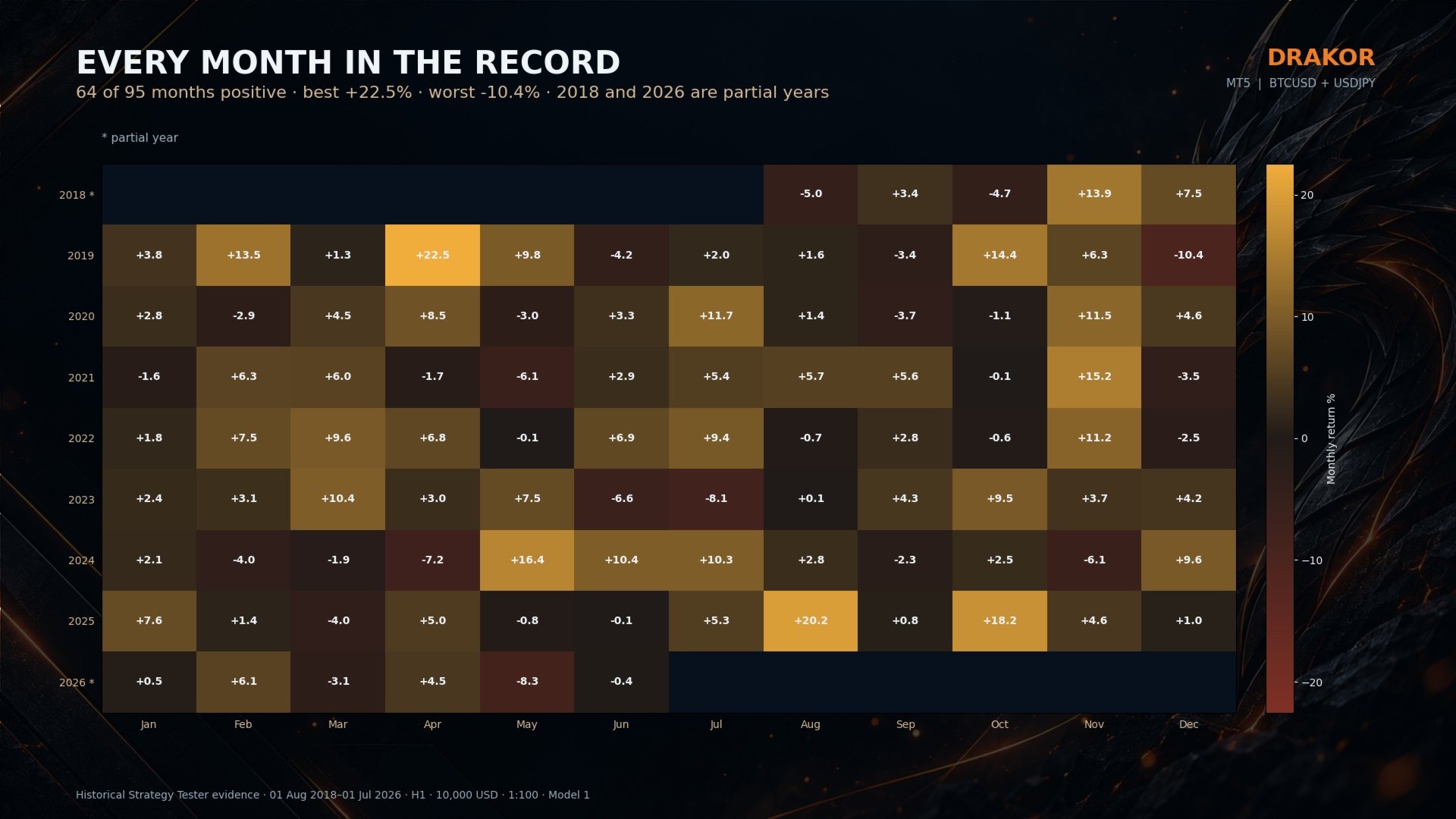
| Stability over time | Year-by-year and month-by-month results were examined including the weak periods, together with trade frequency, the longest silent interval and the worst losing streak, so this listing can state plainly what a normal bad patch looks like. |
| Execution hardening | The order path was tested against absent symbols, closed sessions, insufficient margin, volume limits, split orders and broker stop-distance rules — including validation environments where the configured symbols do not exist at all. |
| Release audit | The published binary is the exact file exercised by the final full-period test, not a later recompile. Source and binary checksums are recorded, and every figure on this page is regenerated from the retained platform reports rather than retyped by hand. |
The two engines that shipped are the ones that survived all of it. Their specific entry and exit rules remain proprietary.
DISCLAIMER
Trading foreign exchange, cryptocurrency and CFDs carries substantial risk and is not suitable for every investor. Past performance does not guarantee future results, and losses are possible.
Results differ between brokers and accounts because of differences in quotes, spreads, commissions, swaps, slippage, liquidity, sessions and contract rules. The figures on this page were measured on two specific reference feeds over one specific period; they are a record of what happened, not a projection of what will happen.
DRAKOR uses a hard stop loss on every position, sizes from a defined risk percentage, skips entries it cannot open safely and offers optional drawdown brakes. None of that removes trading risk: stops cannot eliminate gap or slippage losses, and no system can guarantee a result. Test DRAKOR in your own broker's Strategy Tester, and on a demo account, before committing real capital.
Broker selection, account conditions, allocation size and the decision to trade live remain entirely your own responsibility.