GOLD OPTIMUS
One XAUUSD trade per day, taken on the London and New York overlap.
To Backtest, use every tick based on real tick, use default settings (you can change lot size changing to fized mode and input lot size if you want), chose last year to get chart for last
Recommended minimum balance: 1,000 USD at 0.01 lots.
Run the default settings exactly as they ship. Every default is a tested
value and no preset file is needed. Experienced traders are free to explore
other settings and lot sizes, and the settings reference below explains what
each one does.
ONE TRADE A DAY
Most gold robots trade too much. Gold Optimus takes one trade a day, and
only when the market has shown its hand.
Gold spends the Asian session building a range. Then London opens, New York
follows, and for four hours the two largest sessions overlap. That overlap is
the trendiest stretch of the gold day. Across two years of M1 data it
travelled 1.42 times further per unit of range than the Asian session, and it
set 1.49 times more of the day's highs and lows than its share of the clock
would predict.
Gold Optimus measures the Asian range, waits for the overlap, and takes the
first clean break of that range. One position. It is flat before the overlap
ends, and it does not trade again until the next day.
That restraint is the product. Every hour the EA sits out is an hour it
cannot lose money in a market that is not paying.
HOW IT WORKS
1. Build the range. From 18:00 to 03:00 New York the EA records the high and
low of the Asian session. That range is the day's reference and the source
of every level that follows.
2. Wait. Between 03:00 and 08:00 nothing happens. No orders, no pending
entries.
3. Arm at 08:00 New York, when London and New York are both open.
4. Trigger on the first clean break. Price must exceed the range by 3% of the
range itself before anything is sent. That buffer is what separates a break
from a poke at the edge.
5. Stop at 75% of the range. The stop is derived from the day's own
volatility rather than a fixed pip count. A quiet Asian session produces a
tight stop and a larger position; a violent one produces a wide stop and a
smaller position. Risk stays constant while the market does not.
6. Bank half at the first target. When price reaches one full range beyond
entry, half the position is closed and the stop is left exactly where it
was. The remainder carries the original risk and nothing is re-priced
mid-trade.
7. Flat by 12:00 New York. The remainder closes at the end of the overlap.
Nothing is carried into the afternoon, overnight, or over a weekend.
8. Size by risk, not by lots. 1% of equity per trade by default, calculated
from the actual stop distance in the account's own currency. On a 1,000 USD
account that works out to about 0.01 lots. Switch to fixed lot mode if you
prefer to set the size yourself.
The EA works out the broker's clock by itself. It finds gold's daily one-hour
break in the price history, infers the server's GMT offset from it, and
handles US daylight saving in both directions. There is nothing to configure
for a broker in a different time zone.
WHAT IT WILL NOT DO
- No martingale. Position size never increases after a loss.
- No grid and no averaging down. One position at a time. A losing trade is
never reinforced.
- No hedging or recovery sequences.
- No overnight or weekend exposure. The position is closed at the end of the
overlap, roughly five hours before the Friday close.
- No hidden stop. Every trade carries a real stop loss on the server from the
moment it opens.
- No DLL, no WebRequest, no external files.
One more, and it is the one worth reading. Trailing stop and breakeven are
switched off by default. Both are built in and both were tested. Moving the
stop to breakeven, or trailing it, cut the profit factor to 0.90 from 1.26 on
an equivalent system, because the same pullback that would have resolved into
a winner was clipping a tightened stop first.
Most vendors ship these on because they read as prudent. The measurement says
otherwise, so they are off. The inputs are there if you want them.
HOW IT WAS TESTED
The data. 706,755 one-minute XAUUSD bars, September 2024 to September 2026.
Two full years, carrying the broker's own recorded spread on every single bar.
The costs are measured, not assumed. Every simulated trade pays the spread
that was actually on the bar it filled against, plus a slippage allowance on
top. No optimistic fixed-spread assumption anywhere.
Walk-forward, not curve-fit. The two years were split in half. Settings chosen
over the whole period had to survive in each half independently. They did:
profit factor 1.34 in year one and 1.71 in year two. Eight of the nine
quarters were positive.
A modelling error, found and corrected. Part way through development the
simulator was moving trailing stops once per bar, while the live EA moves them
every tick. The model predicted an average win of 2.99 USD; the real Strategy
Tester produced 2.27. The simulator was rebuilt to be tick-accurate, after
which it reproduced the live tester almost exactly. Every number quoted in
this description comes from the corrected model, and that correction is what
led to trailing and breakeven being switched off.
Two independent implementations agree. The EA carries its own history study,
written separately from the research code and running on M5 bars instead of
M1. Over the same two years it reports a profit factor of 1.55 against the
research model's 1.58. Different code, different data resolution, agreeing
within 0.03.
The model matches the terminal. Across three separate runs, the research model
and the MT5 Strategy Tester agreed on maximum drawdown to within four cents.
WHAT WAS TESTED AND THROWN AWAY
Anyone can show you what made it into a product. Here is what did not, and
why. Each of these looked good before it was tested properly.
Trading more often. The obvious upgrade is more trades. It was built and
measured across the full frequency range on M1 data. Every setting above
roughly 1.6 trades a day lost money in year one once realistic slippage was
applied. In gold, transaction costs eat 22% to 33% of a typical minute's
range, and no amount of signal quality survives that. The scalper was
finished, tested and abandoned. Gold Optimus trades once a day because once a
day is what the data supports.
Time-of-day entry windows. 87 candidate windows passed a filter requiring
profit in both years independently. Then the same search was run on
direction-randomised data, where no edge can exist by construction. It passed
47 windows on average. Most of the 87 were noise wearing a good result.
Rejected.
Filtering by Asian range size. Sorting days into quintiles by range size
looked persuasive: the top quintile returned a profit factor of 2.07. But a
real effect strengthens smoothly as you tighten the threshold. This one
wandered: 1.68, 1.67, 1.73, 1.78, 1.67, 2.00, 2.95. That is a bucket chosen
after the fact, not a relationship. Rejected.
Skipping Tuesdays. Tuesday is the weakest weekday in every cut of the data.
Shuffling the day labels 4,000 times produced a day that consistently weak
3.5% of the time, which clears the conventional bar but only just, and the
size of the effect changes with bar resolution. Too close to the line to
hard-code. The day switches are in the inputs, set to trade all five, and you
can run the comparison yourself.
Four ideas tested, four left out. What is in the EA is what survived.
RESULTS
XAUUSD, September 2024 to September 2026, at a fixed 0.01 lot throughout, with
the spread recorded on each bar plus slippage charged on every fill.
Trades 439
Net profit 1,771 USD
Profit factor 1.58
Maximum drawdown 158 USD
Year one profit factor 1.34
Year two profit factor 1.71
Positive quarters 8 of 9
Profit factor by weekday over the same period:
Monday 2.54 Tuesday 0.91 Wednesday 1.49 Thursday 1.66 Friday 1.65
The figure worth more than the profit factor is the drawdown. 158 USD of peak
drawdown against 1,771 USD of profit, at a lot size anyone can run, is what a
system looks like when it is not reaching for returns it cannot hold.
These are backtest results on historical data. They are not a forecast and not
a promise. Spreads, execution quality and slippage differ between brokers, and
your figures will differ from these. That is exactly why the EA computes the
same study from your own broker's history, on your own chart, rather than
asking you to take a vendor's table on trust.
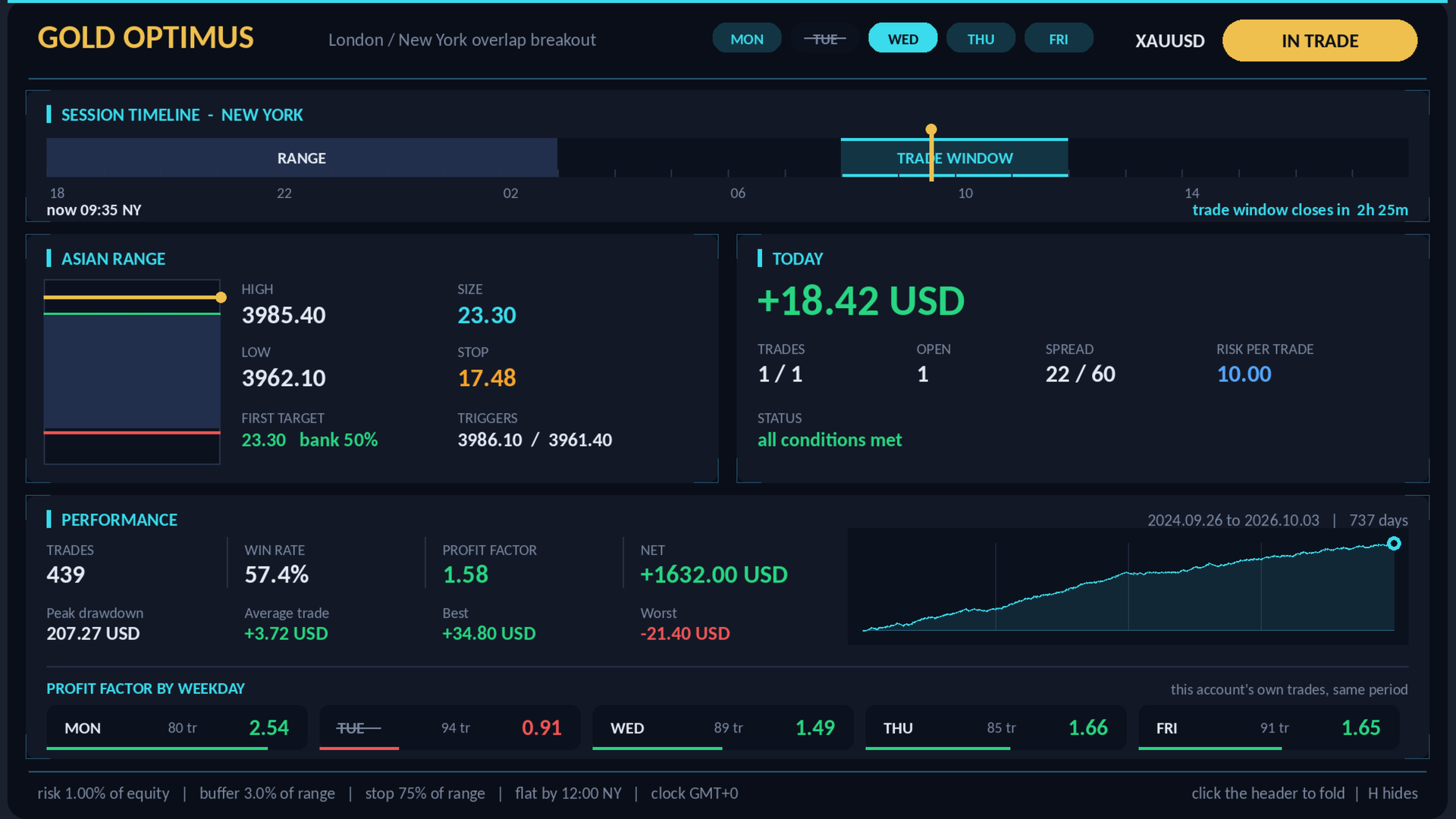
WHAT YOU SEE ON THE CHART
A full dashboard, not a label in the corner.
- Session timeline. The whole gold day laid out end to end, with the range
window and the trade window marked and a live marker moving across it, plus
a countdown to the next window opening or closing.
- Range gauge. The Asian range drawn as a block with the buy and sell trigger
lines on it and live price moving between them. Beside it: the range high,
low and size, the stop distance, the first target, and both trigger prices.
- Today. Profit or loss in large type, trades taken against the daily limit,
open positions, live spread against its ceiling, and the cash at risk on the
next trade.
- Performance. Trades, win rate, profit factor, net, peak drawdown, average
trade, best and worst, with an equity curve and the exact date range those
numbers cover.
- Profit factor by weekday, computed by replaying the strategy over the last
365 days of your own broker's history. It is populated the moment you attach
the EA, before a single trade, and it states the period and the number of
simulated trades behind it.
- Day switches shown as chips in the header, so you can see which weekdays are
live without opening the inputs.
Click the header to fold the panel, press H to hide it. It scales itself to
the chart window.
HOW MUCH ACCOUNT YOU NEED
The actual two-year sequence of trades was reshuffled 5,000 times and replayed
against different starting balances, to see how often a bad run arrives early
enough to end the account.
100 USD 16.7% chance of wiping out
200 USD 2.9%
300 USD 0.4%
500 USD or more effectively zero
Minimum 500 USD. Recommended 1,000 USD, at 0.01 lot per 1,000 of balance.
If you have 100 USD, this EA is not for you yet. Not because it cannot trade
that account, but because roughly one trader in six would be wiped out by
ordering alone, with nothing wrong with the strategy. No setting fixes that.
Only a larger balance does.
It costs me sales to say so. It costs you more to find out the hard way.
SETUP
There is no preset file to load. Every default in the EA is the value that was
validated over the two years. Attach it to an XAUUSD chart and it runs. If a
vendor ships you a .set file, ask why the defaults were not the right ones.
Symbol XAUUSD, under any broker's naming
Timeframe Any. The EA reads M1 internally regardless of the chart
Account type Hedging or netting. Raw or ECN spreads preferred
Minimum deposit 500 USD, 1,000 USD recommended
VPS Recommended. The EA must be running 08:00 to 12:00 NY
SETTINGS REFERENCE
Every default below is a validated value. You can run the EA without reading
this section. It is here so you know what each input does before you change
one.
SESSIONS (New York time, handled across daylight saving)
Range window starts 18 The hour the Asian range begins
Range window ends 3 The hour it stops; the range is fixed
Breakout window starts 8 Entries become possible
Breakout window ends 12 Entries stop, open position closed
Close at end of window On Off carries past 12:00. Untested
These four hours are the strategy. Change them and you have a different EA,
one the results above no longer describe.
ENTRY
Break must exceed range by 3.0% Separates a break from a poke at the
edge. Higher is fewer and cleaner
Trade direction Both Both is what was tested
Max trades per session 1 The one-trade-a-day rule
Skip if range smaller than 0 off Range filters tested and rejected
Skip if range larger than 0 off As above
STOP LOSS AND TARGET
Stop loss 75% Of the range, so it scales daily
Take profit 0 Runs to window end. A fixed target
caps the winners that pay for losses
Bank part at first target On
That target 100% One full range beyond entry
How much to bank there 50% NEEDS 0.02 LOTS OR MORE. At 0.01,
half a lot step rounds to zero and
the partial is correctly skipped
Move stop to breakeven Off Tested; it cut the profit factor
Breakeven trigger 60% Used only when breakeven is on
Use a trailing stop Off Same finding
Trailing distance 50% Used only when trailing is on
POSITION SIZING
Lot mode Risk % Suits a stop that changes size daily
Risk % of equity per trade 1.0 Lower to 0.5 for a calmer ride
Fixed lot 0.01 Used only in fixed mode
Max lot per trade 5.0 A ceiling, not a target
DAILY PROTECTION
Daily max loss % of balance 0 off Prop firm traders should set this
Daily profit target % 0 off Stops trading for the day
Close open trades on a limit On
FILTERS
Max spread to enter 60 pts Raise on a wide-spread broker or you
will skip trades. The panel shows
live spread against this
Block entries around news Off Live trading only, ignored in tester
Minutes before and after 30, 30 Used only when the filter is on
TRADING DAYS
Monday to Friday, all on. Switch one off to skip that weekday. The header
chips show which are live.
GENERAL
Magic number 990300 Change if another EA shares the account
Max slippage 30 pts
Broker clock mode Auto Detects the server offset from gold's
own daily break. Set a fixed offset
only if auto fails, which the panel
footer will show
Fixed broker GMT offset 0 Used only in fixed mode
Show the panel On
Draw the range on the chart On
Panel X, Y, scale 12, 24, 1.0
Weekday study days 365 Days replayed for the weekday table;
0 turns the study off
Log every blocked entry Off Shows in Experts why no trade was taken
COMMON ADJUSTMENTS
- Wide spread broker: raise the max spread above 60 points, or you will sit
out valid breaks.
- Prop firm account: set a daily max loss to match the firm's rule.
- You want the partial close: you need 0.02 lots or more, which means roughly
5,200 USD at 1% risk. Below that the EA runs the full position to the window
end, which is correct behaviour, not a fault.
- Another EA on the same account: change the magic number.
- Calmer ride: drop risk to 0.5%. Returns and drawdown both halve.
WHAT THIS EA IS NOT
It is slow. One trade a day, roughly twenty a month. You will have losing
weeks and losing months. Year one returned a profit factor of 1.34, not year
two's 1.71. Judge it over quarters, not over a fortnight, and if a month of
twenty trades is going to make you turn it off, this is not the right product
for you.
About one weekday in six produces no trade at all, because price never breaks
the range during the window. A quiet panel is the EA working, not the EA
broken.
It depends on gold continuing to trend during the overlap. That has been true
for the two years measured and for structural reasons likely to persist, but
structural is not permanent. If it stops being true the EA will stop working,
and no backtest can tell you the day that happens.
It does not avoid news. The 08:30 New York releases land inside the trade
window. That is deliberate, because those releases produce some of the
cleanest breaks in the sample, but it does mean you will see volatile days and
the occasional ugly one. The news filter is there if you disagree.
Two years is two years. It is a serious sample and it spans one broad market
regime. It is not a decade, and nobody should pretend it is.
Your weekday table will not match mine. With about forty trades per weekday in
a year, those figures are small samples and the ordering moves around. Only
Tuesday being the weakest has held across every cut of the data.
If something does not behave as described, message me. I would rather fix it
than read about it in a review.