Vertex Rebound
- エキスパート
- バージョン: 3.4
- アップデート済み: 16 9月 2026
- アクティベーション: 5

Vertex Rebound — Micro-Range Reversion & Volatility-Surge Breakout EA (Spread-Sensitive, Short-Holding-Period System)
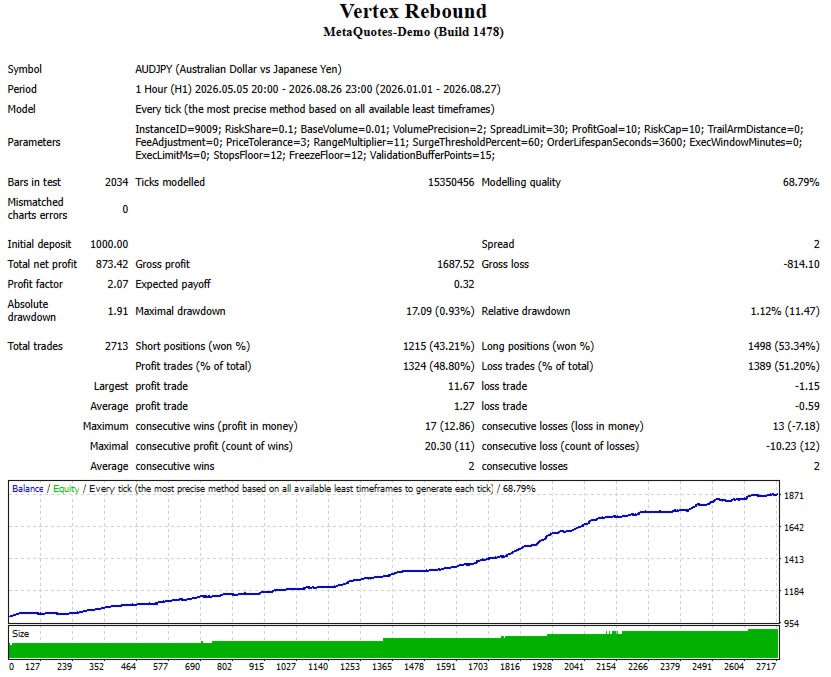
Vertex Rebound is a dual-logic automated system operating on a very short statistical lookback: a compatible price channel is rebuilt on every tick from an M1 moving average and a bands indicator over a 3-bar window, giving the EA a live estimate of the instrument's short-term equilibrium range. Two complementary signal families are derived from this channel: a mean-reversion entry when price is pushed outside the channel and expected to snap back, and a volatility-surge breakout entry when the measured M1 range expands well beyond its recent average, signalling continuation rather than reversion. Because both signal families are recalculated from a rolling sample of the instrument's own recent spread and volatility rather than from fixed pip values, the system is inherently self-calibrating to whatever instrument and session it is running on — but this also means transaction cost is not a side variable, it is one of the direct inputs to the entry/exit geometry itself.
Why spread and commission are structural to this strategy, not just a cost
This is a short-holding-period, high-frequency-style system: entries, stop-loss/take-profit distances and even the volatility threshold that triggers a breakout signal are all computed as multiples of the live rolling average spread (RangeFactor × average spread defines the volatility limit; SpreadCap gates whether a trade is allowed to open at all). In practice this means the spread is not merely subtracted from profit after the fact — it is baked into the sizing of every stop and target the EA places. On a wide-spread feed, the same RangeFactor produces proportionally wider stops and targets, which both dilutes the statistical edge the channel filter is built on and increases the probability that a "surge" reading is actually just spread noise rather than genuine market volatility. Because average trade duration is short and trade frequency is comparatively high, cost-per-round-turn (spread + commission, via the FeeAdj input) is amortized over far fewer pips of expected movement than a swing or position strategy would tolerate — which is exactly why the ratio of expected edge to transaction cost collapses fastest, of all strategy classes, when spread widens.
Practical requirement: for the EA's edge to remain intact, it should be run on the tightest raw/ECN-type spread available for the instrument, ideally with volume-based or fixed low commission rather than markup-in-spread pricing, and SpreadCap should be set close to the instrument's typical raw spread rather than left permissive — a permissive SpreadCap does not make the strategy safer, it simply allows the EA to keep trading through conditions where its cost basis no longer supports its edge. Running this system on a standard/marked-up account with variable spread during low-liquidity sessions is expected to materially degrade results, independent of the entry logic's accuracy, because the cost component of every trade scales with exactly the same volatility measure the EA uses to decide whether to trade at all.
Key features
- Dual-logic entries: channel mean-reversion + volatility-surge breakout, both derived from a live rolling spread/volatility estimate
- Pending stop orders with adaptive repositioning as price moves
- Broker-aware minimum stop/freeze distance handling
- Rolling spread filter (SpreadCap) gating new entries
- Optional equity-percentage or fixed lot sizing
- Optional trailing stop
- Built-in execution-latency self-test for evaluating broker/VPS execution quality
- Safe order-modify retry logic to reduce requote-related failures
Inputs
- InstanceTag — magic number identifying the EA's orders
- RiskPct — risk percentage of equity used for lot calculation (0 = use fixed lot)
- BaseLot — fixed lot size used when RiskPct = 0
- LotPrecision — number of decimal digits for lot normalization
- SpreadCap — maximum allowed rolling average spread, in points; recommend setting close to the instrument's typical raw spread (see spread/commission note above)
- TPPoints — take-profit distance, in points
- SLPoints — stop-loss distance, in points
- TrailArm — profit distance (in points) required before trailing starts
- FeeAdj — commission adjustment applied to entry price, in points; use this to reflect the account's actual per-lot commission
- Slippage — maximum allowed price deviation on order execution
- RangeFactor — multiplier applied to the rolling average spread to define the volatility limit that gates breakout signals
- SurgePercent — percentage by which measured volatility must exceed the volatility limit to trigger a breakout signal
- ExpireSec — lifetime of a pending order before automatic expiration
- ExecWindowMin — interval, in minutes, for the built-in execution self-test (0 = disabled)
- ExecCapMs — maximum acceptable average execution time, in milliseconds, before new signals are paused
- StopsMin — minimum stop distance (points) enforced regardless of broker-reported value
- FreezeMin — minimum freeze distance (points) enforced regardless of broker-reported value
- ValidationBuffer — additional safety margin (points), applied only on broker verification/validation symbols, to prevent modification errors during automated testing
Recommendations
- Use a raw/ECN-type account with the lowest achievable spread + commission for the traded instrument — this is not optional for the strategy's expectancy, given how directly transaction cost feeds into its entry and exit geometry
- Avoid running through low-liquidity sessions where spread widens beyond SpreadCap's typical value
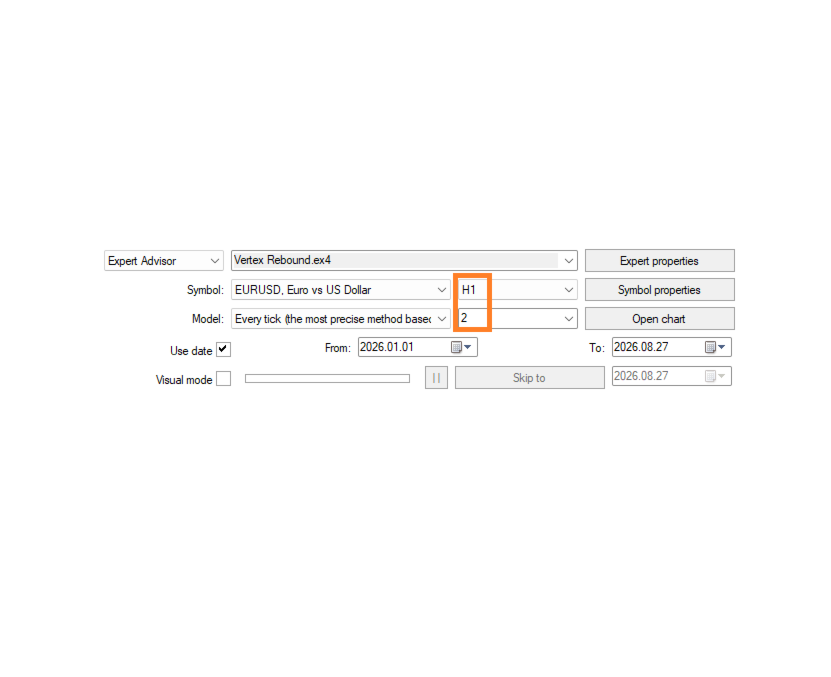
- Timeframe: any (the channel filter is computed internally on M1)
- Test on a demo account first to confirm your broker's real spread/commission conditions match the assumptions above
- Past or tested performance does not guarantee future results; use appropriate risk management