High Tide EA
- Experts
-
Mark Christopher Small
 I'm a UK based Expert Advisor developer focussed on sustainable and long term growth.
No Grid.
No Martingale.
I want everyone in this space to succeed.
Mark
High Tide Trading - Versione: 1.21
- Attivazioni: 5
High Tide EA (Expert Advisor) runs six rule-based strategies from one chart, on one account, with one risk setting. It trades Bitcoin and Ethereum, gold and silver, the yen crosses, seven stock indices and oil. It also watches the drawdown of your whole account, not just its own trades.
There is no grid, no martingale and no averaging down. Every trade opens with a stop loss.
I'm Mark, a trader based in the UK. Over the past year I've built and tested each of these strategies on its own and kept the ones that held up in testing with full costs. High Tide EA puts the six that survived into one Expert Advisor, so you can run them together without juggling six charts and six sets of settings. They were designed to work together as a portfolio.
Why one EA instead of six
- One risk setting scales all six strategies: choose from Conservative, Default or Aggressive. Or select a custom risk setting.
- One dashboard shows each strategy's month, total, drawdown, open profit or loss and slippage.
- Drawdown controls work on the whole account and step in early.
- You can switch any strategy off. Its open trades are still managed until they close.
The six strategies
High Tide (BTCUSD, ETHUSD). An hourly (H1) channel breakout with a trailing stop. It aims to catch the large crypto trends. Expect plenty of small losses and a few big winners.
Low Tide (BTCUSD). An intraday volatility breakout using pending stop orders. Once a trade is as far in profit as its stop distance, the stop moves to the entry price. It is flat by the end of the day and skips weekends.
Gold Breakout (XAUUSD, XAGUSD). Trades breakouts from swing highs and lows on gold and silver, with the stop sized from daily volatility. A trailing stop locks in profit on trades that run. Silver uses exactly the same rules as gold. In the backtest the two metals rarely traded on the same day, and their monthly results were almost unrelated.
Gotobi (USDJPY, EURJPY, GBPJPY). A calendar strategy built around Japanese payment days, when yen flows tend to follow a regular pattern. Short holding times. Trades close on a time rule.
Rip Tide (US500, US30, USTEC, DE40, UK100, STOXX50, JP225). Buys sharp index falls while the longer trend is up, then exits on the rebound. It has two parts: Rip Tide 1 buys the morning after a fall, Rip Tide 2 buys at the cash close on the day of the fall. Rip Tide 2 skips any trade where the broker's minimum lot would be much bigger than planned.
Deep Tide (BTCUSD, ETHUSD, XTIUSD). Slow trend following on daily bars. Few trades, each held for longer.
These six behave differently from each other. In the backtest, Gold Breakout (gold and silver together) made about 46% of the profit and no other strategy more than about 18%. The average correlation of monthly results between any two strategies was close to zero.
Risk controls
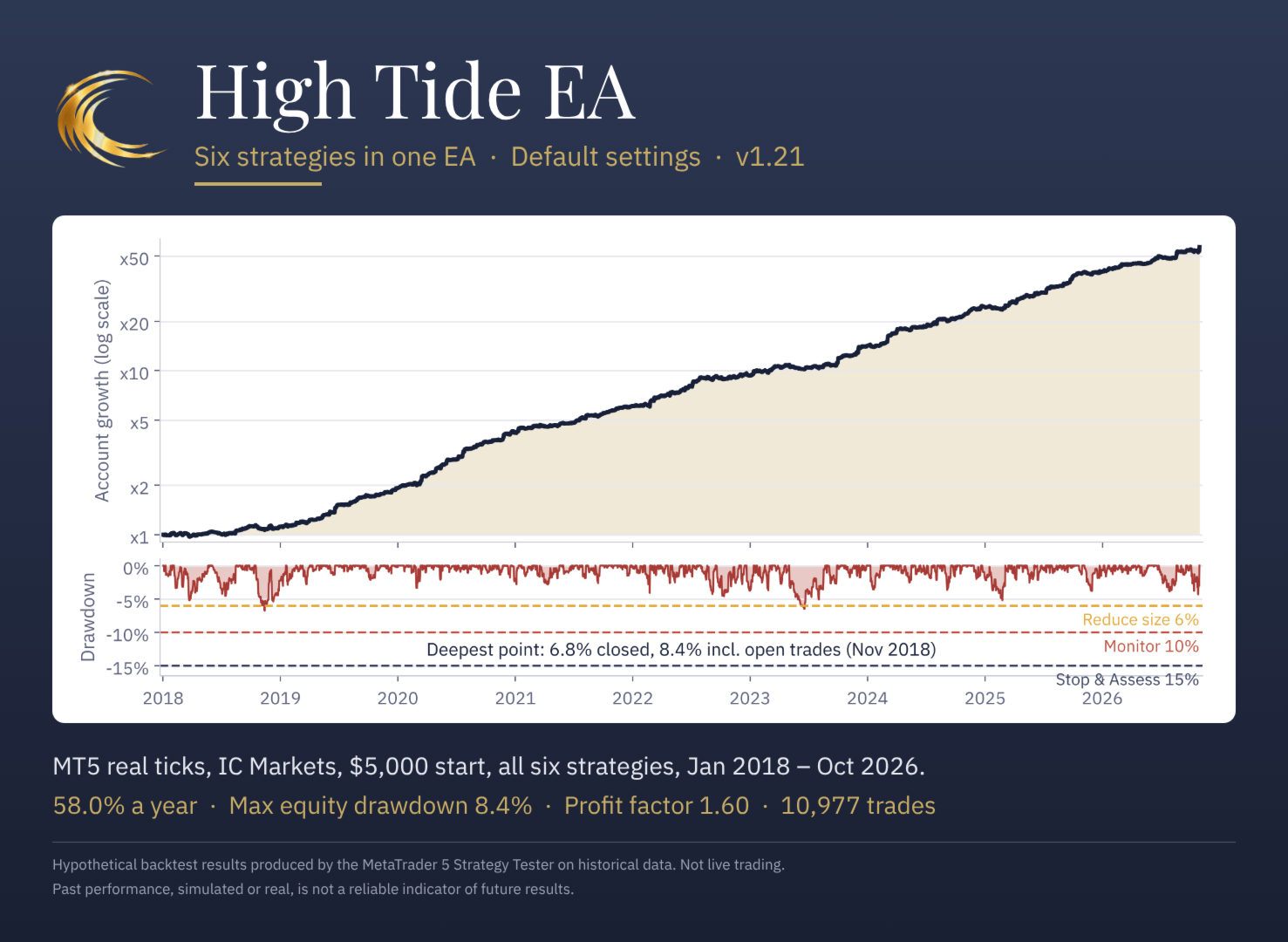
All three levels are measured on account equity, from its highest point. The figures below are for the Default setting.
- Reduce size at 6%. New trades open at half size until equity recovers. Open trades keep their size.
- Monitor at 10%. You get an alert. Nothing is closed.
- Stop and Assess at 15%. Every trade is closed, pending orders are deleted and no new trades open until you restart the EA.
- Deposits and withdrawals move the high by the same amount, so they never count as profit or drawdown. Each strategy also has its own cap on risk per trade and on the number of open trades.
Every trade opens with a stop loss. High Tide, Low Tide, Gold Breakout and Rip Tide 1 also set a take profit. Gotobi and Rip Tide 2 close on a time rule, and Deep Tide closes when its trend channel is broken.
Prop firm controls
For prop firm accounts there is a separate block of settings. Everything in it is off unless you switch it on, so the EA trades as normal until you do.
- Daily loss limit. Set the firm's limit, how it is measured (start-of-day balance, equity or whichever is higher) and the hour the firm's day starts. When the limit is close, every High Tide trade is closed and nothing new opens until the next day.
- Maximum loss. Fixed from the account size or trailing from the highest point. When it is close, everything is closed and the EA stops.
- Safety buffer. Each limit is acted on early, by 1% unless you change it.
- Pre-trade check. Before each trade, the EA adds up what every open trade could still lose at its stop. If the new trade could take the account past a limit, it is made smaller or skipped.
- Weekend close. Closes everything on Friday evening and opens nothing until Monday.
- News pause. No new trades and no pending orders on a market around high-impact news for its currency. This works on a live account only, because the MT5 economic calendar is not available in the Strategy Tester.
- Prop firm rules differ and change, so please check your firm's rules and set the inputs to match. Some firms also limit or do not allow commercial EAs, so check that first. In a 1-minute test with a 5% daily limit, a 10% trailing limit and weekend closing, the Conservative setting made 28% a year with a 4.3% maximum drawdown (hypothetical, January 2018 to October 2026).
Alerts, reports and health checks
- Alerts by pop-up, MT5 phone push or Telegram. Switch on the ones you want.
- A weekly report every Friday and a monthly report at the end of each month.
- A slippage tracker. It compares every fill with the price the EA asked for, for each strategy, and warns you if slippage gets too high for that strategy.
- A live versus backtest check. It compares each strategy's average live trade with its backtest and tells you if it is running well below.
- EA stopped alerts. You hear about it if the EA is removed, Algo Trading is switched off or the broker connection drops for 5 minutes. An optional daily "all OK" message helps you spot a VPS that has gone down.
- These checks only measure and alert. They never change or close your trades.
Backtest results
MT5 (MetaTrader 5) Strategy Tester, "Every tick based on real ticks", IC Markets Raw data, 1 January 2018 to 31 October 2026. Starting balance 5,000 USD, hedging account, leverage 1:100, historical spreads with commission and swap included. IC keeps genuine ticks for recent years; earlier years are built from 1-minute bars.
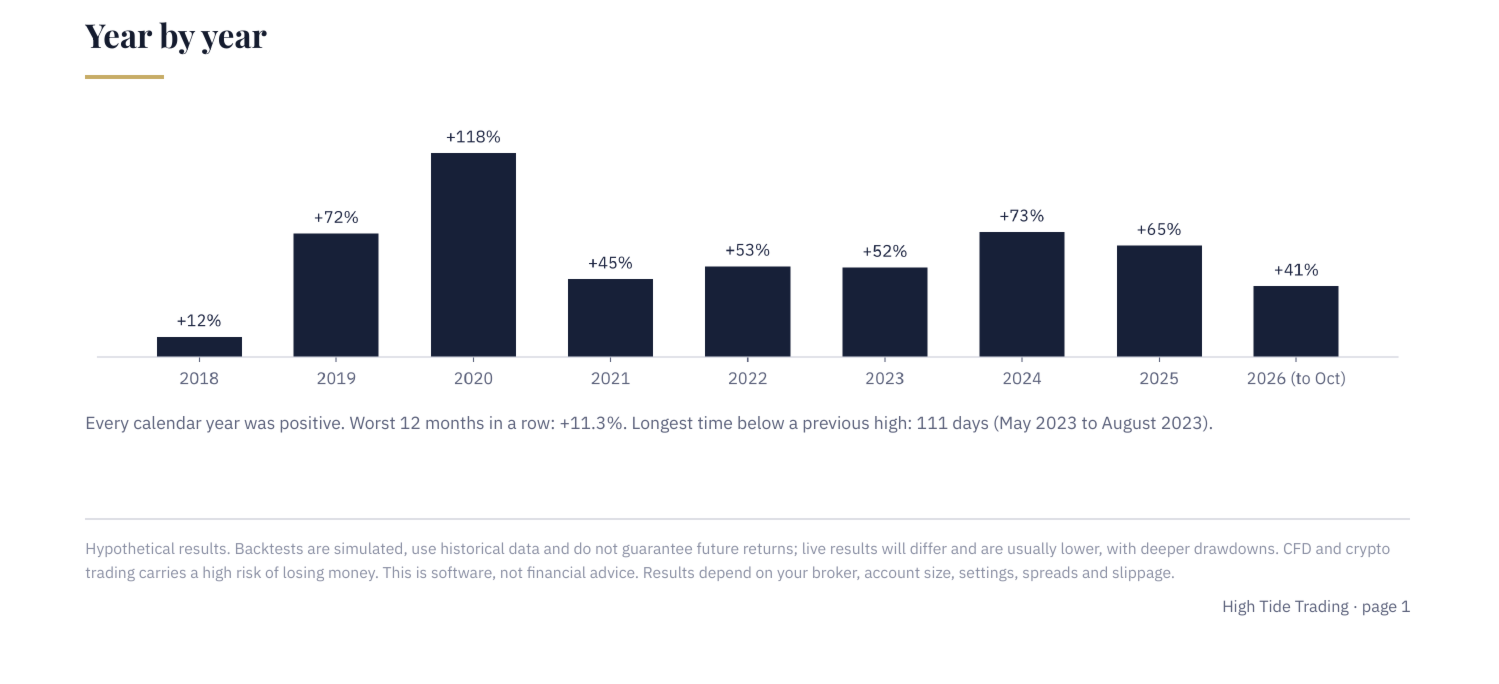
- Default (risk x0.72), all six strategies: maximum equity drawdown 8.4%, average growth 58.0% a year, profit factor 1.60, 10,977 trades. 86% of months were positive and the worst month was -3.7%. Every calendar year was positive.
- Conservative (x0.47): maximum drawdown 4.9%, average growth 32.7% a year, profit factor 1.61.
- Aggressive (x1.14): maximum drawdown 10.1%, average growth 102.5% a year, profit factor 1.63.
- Without crypto (Default size, High Tide and Low Tide off, Deep Tide on oil only): maximum drawdown 12.2%, average growth 29.3% a year, profit factor 1.75. Most of that drawdown came in 2018, the one losing year for this setup.
Independent data check
To make sure the results were not just a quirk of one broker's price history, I also ran the Default setting on Dukascopy tick data, which is 100% real ticks from a different source with wider spreads than IC Raw (January 2021 to October 2026, 5,000 USD, oil on IC data as it wasn't of sufficient quality). It made 40.8% a year with a maximum drawdown of 13.1% and a profit factor of 1.43 on the default setting. That is lower than the IC test, which is what I would expect from the higher costs, and all six strategies stayed profitable.
Please read these figures with care. A backtest is not a forecast. In my own stress test, adding a moderate amount of extra slippage to every trade took about a sixth off the yearly return. Expect live returns to be lower than the backtest and drawdowns to be deeper. For my own planning I assume only half the backtest edge survives live to be extra conservative. On that assumption a typical year would be roughly 26%, with a dip of about 5%, and about 11% in a bad one. This is an assumption, not a forecast.
Live results
The EA has traded a live account since 1 November 2026. I'll share monthly updates here in the comments, losing months included.
Requirements
- MetaTrader 5 and a hedging account (recommended). On a netting account the EA holds only one position per market at a time, so it takes fewer trades.
- Broker server time GMT+2 in winter and GMT+3 in summer. If your broker uses a different offset, set it in the time options of the inputs.
- A broker that offers the markets above. Symbol names differ between brokers (for example SPX500 instead of US500). Edit the symbol lists in the inputs to match. Gotobi and Deep Tide also have a suffix setting.
- Account size: from about 5,000 for Default and about 10,000 for Conservative (USD, GBP or EUR). On smaller accounts some trades are already at the broker's minimum lot and cannot be made smaller.
- A VPS (virtual private server) is strongly recommended. Crypto trades can stay open over the weekend.
- If your broker does not offer crypto CFDs, switch off High Tide and Low Tide and set Deep Tide to trade XTIUSD only. The backtest for that setup is shown above.
Setting it up
- Attach ONE copy to any chart, for example XAUUSD H1. It trades every symbol itself, so the chart makes no difference.
- Choose your risk setting (Overall risk) in the inputs.
- The inputs start set up for a GBP account. For a USD account, change three inputs: GB_CommissionPerLot = 7.0, GT_LotsPer10k = 0.08 and RT_GrowthSymbols = USTEC=19000 (the backtests above use these). Ready-made set files for GBP and USD accounts are available on request in the comments.
- To use Telegram alerts, allow WebRequest for the Telegram API address under Tools > Options > Expert Advisors. The exact address is in the user guide.
- Set "Send test now" to true once to check your alerts arrive, then set it back to false.
- Backtesting: some brokers' test servers are missing price history for some markets, and MT5 stops a test as soon as a strategy asks for it. So by default a backtest uses gold and USDJPY only. To backtest all six strategies, set "Backtest all markets" (InpBacktestAll) to true. Live trading always uses all six.
Inputs
The inputs are grouped into blocks. Most people only need the first two.
Portfolio risk
- Overall risk: Conservative (x0.47), Default (x0.72), Aggressive (x1.14) or Custom.
- Custom risk multiplier: used only with Custom.
- Monitor and Stop and Assess levels: equity drawdown % for the alert and for closing everything. 0 uses the preset (6/11, 10/15, 13/20).
- Taper: smaller trades during a drawdown, from 60% of the Monitor level, at half size.
- Minimum lot mode: trade the broker minimum lot when a trade works out smaller, or skip it.
- Pause after Stop and Assess: stay stopped until you resume, or resume after a number of days.
- Resume trading and Reset high: one-off switches. Set to true, press OK, then set back to false.
Prop firm rules
Account size, daily loss limit and how it is measured, the hour the firm's day starts, maximum loss (fixed or trailing), safety buffer, pre-trade check, weekend close and news pause. All off by default.
Alerts and reports
- Pop-up, push and Telegram on or off, with the Telegram bot token and chat ID.
- Weekly report, monthly report and report hour (UK time).
- Account label, to tell demo and live reports apart.
Health checks
- Slippage alert on or off, the number of fills measured and the limit for each strategy in basis points.
- Live versus backtest alert on or off, how far below counts as "well below" and the minimum number of trades.
- EA stopped alerts, the disconnect time in minutes and the optional daily heartbeat.
Strategy settings
Each strategy has its own block with its symbols, risk per trade, stops, targets, filters and magic numbers. The defaults are the tested values. Apart from symbol names and time zone settings, I recommend leaving them as they are.
Dashboard
Show or hide, position, font, colours and the date to count results from.
Please note
Backtest results are hypothetical. They do not guarantee future returns. Your results will depend on your broker, account size, spreads, slippage and settings. Trading CFDs, including crypto CFDs, carries a high risk of losing money. Only trade with money you can afford to lose.
Updates are free. If you have a question before or after buying, ask in the comments or send me a private message here on MQL5. I'm always happy to answer questions and hear feedback.