Apex Helios
- Experts
- Versione: 11.0
- Attivazioni: 15

APEX HELIOS - ONE QUALIFIED TRADE PER DAY ON GOLD
Most gold robots trade constantly. Apex Helios does the opposite.
It maps the opening range of each session, waits for one qualified break from that range, and then does nothing for the rest of the day. If no setup meets its quality thresholds, it does not trade at all.
One position at a time. A stop loss attached from the moment it opens. Risk on any single trade capped by design.
BUILT FROM A TRADE LOG, NOT FROM AN IDEA
Version 11 is not a feature update. It is the result of taking the previous version apart.
I logged every trade it made on XAUUSD H1 from January 2023 to August 2026 - 485 trades - and recorded the outcome of each one as a multiple of the risk taken. The distribution showed the problem immediately:
39% of all trades ended flat at break-even
Only 21% ever reached +1R in profit
Across 2023-2024, the system was not profitable at all
The robot was pushing into profit, moving its stop to break-even, and then handing the move back. Two trades in five did all the work of a trade and banked nothing.
Everything in this version exists to fix something that log revealed. Nothing was added because it sounded good.
SELECTIVE BY DESIGN
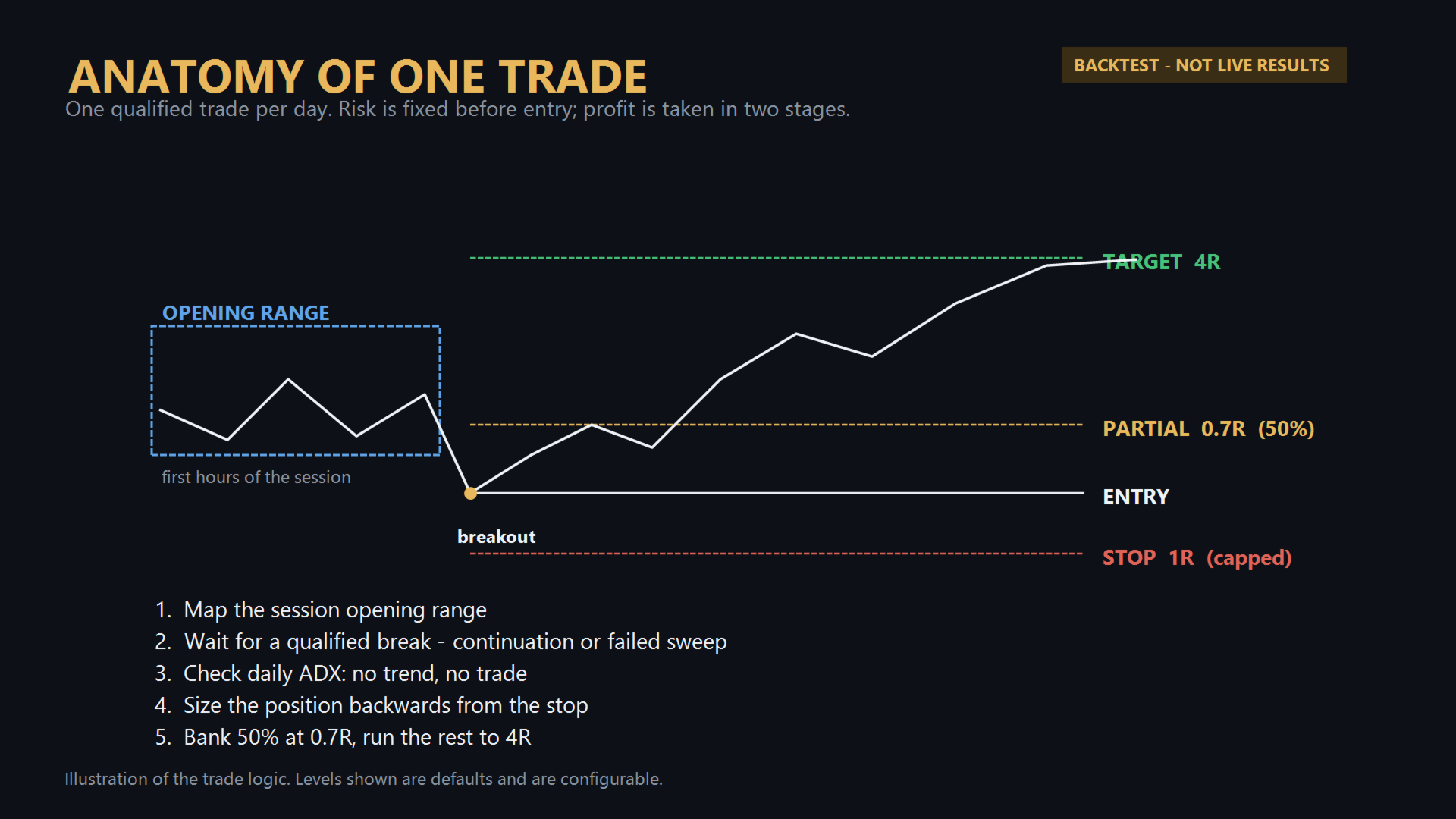
Each session Apex Helios builds a price box from the first hours of trading - the day's opening range, where the market has already agreed on value.
It then watches for price to leave that zone convincingly, and classifies what it sees:
A continuation - price closes decisively outside the range with a strong body
A sweep - price pushes through the boundary, fails, and closes back inside
Both are traded, in the direction the structure supports. A qualification stage then filters on trend bias, candle quality, box width relative to volatility, session timing and spread. Setups that fail are discarded and the day is skipped.
Fewer trades is the point, not a limitation.
IT STANDS ASIDE WHEN GOLD IS NOT TRENDING
An opening-range breakout bleeds in a sideways market no matter which direction it takes. Apex Helios checks daily ADX before acting and skips signals when there is no trend to work with.
The filter is deliberately direction-agnostic. It does not ask which way gold is going, only whether a trend exists at all.
In testing, this single change did more to reduce drawdown than anything else in the build.
PROFIT TAKEN IN TWO STAGES
The robot banks part of the position early, at a configurable multiple of initial risk, and lets the remainder run to the full target.
That is the direct answer to the 39% break-even problem. A trade that proves itself and then retraces no longer banks nothing - it has already paid part of its way - while the runner still carries the wider target for the moves that keep going.
RISK IS CAPPED PER TRADE
This is the part worth reading twice.
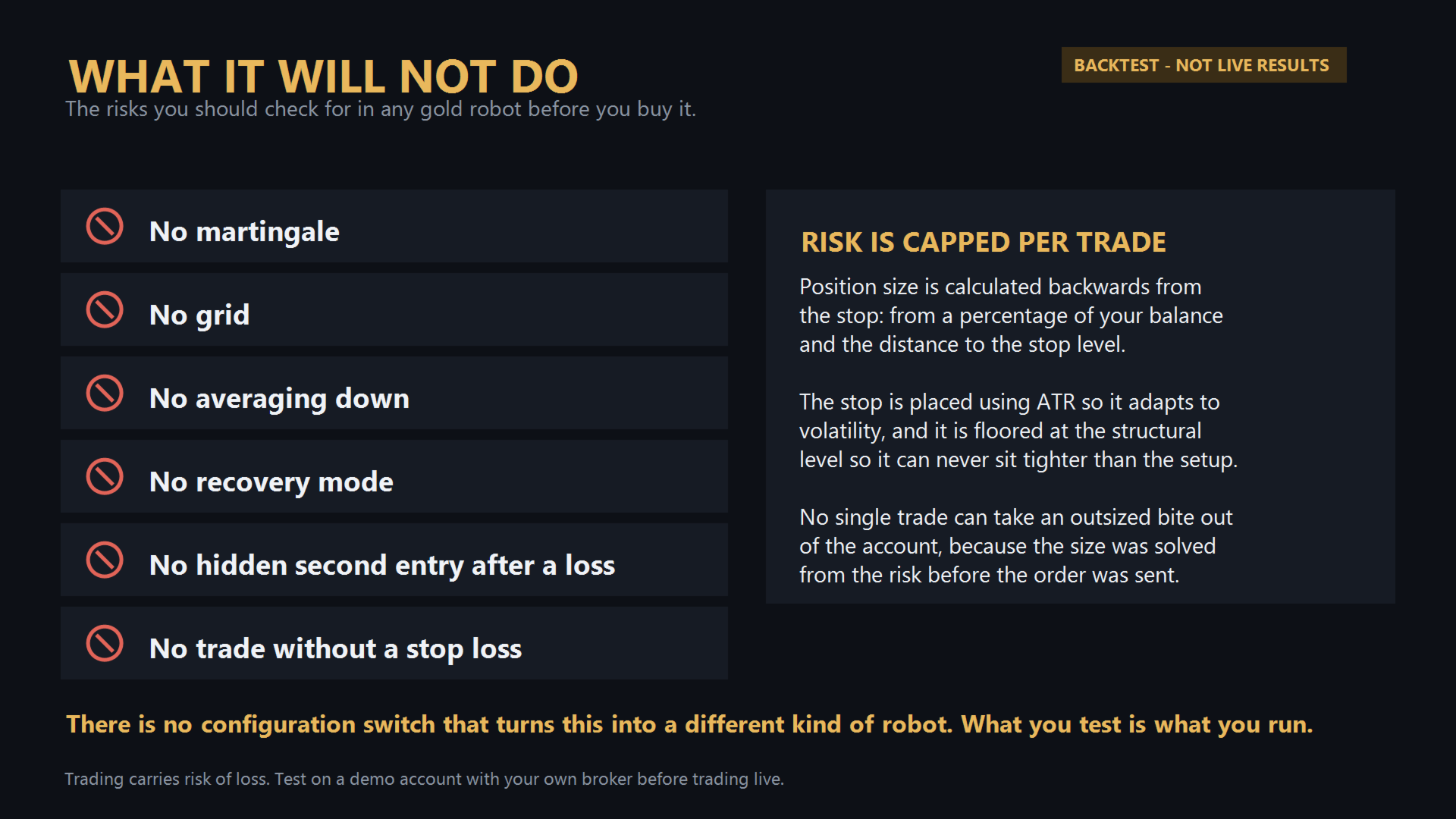
Position size is calculated backwards from the stop: from a percentage of your balance and the distance to the stop level. The stop itself is placed using ATR so it adapts to volatility, and it is floored at the structural level so it can never sit tighter than the setup.
The consequence is that no single trade can take an outsized bite out of the account. The size was solved from the risk before the order was ever sent.
Alongside that:
One qualified trade per day, with optional stop-after-win
Optional hard lot cap on top of percent sizing
Automatic break-even
Daily loss limit
Equity-drawdown guard that reduces position size while the account is below its high-water mark, rather than halting. Halting an account locks it out of its own recovery.
Broker-safety handling for stop levels, freeze levels, free margin and symbol volume limits
WHAT IT WILL NOT DO
No martingale
No grid
No averaging down
No recovery mode
No hidden second entry after a loss
No trade without a stop loss
There is no recovery multiplier buried in the settings, and no configuration switch that turns this into a different kind of robot. What you test is what you run.
BACKTEST RESULTS
The following are backtest results. They are not live trading results.
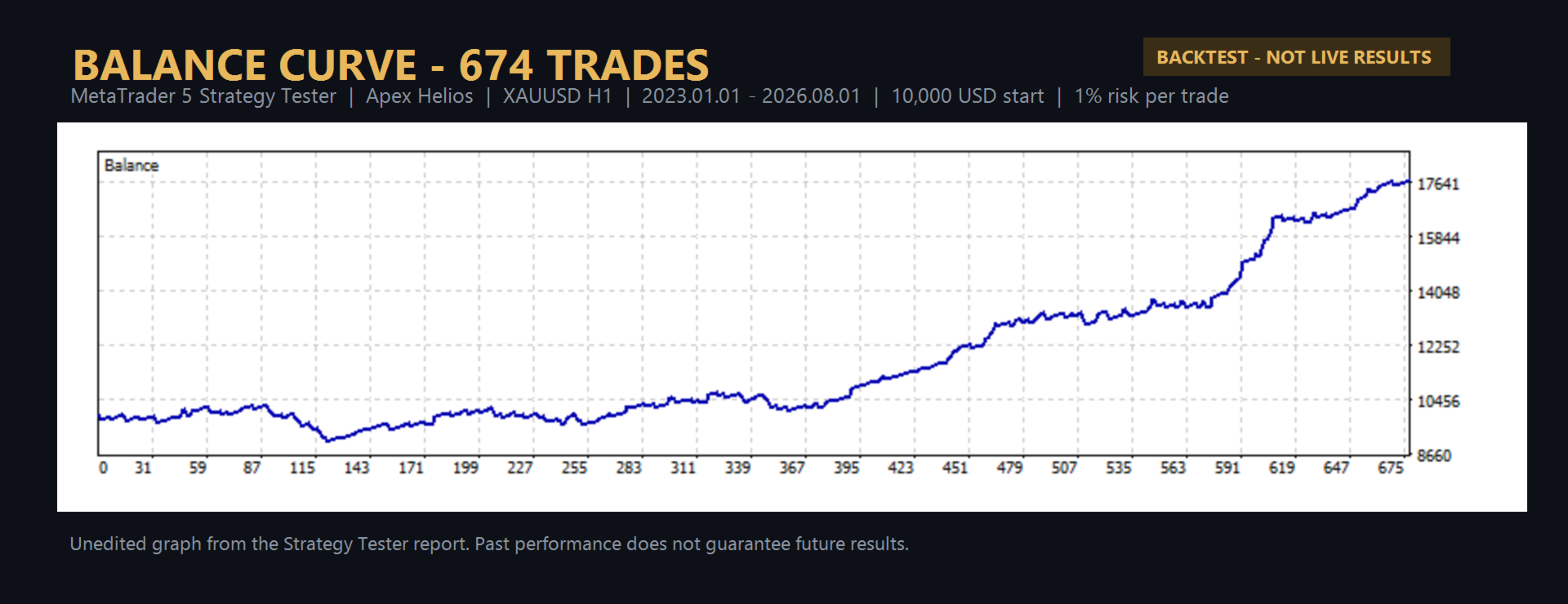
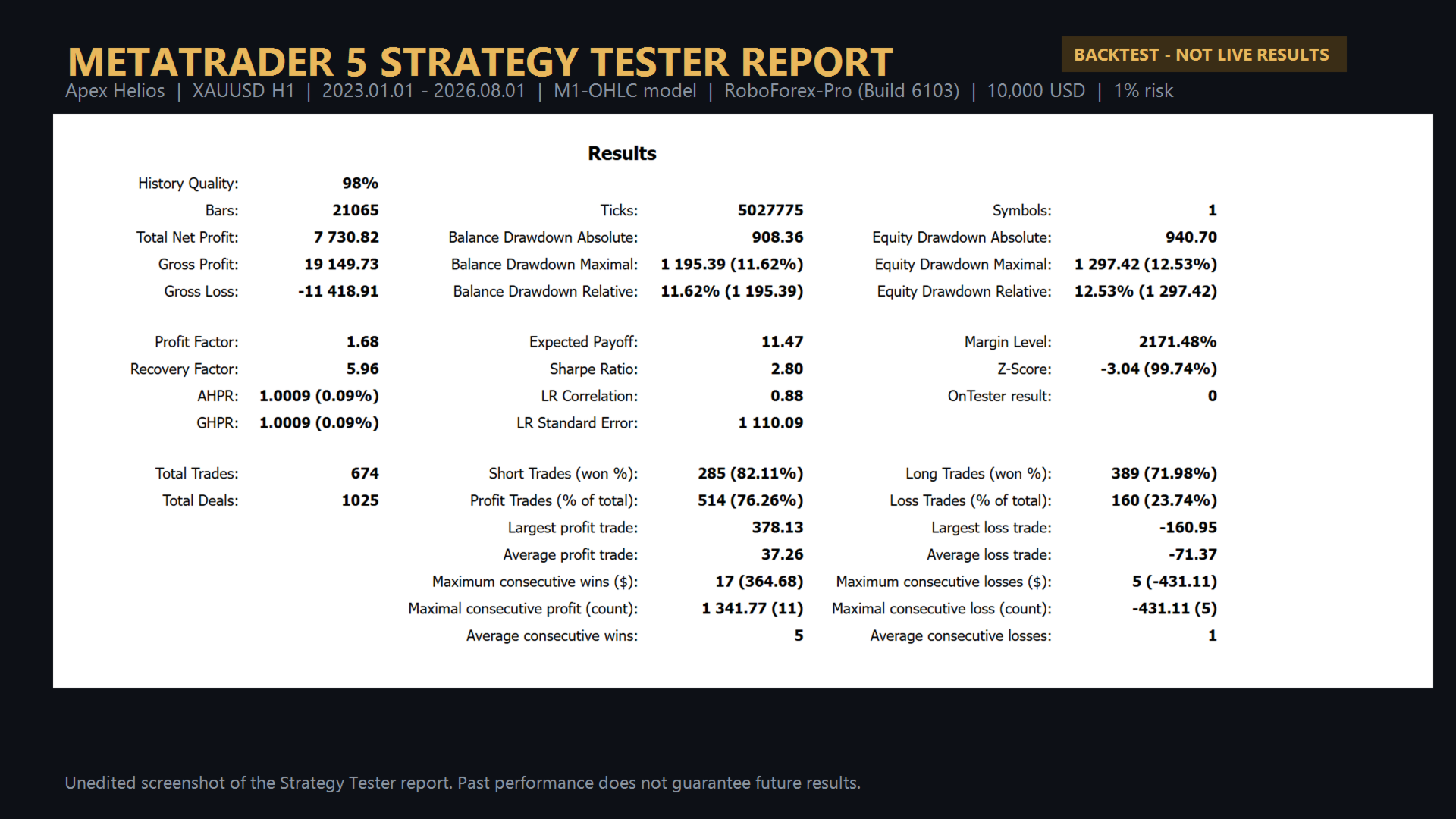
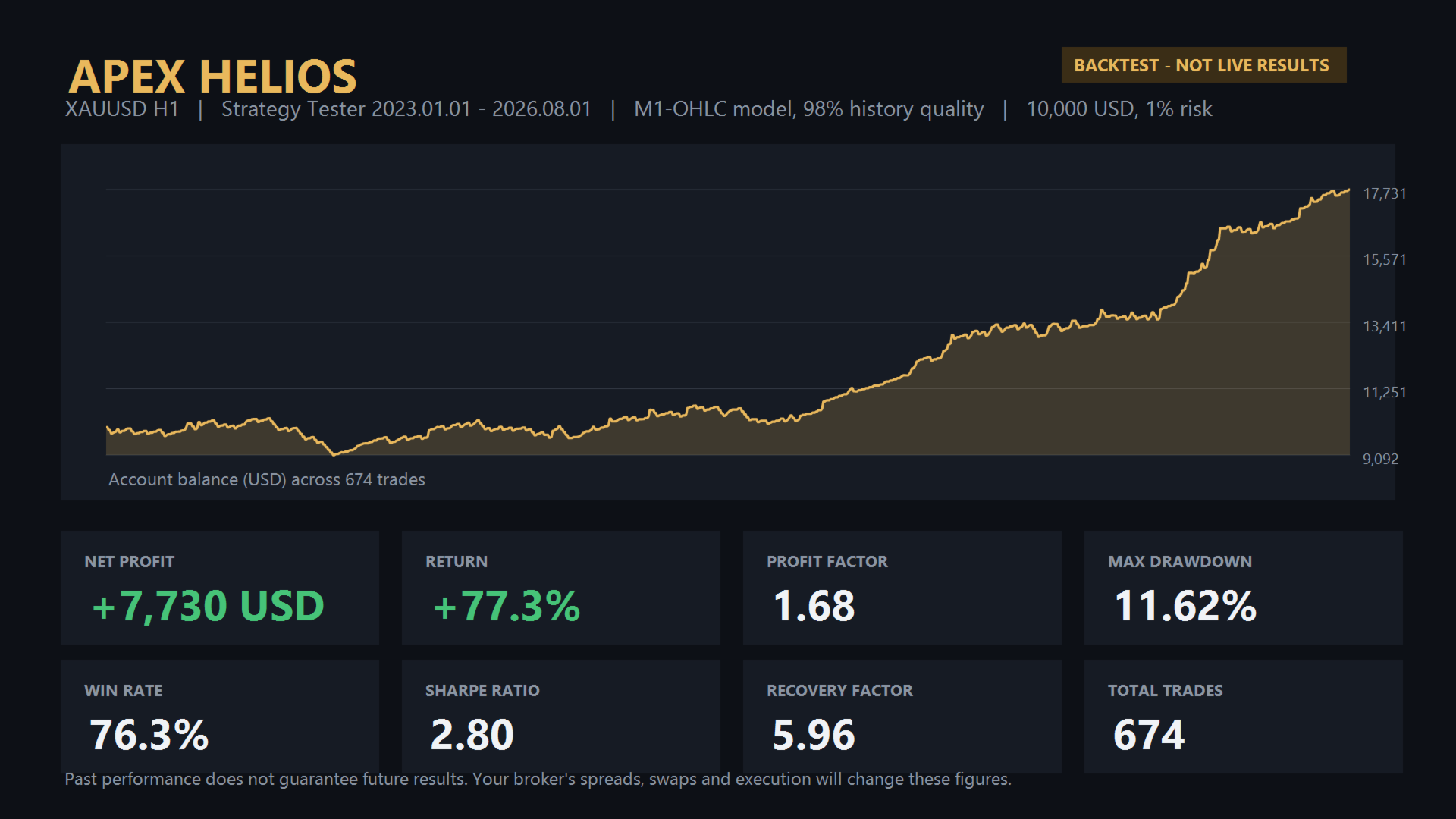
XAUUSD H1, 2023.01.01 to 2026.08.01, MetaTrader 5 Strategy Tester, M1-OHLC model, 98% history quality, 10,000 USD starting balance, 1% risk per trade:
Net profit: +7,730 USD (+77.3%)
Profit factor: 1.68
Maximum drawdown: 11.62%
Trades: 674
Win rate: 76.3%
Sharpe ratio: 2.80
Recovery factor: 5.96
Max consecutive losses 5
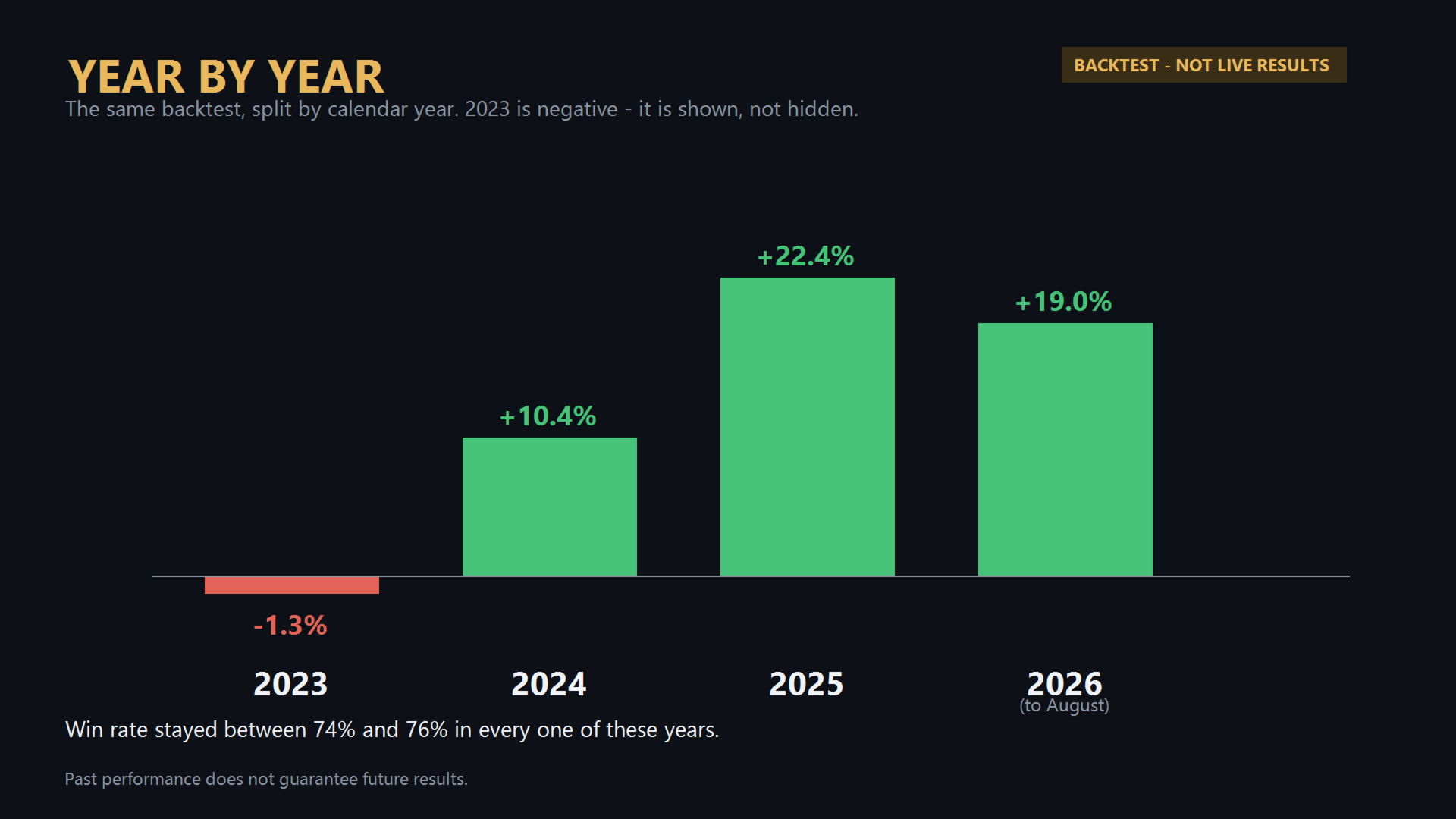
Year by year on the same run:
2023: -1.3%
2024: +10.4%
2025: +22.4%
2026: +19.0% (to August)
2023 is negative. I am leaving it in, because a robot that shows four perfect years is telling you about its curve fitting, not its edge.
HOW THESE NUMBERS WERE PRODUCED
This matters more than the numbers themselves.
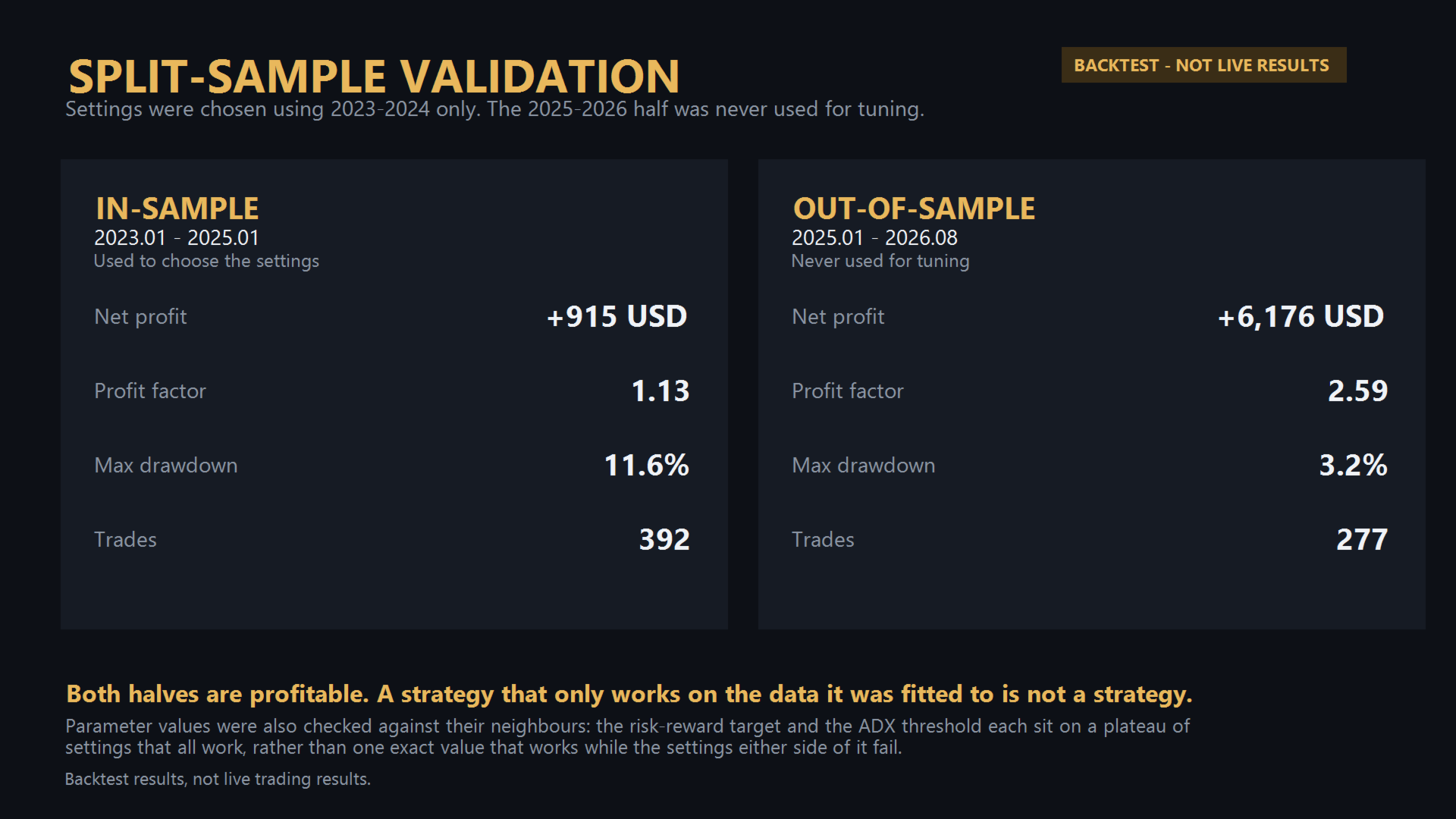
The settings were tuned on 2023-2024 data and then tested against 2025-2026 data that was not used for tuning. Both halves are profitable. A strategy that only works on the data it was fitted to is not a strategy.
Where a parameter was chosen, its neighbours were tested too. The risk-reward setting and the ADX threshold each sit on a plateau of values that all work, rather than a single value that works while the ones either side of it fail. A result that survives only at one exact setting is an accident.
A cross-check of 2025 under the every-tick model at 100% history quality returned the same trade count and the same win rate, with profit about 7% lower than the M1-OHLC figure.
Your broker's spreads, swaps, execution and gold contract specification will change these results.
MARKET
XAUUSD (Gold), H1 timeframe.
The defaults in this build are specific to gold. Other symbols are not recommended without re-optimisation, and I would rather say that plainly than claim a universality the testing does not support.
ABOUT THE MINIMUM DEPOSIT - PLEASE READ THIS
I would rather lose the sale than have you fund this with too little.
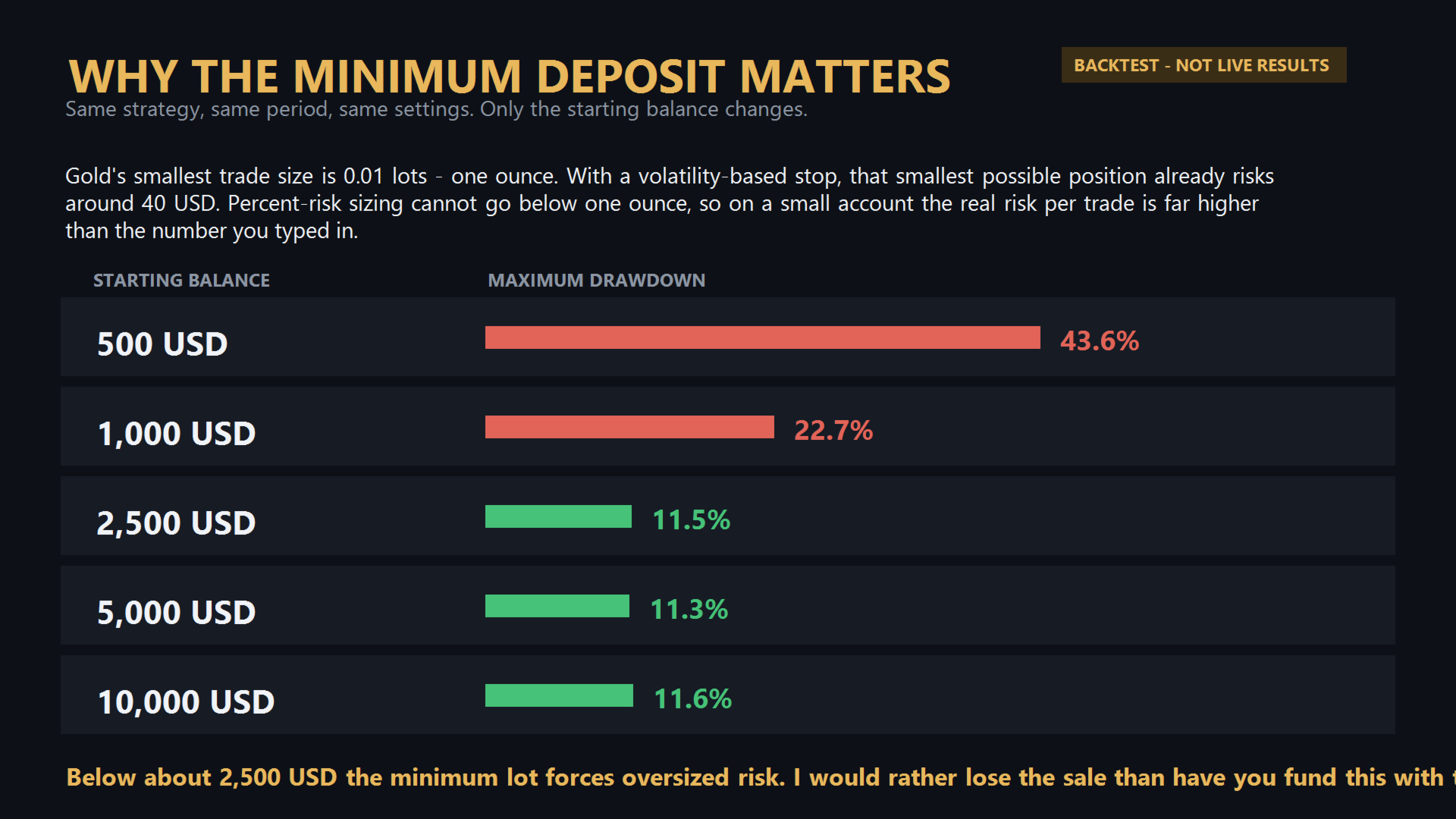
Gold's minimum trade size is 0.01 lots, which is one ounce. With a volatility-based stop, that smallest possible position already risks roughly 40 USD on a single trade. Percent-risk sizing cannot go below one ounce, so on a small account the real risk per trade is far higher than the number you typed in.
Measured over the same 2023-2026 backtest, changing nothing but the starting balance:
500 USD: 43.6% maximum drawdown
1,000 USD: 22.7% maximum drawdown
2,500 USD: 11.5% maximum drawdown
5,000 USD: 11.3% maximum drawdown
10,000 USD: 11.6% maximum drawdown
The strategy does not change. Only position granularity does. Below about 2,500 USD the minimum lot forces oversized risk and the drawdown profile stops resembling anything described here.
If you have less than that, run it on demo until the balance justifies it, or use a broker offering micro gold contracts.
REQUIREMENTS
Platform: MetaTrader 5
Account type: Standard, ECN or Raw Spread
Leverage: 1:30 or higher
Minimum deposit: 2,500 USD (5,000 USD or more recommended)
VPS: recommended for continuous operation
Confirm your broker's server time before deployment. The session window uses server hours, not your local time.
GETTING STARTED
1. Attach to an XAUUSD H1 chart
2. Enable algo trading
3. Leave Preset on AUTO, or load the supplied set file
4. Confirm the dashboard shows SCANNING
INCLUDED
Apex Helios
Pre-configured XAUUSD set file
User guide covering installation, settings and the dashboard
Free updates for the life of the product
Direct support through MQL5 messaging
LAUNCH PRICING
This is the introductory price for the first buyers. It increases as the product establishes its review history.
Questions before you buy are welcome. Message me and I will answer them directly, including the ones about what this robot does badly.
IMPORTANT
Trading carries risk of loss, and losses are possible.
No-trade days are normal and intended. The regime filter deliberately adds more of them. This is a trend-following approach: it is built to trade when gold trends and to stand aside when it does not. Quiet periods are the design working, not a fault.
Past performance does not guarantee future results. No system can remove risk from trading. Test on a demo account with your own broker before trading live.