The dollar managed to beat the euro and the yen, but stayed behind
the mighty pound and the recovering loonie. Will these trends continue?
The FOMC Meeting Minutes, Australian, Canadian employment figures and
the rate decision in the UK are the main market movers on FX calendar.
Here is an outlook on the top events this week.
The US labor market is certainly picking up, with a gain of 288K jobs
and another drop of the unemployment rate to 6.1%. This has been the
fifth straight month where job gains surpassed 200,000 positions. Job
growth averaged 231,000 per month in the first half of the year. Is this
enough to move the Fed? In the euro-zone, Draghi maintained a dovish
message, leaving the door wide open to QE. The pound enjoyed positive
PMIs and continued advancing against both currencies. The Australian
dollar suffered a blow from the RBA after reaching highs while another
commodity currency, the C$,enjoyed its momentum. Let’s start,
JOLTS Job Openings:
Tuesday, 14:00. This lagging measure of US employment is closely
watched by the Fed, which looks at a wider array of job figures and not
only the unemployment rate. Job openings jumped to 4.45 million in
April and are now expected to advance to 4.53 million.
FOMC Meeting Minutes:
Wednesday, 18:00. In the June meeting, the Fed tapered for the fifth
time as expected, and also lowered growth forecasts. In the accompanying
press conference, Yellen maintained a dovish tone, weighing on the
dollar. Given similar moves in the past, can the meeting minutes reveal
a slightly more hawkish Fed than the initial message suggested?
Australian employment data:
Thursday, 1:30. Australia’s unemployment rate remained unchanged at
5.8% in May, despite an unexpected drop of 5.9% in the number of jobs.
Analysts expected a rise of 10,000 positions as well as a climb to 5.9%
in Jobless claims. However, not all was bad, the number of full time
positions increased by 22,200 while part time positions declines by
27,000. The unemployment rate increased to a decade-high 6.0% in
January, while analysts and the Treasury expecting it to edge higher
this year during the transition away from mining-led growth.
Australia’s job market is expected to increase by 12,300 while the
unemployment rate is expected to stand at 5.9%.
UK rate decision:
Thursday, 11:00. There was a general belief that the BOE’s would not
increase interest rates until after the General Election in May 2015.
However recent market data suggests the central bank may raise rates to
3% much sooner. Mark Carney originally bonded between the UK
unemployment rate and BOE base rate, saying he will raise rates of
unemployment drops below 7%. This goal has been unexpectedly reached
forcing Carney to change the rate hike trigger to18 economic
indicators. Most analysts expect a gradual rise in rates which will
continue until 2017 with a first rise to 0.75% within the fourth
quarter of this year.No chnge in rates is expcted this time.
US Unemployment Claims:
Thursday, 12:30. Initial applications for jobless benefits inched
higher by 2,000 last week to a seasonally adjusted 315,000, staying
near pre-recession levels. The reading was broadly in line with market
forecast. the four-week moving average of continuing claims dropped to
2,580,250, declining by 6,000 from the prior week’s revised level of
2,586,250. US jobless claims are expected to reach 316,000 this time.
Canadian employment data:
Friday, 12:30. Canada’s unemployment rate unexpectedly climbed to 7%
in May from 6.9% in the previous month amid job addition of 25,800. The
main gain was part time positions, while full employment dropped
29,100. The readings were broadly in line with market forecast. The
bank of Canada stated that rising global demand and a lower Canadian
dollar will boost Canadian economic growth. Canadian labor market is
expected to add 26,200 jobs, while the unemployment rate is predicted
to remain unchanged at 7%.
The Euro and Swiss Franc were under more intense pressure versus the British Pound, hitting new yearly lows.
EURUSD was vulnerable going into Thursday and a breakdown may have just started after the strong US NFPs.
The Euro experienced a minor setback this week against most of its
major counterparts, losing the most ground to the increasingly
resilient and impressive British Pound. Even EURUSD had a late-week
letdown on the back of the US labor market showing additional
fortitude, as the US unemployment rate fell to a post-recession low of
6.1%, the lowest since September 2008. The recent barrage of
important data on both sides of the pond suggests a widening
differential in central bank policy, leaving the Euro at a disadvantage
against the British Pound and the US Dollar going forward.
As traders were buying US Dollars on Thursday after the June US labor
market showed the fifth consecutive month of jobs growth above +200K,
European Central Bank President Mario Draghi was simultaneously holding
court after the ECB policy meeting; the Governing Council’s latest actions did little to help support the Euro.
In absence of new policy action, ECB President Draghi’s greatest
contribution on Thursday was to remind traders that not only would
interest rates remain low for an extended period of time, but that the
ECB was also intensifying prep work related to asset-backed securities
(ABS) purchases.
The problem for the ECB with ABS purchases, which is why the market
hasn’t taken the threat as a significant reason to drive Euro exchange
rates lower, is that the ABS market in the Euro-Zone is not nearly as developed as it is in the United States;
and therefore the amount of ABS purchases potentially necessary is
difficult to quantify. The ECB, up until this point, was not (and still
truly isn’t) necessarily aware of how big the ABS market was and how
strong of a purchase program they would need to design.
While the threat of a major LSAP is certainly brewing, the clout
behind the ECB’s potential €1 trillion TLTRO is rather weak, at least
from the perspective that it could keep downside pressure on the
EUR-crosses in a meaningful way. Simply put, these are not carte
blanche liquidity injections; the rules published by the ECB on
Thursday make well-clear their intention to improve liquidity channels
and reduce credit fragmentation across the Euro-Zone.
If the TLTROs are effective, they end result will be capital used to
boost organic growth opportunities rather than speculative reach for
yield (in the US, the UK, and the Euro-Zone, open-ended QE is widely
perceived as free money for financial institutions at the expense of
taxpayers and savers, so the ECB is being careful to craft a program
that won’t fan the speculative flames). Over time, the TLTROs could even prove to be broadly EUR-positive, but not for several months or years.
For now, the Euro is stuck with a central bank in holding position,
preparing for its next move, as it waits and observes what its prior
actions have resulted in. One thing is clear, however: the ECB is taking
on a more dovish stance by expanding its non-standard policy easing
toolbox, and has no intention of tightening policy within the next 12-
to 18-months.
The ECB’s ‘lower for longer’ stance is prohibitive for the Euro
because the British Pound and the US Dollar are being bombarded with
strong economic data and rising sovereign yields as a result, as market
participants start to price in interest rate hikes from the Bank of
England and the Federal Reserve, respectively.
In this interim period of ECB inaction, we turn our attention outwardly to the BoE and the Fed as the more significant drivers of price action in EURGBP and EURUSD (and
GBPCHF and USDCHF as well, given the highly significant, nearly perfect
positive correlation between EUR and CHF since September 2011 when the
SNB levied the Sf1.2000 floor in EURCHF).
The EUR/USD pair tried to rally during the course of the week, but as
you can see failed at the 1.37 handle. The resulting candle is a
shooting star, but it’s hardly a decent sell signal, as there is
significant support down at the 1.35 handle. With this, we believe that
ultimately this market continues to chop around sideways, and therefore
we have no interest in a longer-term trade at this point in time as the
market has essentially been taken over by the scalpers. It is not until
we break out of this area that we feel comfortable with a longer-term
position.
The euro fell to more than one-week lows against the dollar on Friday,
one day after a robust U.S. employment report for June eased concerns
over the outlook for the economic recovery.
EUR/USD ended Friday’s session at 1.3594, down 0.35% for the week.
The pair is likely to find support at 1.3550 and resistance at 1.3600.
The Labor Department reported Thursday that that U.S. economy added
288,000 jobs last month, well above expectations for jobs growth of
212,000. The previous month’s figure was revised up to a gain of 224,000
from a previously reported increase of 217,000.
The unemployment rate ticked down to 6.1% from 6.3% in May, the lowest
in almost six years. The data was released a day early, ahead of
Friday’s Independence Day holiday.
The upbeat data revived expectations that the Federal Reserve could bring forward its timetable for raising interest rates.
The euro came under pressure after the European Central Bank repeated
its forward guidance that rates will remain on hold at present or lower
levels for an extended period.
The ECB also reiterated that it could use "unconventional measures" to
combat persistently low levels of inflation in the euro area.
The ECB left all rates on hold on Thursday, in a widely anticipated decision, after cutting rates to record lows in June.
The single currency was lower against the yen on Friday, with EUR/JPY
down 0.24% to 138.74, off Thursday’s one-month highs of 139.26.
The euro fell to almost two-year lows against the stronger pound on
Friday, with EUR/GBP down 0.14% to 0.7921, the weakest since September
2012.
Demand for sterling continued to be underpinned by expectations that the
deepening economic recovery in the U.K. will prompt the Bank of England
to raise interest rates before the end of this year.
In the week ahead, investors will be focusing on Wednesdays’ minutes of
the Federal Reserve’s June meeting, with few other major economic
reports on the calendar.
Ahead of the coming week, Investing.com has compiled a list of this and
other significant events likely to affect the markets. The guide skips
Monday, as there are no relevant events on this day.
Tuesday, July 8
In the euro zone, Germany is to publish data on the trade balance, the difference in value between imports and exports.
Wednesday, July 9
The Federal Reserve is to publish the minutes of its June meeting.
Thursday, July 10
France is to publish reports on consumer prices and industrial production, while the ECB is to publish its monthly bulletin.
Later Thursday, the U.S. is to release the weekly government report on initial jobless claims.
Friday, July 11
Spain is to publish revised data on consumer inflation.
The EUR/USD
closed the week below the 1.36 range falling steadily after the ECB
decision and the dovish Mario Draghi on Thursday. On Friday German
factory orders missed expectations driving down the shared currency. The
euro closed the week at 1.3588.
ECB officials, led by President Mario Draghi, left monetary policy
unchanged after Thursday’s meeting in Frankfurt, according to analysts.
The ECB unveiled unprecedented stimulus measures at its previous meeting
on June 5, including negative deposit rates that tend to weaken a
currency. Markets largely shrugged off the European Central Bank’s
latest monetary policy meeting, but the euro weakened against the dollar
following stronger -than-expected jobs growth in the U.S.
ECB Chief Mario Draghi struck a cautious tone in his monthly news
conference Thursday, running through technical details of the central
bank’s plan to provide cheap loans to euro-area banks. Longer term, some
analysts think last month’s easing package could make a bigger dent in
the euro.
Mr. Draghi said its program of cheap loans to banks could total as much as a trillion euros.
“If Draghi is right the ECB balance sheet would grow considerably
over time. Given the historic link between [the Eurodollar exchanged
rate] and the ratio of Fed/ECB balance sheet—this should underscore the
downside risks to [the euro],” said Valentin Marinov at Citigroup.
if actual > forecast = good for currency (for EUR in our case)
[EUR - German Industrial Production] = Change in the total inflation-adjusted value of output produced by manufacturers, mines, and utilities. It's a leading indicator of economic health - production reacts quickly
to ups and downs in the business cycle and is correlated with consumer
conditions such as employment levels and earnings.
German industrial production declined unexpectedly in May, official data indicated Monday.
Industrial
output fell 1.8 percent in May from the prior month, Destatis reported.
This was the third consecutive fall in production. Economists had
forecast a 0.2 percent rise after declining by revised 0.3 percent in
April.
Production in industry excluding energy and construction decreased 1.6 percent in May.
Within
industry, the production of intermediate goods and consumer goods
decreased by 3 percent and 3.5 percent. The producers of capital goods,
however, reported a slight increase of 0.3 percent on the previous
month.
Energy production gained 1 percent in May, while the production in construction slid 4.9 percent from April.
The euro slipped on Monday,
testing a 22-month trough against the British pound, after weak
German industrial data highlighted the divergent economic
prospects between the euro zone and those of its biggest trading
partners.
German industrial output fell 1.8 percent on the month in
May, its biggest drop in more than two years, surprising most
analysts, who had forecast an unchanged reading.
The weak data kept alive expectations that the European
Central Bank may need to loosen monetary policy further in
coming months in the face of disinflationary pressures and
subdued economic growth.
ECB policymaker Benoit Coeure said at the weekend that rates
will remain very low for a long time, regardless of developments
in the rest of the world.
In contrast, the Bank of England is expected to tighten
policy either before the end of this year or early next year.
Investors have also brought forward their view on the timing of
the first rate hike by the U.S. Federal Reserve to mid-2015
after a stellar jobs report last week.
That helped the dollar index trade near its highest
in nearly two weeks, at 80.359. The euro was down slightly at
$1.3590, having fallen to $1.3576 earlier in the European
session, its lowest since July 26. It fell to a 22-month low
against the pound of 79.14 pence after the German
data, but recovered to trade at 79.35 pence.
"The German data was a bit weak and in line with recent euro
zone data. This will add to selling pressure in the euro in the
near term," said Yujiro Goto, currency analyst at Nomura.
He expected euro/dollar to drift lower, especially in light
of last week's U.S. jobs data. The strong non-farm payrolls
report prompted traders to slightly increase bets that the Fed
will lift rates in June next year.
Most traders, though, are cautious about adding to long
dollar bets, aware that Fed policymakers will probably err on
the side of caution or wait for wage inflation to pick up before
hiking interest rates.
FED MINUTES IN FOCUS
Fed minutes, due to be released later this week, should shed
more light on how the debate within the rate-setting committee
is shaping up, traders said.
"The FOMC minutes this week could reveal how the Fed views
the recent rise in inflation and stronger data. The risk is that
there is a divergence between the doves and the hawks on the
committee," Morgan Stanley analysts said in a note.
"With (Fed chair Janet) Yellen staying firmly dovish, the
minutes may reflect this and has a chance to put the dollar
under pressure."
The dollar's failure to make much headway has been the big
disappointment on currency markets this year. Most traders say
that unless two-year Treasury yields rise sharply,
the dollar, which has a good correlation to U.S. yields, is
unlikely to push much higher.
The dollar fell against the yen to 101.90 yen, after
having risen 0.7 percent last week. The euro also shed 0.2
percent to trade at 138.51 yen with falling stock
markets offering the safe-haven yen some support.
Sterling, however, slipped against the dollar to $1.7125,
off last week's six-year high of $1.7180. The Canadian
dollar, also in favour at the moment, stood at C$1.0643 per USD
, just off a six-month high of C$1.0620 struck on
Thursday.
The U.S. dollar inched higher against the euro on Monday but pared
some early gains, as investors continued to digest last week's strong
U.S. employment report and speculated about when the Federal Reserve is
likely to begin raising rates.
The dollar stabilized after a week of gains, with no major U.S.
economic releases due this week and trading expected to be relatively
light after the Independence Day holiday.
The dollar has gained and the Treasuries yield curve has flattened
after data on Thursday showed nonfarm payrolls increased by 288,000 jobs
last month and the unemployment rate fell to 6.1 percent from 6.3
percent in May.
if actual > forecast = good for currency (for AUD in our case)
[AUD - NAB Business Confidence] = Level of a diffusion index based on surveyed businesses, excluding the farming industry. It's a leading indicator of economic health - businesses react quickly
to market conditions, and changes in their sentiment can be an early
signal of future economic activity such as spending, hiring, and
investment
Australian business
confidence improved in June, although conditions remained sub-trend,
results of a survey by the National Australia Bank showed Tuesday.
The
NAB business confidence index increased to 8 in June from 7 in May
despite the government's challenging new budget. This improvement was
driven by strengthened confidence in almost all the industries, with the
surge in construction industry confidence contributing the most.
New orders remained stagnant in June, the same as in May.
However,
the employment index weakened in June, coming in at -3, after being
unchanged in May. Capacity utilization fell to 79.3 percent in June from
80.2 in May.
On the pricing front, input costs rose 0.3 percent
quarter-over-quarter in June, a slower rate of increase than the 0.4
percent increase in May. Labor wages grew at a slower rate of 0.6
percent in June following the 0.7 percent increase in May. Output prices
rose 0.1 percent on a quarterly basis in June, the same rate as in May.
The
business conditions index increased to 2 in June from -1 in May, ending
the negative trend that started in the beginning of the year. Sales and
profits were stronger in June while employment remained weak.
The FX market is slow, same on metals while stocks are moving
slightly bearish. On the USD pairs we are still observing corrective
price action from where USD is expected to strengthen against the
majors, such as EUR, CHF, AUD and even JPY.
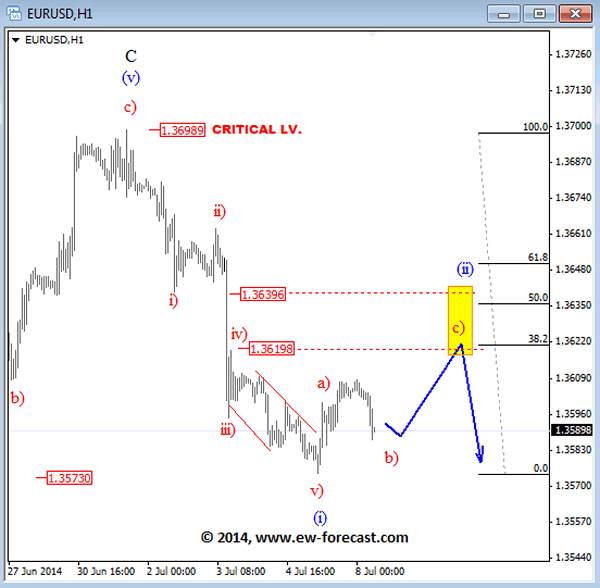
On the EURUSD chart we are looking at a three wave rally against the
five wave decline that occurred last week. Nice resistance for this pair
comes in at 1.3620-1.3640 from where we expect a resumption of a
downtrend. Invalidation level is at 1.3700 as current corrective rally
must not retrace more than 100% of preceding, impulsive decline.
The dollar managed to beat the euro and the yen, but stayed behind the mighty pound and the recovering loonie. Will these trends continue? The FOMC Meeting Minutes, Australian, Canadian employment figures and the rate decision in the UK are the main market movers on FX calendar. Here is an outlook on the top events this week.
The US labor market is certainly picking up, with a gain of 288K jobs and another drop of the unemployment rate to 6.1%. This has been the fifth straight month where job gains surpassed 200,000 positions. Job growth averaged 231,000 per month in the first half of the year. Is this enough to move the Fed? In the euro-zone, Draghi maintained a dovish message, leaving the door wide open to QE. The pound enjoyed positive PMIs and continued advancing against both currencies. The Australian dollar suffered a blow from the RBA after reaching highs while another commodity currency, the C$,enjoyed its momentum. Let’s start,
EURUSD Fundamentals (based on dailyfx article)
Fundamental Forecast for Euro: NeutralThe Euro experienced a minor setback this week against most of its major counterparts, losing the most ground to the increasingly resilient and impressive British Pound. Even EURUSD had a late-week letdown on the back of the US labor market showing additional fortitude, as the US unemployment rate fell to a post-recession low of 6.1%, the lowest since September 2008. The recent barrage of important data on both sides of the pond suggests a widening differential in central bank policy, leaving the Euro at a disadvantage against the British Pound and the US Dollar going forward.
As traders were buying US Dollars on Thursday after the June US labor market showed the fifth consecutive month of jobs growth above +200K, European Central Bank President Mario Draghi was simultaneously holding court after the ECB policy meeting; the Governing Council’s latest actions did little to help support the Euro.
In absence of new policy action, ECB President Draghi’s greatest contribution on Thursday was to remind traders that not only would interest rates remain low for an extended period of time, but that the ECB was also intensifying prep work related to asset-backed securities (ABS) purchases.
The problem for the ECB with ABS purchases, which is why the market hasn’t taken the threat as a significant reason to drive Euro exchange rates lower, is that the ABS market in the Euro-Zone is not nearly as developed as it is in the United States; and therefore the amount of ABS purchases potentially necessary is difficult to quantify. The ECB, up until this point, was not (and still truly isn’t) necessarily aware of how big the ABS market was and how strong of a purchase program they would need to design.
While the threat of a major LSAP is certainly brewing, the clout behind the ECB’s potential €1 trillion TLTRO is rather weak, at least from the perspective that it could keep downside pressure on the EUR-crosses in a meaningful way. Simply put, these are not carte blanche liquidity injections; the rules published by the ECB on Thursday make well-clear their intention to improve liquidity channels and reduce credit fragmentation across the Euro-Zone.
If the TLTROs are effective, they end result will be capital used to boost organic growth opportunities rather than speculative reach for yield (in the US, the UK, and the Euro-Zone, open-ended QE is widely perceived as free money for financial institutions at the expense of taxpayers and savers, so the ECB is being careful to craft a program that won’t fan the speculative flames). Over time, the TLTROs could even prove to be broadly EUR-positive, but not for several months or years.
For now, the Euro is stuck with a central bank in holding position, preparing for its next move, as it waits and observes what its prior actions have resulted in. One thing is clear, however: the ECB is taking on a more dovish stance by expanding its non-standard policy easing toolbox, and has no intention of tightening policy within the next 12- to 18-months.
The ECB’s ‘lower for longer’ stance is prohibitive for the Euro because the British Pound and the US Dollar are being bombarded with strong economic data and rising sovereign yields as a result, as market participants start to price in interest rate hikes from the Bank of England and the Federal Reserve, respectively.
In this interim period of ECB inaction, we turn our attention outwardly to the BoE and the Fed as the more significant drivers of price action in EURGBP and EURUSD (and GBPCHF and USDCHF as well, given the highly significant, nearly perfect positive correlation between EUR and CHF since September 2011 when the SNB levied the Sf1.2000 floor in EURCHF).
The EUR/USD pair tried to rally during the course of the week, but as you can see failed at the 1.37 handle. The resulting candle is a shooting star, but it’s hardly a decent sell signal, as there is significant support down at the 1.35 handle. With this, we believe that ultimately this market continues to chop around sideways, and therefore we have no interest in a longer-term trade at this point in time as the market has essentially been taken over by the scalpers. It is not until we break out of this area that we feel comfortable with a longer-term position.
The euro fell to more than one-week lows against the dollar on Friday, one day after a robust U.S. employment report for June eased concerns over the outlook for the economic recovery.
EUR/USD ended Friday’s session at 1.3594, down 0.35% for the week.
The pair is likely to find support at 1.3550 and resistance at 1.3600.
The Labor Department reported Thursday that that U.S. economy added 288,000 jobs last month, well above expectations for jobs growth of 212,000. The previous month’s figure was revised up to a gain of 224,000 from a previously reported increase of 217,000.
The unemployment rate ticked down to 6.1% from 6.3% in May, the lowest in almost six years. The data was released a day early, ahead of Friday’s Independence Day holiday.
The upbeat data revived expectations that the Federal Reserve could bring forward its timetable for raising interest rates.
The euro came under pressure after the European Central Bank repeated its forward guidance that rates will remain on hold at present or lower levels for an extended period.
The ECB also reiterated that it could use "unconventional measures" to combat persistently low levels of inflation in the euro area.
The ECB left all rates on hold on Thursday, in a widely anticipated decision, after cutting rates to record lows in June.
The single currency was lower against the yen on Friday, with EUR/JPY down 0.24% to 138.74, off Thursday’s one-month highs of 139.26.
The euro fell to almost two-year lows against the stronger pound on Friday, with EUR/GBP down 0.14% to 0.7921, the weakest since September 2012.
Demand for sterling continued to be underpinned by expectations that the deepening economic recovery in the U.K. will prompt the Bank of England to raise interest rates before the end of this year.
In the week ahead, investors will be focusing on Wednesdays’ minutes of the Federal Reserve’s June meeting, with few other major economic reports on the calendar.
Ahead of the coming week, Investing.com has compiled a list of this and other significant events likely to affect the markets. The guide skips Monday, as there are no relevant events on this day.
Tuesday, July 8
- In the euro zone, Germany is to publish data on the trade balance, the difference in value between imports and exports.
Wednesday, July 9- The Federal Reserve is to publish the minutes of its June meeting.
Thursday, July 10- France is to publish reports on consumer prices and industrial production, while the ECB is to publish its monthly bulletin.
- Later Thursday, the U.S. is to release the weekly government report on initial jobless claims.
Friday, July 11EUR/USD Weekly Fundamental Analysis July 7 – 11, 2014 Forecast
The EUR/USD closed the week below the 1.36 range falling steadily after the ECB decision and the dovish Mario Draghi on Thursday. On Friday German factory orders missed expectations driving down the shared currency. The euro closed the week at 1.3588. ECB officials, led by President Mario Draghi, left monetary policy unchanged after Thursday’s meeting in Frankfurt, according to analysts. The ECB unveiled unprecedented stimulus measures at its previous meeting on June 5, including negative deposit rates that tend to weaken a currency. Markets largely shrugged off the European Central Bank’s latest monetary policy meeting, but the euro weakened against the dollar following stronger -than-expected jobs growth in the U.S.
ECB Chief Mario Draghi struck a cautious tone in his monthly news conference Thursday, running through technical details of the central bank’s plan to provide cheap loans to euro-area banks. Longer term, some analysts think last month’s easing package could make a bigger dent in the euro.
Mr. Draghi said its program of cheap loans to banks could total as much as a trillion euros.
“If Draghi is right the ECB balance sheet would grow considerably over time. Given the historic link between [the Eurodollar exchanged rate] and the ratio of Fed/ECB balance sheet—this should underscore the downside risks to [the euro],” said Valentin Marinov at Citigroup.
2014-07-07 06:00 GMT (or 08:00 MQ MT5 time) | [EUR - German Industrial Production]
if actual > forecast = good for currency (for EUR in our case)
[EUR - German Industrial Production] = Change in the total inflation-adjusted value of output produced by manufacturers, mines, and utilities. It's a leading indicator of economic health - production reacts quickly to ups and downs in the business cycle and is correlated with consumer conditions such as employment levels and earnings.
Also Called : Industrial Output.
==========
German Industrial Output Falls Unexpectedly In MayGerman industrial production declined unexpectedly in May, official data indicated Monday.
Industrial output fell 1.8 percent in May from the prior month, Destatis reported. This was the third consecutive fall in production. Economists had forecast a 0.2 percent rise after declining by revised 0.3 percent in April.
Production in industry excluding energy and construction decreased 1.6 percent in May.
Within industry, the production of intermediate goods and consumer goods decreased by 3 percent and 3.5 percent. The producers of capital goods, however, reported a slight increase of 0.3 percent on the previous month.
Energy production gained 1 percent in May, while the production in construction slid 4.9 percent from April.
Euro subdued by German data, dollar holds on to recent gains
The euro slipped on Monday, testing a 22-month trough against the British pound, after weak German industrial data highlighted the divergent economic prospects between the euro zone and those of its biggest trading partners.
German industrial output fell 1.8 percent on the month in May, its biggest drop in more than two years, surprising most analysts, who had forecast an unchanged reading.
The weak data kept alive expectations that the European Central Bank may need to loosen monetary policy further in coming months in the face of disinflationary pressures and subdued economic growth.
ECB policymaker Benoit Coeure said at the weekend that rates will remain very low for a long time, regardless of developments in the rest of the world.
In contrast, the Bank of England is expected to tighten policy either before the end of this year or early next year. Investors have also brought forward their view on the timing of the first rate hike by the U.S. Federal Reserve to mid-2015 after a stellar jobs report last week.
That helped the dollar index trade near its highest in nearly two weeks, at 80.359. The euro was down slightly at $1.3590, having fallen to $1.3576 earlier in the European session, its lowest since July 26. It fell to a 22-month low against the pound of 79.14 pence after the German data, but recovered to trade at 79.35 pence.
"The German data was a bit weak and in line with recent euro zone data. This will add to selling pressure in the euro in the near term," said Yujiro Goto, currency analyst at Nomura.
He expected euro/dollar to drift lower, especially in light of last week's U.S. jobs data. The strong non-farm payrolls report prompted traders to slightly increase bets that the Fed will lift rates in June next year.
Most traders, though, are cautious about adding to long dollar bets, aware that Fed policymakers will probably err on the side of caution or wait for wage inflation to pick up before hiking interest rates.
FED MINUTES IN FOCUS
Fed minutes, due to be released later this week, should shed more light on how the debate within the rate-setting committee is shaping up, traders said.
"The FOMC minutes this week could reveal how the Fed views the recent rise in inflation and stronger data. The risk is that there is a divergence between the doves and the hawks on the committee," Morgan Stanley analysts said in a note.
"With (Fed chair Janet) Yellen staying firmly dovish, the minutes may reflect this and has a chance to put the dollar under pressure."
The dollar's failure to make much headway has been the big disappointment on currency markets this year. Most traders say that unless two-year Treasury yields rise sharply, the dollar, which has a good correlation to U.S. yields, is unlikely to push much higher.
The dollar fell against the yen to 101.90 yen, after having risen 0.7 percent last week. The euro also shed 0.2 percent to trade at 138.51 yen with falling stock markets offering the safe-haven yen some support.
Sterling, however, slipped against the dollar to $1.7125, off last week's six-year high of $1.7180. The Canadian dollar, also in favour at the moment, stood at C$1.0643 per USD , just off a six-month high of C$1.0620 struck on Thursday.
EUR/USD Above 1.36 with Focus on Fed Minutes
The U.S. dollar inched higher against the euro on Monday but pared some early gains, as investors continued to digest last week's strong U.S. employment report and speculated about when the Federal Reserve is likely to begin raising rates.
The dollar stabilized after a week of gains, with no major U.S. economic releases due this week and trading expected to be relatively light after the Independence Day holiday.
The dollar has gained and the Treasuries yield curve has flattened after data on Thursday showed nonfarm payrolls increased by 288,000 jobs last month and the unemployment rate fell to 6.1 percent from 6.3 percent in May.
2014-07-08 01:30 GMT (or 03:30 MQ MT5 time) | [AUD - NAB Business Confidence]
if actual > forecast = good for currency (for AUD in our case)
[AUD - NAB Business Confidence] = Level of a diffusion index based on surveyed businesses, excluding the farming industry. It's a leading indicator of economic health - businesses react quickly to market conditions, and changes in their sentiment can be an early signal of future economic activity such as spending, hiring, and investment
Acro Expand : National Australia Bank (NAB).
==========
Australian Business Confidence Strengthens In June
Australian business confidence improved in June, although conditions remained sub-trend, results of a survey by the National Australia Bank showed Tuesday.
The NAB business confidence index increased to 8 in June from 7 in May despite the government's challenging new budget. This improvement was driven by strengthened confidence in almost all the industries, with the surge in construction industry confidence contributing the most.
New orders remained stagnant in June, the same as in May.
However, the employment index weakened in June, coming in at -3, after being unchanged in May. Capacity utilization fell to 79.3 percent in June from 80.2 in May.
On the pricing front, input costs rose 0.3 percent quarter-over-quarter in June, a slower rate of increase than the 0.4 percent increase in May. Labor wages grew at a slower rate of 0.6 percent in June following the 0.7 percent increase in May. Output prices rose 0.1 percent on a quarterly basis in June, the same rate as in May.
The business conditions index increased to 2 in June from -1 in May, ending the negative trend that started in the beginning of the year. Sales and profits were stronger in June while employment remained weak.
EURUSD Elliott Wave Morning Review
The FX market is slow, same on metals while stocks are moving slightly bearish. On the USD pairs we are still observing corrective price action from where USD is expected to strengthen against the majors, such as EUR, CHF, AUD and even JPY.
On the EURUSD chart we are looking at a three wave rally against the five wave decline that occurred last week. Nice resistance for this pair comes in at 1.3620-1.3640 from where we expect a resumption of a downtrend. Invalidation level is at 1.3700 as current corrective rally must not retrace more than 100% of preceding, impulsive decline.