Gold traded below a two-month high
as investors assessed the U.S. economic recovery and the impact
on borrowing costs amid signs of slowing physical demand.
Bullion for immediate delivery lost as much as 0.3 percent
to $1,313.98 an ounce, and traded at $1,314.94 at 2:01 p.m. in
Singapore, according to Bloomberg generic pricing. Gold rose to
$1,322.12 on June 20, the highest level since April 15, after
the Federal Reserve said it will keep interest rates at almost
zero for a considerable time even as the economy improved.
Gold is on course for the first back-to-back quarterly gain
since 2011, in part as violence in Iraq and tension in Ukraine
spurred haven demand. The metal ended a 12-year rally in 2013 on
expectations that the Fed would scale back stimulus put in place
to help the economy recover from the worst recession since the
1930s. In China, the largest consumer, volumes for the benchmark
spot contract in Shanghai fell for a third day yesterday.
“The U.S. has entered the monetary tightening cycle and
will continue to reduce stimulus as economic data improves,”
said Zhang Lin, a Hangzhou-based analyst at Yongan Futures Co.
“Interest rates will rise at some point, so the longer-term
outlook for gold remains bearish.”
Data today may show growth in new home sales slowed after a
report yesterday said that existing home sales in May had the
biggest monthly increase in almost three years.
Gold for August delivery lost 0.2 percent to $1,315.50 an
ounce on the Comex in New York.
Strike Ends
Platinum rose 0.2 percent to $1,459.07 an ounce, and
palladium increased 0.5 percent to $826.65 an ounce.
In South Africa, the largest platinum and second-biggest
palladium producer, the main union at the mines of the three
largest platinum companies will today sign a deal to end the
five-month stoppage that’s crippled output.
Platinum has risen 2.9 percent since the end of March,
heading for two quarterly increases that’s the best run since
2010. Palladium is also heading for a second quarterly rise.
Silver for immediate delivery declined 0.3 percent to
$20.8210 an ounce, poised for its first back-to-back quarterly
gain since 2011.
if actual > forecast = good for currency (for USD in our case)
[USD - Consumer Confidence] = Level of a composite index based on surveyed households. Financial confidence is a leading indicator of consumer spending, which accounts for a majority of overall economic activity
Reflecting a notable improvement in consumers' assessment of current business
conditions, the Conference Board released a report on Tuesday showing
that its reading on U.S. consumer confidence rose by much more than
expected in the month of June.
The Conference Board said its
consumer confidence index jumped to 85.2 in June from a revised 82.2 in
May, reaching its highest level since January of 2008.
Economists
had expected the consumer confidence index to edge up to 83.5 from the
83.0 originally reported for the previous month.
Amna Asaf, an
economist at Capital Economics, said the jump by the index "suggests
that the positive effects from an improving labor market and record high
equity prices trumped the negative effect from rising gasoline prices."
"Overall,
a welcome improvement in sentiment," Asaf said. "Admittedly, the level
of confidence is still below the historical average of 92.6, but we
think that level is not far from achieving given that the labor market
is on the mend and income prospects are bright."
The report said
the present situation index climbed to 85.1 in June from 80.3 in May,
reflecting the improvement in consumers' appraisal of current conditions
Consumers
saying business conditions are "good" increased to 23.0 percent from
21.1 percent, while those saying business conditions are "bad" fell to
22.8 percent from 24.6 percent.
The Conference Board said the
assessment of the job market was also more favorable, as consumers
claiming jobs are "plentiful" edged up to 14.7 percent from 14.2
percent, while those claiming jobs are "hard to get" dipped to 31.8
percent from 32.2 percent.
Additionally,
the expectations index ticked up to 85.2 in June from 83.5 in May, as
consumers' expectations were generally more positive.
The
percentage of consumers expecting business conditions to improve over
the next six months rose to 18.8 percent from 17.7 percent.
At
the same time, the report said the percentage of consumers expecting
business conditions to worsen also edged up to 11.4 percent from 10.7
percent.
The Conference Board said consumers were more positive
about the outlook for the labor market. Consumers expecting more jobs in
the months ahead climbed to 16.3 percent from 15.2 percent, while those
anticipating fewer jobs slipped to 18.7 percent from 18.9 percent.
Meanwhile,
the report also showed that the percentage of consumers expecting their
incomes to grow fell to 15.9 percent from 18.0 percent, but those
expecting a drop in their incomes also fell to 12.1 percent from 14.5
percent.
Currency analysts at Bank of America Merrill Lynch are standing by
their 2014 forecast that sees a lower euro dollar exchange rate.
The euro dollar rate has been heading lower since the ECB rate cut in early June, however following a less-than-hawkish FOMC minutes released mid-month dollar weakness has allowed the euro a recovery.
On Tuesday the following euro exchange rates are on offer:
The euro to dollar exchange rate (EUR/USD) is 0.11 pct higher on a day-to-day to basis at 1.3619.
The euro to pound exchange rate (EUR/GBP) is 0.33 pct higher at 0.8017.
The euro to Australian dollar rate (EUR/AUD) is 0.39 pct higher at 1.4497.
Please be aware that the above mid-market quotes are subject to a
discretionary spread levied by your bank. An independent FX provider
will however seek to undercut your bank's offer and in some instances
can deliver up to 5% more currency on execution.
2014 forecast for lower euro, higher dollar
The latest currency forecast at Bank of America Merrill Lynch Global
Research has had to account for an under-performing USD thus far in
2014.
However, analysts are confident the move higher will eventual start once again:
"We continue to look for lower EUR-USD & higher USD-JPY in 2014, on the back of a sustained US recovery.
"However, we recently modified our expectations to reflect the lower
USD YTD. The USD continues to be range bound with Treasury yields
failing to break higher.
"As a result, we see a diminished likelihood of a significant near-term USD rally.
"But, we still see the risks in our outlook to the upside believing
stronger growth and continued upside employment surprises could lead to
higher inflation, which would imply a faster, USD-positive reduction in
Fed stimulus."
US Federal Reserve undermines the USD bulls
June had been rather kind to the USD until the 18th.
As expected, the Fed kept on tapering its monetary stimulus at a $10 bn thanks to the persistent decline in unemployment.
But, why did the dollar exchange rate slump? According to Swissquote
Research, "the hawkish bias implied by the FOMC forecasts was eclipsed
by the dovish comments of Fed Chair Yellen during the press conference.
"By qualifying the recent rise in inflation as "noise"and by backing
away from her six months estimate for the "considerable time" Fed funds
would stay unchanged after the end of the tapering process, Yellen
showed no hurry to start hiking rates."
Analysts reckon that as tapering should be over close to the end of
the year, Yellen's comments imply that June 2015 is the earliest time
window for a potential raise in rates.
The short-term effect of Yellen's speech should act as a drag for the US dollar.
"However, even if the Euro could strengthen temporarily against the
greenback, the strength in British pound looks more sustainable as the
Bank of England will likely be the first major central bank to raise
rate," say Swissquote.
EUR is beginning it squeeze higher, with EUR/GBP breaking near term resistance at 0.7999, notes Bank of America Merrill Lynch.
"In the sessions ahead we look for gains to extend to 0.8090/0.8107
area before renewed topping and a resumption of the larger bear trend
for the Jul’12 lows at 0.7765," BofA projects.
"This should help push EUR/USD into our 1.3676/1.3735 sell zone and even push USD/CHF into our 0.8910/0.8865 buy zone," BofA argues.
Specifically in EUR/USD, BofA looks to sell there for a resumption of the larger downtrend.
"We continue to target the 1.3479 Jan-31 low, ahead of the
1.3295 Nov-0v low. Bigger picture, we target 1.3104 ahead of
1.2777/1.2685 and eventually below. We would bite the bullet and go
short on a break of the 1.3505, May-05 low," BofA advises.
In USD/CHF, BofA notes that from the highs of 0.99038 the pair has been consolidating /correcting into the 0.8910/0.8865 zone.
"We look for the basing & a resumption of the long term
bull trend. The May-09 closing break of 9m wedge resistance confirmed
that the medium, potentially long term uptrend is underway," BofA argues.
"We target 0.9208/0.9266 ahead of 0.9457/0.9987 and eventually
a test and break of the 2013/2012 highs at 0.9841/0.99974. Pullbacks
should be limited to the 100d (now at 0.8881)," BofA projects.
if actual > forecast = good for currency (for EUR in our case)
[EUR - GfK German Consumer Climate] = Level of a composite index based on surveyed consumers. Financial confidence is a leading indicator of consumer spending, which accounts for a majority of overall economic activity
German consumer confidence is set to improve in July, survey data from market research group GfK showed Wednesday.
The
forward-looking consumer sentiment index rose to 8.9 in July from a
revised 8.6 points in June, as economic expectations rose to a
three-year high. Economists had forecast the indicator to rise to 8.6
points from June's original estimate of 8.5.
The economic
expectations index rose 7.7 points to 46.2 in June. Willingness to buy
gained 3.7 points to reach 53.2. Meanwhile, income expectations fell by
0.6 point to 47.2 in June.
The survey suggests that private consumption will rise 1.5 percent in 2014.
23 June 2014 - Travel is becoming an increasingly important sector for the small and affluent country of Singapore as frequency of outbound trips by air made by consumers here have been rising over the years. 11 June 2014 - GfK today announced the launch of GfK MarketBuilder, an innovation management solution that proactively drives...
Trading the News: U.S. Gross Domestic Product (GDP)(based on dailyfx article)
U.S. Final 1Q GDP Print to Show Another Downward Revision/Larger Contraction.
1.8% Decline Would Mark the Biggest Drop Since 1Q 2009 (-5.4%).
The final 1Q Gross Domestic Product (GDP) report may heighten the
bearish sentiment surrounding the U.S. dollar as market participants
anticipate another downward revision in the growth rate.
What’s Expected:
Why Is This Event Important:
A more meaningful decline in the growth rate may spark a bearish
reaction in the greenback (bullish EUR/USD) as it gives the Federal
Reserve greater scope to retain its highly accommodative policy stance,
and the reserve currency may face additional headwinds throughout the
summer months as central bank Chair Janet Yellen continues to endorse a
dovish tone for monetary policy.
The ongoing slack in business outputs paired with the slowdown in
housing activity may prompt a larger-than-expected decline in 1Q GDP,
and a dismal print may generate a more meaningful rebound in the EUR/USD
as the data drags on interest rate expectations.
However, stronger job growth along with the pickup in private sector
credit may have helped to limit the downturn in economic activity, and a
positive development may generate a bullish outlook for the greenback
as it puts increased pressure on the Fed to normalize monetary policy
sooner rather than later.
How To Trade This Event Risk
Bearish USD Trade: U.S. 1Q GDP Contracts 1.8% or Greater
Need green, five-minute candle following the GDP print to consider a long EUR/USD trade
If market reaction favors a bearish dollar trade, long EUR/USD with two separate position
Place stop at the near-by swing low/reasonable distance from entry; look for at least 1:1 risk-to-reward
Move stop to entry on remaining position once initial target is hit, set reasonable limit
Need red, five-minute candle to favor a short EUR/USD trade
Implement same setup as the bearish dollar trade, just in opposite direction
Potential Price Targets For The Release EUR/USD Daily
Continues to Threaten Trendline Resistance; Bullish Breakout Brings Up June High (1.3676)
Interim Resistance: 1.3650 (78.6% expansion) to 1.3670 (61.8% retracement)
Interim Support: 1.3490 (50.0% retracement to 1.3500 Pivot
Impact that U.S. GDP has had on EUR/USD during the last quarter
Period
Data Released
Estimate
Actual
Pips Change
(1 Hour post event )
Pips Change
(End of Day post event)
4Q F 2014
03/27/2014 12:30 GMT
2.7%
2.6%
+10
-18
The final 4Q GDP report showed an upward revision in the growth rate as
the U.S. economy expanded an annualized 2.6% amid an initial forecast of
2.4%. The greenback struggled to hold its ground following the release
as the EUR/USD climbed towards the 1.3775 region, but the dollar
regained its footing during the North American trade, with the pair
ending the day at 1.3739.
'We've kind of traded sideways a little bit. It's largely technical,
but there's some geopolitical headlines that may be weighing on risk
appetite.' - Commonwealth Foreign Exchange (based on Bloomberg)
Pair's Outlook
There are still no consistency among the technical indicators, as
they are pointing in different directions on the weekly an monthly
time-frames. Nevertheless, the currency pair is considered to be capable
of rising up to 1.37 before coming under selling pressure and
subsequently re-challenging a key support level at 1.35, which is
reinforced by the monthly S1 and 2014 low. A breach of the latter level
may potentially open a way towards 1.28—2013 lows.
Traders' Sentiment
The bears are starting to gain an upper hand over their counterparts,
as the former now constitute 56% of the market (54% yesterday). As for
the orders, 63% are set to sell the Euro against the greenback.
Questions about how long the euro can remain on top in Forex trading
are being raised today as the 18-nation currency continues to hold its
own against some of its major counterparts. While the euro is down
against the yen, it is higher against the dollar and the pound.
Even with the disappointing data recently released in the eurozone,
the euro is heading higher against some of its major counterparts
today. Sterling is weak on dovish comments, and the dollar continues
to struggle as the Fed refuses to commit to an interest rate timetable.
Some economists and analysts are concerned that the eurozone will
find itself in a situation of long-term deflation, like that experienced
by Japan. Japan is still going through its “lost decade” — a decade
that has stretched out to nearly 15 years. However, other analysts point
out that the eurozone is in recovery, even though it is a slow
recovery. Plus, they say, deflationary pressure hasn’t been at the same
level.
Even though many analysts think the eurozone will avoid
a Japanese-style economic problem, future euro weakness is assumed
because the ECB will likely have to adopt even looser monetary policy.
At 13:21 GMT EUR/USD is up to 1.3635 from the open at 1.3606. EUR/GBP
is up to 0.8023 from the open at 0.8010. EUR/JPY is down to 138.7150
from the open at 138.7455.
Five billionaires. A miser. A Nobel laureate. A Founding Father. We’ve
rounded up the 20 finest market minds—dead or alive—and distilled their
timeless wisdom into specific suggestions for stocks, bonds and funds
you can buy today. Be warned: You just might get rich.
Investor profiles by: Tom Anderson, John Dobosz, Maggie McGrath, Janet
Novack, Steve Schaefer, Matt Schifrin, Samantha Sharf, Brian Solomon,
Nathan Vardi, John F. Wasik
---
Jack Bogle
Age: 85 Founder, Vanguard Indispensible Wisdom: It's the fees, stupid Nicknames: Jack, Saint Jack (used by supporters and detractors alike) Money Quote: "Don't let the miracle of long-term compounding of returns be overwhelmed by the tyranny of long-term compounding of costs."
---
Sir John Templeton 1912-2008 Founder, Templeton Funds Indispensable wisdom: Buy at the point of maximum pessimism; sell at the point of maximum optimism Money quote: "If you buy the same securities everyone else is buying, you will have the same results as everyone else."
---
Warren Buffett
Age: 83 Chairman and CEO, Berkshire Hathaway Indispensible Wisdom: Only invest in what you understand and at the right price Nickname: Oracle of Omaha Bestseller: Berkshire's annual letter to shareholders Money Quote: "Whether socks or stocks, I like buying quality merchandise when it is marked down."
---
Nathan Mayer Rothschild
1777-1836 Founder, N.M. Rothschild & Sons Indispensable Wisdon: Information is money Crystal Ball Cred: Thanks to his extensive network of carrier
pigeons Rothschild knew that England had defeated France at Waterloo
before anyone else in London. As other traders on the stock exchange
braced for a British loss, he went long. Fundamentals: Rothschild's father planted the seeds for the 19th
century's greatest banking empire by stationing each of his five sons
in different European cities. Nathan got London, but throughout his
career he was able to profit from the insights of his brothers in
Frankfurt, Paris, Naples and Vienna.
Invest Like Rothschild: Tap into groups with their fingers on
the pulse. Consider shares in high-yielding private equity firms like
Blackstone Group, Apollo Global Management, Kohlberg Kravis Roberts and
Carlyle Group.
---
Sam Zell
Age: 72 Chairman, Equity Group Investments Indispensible Wisdom: Losers can be lucrative, too Nickname: The Grave Dancer Money Quote: "Look for good companies with bad balance sheets and understand your downside." ---
Five billionaires. A miser. A Nobel laureate. A Founding Father. We’ve rounded up the 20 finest market minds—dead or alive—and distilled their timeless wisdom into specific suggestions for stocks, bonds and funds you can buy today. Be warned: You just might get rich. Investor profiles by: Tom Anderson, John Dobosz, Maggie McGrath, Janet Novack, Steve Schaefer, Matt Schifrin, Samantha Sharf, Brian Solomon, Nathan Vardi, John F. WasikIllustrations by: Filip Peraic for Forbes.
Gold Trades Below 2-Month High as Investors Weigh U.S. Recovery
Gold traded below a two-month high as investors assessed the U.S. economic recovery and the impact on borrowing costs amid signs of slowing physical demand.
Bullion for immediate delivery lost as much as 0.3 percent to $1,313.98 an ounce, and traded at $1,314.94 at 2:01 p.m. in Singapore, according to Bloomberg generic pricing. Gold rose to $1,322.12 on June 20, the highest level since April 15, after the Federal Reserve said it will keep interest rates at almost zero for a considerable time even as the economy improved.
Gold is on course for the first back-to-back quarterly gain since 2011, in part as violence in Iraq and tension in Ukraine spurred haven demand. The metal ended a 12-year rally in 2013 on expectations that the Fed would scale back stimulus put in place to help the economy recover from the worst recession since the 1930s. In China, the largest consumer, volumes for the benchmark spot contract in Shanghai fell for a third day yesterday.
“The U.S. has entered the monetary tightening cycle and will continue to reduce stimulus as economic data improves,” said Zhang Lin, a Hangzhou-based analyst at Yongan Futures Co. “Interest rates will rise at some point, so the longer-term outlook for gold remains bearish.”
Data today may show growth in new home sales slowed after a report yesterday said that existing home sales in May had the biggest monthly increase in almost three years.
Gold for August delivery lost 0.2 percent to $1,315.50 an ounce on the Comex in New York.
Strike EndsPlatinum rose 0.2 percent to $1,459.07 an ounce, and palladium increased 0.5 percent to $826.65 an ounce.
In South Africa, the largest platinum and second-biggest palladium producer, the main union at the mines of the three largest platinum companies will today sign a deal to end the five-month stoppage that’s crippled output.
Platinum has risen 2.9 percent since the end of March, heading for two quarterly increases that’s the best run since 2010. Palladium is also heading for a second quarterly rise.
Silver for immediate delivery declined 0.3 percent to $20.8210 an ounce, poised for its first back-to-back quarterly gain since 2011.
2014-06-24 14:00 GMT (or 16:00 MQ MT5 time) | [USD - Consumer Confidence]
if actual > forecast = good for currency (for USD in our case)
[USD - Consumer Confidence] = Level of a composite index based on surveyed households. Financial confidence is a leading indicator of consumer spending, which accounts for a majority of overall economic activity
Acro Expand : The Conference Board (CB).
==========
U.S. Consumer Confidence Shows Significant Improvement In June
Reflecting a notable improvement in consumers' assessment of current business conditions, the Conference Board released a report on Tuesday showing that its reading on U.S. consumer confidence rose by much more than expected in the month of June.
The Conference Board said its consumer confidence index jumped to 85.2 in June from a revised 82.2 in May, reaching its highest level since January of 2008.
Economists had expected the consumer confidence index to edge up to 83.5 from the 83.0 originally reported for the previous month.
Amna Asaf, an economist at Capital Economics, said the jump by the index "suggests that the positive effects from an improving labor market and record high equity prices trumped the negative effect from rising gasoline prices."
"Overall, a welcome improvement in sentiment," Asaf said. "Admittedly, the level of confidence is still below the historical average of 92.6, but we think that level is not far from achieving given that the labor market is on the mend and income prospects are bright."
The report said the present situation index climbed to 85.1 in June from 80.3 in May, reflecting the improvement in consumers' appraisal of current conditions
Consumers saying business conditions are "good" increased to 23.0 percent from 21.1 percent, while those saying business conditions are "bad" fell to 22.8 percent from 24.6 percent.
The Conference Board said the assessment of the job market was also more favorable, as consumers claiming jobs are "plentiful" edged up to 14.7 percent from 14.2 percent, while those claiming jobs are "hard to get" dipped to 31.8 percent from 32.2 percent.
Additionally, the expectations index ticked up to 85.2 in June from 83.5 in May, as consumers' expectations were generally more positive.
The percentage of consumers expecting business conditions to improve over the next six months rose to 18.8 percent from 17.7 percent.
At the same time, the report said the percentage of consumers expecting business conditions to worsen also edged up to 11.4 percent from 10.7 percent.
The Conference Board said consumers were more positive about the outlook for the labor market. Consumers expecting more jobs in the months ahead climbed to 16.3 percent from 15.2 percent, while those anticipating fewer jobs slipped to 18.7 percent from 18.9 percent.
Meanwhile, the report also showed that the percentage of consumers expecting their incomes to grow fell to 15.9 percent from 18.0 percent, but those expecting a drop in their incomes also fell to 12.1 percent from 14.5 percent.
Euro Rate Today: Forecasting a Lower EUR/USD Exchange Rate in 2014 Remains Intact at Bank of America
Currency analysts at Bank of America Merrill Lynch are standing by their 2014 forecast that sees a lower euro dollar exchange rate.
The euro dollar rate has been heading lower since the ECB rate cut in early June, however following a less-than-hawkish FOMC minutes released mid-month dollar weakness has allowed the euro a recovery.
On Tuesday the following euro exchange rates are on offer:
Please be aware that the above mid-market quotes are subject to a discretionary spread levied by your bank. An independent FX provider will however seek to undercut your bank's offer and in some instances can deliver up to 5% more currency on execution.
2014 forecast for lower euro, higher dollar
The latest currency forecast at Bank of America Merrill Lynch Global Research has had to account for an under-performing USD thus far in 2014.
However, analysts are confident the move higher will eventual start once again:
"We continue to look for lower EUR-USD & higher USD-JPY in 2014, on the back of a sustained US recovery.
"However, we recently modified our expectations to reflect the lower USD YTD. The USD continues to be range bound with Treasury yields failing to break higher.
"As a result, we see a diminished likelihood of a significant near-term USD rally.
"But, we still see the risks in our outlook to the upside believing stronger growth and continued upside employment surprises could lead to higher inflation, which would imply a faster, USD-positive reduction in Fed stimulus."
US Federal Reserve undermines the USD bulls
June had been rather kind to the USD until the 18th.
As expected, the Fed kept on tapering its monetary stimulus at a $10 bn thanks to the persistent decline in unemployment.
But, why did the dollar exchange rate slump? According to Swissquote Research, "the hawkish bias implied by the FOMC forecasts was eclipsed by the dovish comments of Fed Chair Yellen during the press conference.
"By qualifying the recent rise in inflation as "noise"and by backing away from her six months estimate for the "considerable time" Fed funds would stay unchanged after the end of the tapering process, Yellen showed no hurry to start hiking rates."
Analysts reckon that as tapering should be over close to the end of the year, Yellen's comments imply that June 2015 is the earliest time window for a potential raise in rates.
The short-term effect of Yellen's speech should act as a drag for the US dollar.
"However, even if the Euro could strengthen temporarily against the greenback, the strength in British pound looks more sustainable as the Bank of England will likely be the first major central bank to raise rate," say Swissquote.
EUR/USD: Where's Sell-Zone; USD/CHF: Where's Buy-Zone - BofA Merrill
EUR is beginning it squeeze higher, with EUR/GBP breaking near term resistance at 0.7999, notes Bank of America Merrill Lynch.
"In the sessions ahead we look for gains to extend to 0.8090/0.8107 area before renewed topping and a resumption of the larger bear trend for the Jul’12 lows at 0.7765," BofA projects.
"This should help push EUR/USD into our 1.3676/1.3735 sell zone and even push USD/CHF into our 0.8910/0.8865 buy zone," BofA argues.
Specifically in EUR/USD, BofA looks to sell there for a resumption of the larger downtrend.
"We continue to target the 1.3479 Jan-31 low, ahead of the 1.3295 Nov-0v low. Bigger picture, we target 1.3104 ahead of 1.2777/1.2685 and eventually below. We would bite the bullet and go short on a break of the 1.3505, May-05 low," BofA advises.
In USD/CHF, BofA notes that from the highs of 0.99038 the pair has been consolidating /correcting into the 0.8910/0.8865 zone.
"We look for the basing & a resumption of the long term bull trend. The May-09 closing break of 9m wedge resistance confirmed that the medium, potentially long term uptrend is underway," BofA argues.
"We target 0.9208/0.9266 ahead of 0.9457/0.9987 and eventually a test and break of the 2013/2012 highs at 0.9841/0.99974. Pullbacks should be limited to the 100d (now at 0.8881)," BofA projects.
2014-06-25 06:00 GMT (or 08:00 MQ MT5 time) | [EUR - GfK German Consumer Climate]
if actual > forecast = good for currency (for EUR in our case)
[EUR - GfK German Consumer Climate] = Level of a composite index based on surveyed consumers. Financial confidence is a leading indicator of consumer spending, which accounts for a majority of overall economic activity
==========
German GfK Consumer Confidence To Improve In July
German consumer confidence is set to improve in July, survey data from market research group GfK showed Wednesday.
The forward-looking consumer sentiment index rose to 8.9 in July from a revised 8.6 points in June, as economic expectations rose to a three-year high. Economists had forecast the indicator to rise to 8.6 points from June's original estimate of 8.5.
The economic expectations index rose 7.7 points to 46.2 in June. Willingness to buy gained 3.7 points to reach 53.2. Meanwhile, income expectations fell by 0.6 point to 47.2 in June.
The survey suggests that private consumption will rise 1.5 percent in 2014.
Trading the News: U.S. Gross Domestic Product (GDP) (based on dailyfx article)
The final 1Q Gross Domestic Product (GDP) report may heighten the bearish sentiment surrounding the U.S. dollar as market participants anticipate another downward revision in the growth rate.
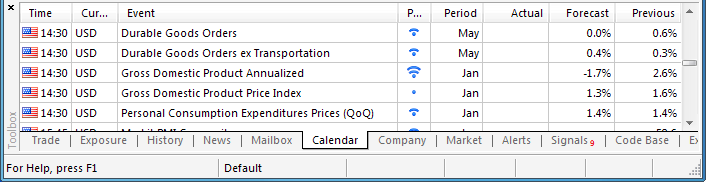
What’s Expected:
Why Is This Event Important:
A more meaningful decline in the growth rate may spark a bearish reaction in the greenback (bullish EUR/USD) as it gives the Federal Reserve greater scope to retain its highly accommodative policy stance, and the reserve currency may face additional headwinds throughout the summer months as central bank Chair Janet Yellen continues to endorse a dovish tone for monetary policy.
The ongoing slack in business outputs paired with the slowdown in housing activity may prompt a larger-than-expected decline in 1Q GDP, and a dismal print may generate a more meaningful rebound in the EUR/USD as the data drags on interest rate expectations.
However, stronger job growth along with the pickup in private sector credit may have helped to limit the downturn in economic activity, and a positive development may generate a bullish outlook for the greenback as it puts increased pressure on the Fed to normalize monetary policy sooner rather than later.
How To Trade This Event Risk
Bearish USD Trade: U.S. 1Q GDP Contracts 1.8% or Greater
- Need green, five-minute candle following the GDP print to consider a long EUR/USD trade
- If market reaction favors a bearish dollar trade, long EUR/USD with two separate position
- Place stop at the near-by swing low/reasonable distance from entry; look for at least 1:1 risk-to-reward
- Move stop to entry on remaining position once initial target is hit, set reasonable limit
Bullish USD Trade: Growth Rate Exceeds Market Expectations- Need red, five-minute candle to favor a short EUR/USD trade
- Implement same setup as the bearish dollar trade, just in opposite direction
Potential Price Targets For The ReleaseEUR/USD Daily
Impact that U.S. GDP has had on EUR/USD during the last quarter
(1 Hour post event )
(End of Day post event)
The final 4Q GDP report showed an upward revision in the growth rate as the U.S. economy expanded an annualized 2.6% amid an initial forecast of 2.4%. The greenback struggled to hold its ground following the release as the EUR/USD climbed towards the 1.3775 region, but the dollar regained its footing during the North American trade, with the pair ending the day at 1.3739.
MetaTrader Trading Platform Screenshots
EURUSD, M5, 2014.06.25
MetaQuotes Software Corp., MetaTrader 5, Demo
EURUSD M5 : 27 pips price movement by USD - GDP news event
EUR/USD Stays Motionless
'We've kind of traded sideways a little bit. It's largely technical, but there's some geopolitical headlines that may be weighing on risk appetite.' - Commonwealth Foreign Exchange (based on Bloomberg)
Pair's Outlook
There are still no consistency among the technical indicators, as they are pointing in different directions on the weekly an monthly time-frames. Nevertheless, the currency pair is considered to be capable of rising up to 1.37 before coming under selling pressure and subsequently re-challenging a key support level at 1.35, which is reinforced by the monthly S1 and 2014 low. A breach of the latter level may potentially open a way towards 1.28—2013 lows.
Traders' Sentiment
The bears are starting to gain an upper hand over their counterparts, as the former now constitute 56% of the market (54% yesterday). As for the orders, 63% are set to sell the Euro against the greenback.
How Long Can the Euro Stay on Top?
Questions about how long the euro can remain on top in Forex trading are being raised today as the 18-nation currency continues to hold its own against some of its major counterparts. While the euro is down against the yen, it is higher against the dollar and the pound.
Even with the disappointing data recently released in the eurozone, the euro is heading higher against some of its major counterparts today. Sterling is weak on dovish comments, and the dollar continues to struggle as the Fed refuses to commit to an interest rate timetable.
Some economists and analysts are concerned that the eurozone will find itself in a situation of long-term deflation, like that experienced by Japan. Japan is still going through its “lost decade” — a decade that has stretched out to nearly 15 years. However, other analysts point out that the eurozone is in recovery, even though it is a slow recovery. Plus, they say, deflationary pressure hasn’t been at the same level.
Even though many analysts think the eurozone will avoid a Japanese-style economic problem, future euro weakness is assumed because the ECB will likely have to adopt even looser monetary policy.
At 13:21 GMT EUR/USD is up to 1.3635 from the open at 1.3606. EUR/GBP is up to 0.8023 from the open at 0.8010. EUR/JPY is down to 138.7150 from the open at 138.7455.
The Best Investment Advice Of All Time
Five billionaires. A miser. A Nobel laureate. A Founding Father. We’ve rounded up the 20 finest market minds—dead or alive—and distilled their timeless wisdom into specific suggestions for stocks, bonds and funds you can buy today. Be warned: You just might get rich.
Investor profiles by: Tom Anderson, John Dobosz, Maggie McGrath, Janet Novack, Steve Schaefer, Matt Schifrin, Samantha Sharf, Brian Solomon, Nathan Vardi, John F. Wasik
---
Jack Bogle
Age: 85
Founder, Vanguard
Indispensible Wisdom: It's the fees, stupid
Nicknames: Jack, Saint Jack (used by supporters and detractors alike)
Money Quote: "Don't let the miracle of long-term compounding of returns be overwhelmed by the tyranny of long-term compounding of costs."
---
Sir John Templeton
1912-2008
Founder, Templeton Funds
Indispensable wisdom: Buy at the point of maximum pessimism; sell at the point of maximum optimism
Money quote: "If you buy the same securities everyone else is buying, you will have the same results as everyone else."
---
Warren Buffett
Age: 83
Chairman and CEO, Berkshire Hathaway
Indispensible Wisdom: Only invest in what you understand and at the right price
Nickname: Oracle of Omaha
Bestseller: Berkshire's annual letter to shareholders
Money Quote: "Whether socks or stocks, I like buying quality merchandise when it is marked down."
---
Nathan Mayer Rothschild
1777-1836
Founder, N.M. Rothschild & Sons
Indispensable Wisdon: Information is money
Crystal Ball Cred: Thanks to his extensive network of carrier pigeons Rothschild knew that England had defeated France at Waterloo before anyone else in London. As other traders on the stock exchange braced for a British loss, he went long.
Fundamentals: Rothschild's father planted the seeds for the 19th century's greatest banking empire by stationing each of his five sons in different European cities. Nathan got London, but throughout his career he was able to profit from the insights of his brothers in Frankfurt, Paris, Naples and Vienna.
Invest Like Rothschild: Tap into groups with their fingers on the pulse. Consider shares in high-yielding private equity firms like Blackstone Group, Apollo Global Management, Kohlberg Kravis Roberts and Carlyle Group.
---
Sam Zell
Age: 72
Chairman, Equity Group Investments
Indispensible Wisdom: Losers can be lucrative, too
Nickname: The Grave Dancer
Money Quote: "Look for good companies with bad balance sheets and understand your downside."
---
read more here