if actual > forecast = good for currency (for AUD in our case)
[AUD - NAB Business Confidence] = Level of a diffusion index based on surveyed businesses, excluding the farming industry. It's a leading indicator of economic health - businesses react quickly
to market conditions, and changes in their sentiment can be an early
signal of future economic activity such as spending, hiring, and
investment.
An index measuring business
confidence in Australia was relatively unchanged in May, the latest
survey from National Australia Bank revealed on Tuesday - showing a
score of 7, the same as in April.
The index for business conditions dipped into negative territory, sliding to -1 from 0 a month earlier.
NAB
economist Alan Oster said the readings were a surprise, especially in
light of the drastic spending cuts unveiled in the latest budget.
"This
is a little surprising given consumer reactions to the budget and the
persistently soft business conditions that firms are reporting," Oster
said.
if actual > forecast = good for currency (for GBP in our case)
[GBP - Manufacturing Production] = Change in the total inflation-adjusted value of output produced by manufacturers. It's a leading indicator of economic health - production reacts quickly
to ups and downs in the business cycle and is correlated with consumer
conditions such as employment levels and earnings.
U.K. industrial production expanded at a faster pace in April, the Office for National Statistics said Tuesday.
Industrial
output gained 0.4 percent in April from March, when it grew by revised
0.1 percent. The rate matched economists' expectations.
The
increase in total production reflected increase of 0.4 percent in
manufacturing, the fifth consecutive increase since November 2013.
Manufacturing output growth also came in line with expectations.
On
a yearly basis, industrial production grew 3 percent versus 2.5 percent
in March. This was the eighth consecutive increase since August 2013.
At the same time, manufacturing output advanced 4.4 percent.
Economists had forecast industrial output to rise 2.8 percent and manufacturing to grow 4 percent.
The Chinese CPI accelerated at the faster pace of 2.5% y/y in May
(vs. 2.4% exp. & 1.8% last), while the PPI y/y showed slower
contraction during the same month (-1.4% in May, vs. -1.5% exp. &
-2.0% last). The PBoC gave more details on selective RRR cut program
launched on May 30th; the RRR on bank loans supportive of agricultural
business and small-to-medium size companies will be cut by 50 basis
points, aiming to free CNY 58bn worth of liquidity, higher than CNY 55bn
generated over the first selective RRR cut in April. Growth supportive
news sent Chinese equities to green overnight. Hang Seng and Shanghai’s
Composite added 0.92% and 0.96% at the time of writing, Yuan
strengthened both in onshore and offshore trading, hitting four month
highs against USD in Hong Kong.
AUD/USD advanced to 0.9376 on the back of Chinese news. The pair now
builds support at 0.9339 (Fibonacci 61.8% on Oct’13 - Jan’14 pullback).
Trend and momentum indicators are positive, yet still fragile. The
weakness in Australian home loans in April was offset by better
owner-occupier loan value and faster investment lending. Solid offers
trail below 0.9400/09 (May resistance) and 0.9499 (Fibo 23.6%).
USD/JPY and JPY crosses were mostly offered in Asia. USD/JPY sold-off
to 102.24 (slightly lower than 100-dma), the intra-day pressures are on
the downside. Large option expiries are eyed at 102.50 / 103.00 for
today expiry. On the downside, bids should come into play at 102.00/25
area, light stops are seen below. The key short-term support stands
still at 200-dma (currently at 101.55), then 100.76 (2014 low). EUR/JPY
broke its 21-dma (139.20) on the downside. The key 200-dma support
(138.68) is at risk given the fading bullish momentum in EUR across the
board. Solid offers are eyed sub-140.00.
EUR/USD consolidated losses in the tight range of 1.3585/1.3600 in
Asia. ECB’s additional easing announcement gets into prices, yet slowly.
The 21-dma (1.3649) crossed the 200-dma (1.3656) on the downside,
favoring EUR-bears from technical players’ side. Trend and momentum
indicators are flat, the pair tests last two weeks’ 1.3580/85 support
zone, if broken will bring 1.3477/1.3503 (2014 low / June 5th ECB
reaction low) in focus. Option bids are negatively skewed below 1.3700.
EUR/GBP remains offered below 21-dma (0.81255). A daily close below
0.80680 will signal a short-term bearish reversal according to MACD (12,
26) analysis.
Today, the economic calendar consists of Swiss May Unemployment Rate,
Swiss April Retail Sales y/y French and UK April Industrial and
Manufacturing Production, Italian April Industrial Production m/m &
y/y, Italian 1Q (Final) GDP q/q & y/y, Norwegian May CPI and PPI m/m
& y/y, US May NFIB Small Business Optimism, US April JOLTS Job
Openings, US April Wholesale Inventories m/m and Wholesale Trade Sales
m/m.
I expect sideways trading until the rate decision and for 25bps will be added to bring rates to 3.25%
This should see NZDUSD break up through 0.852 and target 0.864 and eventually 0.87 highs
Fundamentally still strong, I do not expect 'jaw-boning' from RBNZ and for NZDUSD to become bullish after Thursday
Talk of intervention to bring down NZD would have more bearish impact upon NZD than not raising rates
0.840 is a pivotal swing low and for NZDUSD to return to the bullish trend
Despite the fact RBNZ are paying the highest interest rates among G10
currencies traders have continued to short NZD when RBNZ hinted the
rate hikes may not be aggressive as previously thought. They also talked
of potential intervention by shorting NZD if the overpriced Kiwi Dollar
remains among poor fundamental data. Price has been within a steady
downtrend for the past month until price reached 0.840.
0.840 is a key level of support which was successfully defended
following last Thursday's' ECB meeting, and the Greenback sell-off.
NZDUSD posted its single largest day gain since March '14, respecting
the 200-day eMA and closing the week with a Spinning Top Doji to warn of
a weakness the sell-off from the May Highs.
Friday and Monday produced 2 failed attempts to break above 0.8517
resistance, however price continues to hover around the 0.850 handle and
I expect this sideways trading to continue leading up to the release.
If we do break above 0.8520 then we have resistance close by around
0.857 which I expect to hold upon first attempt, so ideally we will see
basing patterns above 0.850 and for buying pressure to increase whilst
the trend is established.
COUNTER-BIAS
A break below this week's range should target 0.843 and 0.840, with a
break below 0.840 being quite bearish for the Kiwi and for losses to
gain momentum. For this scenario we would have to keep rates fixed at 3%
and for NZD to strengthen talk of intervention.
First, let me say what you read here is going to be wrong in several
ways. HFT covers such a wide path of trading that different parties
participate or are impacted in different ways. I wanted to put this out
there as a starting point . Hopefully the comments will help further
educate us all
1. Electronic trading is part of HFT, but not all electronic trading is high frequency trading.
Trading equities and other financial instruments has been around for a
long time. it is Electronic Trading that has lead to far smaller
spreads and lower actual trading costs from your broker. Very often HFT
companies take credit for reducing spreads. They did not. Electronic
trading did.
We all trade electronically now. It’s no big deal
2. Speed is not a problem
People like to look at the speed of trading as the problem. It is
not. We have had a need for speed since the first stock quotes were
communicated cross country via telegraph. The search for speed has been
never ending. While i dont think co location and sub second trading adds
value to the market, it does NOT create problems for the market
3. There has always been a delta in speed of trading.
From the days of the aforementioned telegraph to sub milisecond
trading not everyone has traded at the same speed. You may trade stocks
on a 100mbs broadband connection that is faster than your neighbors
dial up connection. That delta in speed gives you faster information to
news, information, research, getting quotes and getting your trades to
your broker faster.
The same applies to brokers, banks and HFT. THey compete to get the fastest possible speed. Again the speed is not a problem.
4. So what has changed ? What is the problem
What has changed is this. In the past people used their speed
advantages to trade their own portfolios. They knew they had an
advantage with faster information or placing of trades and they used it
to buy and own stocks. If only for hours. That is acceptable. The market
is very darwinian. If you were able to figure out how to leverage the
speed to buy and sell stocks that you took ownership of , more power to
you. If you day traded in 1999 because you could see movement in stocks
faster than the guy on dial up, and you made money. More power to you.
What changed is that the exchanges both delivered information faster
to those who paid for the right AND ALSO gave them the ability via order
types where the faster traders were guaranteed the right to jump in
front of all those who were slower (Traders feel free to challenge me on
this) . Not only that , they were able to use algorithms to see
activity and/or directly see quotes from all those who were even
milliseconds slower.
With these changes the fastest players were now able to make money
simply because they were the fastest traders. They didn’t care what
they traded. They realized they could make money on what is called
Latency Arbitrage. You make money by being the fastest and taking
advantage of slower traders.
It didn’t matter what exchanges the trades were on, or if they were
across exchanges. If they were faster and were able to see or anticipate
the slower trades they could profit from it.
5. This is where the problems start.
If you have the fastest access to information and the
exchanges have given you incentives to jump in front of those users and
make trades by paying you for any volume you create (maker/taker), then
you can use that combination to make trades that you are pretty much
GUARANTEED TO MAKE A PROFIT on.
So basically, the fastest players, who have spent billions of dollars
in aggregate to get the fastest possible access are using that speed to
jump to the front of the trading line. They get to see , either directly or algorithmically the trades that are coming in to the market.
When I say algorithmically, it means that firms are using their speed
and their brainpower to take as many data points as they can use to
predict what trades will happen next. This isn’t easy to do. It is
very hard. It takes very smart people. If you create winning algorithms
that can anticipate/predict what will happen in the next milliseconds in
markets/equities, you will make millions of dollars a year. (Note:not all algorithms are bad. Algorithms are just functions. What matters is what their intent is and how they are used)
These algorithms take any number of data points to direct where and
what to buy and sell and they do it as quickly as they can. Speed of
processing is also an issue. To the point that there are specialty CPUs
being used to process instruction sets. In simple terms, as fast as we
possibly can, if we think this is going to happen, then do that.
The output of the algorithms
, the This Then That creates the trade (again this is a simplification,
im open to better examples) which creates a profit of some relatively
small amount. When you do this millions of times a day, that totals up
to real money . IMHO, this is the definition of High Frequency
Trading. Taking advantage of an advantage in speed and algorithmic
processing to jump in front of trades from slower market participants
to create small guaranteed wins millions of times a day. A High
Frequency of Trades is required to make money.
There in lies the problem. This is where the game is rigged.
If you know that by getting to the front of the line you
are able to see or anticipate some material number of the trades that
are about to happen, you are GUARANTEED to make a profit. What is the
definition of a rigged market ? When you are guaranteed to make a
profit. In casino terms, the trader who owns the front of the line is the house. The house always wins.
So when Michael Lewis and others talk about the stock market
being rigged, this is what they are talking about. You can’t say the
ENTIRE stock market is rigged, but you can say that for those
equities/indexs where HFT plays, the game is rigged so that the
fastest,smart players are guaranteed to make money.
6. Is this bad for individual investors ?
If you buy and sell stocks, why should you care if someone takes
advantage of their investment in speed to make a few pennies from you ?
You decide, but here is what you need to know:
a. Billions of dollars has been spent to get to the front of the
line. All of those traders who invested in speed and expensive
algorithm writers need to get a return on their investment. They do so
by jumping in front of your trade and scalping just a little bit. What
would happen if they weren’t there ? There is a good chance that
whatever profit they made by jumping in front of your trade would go to
you or your broker/banker.
b. If you trade in small stocks, this doesn’t impact small stock
trades. HFT doesn’t deal with low volume stocks. By definition they
need to do a High Frequency of Trades. If the stocks you buy or sell
don’t have volume (i dont know what the minimum amount of volume is),
then they aren’t messing with your stocks
c. Is this a problem of ethics to you and other investors ? If you
believe that investors will turn away from the market because they feel
that it is ethically wrong for any part of the market to offer a select
few participants a guaranteed way to make money, then it could create
significant out flows of investors cash which could impact your net
worth. IMHO, this is why Schwab and other brokers that deal with retail
investors are concerned. They could lose customers who think Schwab, etc
can’t keep up with other brokers or are not routing their orders as
efficiently as others.
7. Are There Systemic Risks That Result From All of This.
The simple answer is that I personally believe that without question the answer is YES. Why ?
If you know that a game is rigged AND that it is LEGAL to
participate in this rigged game, would you do everything possible to
participate if you could ?
Of course you would. But this isn’t a new phenomena. The battle to
capture all of this guaranteed money has been going on for several years
now. And what has happened is very darwinian. The smarter players have
risen to the top. They are capturing much of the loot. It truly is an
arms race. More speed gives you more slots at the front of the lines.
So more money is being spent on speed.
Money is also being spent on algorithms. You need the best and
brightest in order to write algorithms that make you money. You also
need to know how to influence markets in order to give your algorithms
the best chance to succeed. There is a problem in the markets known as
quote stuffing. This is where HFT create quotes that are supposed to
trick other algorithms , traders, investors into believing their is a
true order available to be hit. In reality those are not real orders.
They are decoys. Rather than letting anyone hit the order, because they
are faster than everyone else, they can see your intent to hit the order
or your reaction either directly or algorithmically to the quote and
take action. And not only that, it creates such a huge volume of
information flow that it makes it more expensive for everyone else to
process that information, which in turn slows them down and puts them
further at a disadvantage.
IMHO, this isn’t fair. It isn’t a real intent. At it’s heart it is a
FRAUD ON THE MARKET. There was never an intent to execute a trade. It
is there merely to deceive.
But Order Stuffing is not the only problem.
Everyone in the HFT business wants to get to the front of the line.
THey want that guaranteed money. In order to get there HFT not only uses
speed, but they use algorithms and other tools (feel free to provide
more info here HFT folks) to try to influence other algorithms. It
takes a certain amount of arrogance to be good at HFT. If you think you
can out think other HFT firms you are going to try to trick them into
taking actions that cause their algorithms to not trade or to make bad
trades. It’s analogous to great poker players vs the rest of us.
What we don’t know is just how far afield HFT firms and their algorithms will go to get to the front of the line. There is a moral hazard involved.
Will they take risks knowing that if they fail they may lose their
money but the results could also have systemic implications ?. We saw
what happened with the Flash Crash. Is there any way we can prevent the
same thing from happening again ? I don’t think so. Is it possible that
something far worse could happen ? I have no idea. And neither does
anyone else
It is this lack of ability to quantify risks that creates a huge cost
for all of us. Warren Buffet called derivatives weapons of mass
destruction because he had and has no idea what the potential negative
impact of a bad actor could be. The same problem applies with HFT. How
do we pay for that risk ? And when ?
When you have HFT algorithms fighting to get to the front of the line
to get that guaranteed money , who knows to what extent they will take
risks and what they impact will be not only on our US Equities Markets,
but also currencies, foreign markets and ? ? ?
What about what HFT players are doing right now outside of US markets
? All markets are correlated at some level. Problems outside the US
could create huge problems for us here.
IMHO, there are real systemic issues at play.
8. So Why are some of the Big Banks and Funds not screaming bloody murder ?
To use a black jack analogy , its because they know how to count
cards. They have the resources to figure out how to match the fastest
HFT firms in their trading speeds. They can afford to buy the speed or
they can partner with those that can. They also have the brainpower to
figure out generically how the algorithms work and where they are
scalping their profits. By knowing this they can avoid it. And because
they have the brain power to figure this out, they can actually use HFT
to their advantage from time to time. Where they can see HFT at work,
they can feed them trades which provides some real liquidity as opposed
to volume.
The next point of course is that if the big guys can do it , and the
little guys can let the big guys manage their money , shouldn’t we all
just shut up and work with them ? Of course not. We shouldn’t have to
invest with only the biggest firms to avoid some of the risks of HFT.
We should be able to make our decisions as investors to work with those
that give us the best support in making investments. Not those who have
the best solution to outsmarting HFT.
But more importantly, even the biggest and smartest of traders ,
those who can see and anticipate the HFT firms actions can’t account for
the actions of bad actors. They can’t keep up with the arms race to get
to the front of the line. Its not their core competency. It is a
problem for them, but they also know that by being able to deal with it
better than their peers, it gives them a selling advantage. “We can deal
with HFT no problem”. So they aren’t screaming bloody murder.
9. So My Conclusion ?
IMHO, it’s not worth the risk. I know why there is HFT. I just
don’t see why we let it continue. It adds no value. But if it does
continue, then we should require that all ALGORITHMIC players to
register their Algorithms. While I’m not a fan of the SEC, they do have
smart players at their market structure group. (the value of going to
SEC Speaks :).
While having copies of the algorithms locked up at the SEC wont
prevent a market collapse/meltdown, at least we can reverse engineer it
if it happens.
I know this sounds stupid on its face. Reverse engineer a collapse ?
But that may be a better solution than expecting the SEC to figure out
how to regulate and pre empt a market crash
10…FINAL FINAL THOUGHTS
i wrote this in about 2 hours. Not because i thought it would be
definitive or correct. I expect to get ABSOLUTELY CRUSHED on many points
here. But there is so little knowledge and understanding of what is
going on with HFT, that I believed that someone needed to start the
conversation
Dave Fry, founder and publisher of ETF Digest, and Steve Hammer, founder of HFT Alert, discuss high frequency trading operations, fundamentals, the difference between algorithmic trading and high frequency trading, fluttering, latency and the role high frequency trading had in the May stock market flash crash in 2010.
High frequency trading in action. This video is about 4 minute. CNN's Maggie Lake gets a rare look inside the super-fast trading industry.
This High frequency trading (HFT) is particularly interesting for traders at the present time, for example: there is some thread in russian part of mql5.com about HFT of 82 pages. Some poeple said that it is impossible to create any signal with HFT EA ... who knows ...
Engaging and informative, Algorithmic Trading skillfully covers a wide
array of strategies. Broadly divided into the mean-reverting and
momentum camps, it lays out standard techniques for trading each
category of strategies and, equally important, the fundamental reasons
why a strategy should work. The emphasis throughout is on simple and
linear strategies, as an antidote to the over-fitting and data-snooping
biases that often plague complex strategies. Along the way, it provides
comprehensive coverage of:
Choosing the right automated execution platform as well
as a backtesting platform that will allow you to reduce or eliminate
common pitfalls associated with algorithmic trading strategies
Multiple
statistical techniques for detecting "time series" mean reversion or
stationarity, and for detecting cointegration of a portfolio of
instruments
Simple techniques for trading
mean-reverting portfolios—linear, Bollinger band, and Kalman filter—and
whether using raw prices, log prices, or ratios make the most sense as
inputs to these tests and strategies
Mean-reverting strategies for stocks, ETFs, currencies, and futures calendar and intermarket spreads
The
four main drivers of momentum in stocks and futures, and strategies
that can extract time series and cross sectional momentum
Newer momentum strategies based on news events and sentiment, leveraged ETFs, order flow, and high-frequency trading
Issues
involving risk and money management based on the Kelly formula, but
tempered with the author's practical experience in risk management
involving black swans, Constant Proportion Portfolio Insurance, and stop
losses
While Algorithmic Trading contains an abundance of strategies that will
be attractive to both independent and institutional traders, it is not a
step-by-step guide to implementing them. It offers a realistic
assessment of common algorithmic trading techniques and can help serious
traders further refine their skills in this field.
Flow chart of an algorithm (Euclid's algorithm) for calculating the greatest common divisor (g.c.d.) of two numbers a and b in locations named A and B. The algorithm proceeds by successive subtractions in two loops: IF the test B ≥ A yields "yes" (or true) (more accurately the number b in location B is greater than or equal to the number a in...
The Australian dollar rallied against its US peer and erased losses
versus the Japanese yen today with help of rather positive domestic
business confidence and good economic data from China.
The business confidence index of National Australia Bank remained unchanged in May. The report commented on this:
That result was surprising, with firm’s still discounting persistently
soft levels of business conditions and the negative sentiment
surrounding the Federal budget – including the post-budget collapse
in consumer confidence.
Other Australian reports were not as good, with no growth in the number of home loans in April (even though analysts predicted an increase by 0.3 percent) and the drop of job advertisements. The Aussie was still able to make a move higher with support of positive data from China, the biggest Australia’s trading partner.
AUD/USD went up from 0.9275 to 0.9295 as of 16:07 GMT today after
falling to 0.9257 earlier. AUD/JPY near the opening level of 92.29
following the drop to 94.94.
Business confidence survived the government’s ‘tough budget’ intact, but business conditions eased again (reflecting sales). Employment and profits were steady at soft levels. Conditions are mixed across industries, but are generally negative outside of services: ‘bellwether’ sectors (wholesale, transport) still soft, but forward orders...
Irene Aldridge: On the Michael Lewis topic, I
suppose I am most disappointed in the pay-for-play quality of the book.
Even the fastest best-selling writers can tell you that they are only
capable of writing 15 pages per day, at best. To write a 300-page book,
[is] a five-month process, at a bare minimum.
Incidentally, at the time Mr. Lewis’s book was released, the trading
venue around which much of the book revolves, has been in existence for,
wait for it, exactly five months! In other words, Mr. Lewis began to
write the novel about his great protagonists and its creation prior to
the launch of this trading venue at the center of this book—I really
don’t see how he could have covered this in depth. [It appears to be an]
elaborate marketing campaign for this trading venue. In other words,
the book is marketing masquerading as a fair markets discourse. For a
writer like Lewis, stooping so low is a complete disgrace. Markets have
moved a long way toward fairness since then, so most of his criticism is
completely unfounded.
AP: Is high frequency trading taking the heat for problems caused market structure or regulations?
IA: From what we are seeing, this HFT pre-hedging
that boils down to front-running [may have] unfortunately become common
practice following the Volcker and Dodd-Frank rules. There still exists a
FINRA rule that encourages brokers to avoid front-running, but FINRA is
a self-regulatory organization, and the consequences of not following
its rules [may not be so harsh]. While most of ABLE Alpha clients have
the permission to access the markets directly and, as a result, avoid
front-running, many smaller entities are not so lucky and end up losing
money. I do not believe that this is what the regulators had in mind
when they designed the laws, but these are the unintended consequences.
AP: There is an ongoing argument over whether HFT is a net liquidity maker or taker as opposed to traditional market makers?
IA: I was just presenting at the Princeton Quant
Trading conference, where a fellow speaker, [from a] prominent broker
discussed how they are forced to spend money to build systems that
monitor the number of zeroes human brokers put at the end of their
orders simply because brokers so often come to work hung over and unable
to focus. Well, needless to say, hangovers do not happen to computers.
Overall, the computers are considerably cheaper, more reliable and less
demanding than human brokers, so there is absolutely no doubt in my
mind that the computerized trading technology, known as HFT, will
replace most of the presently-human trading operation at brokers in
continuing the digital revolution observed elsewhere in the society.
AP: Will the size of HFT be self-correcting? Will algorithms exploit inefficiencies until they’re gone?
One of our products is the HFT Index, science, not hear-say, based
[on a] real-time estimate of aggressive HFT participation in electronic
markets of customer choice. According to our estimates, activity level
of aggressive HFTs by volume averages 15% to 20% in most markets,
although intraday it may spike up 100%, or drop to 0%.
According to the HFT Index, many highly liquid securities have the
lowest HFT participation as a percent of overall volume, seldom
exceeding 15%, while some other instruments are dominated by the
aggressive HFTs. Painting the entire market with a wide 50% HFT brush
gives little insight into what we and our clients are actually seeing.
Peter Nabicht: The name “high frequency trading” is self-defining. It is simply trading with a higher frequency relative to other market participants. Lately, the phrase has been given so much implied meaning. “HFT” has become a catch-all phrase that is mostly used by people to label specific activity that they do not like or find to be...
Trading the News: U.K. Jobless Claims Change(based on dailyfx article)
U.K. Jobless Claims to Decline for 19 Consecutive Months
ILO Unemployment Rate to Narrow to 6.7%- Lowest Since January 2009
Another decline in U.K. Jobless Claims may prompt a near-term advance in
the GBP/USD as it puts increased pressure on the Bank of England (BoE)
to normalize monetary policy sooner rather than later.
What’s Expected:
Why Is This Event Important:
Indeed, the BoE Minutes due out on June 18 may highlight a growing
dissent within the Monetary Policy Committee (MPC) as the central bank
continues to see a stronger recovery in 2014, and the bullish sentiment
surrounding the British Pound may gather pace in the second-half of the
year should we see a growing number of BoE officials adopt a more
hawkish tone for monetary policy.
The ongoing expansion in private sector consumption along with the rise
in business outputs may generate a larger-than-expected decline in
unemployment, and an upbeat labor report may pave the way for a
higher-high in the GBP/USD as it raises the fundamental outlook for the
U.K. economy.
However, sticky inflation paired with the slowdown in private lending
may drag on hiring, and a dismal jobless claims report may spur a larger
correction in the GBP/USD as it drags on interest rate expectations.
How To Trade This Event Risk
Bullish GBP Trade: U.K. Jobless Claims Contract 25.0K or Greater
Need green, five-minute candle following a hawkish statement to favor a long British Pound trade
If reaction favors buying British Pound, long GBP/USD with two separate position
Set stop at the near-by swing low/reasonable distance from entry; need at least 1:1 risk-to-reward
Move stop to entry on remaining position once initial target is hit, set reasonable limit
Bearish GBP Trade: Labor Data Disappoints, Dragging on Rate Expectations
Need red, five-minute candle to consider a short GBP/USD trade
Implement same setup as the bullish British Pound trade, just in the opposite direction
Potential Price Targets For The Release
GBP/USD Daily
Outlook Remains Bullish as Pair Holds Above Monthly Opening Low (1.6697)
Interim Resistance: 1.7000 Pivot to 1.7030 (100.0% expansion)
Impact that the U.K Jobless Claims report has had on GBP during the last release
Period
Data Released
Estimate
Actual
Pips Change
(1 Hour post event )
Pips Change
(End of Day post event)
APR 2014
05/14/2014 8:30 GMT
-30.0K
-25.1K
-72
-85
April 2014 U.K. Jobless Claims Change
GBPUSD M5 : 41 pips price movement by GBP - Unemployment Rate news event:
U.K. Jobless Claims fell another 25.1K in April following the 30.6K
contraction the month prior, while the ILO rate narrowed to an
annualized 6.8% from 6.9% to mark the lowest reading since February
2009. Nevertheless, the GBP/USD traded lower as the print missed market
expectations, and the British Pound weakened further throughout the day
as the Bank of England Inflation report dampened bets of seeing the
central bank normalize monetary policy ahead of schedule.
It’s been a busy few weeks to say the least, as I sit here writing this
article from the comfort of my own home in London following a fantastic
two weeks of teaching and working with some fantastic students at the
Online Trading Academy Los Angeles campus.
Having received an invitation to come and visit the campus in LA from my
good friend and the general manager at the center Mike Green, I taught
the Professional Trader and the Professional Forex Trader classes back
to back.
While this was somewhat of a marathon for me as I’m not used to teaching
that much, I wanted to make the most of the time as it’s not often I
get to travel to the West Coast of America. I worked with a fantastic
bunch of students many of whom joined me for both classes.
Over that two-week period we really got into the depths of what it takes
to be consistent in today’s markets.In fact the experience in LA is
what prompted me to the idea of this week’s article. You see, the
professional Trader class is probably the most important class that we
teach in the Academy because it details all of the rules and dynamics
that make up our patented rule-based core strategy.
Students are taught how to recognize institutional levels of supply and
demand in the markets and how to trade the entries and exits with
precision and strict risk management. Having taken that class, students
then move on to a leveraged asset class of their choice, typically
Futures, FX, Options or for many, all of them.
Once a student gets to the stage of the leveraged asset class, they are
now comfortable in drawing supply and demand zones and they have worked
out the fundamental details of their trading plan with their education
counsellor.
In these follow-up classes, we get to go through the characteristics of
the individual asset classes and also spend a lot more time on a subject
of trading which my regular readers will know I’m exceptionally
passionate about and that is the mastery of the mental and psychological
game. In my second week at the LA campus during the FX class, we spent a
considerable amount of time working on this subject which inspired me
to share with you the five key areas of psychology which my colleagues
and I believe need to be mastered in order to become proficient and
consistent in trading today’s markets.
I’m going to list these out for you individually and give my thoughts on
why I feel they are key areas of consideration for any trader hoping to
make money speculating in the currency markets. I hope you find these
insights useful.
1 – Discipline
Discipline is without doubt the foundation of everything, not just in
trading but in life as well. A person lacking discipline will always
struggle to achieve their goals no matter what they are and will be
stumped time and time again by frustration and disappointment if they’re
not aware of where the true problem lays.
There are things you have to do when you’re a trader which can sometimes
make you feel uncomfortable, like waiting for a set up when the market
is moving and you feel like you’re missing out on an opportunity or
putting in a stop loss only to see it get hit and then the price turn in
the direction you thought it was going to go anyway and you’re left
with nothing.
These are two of many scenarios which can really grate on a market
speculator. But remember, without waiting for the right setups and
getting out of a trade when we are wrong, we will never ever have the
tools or be in the position to be profitable in the long term.
Trading is really about creating good habits and the tough thing about
good habits is that they are often hard to develop and painful at first
even though they reward us in the long term. One cool little trick that I
do to help develop the students’ discipline is to get them to do
something which feels a little bit uncomfortable every single day.
This may mean getting up a little earlier now and then or watching less
TV or reading more. Everybody is different but by doing something that
doesn’t feel natural you are going to train yourself mentally to do the
things that you know you must do when you are trading. Develop
discipline and you will develop as a trader.
2 – Integrity
When I talk about integrity with a new student sometimes they get a little bit confused and wonder what I mean by it.
The simplest way I can describe integrity is by repeating to you something that was told to me when I was a student.
When I asked my first instructor what made a successful trader standout
amongst the rest he replied, “A successful trader knows the rules and
follows them every single time. A novice trader knows they should have
rules and maybe even knows what these rules are but never follows them
consistently.” Again, this is something we do in real life.
There are things we know we should be doing but we put them off or we
bury our head in the sand and pretend it doesn’t really matter.
Everything always catches up to you in the end and if you don’t show a
high degree of integrity and make every single effort you can to follow
your rules and your trade plan, what are you really saying about your
expectations of your results as a trader?
Write your rules, plan your trade and follow them is all I ask.
3 – Diligence
Diligence is more about the “housekeeping” we have to do as a trader. In
the early stages of a traders career, it is vital to make sure that
you’re crossing all of the “t’s” and dotting all of the “i’s” and paying
special attention to the level of detail you’re applying to your plan
and your subsequent trades which you take.
It can be easy to take our eye off the ball from time to time and
everybody can be forgiven for making the odd mistake here and there.
However, it is your job to remain focused and take care of your work and
your processes throughout your whole trading experience.
You and you alone are solely responsible for your trading results,
therefore requiring you to pay attention to all the details at hand and
to make sure that not only do you develop your plan, take trades from
your plan and follow your rules but you also follow this up with keeping
a solid track record of all of your trading activity. Nobody can do
this for you.
4 – Patience
Probably one of the toughest things for a trader to learn is patience. Just think about the verb “to trade.”
It alone suggests a very active profession doesn’t it?
Yet the irony is that actual trading is often one of the most passive things we could ever do for a career.
Most of my time is spent waiting for price to come to my area of demand to buy or my zone of supply to sell.
Needy traders typically think that the more you click buttons the more
money will make and if you just sit down and watch the charts and wait
for the price to come to you, you’ll never ever make any money.
In fact I used to think that myself until I soon realized that I wasn’t
following any rules and was just clicking buttons when I felt like it.
There aren’t any real secrets to successful trading but I can tell you
this: if you don’t wait for price to come to the optimal entry points,
you will never achieve the greatest rewards with the lowest risks and
the highest probabilities.
Our core strategy follows what institutions do. Institutions wait for
the best prices to get in and the best prices to get out. Sure my
friends, that requires patience and I’m also well aware of the old
saying that patience pays in the long run. Let time do its work and your
plan will do the rest for you.
5 – Hard Work
Finally we come to the last piece of the puzzle, often the part that
many people don’t really want to apply and that is hard, work plain and
simple.
Profitable traders are an elite group of individuals who have learned
through solid education and experience what it takes to make money in
the currency markets.
Many other people out there think there’s some big secret to trading and
investing, when the truth of it is that the big secret is that there is
no secret at all.
I remember a good friend of mine once saying about how people always
said he was lucky in his business deals and transactions. I said to him,
“How does that make you feel when people say you got lucky?” His
response was, “You know Sam, I kind of agree with them. I’ve noticed
myself over the years that the harder I work the luckier I seem to get.”
We all like the idea of trading, I mean who wouldn’t?
But most don’t really like the reality and the hard work that is required to get you where you want to get.
This is just like any other business or venture out there. If you want
to rise above everybody else and do the things that most other people
only dream about you have to go the extra mile in both your education,
your mind-set, and of course good old-fashioned hard work. Invest the
time in yourself and in time others will want to invest in you.
President of Forbes inc. and former Presidential candidate, Steve Forbes joins Merlin Rothfeld
and John O’Donnell for a look at several major factors which may lead
to a second Great Depression. The trio discuss the concept of Flat Tax
and how it might impact the markets and transition into Mr. Forbes new
book about the devaluation of the US Dollar. Mr. Forbes voices his
support for a gold standard to help add stability to the financial
system and economy as a whole.
Allow the use of cookies to log in to the MQL5.com website.
Please enable the necessary setting in your browser, otherwise you will not be able to log in.
You are signed in. Two-factor authentication has been disabled. Set it up again and scan a new QR code, or continue with two-factor authentication disabled.
2014-06-10 01:30 GMT (or 03:30 MQ MT5 time) | [AUD - NAB Business Confidence]
if actual > forecast = good for currency (for AUD in our case)
[AUD - NAB Business Confidence] = Level of a diffusion index based on surveyed businesses, excluding the farming industry. It's a leading indicator of economic health - businesses react quickly to market conditions, and changes in their sentiment can be an early signal of future economic activity such as spending, hiring, and investment.
==========
Australia Business Confidence Index Flat In May - NAB
An index measuring business confidence in Australia was relatively unchanged in May, the latest survey from National Australia Bank revealed on Tuesday - showing a score of 7, the same as in April.
The index for business conditions dipped into negative territory, sliding to -1 from 0 a month earlier.
NAB economist Alan Oster said the readings were a surprise, especially in light of the drastic spending cuts unveiled in the latest budget.
"This is a little surprising given consumer reactions to the budget and the persistently soft business conditions that firms are reporting," Oster said.
2014-06-10 01:30 GMT (or 03:30 MQ MT5 time) | [GBP - Manufacturing Production]
if actual > forecast = good for currency (for GBP in our case)
[GBP - Manufacturing Production] = Change in the total inflation-adjusted value of output produced by manufacturers. It's a leading indicator of economic health - production reacts quickly to ups and downs in the business cycle and is correlated with consumer conditions such as employment levels and earnings.
==========
U.K. Industrial Production Growth Improves In April
U.K. industrial production expanded at a faster pace in April, the Office for National Statistics said Tuesday.
Industrial output gained 0.4 percent in April from March, when it grew by revised 0.1 percent. The rate matched economists' expectations.
The increase in total production reflected increase of 0.4 percent in manufacturing, the fifth consecutive increase since November 2013. Manufacturing output growth also came in line with expectations.
On a yearly basis, industrial production grew 3 percent versus 2.5 percent in March. This was the eighth consecutive increase since August 2013. At the same time, manufacturing output advanced 4.4 percent.
Economists had forecast industrial output to rise 2.8 percent and manufacturing to grow 4 percent.
Good News Out Of China Boost CNY, AUD
The Chinese CPI accelerated at the faster pace of 2.5% y/y in May (vs. 2.4% exp. & 1.8% last), while the PPI y/y showed slower contraction during the same month (-1.4% in May, vs. -1.5% exp. & -2.0% last). The PBoC gave more details on selective RRR cut program launched on May 30th; the RRR on bank loans supportive of agricultural business and small-to-medium size companies will be cut by 50 basis points, aiming to free CNY 58bn worth of liquidity, higher than CNY 55bn generated over the first selective RRR cut in April. Growth supportive news sent Chinese equities to green overnight. Hang Seng and Shanghai’s Composite added 0.92% and 0.96% at the time of writing, Yuan strengthened both in onshore and offshore trading, hitting four month highs against USD in Hong Kong.
AUD/USD advanced to 0.9376 on the back of Chinese news. The pair now builds support at 0.9339 (Fibonacci 61.8% on Oct’13 - Jan’14 pullback). Trend and momentum indicators are positive, yet still fragile. The weakness in Australian home loans in April was offset by better owner-occupier loan value and faster investment lending. Solid offers trail below 0.9400/09 (May resistance) and 0.9499 (Fibo 23.6%).
USD/JPY and JPY crosses were mostly offered in Asia. USD/JPY sold-off to 102.24 (slightly lower than 100-dma), the intra-day pressures are on the downside. Large option expiries are eyed at 102.50 / 103.00 for today expiry. On the downside, bids should come into play at 102.00/25 area, light stops are seen below. The key short-term support stands still at 200-dma (currently at 101.55), then 100.76 (2014 low). EUR/JPY broke its 21-dma (139.20) on the downside. The key 200-dma support (138.68) is at risk given the fading bullish momentum in EUR across the board. Solid offers are eyed sub-140.00.
EUR/USD consolidated losses in the tight range of 1.3585/1.3600 in Asia. ECB’s additional easing announcement gets into prices, yet slowly. The 21-dma (1.3649) crossed the 200-dma (1.3656) on the downside, favoring EUR-bears from technical players’ side. Trend and momentum indicators are flat, the pair tests last two weeks’ 1.3580/85 support zone, if broken will bring 1.3477/1.3503 (2014 low / June 5th ECB reaction low) in focus. Option bids are negatively skewed below 1.3700. EUR/GBP remains offered below 21-dma (0.81255). A daily close below 0.80680 will signal a short-term bearish reversal according to MACD (12, 26) analysis.
Today, the economic calendar consists of Swiss May Unemployment Rate, Swiss April Retail Sales y/y French and UK April Industrial and Manufacturing Production, Italian April Industrial Production m/m & y/y, Italian 1Q (Final) GDP q/q & y/y, Norwegian May CPI and PPI m/m & y/y, US May NFIB Small Business Optimism, US April JOLTS Job Openings, US April Wholesale Inventories m/m and Wholesale Trade Sales m/m.
NZDUSD - Sell The Rumour, Buy The Fact?
Despite the fact RBNZ are paying the highest interest rates among G10 currencies traders have continued to short NZD when RBNZ hinted the rate hikes may not be aggressive as previously thought. They also talked of potential intervention by shorting NZD if the overpriced Kiwi Dollar remains among poor fundamental data. Price has been within a steady downtrend for the past month until price reached 0.840.
0.840 is a key level of support which was successfully defended following last Thursday's' ECB meeting, and the Greenback sell-off. NZDUSD posted its single largest day gain since March '14, respecting the 200-day eMA and closing the week with a Spinning Top Doji to warn of a weakness the sell-off from the May Highs.
Friday and Monday produced 2 failed attempts to break above 0.8517 resistance, however price continues to hover around the 0.850 handle and I expect this sideways trading to continue leading up to the release.
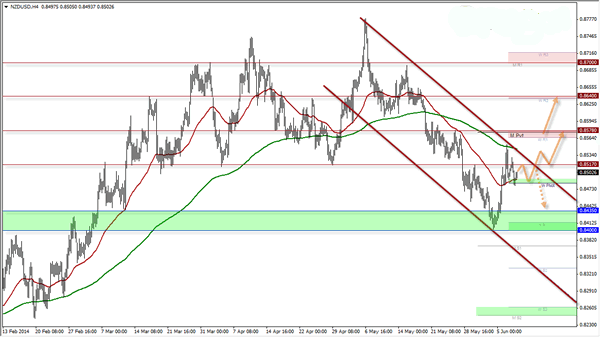
If we do break above 0.8520 then we have resistance close by around 0.857 which I expect to hold upon first attempt, so ideally we will see basing patterns above 0.850 and for buying pressure to increase whilst the trend is established.
COUNTER-BIAS
A break below this week's range should target 0.843 and 0.840, with a break below 0.840 being quite bearish for the Kiwi and for losses to gain momentum. For this scenario we would have to keep rates fixed at 3% and for NZD to strengthen talk of intervention.
The Idiots Guide to High Frequency Trading
First, let me say what you read here is going to be wrong in several ways. HFT covers such a wide path of trading that different parties participate or are impacted in different ways. I wanted to put this out there as a starting point . Hopefully the comments will help further educate us all
1. Electronic trading is part of HFT, but not all electronic trading is high frequency trading.
Trading equities and other financial instruments has been around for a long time. it is Electronic Trading that has lead to far smaller spreads and lower actual trading costs from your broker. Very often HFT companies take credit for reducing spreads. They did not. Electronic trading did.
We all trade electronically now. It’s no big deal
2. Speed is not a problem
People like to look at the speed of trading as the problem. It is not. We have had a need for speed since the first stock quotes were communicated cross country via telegraph. The search for speed has been never ending. While i dont think co location and sub second trading adds value to the market, it does NOT create problems for the market
3. There has always been a delta in speed of trading.
From the days of the aforementioned telegraph to sub milisecond trading not everyone has traded at the same speed. You may trade stocks on a 100mbs broadband connection that is faster than your neighbors dial up connection. That delta in speed gives you faster information to news, information, research, getting quotes and getting your trades to your broker faster.
The same applies to brokers, banks and HFT. THey compete to get the fastest possible speed. Again the speed is not a problem.
4. So what has changed ? What is the problem
What has changed is this. In the past people used their speed advantages to trade their own portfolios. They knew they had an advantage with faster information or placing of trades and they used it to buy and own stocks. If only for hours. That is acceptable. The market is very darwinian. If you were able to figure out how to leverage the speed to buy and sell stocks that you took ownership of , more power to you. If you day traded in 1999 because you could see movement in stocks faster than the guy on dial up, and you made money. More power to you.
What changed is that the exchanges both delivered information faster to those who paid for the right AND ALSO gave them the ability via order types where the faster traders were guaranteed the right to jump in front of all those who were slower (Traders feel free to challenge me on this) . Not only that , they were able to use algorithms to see activity and/or directly see quotes from all those who were even milliseconds slower.
With these changes the fastest players were now able to make money simply because they were the fastest traders. They didn’t care what they traded. They realized they could make money on what is called Latency Arbitrage. You make money by being the fastest and taking advantage of slower traders.
It didn’t matter what exchanges the trades were on, or if they were across exchanges. If they were faster and were able to see or anticipate the slower trades they could profit from it.
5. This is where the problems start.
If you have the fastest access to information and the exchanges have given you incentives to jump in front of those users and make trades by paying you for any volume you create (maker/taker), then you can use that combination to make trades that you are pretty much GUARANTEED TO MAKE A PROFIT on.
So basically, the fastest players, who have spent billions of dollars in aggregate to get the fastest possible access are using that speed to jump to the front of the trading line. They get to see , either directly or algorithmically the trades that are coming in to the market.
When I say algorithmically, it means that firms are using their speed and their brainpower to take as many data points as they can use to predict what trades will happen next. This isn’t easy to do. It is very hard. It takes very smart people. If you create winning algorithms that can anticipate/predict what will happen in the next milliseconds in markets/equities, you will make millions of dollars a year. (Note:not all algorithms are bad. Algorithms are just functions. What matters is what their intent is and how they are used)
These algorithms take any number of data points to direct where and what to buy and sell and they do it as quickly as they can. Speed of processing is also an issue. To the point that there are specialty CPUs being used to process instruction sets. In simple terms, as fast as we possibly can, if we think this is going to happen, then do that.
The output of the algorithms , the This Then That creates the trade (again this is a simplification, im open to better examples) which creates a profit of some relatively small amount. When you do this millions of times a day, that totals up to real money . IMHO, this is the definition of High Frequency Trading. Taking advantage of an advantage in speed and algorithmic processing to jump in front of trades from slower market participants to create small guaranteed wins millions of times a day. A High Frequency of Trades is required to make money.
There in lies the problem. This is where the game is rigged.
If you know that by getting to the front of the line you are able to see or anticipate some material number of the trades that are about to happen, you are GUARANTEED to make a profit. What is the definition of a rigged market ? When you are guaranteed to make a profit. In casino terms, the trader who owns the front of the line is the house. The house always wins.
So when Michael Lewis and others talk about the stock market being rigged, this is what they are talking about. You can’t say the ENTIRE stock market is rigged, but you can say that for those equities/indexs where HFT plays, the game is rigged so that the fastest,smart players are guaranteed to make money.
6. Is this bad for individual investors ?
If you buy and sell stocks, why should you care if someone takes advantage of their investment in speed to make a few pennies from you ? You decide, but here is what you need to know:
a. Billions of dollars has been spent to get to the front of the line. All of those traders who invested in speed and expensive algorithm writers need to get a return on their investment. They do so by jumping in front of your trade and scalping just a little bit. What would happen if they weren’t there ? There is a good chance that whatever profit they made by jumping in front of your trade would go to you or your broker/banker.
b. If you trade in small stocks, this doesn’t impact small stock trades. HFT doesn’t deal with low volume stocks. By definition they need to do a High Frequency of Trades. If the stocks you buy or sell don’t have volume (i dont know what the minimum amount of volume is), then they aren’t messing with your stocks
c. Is this a problem of ethics to you and other investors ? If you believe that investors will turn away from the market because they feel that it is ethically wrong for any part of the market to offer a select few participants a guaranteed way to make money, then it could create significant out flows of investors cash which could impact your net worth. IMHO, this is why Schwab and other brokers that deal with retail investors are concerned. They could lose customers who think Schwab, etc can’t keep up with other brokers or are not routing their orders as efficiently as others.
7. Are There Systemic Risks That Result From All of This.
The simple answer is that I personally believe that without question the answer is YES. Why ?
If you know that a game is rigged AND that it is LEGAL to participate in this rigged game, would you do everything possible to participate if you could ?
Of course you would. But this isn’t a new phenomena. The battle to capture all of this guaranteed money has been going on for several years now. And what has happened is very darwinian. The smarter players have risen to the top. They are capturing much of the loot. It truly is an arms race. More speed gives you more slots at the front of the lines. So more money is being spent on speed.
Money is also being spent on algorithms. You need the best and brightest in order to write algorithms that make you money. You also need to know how to influence markets in order to give your algorithms the best chance to succeed. There is a problem in the markets known as quote stuffing. This is where HFT create quotes that are supposed to trick other algorithms , traders, investors into believing their is a true order available to be hit. In reality those are not real orders. They are decoys. Rather than letting anyone hit the order, because they are faster than everyone else, they can see your intent to hit the order or your reaction either directly or algorithmically to the quote and take action. And not only that, it creates such a huge volume of information flow that it makes it more expensive for everyone else to process that information, which in turn slows them down and puts them further at a disadvantage.
IMHO, this isn’t fair. It isn’t a real intent. At it’s heart it is a FRAUD ON THE MARKET. There was never an intent to execute a trade. It is there merely to deceive.
But Order Stuffing is not the only problem.
Everyone in the HFT business wants to get to the front of the line. THey want that guaranteed money. In order to get there HFT not only uses speed, but they use algorithms and other tools (feel free to provide more info here HFT folks) to try to influence other algorithms. It takes a certain amount of arrogance to be good at HFT. If you think you can out think other HFT firms you are going to try to trick them into taking actions that cause their algorithms to not trade or to make bad trades. It’s analogous to great poker players vs the rest of us.
What we don’t know is just how far afield HFT firms and their algorithms will go to get to the front of the line. There is a moral hazard involved. Will they take risks knowing that if they fail they may lose their money but the results could also have systemic implications ?. We saw what happened with the Flash Crash. Is there any way we can prevent the same thing from happening again ? I don’t think so. Is it possible that something far worse could happen ? I have no idea. And neither does anyone else
It is this lack of ability to quantify risks that creates a huge cost for all of us. Warren Buffet called derivatives weapons of mass destruction because he had and has no idea what the potential negative impact of a bad actor could be. The same problem applies with HFT. How do we pay for that risk ? And when ?
When you have HFT algorithms fighting to get to the front of the line to get that guaranteed money , who knows to what extent they will take risks and what they impact will be not only on our US Equities Markets, but also currencies, foreign markets and ? ? ?
What about what HFT players are doing right now outside of US markets ? All markets are correlated at some level. Problems outside the US could create huge problems for us here.
IMHO, there are real systemic issues at play.
8. So Why are some of the Big Banks and Funds not screaming bloody murder ?
To use a black jack analogy , its because they know how to count cards. They have the resources to figure out how to match the fastest HFT firms in their trading speeds. They can afford to buy the speed or they can partner with those that can. They also have the brainpower to figure out generically how the algorithms work and where they are scalping their profits. By knowing this they can avoid it. And because they have the brain power to figure this out, they can actually use HFT to their advantage from time to time. Where they can see HFT at work, they can feed them trades which provides some real liquidity as opposed to volume.
The next point of course is that if the big guys can do it , and the little guys can let the big guys manage their money , shouldn’t we all just shut up and work with them ? Of course not. We shouldn’t have to invest with only the biggest firms to avoid some of the risks of HFT. We should be able to make our decisions as investors to work with those that give us the best support in making investments. Not those who have the best solution to outsmarting HFT.
But more importantly, even the biggest and smartest of traders , those who can see and anticipate the HFT firms actions can’t account for the actions of bad actors. They can’t keep up with the arms race to get to the front of the line. Its not their core competency. It is a problem for them, but they also know that by being able to deal with it better than their peers, it gives them a selling advantage. “We can deal with HFT no problem”. So they aren’t screaming bloody murder.
9. So My Conclusion ?
IMHO, it’s not worth the risk. I know why there is HFT. I just don’t see why we let it continue. It adds no value. But if it does continue, then we should require that all ALGORITHMIC players to register their Algorithms. While I’m not a fan of the SEC, they do have smart players at their market structure group. (the value of going to SEC Speaks :). While having copies of the algorithms locked up at the SEC wont prevent a market collapse/meltdown, at least we can reverse engineer it if it happens.
I know this sounds stupid on its face. Reverse engineer a collapse ? But that may be a better solution than expecting the SEC to figure out how to regulate and pre empt a market crash
10…FINAL FINAL THOUGHTS
i wrote this in about 2 hours. Not because i thought it would be definitive or correct. I expect to get ABSOLUTELY CRUSHED on many points here. But there is so little knowledge and understanding of what is going on with HFT, that I believed that someone needed to start the conversation
Forum on trading, automated trading systems and testing trading strategies
Something Interesting in Forex Video May 2013
newdigital, 2013.05.09 16:54
High Frequency Trading Explained (HFT)
Dave Fry, founder and publisher of ETF Digest, and Steve Hammer, founder of HFT Alert, discuss high frequency trading operations, fundamentals, the difference between algorithmic trading and high frequency trading, fluttering, latency and the role high frequency trading had in the May stock market flash crash in 2010.
Forum on trading, automated trading systems and testing trading strategies
Something Interesting in Forex Video May 2013
newdigital, 2013.05.09 12:31
High frequency trading in action. This video is about 4 minute. CNN's Maggie Lake gets a rare look inside the super-fast trading industry.
This High frequency trading (HFT) is particularly interesting for traders at the present time, for example: there is some thread in russian part of mql5.com about HFT of 82 pages. Some poeple said that it is impossible to create any signal with HFT EA ... who knows ...
Forum on trading, automated trading systems and testing trading strategies
Something Interesting to Read May 2014
newdigital, 2014.04.28 10:33
Chan: Algorithmic Trading: Winning Strategies and Their Rationale (Wiley Trading)
Engaging and informative, Algorithmic Trading skillfully covers a wide array of strategies. Broadly divided into the mean-reverting and momentum camps, it lays out standard techniques for trading each category of strategies and, equally important, the fundamental reasons why a strategy should work. The emphasis throughout is on simple and linear strategies, as an antidote to the over-fitting and data-snooping biases that often plague complex strategies. Along the way, it provides comprehensive coverage of:
- Choosing the right automated execution platform as well
as a backtesting platform that will allow you to reduce or eliminate
common pitfalls associated with algorithmic trading strategies
- Multiple
statistical techniques for detecting "time series" mean reversion or
stationarity, and for detecting cointegration of a portfolio of
instruments
- Simple techniques for trading
mean-reverting portfolios—linear, Bollinger band, and Kalman filter—and
whether using raw prices, log prices, or ratios make the most sense as
inputs to these tests and strategies
- Mean-reverting strategies for stocks, ETFs, currencies, and futures calendar and intermarket spreads
- The
four main drivers of momentum in stocks and futures, and strategies
that can extract time series and cross sectional momentum
- Newer momentum strategies based on news events and sentiment, leveraged ETFs, order flow, and high-frequency trading
- Issues
involving risk and money management based on the Kelly formula, but
tempered with the author's practical experience in risk management
involving black swans, Constant Proportion Portfolio Insurance, and stop
losses
- Mathematics and software are the twin languages
of algorithmic trading. This book stays true to that view by using a
level of mathematics that allows for a more precise discussion of the
concepts involved in financial markets. And it includes illustrative
examples that are built around MATLAB© codes, which are available for
download.
While Algorithmic Trading contains an abundance of strategies that will be attractive to both independent and institutional traders, it is not a step-by-step guide to implementing them. It offers a realistic assessment of common algorithmic trading techniques and can help serious traders further refine their skills in this field.Aussie Moves Higher with Help from Domestic & China’s Data
The Australian dollar rallied against its US peer and erased losses versus the Japanese yen today with help of rather positive domestic business confidence and good economic data from China.
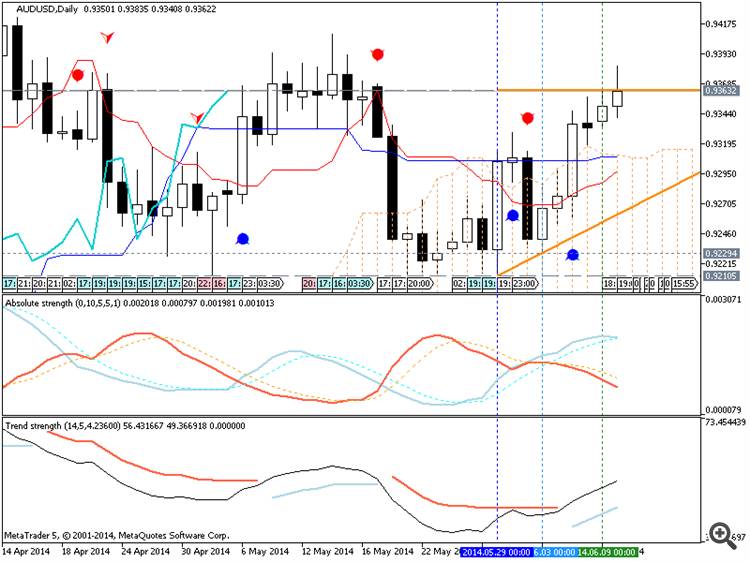
The business confidence index of National Australia Bank remained unchanged in May. The report commented on this:
That result was surprising, with firm’s still discounting persistently soft levels of business conditions and the negative sentiment surrounding the Federal budget – including the post-budget collapse in consumer confidence.
Other Australian reports were not as good, with no growth in the number of home loans in April (even though analysts predicted an increase by 0.3 percent) and the drop of job advertisements. The Aussie was still able to make a move higher with support of positive data from China, the biggest Australia’s trading partner.
AUD/USD went up from 0.9275 to 0.9295 as of 16:07 GMT today after falling to 0.9257 earlier. AUD/JPY near the opening level of 92.29 following the drop to 94.94.

Off Topic with Irene Aldridge
Alpha Pages: You took great issue with Michael Lewis’ claim that the market is “rigged.” Why?
Irene Aldridge: On the Michael Lewis topic, I suppose I am most disappointed in the pay-for-play quality of the book. Even the fastest best-selling writers can tell you that they are only capable of writing 15 pages per day, at best. To write a 300-page book, [is] a five-month process, at a bare minimum.
Incidentally, at the time Mr. Lewis’s book was released, the trading venue around which much of the book revolves, has been in existence for, wait for it, exactly five months! In other words, Mr. Lewis began to write the novel about his great protagonists and its creation prior to the launch of this trading venue at the center of this book—I really don’t see how he could have covered this in depth. [It appears to be an] elaborate marketing campaign for this trading venue. In other words, the book is marketing masquerading as a fair markets discourse. For a writer like Lewis, stooping so low is a complete disgrace. Markets have moved a long way toward fairness since then, so most of his criticism is completely unfounded.
AP: Is high frequency trading taking the heat for problems caused market structure or regulations?
IA: From what we are seeing, this HFT pre-hedging that boils down to front-running [may have] unfortunately become common practice following the Volcker and Dodd-Frank rules. There still exists a FINRA rule that encourages brokers to avoid front-running, but FINRA is a self-regulatory organization, and the consequences of not following its rules [may not be so harsh]. While most of ABLE Alpha clients have the permission to access the markets directly and, as a result, avoid front-running, many smaller entities are not so lucky and end up losing money. I do not believe that this is what the regulators had in mind when they designed the laws, but these are the unintended consequences.
AP: There is an ongoing argument over whether HFT is a net liquidity maker or taker as opposed to traditional market makers?
IA: I was just presenting at the Princeton Quant Trading conference, where a fellow speaker, [from a] prominent broker discussed how they are forced to spend money to build systems that monitor the number of zeroes human brokers put at the end of their orders simply because brokers so often come to work hung over and unable to focus. Well, needless to say, hangovers do not happen to computers. Overall, the computers are considerably cheaper, more reliable and less demanding than human brokers, so there is absolutely no doubt in my mind that the computerized trading technology, known as HFT, will replace most of the presently-human trading operation at brokers in continuing the digital revolution observed elsewhere in the society.
AP: Will the size of HFT be self-correcting? Will algorithms exploit inefficiencies until they’re gone?
One of our products is the HFT Index, science, not hear-say, based [on a] real-time estimate of aggressive HFT participation in electronic markets of customer choice. According to our estimates, activity level of aggressive HFTs by volume averages 15% to 20% in most markets, although intraday it may spike up 100%, or drop to 0%.
According to the HFT Index, many highly liquid securities have the lowest HFT participation as a percent of overall volume, seldom exceeding 15%, while some other instruments are dominated by the aggressive HFTs. Painting the entire market with a wide 50% HFT brush gives little insight into what we and our clients are actually seeing.Trading the News: U.K. Jobless Claims Change (based on dailyfx article)
Another decline in U.K. Jobless Claims may prompt a near-term advance in the GBP/USD as it puts increased pressure on the Bank of England (BoE) to normalize monetary policy sooner rather than later.
What’s Expected:
Why Is This Event Important:
Indeed, the BoE Minutes due out on June 18 may highlight a growing dissent within the Monetary Policy Committee (MPC) as the central bank continues to see a stronger recovery in 2014, and the bullish sentiment surrounding the British Pound may gather pace in the second-half of the year should we see a growing number of BoE officials adopt a more hawkish tone for monetary policy.
The ongoing expansion in private sector consumption along with the rise in business outputs may generate a larger-than-expected decline in unemployment, and an upbeat labor report may pave the way for a higher-high in the GBP/USD as it raises the fundamental outlook for the U.K. economy.
However, sticky inflation paired with the slowdown in private lending may drag on hiring, and a dismal jobless claims report may spur a larger correction in the GBP/USD as it drags on interest rate expectations.
How To Trade This Event Risk
Bullish GBP Trade: U.K. Jobless Claims Contract 25.0K or Greater
- Need green, five-minute candle following a hawkish statement to favor a long British Pound trade
- If reaction favors buying British Pound, long GBP/USD with two separate position
- Set stop at the near-by swing low/reasonable distance from entry; need at least 1:1 risk-to-reward
- Move stop to entry on remaining position once initial target is hit, set reasonable limit
Bearish GBP Trade: Labor Data Disappoints, Dragging on Rate Expectations- Need red, five-minute candle to consider a short GBP/USD trade
- Implement same setup as the bullish British Pound trade, just in the opposite direction
Potential Price Targets For The ReleaseGBP/USD Daily
Impact that the U.K Jobless Claims report has had on GBP during the last release
(1 Hour post event )
(End of Day post event)
April 2014 U.K. Jobless Claims Change
GBPUSD M5 : 41 pips price movement by GBP - Unemployment Rate news event:
U.K. Jobless Claims fell another 25.1K in April following the 30.6K contraction the month prior, while the ILO rate narrowed to an annualized 6.8% from 6.9% to mark the lowest reading since February 2009. Nevertheless, the GBP/USD traded lower as the print missed market expectations, and the British Pound weakened further throughout the day as the Bank of England Inflation report dampened bets of seeing the central bank normalize monetary policy ahead of schedule.
The 5 Stages Of Forex Consistency
It’s been a busy few weeks to say the least, as I sit here writing this article from the comfort of my own home in London following a fantastic two weeks of teaching and working with some fantastic students at the Online Trading Academy Los Angeles campus.
Having received an invitation to come and visit the campus in LA from my good friend and the general manager at the center Mike Green, I taught the Professional Trader and the Professional Forex Trader classes back to back.
While this was somewhat of a marathon for me as I’m not used to teaching that much, I wanted to make the most of the time as it’s not often I get to travel to the West Coast of America. I worked with a fantastic bunch of students many of whom joined me for both classes.
Over that two-week period we really got into the depths of what it takes to be consistent in today’s markets.In fact the experience in LA is what prompted me to the idea of this week’s article. You see, the professional Trader class is probably the most important class that we teach in the Academy because it details all of the rules and dynamics that make up our patented rule-based core strategy.
Students are taught how to recognize institutional levels of supply and demand in the markets and how to trade the entries and exits with precision and strict risk management. Having taken that class, students then move on to a leveraged asset class of their choice, typically Futures, FX, Options or for many, all of them.
Once a student gets to the stage of the leveraged asset class, they are now comfortable in drawing supply and demand zones and they have worked out the fundamental details of their trading plan with their education counsellor.
In these follow-up classes, we get to go through the characteristics of the individual asset classes and also spend a lot more time on a subject of trading which my regular readers will know I’m exceptionally passionate about and that is the mastery of the mental and psychological game. In my second week at the LA campus during the FX class, we spent a considerable amount of time working on this subject which inspired me to share with you the five key areas of psychology which my colleagues and I believe need to be mastered in order to become proficient and consistent in trading today’s markets.
I’m going to list these out for you individually and give my thoughts on why I feel they are key areas of consideration for any trader hoping to make money speculating in the currency markets. I hope you find these insights useful.
1 – Discipline
Discipline is without doubt the foundation of everything, not just in trading but in life as well. A person lacking discipline will always struggle to achieve their goals no matter what they are and will be stumped time and time again by frustration and disappointment if they’re not aware of where the true problem lays.
There are things you have to do when you’re a trader which can sometimes make you feel uncomfortable, like waiting for a set up when the market is moving and you feel like you’re missing out on an opportunity or putting in a stop loss only to see it get hit and then the price turn in the direction you thought it was going to go anyway and you’re left with nothing.
These are two of many scenarios which can really grate on a market speculator. But remember, without waiting for the right setups and getting out of a trade when we are wrong, we will never ever have the tools or be in the position to be profitable in the long term.
Trading is really about creating good habits and the tough thing about good habits is that they are often hard to develop and painful at first even though they reward us in the long term. One cool little trick that I do to help develop the students’ discipline is to get them to do something which feels a little bit uncomfortable every single day.
This may mean getting up a little earlier now and then or watching less TV or reading more. Everybody is different but by doing something that doesn’t feel natural you are going to train yourself mentally to do the things that you know you must do when you are trading. Develop discipline and you will develop as a trader.
2 – Integrity
When I talk about integrity with a new student sometimes they get a little bit confused and wonder what I mean by it.
The simplest way I can describe integrity is by repeating to you something that was told to me when I was a student.
When I asked my first instructor what made a successful trader standout amongst the rest he replied, “A successful trader knows the rules and follows them every single time. A novice trader knows they should have rules and maybe even knows what these rules are but never follows them consistently.” Again, this is something we do in real life.
There are things we know we should be doing but we put them off or we bury our head in the sand and pretend it doesn’t really matter.
Everything always catches up to you in the end and if you don’t show a high degree of integrity and make every single effort you can to follow your rules and your trade plan, what are you really saying about your expectations of your results as a trader?
Write your rules, plan your trade and follow them is all I ask.
3 – Diligence
Diligence is more about the “housekeeping” we have to do as a trader. In the early stages of a traders career, it is vital to make sure that you’re crossing all of the “t’s” and dotting all of the “i’s” and paying special attention to the level of detail you’re applying to your plan and your subsequent trades which you take.
It can be easy to take our eye off the ball from time to time and everybody can be forgiven for making the odd mistake here and there.
However, it is your job to remain focused and take care of your work and your processes throughout your whole trading experience.
You and you alone are solely responsible for your trading results, therefore requiring you to pay attention to all the details at hand and to make sure that not only do you develop your plan, take trades from your plan and follow your rules but you also follow this up with keeping a solid track record of all of your trading activity. Nobody can do this for you.
4 – Patience
Probably one of the toughest things for a trader to learn is patience. Just think about the verb “to trade.”
It alone suggests a very active profession doesn’t it?
Yet the irony is that actual trading is often one of the most passive things we could ever do for a career.
Most of my time is spent waiting for price to come to my area of demand to buy or my zone of supply to sell.
Needy traders typically think that the more you click buttons the more money will make and if you just sit down and watch the charts and wait for the price to come to you, you’ll never ever make any money.
In fact I used to think that myself until I soon realized that I wasn’t following any rules and was just clicking buttons when I felt like it.
There aren’t any real secrets to successful trading but I can tell you this: if you don’t wait for price to come to the optimal entry points, you will never achieve the greatest rewards with the lowest risks and the highest probabilities.
Our core strategy follows what institutions do. Institutions wait for the best prices to get in and the best prices to get out. Sure my friends, that requires patience and I’m also well aware of the old saying that patience pays in the long run. Let time do its work and your plan will do the rest for you.
5 – Hard Work
Finally we come to the last piece of the puzzle, often the part that many people don’t really want to apply and that is hard, work plain and simple.
Profitable traders are an elite group of individuals who have learned through solid education and experience what it takes to make money in the currency markets.
Many other people out there think there’s some big secret to trading and investing, when the truth of it is that the big secret is that there is no secret at all.
I remember a good friend of mine once saying about how people always said he was lucky in his business deals and transactions. I said to him, “How does that make you feel when people say you got lucky?” His response was, “You know Sam, I kind of agree with them. I’ve noticed myself over the years that the harder I work the luckier I seem to get.” We all like the idea of trading, I mean who wouldn’t?
But most don’t really like the reality and the hard work that is required to get you where you want to get.
This is just like any other business or venture out there. If you want to rise above everybody else and do the things that most other people only dream about you have to go the extra mile in both your education, your mind-set, and of course good old-fashioned hard work. Invest the time in yourself and in time others will want to invest in you.
Audio - A Sit Down with Steve Forbes
President of Forbes inc. and former Presidential candidate, Steve Forbes joins Merlin Rothfeld and John O’Donnell for a look at several major factors which may lead to a second Great Depression. The trio discuss the concept of Flat Tax and how it might impact the markets and transition into Mr. Forbes new book about the devaluation of the US Dollar. Mr. Forbes voices his support for a gold standard to help add stability to the financial system and economy as a whole.