Amidst the declining prices of the West Texas Intermediate or WTI, the
price differential between it and Brent widened to $14/bbl, and
according to some market observers this is happening due to the fact
that WTI prices remained weak on rising stock levels, planned and
unplanned refinery maintenance, strong import levels, and rising oil
production.
People who have been keeping an eye on the global oil prices admit that
as each benchmark diverged for geopolitical and fundamental reasons, the
difference between the crude prices from the two i.e. WTI and Brent was
expected. Additionally, there are reports of increased oil production
in the U.S. by the oil companies.
The US Energy Information Administration has already brought a report
wherein it claims that the new drilling and productivity report clearly
shows that Bakken output should cross the limit of 1 million b/d in
December. Similarly, Eagle Ford production is expected to reach 1.3
million b/d.
Amidst the declining prices of the West Texas Intermediate or WTI, the price differential between it and Brent widened to $14/bbl, and according to some market observers this is happening due to the fact that WTI prices remained weak on rising stock levels, planned and unplanned refinery maintenance, strong import levels, and rising oil...
China has unveiled its most sweeping reform agenda in more than 30
years, after a meeting of key Communist Party leaders in Beijing last
week. The agenda aims to transition China to a more free-market consumer
economy with fewer social controls. On the economic front, the plans
include reducing the power of giant state-owned companies, removing a
swathe of price controls, phasing out caps on interest rates and moving
towards yuan convertibility. More broadly, the plans also outline
loosening the one-child policy, abolishing the controversial
“re-education” labor camps and introducing steps toward an independent
judiciary.
The euro zone’s current account surplus narrowed unexpectedly in September, official data showed on Monday.
In
a report, the European Central Bank said that the euro zone current
account recorded a seasonally adjusted surplus of EUR13.7 billion in
September, down from a surplus of EUR17.9 billion in August, whose
figure was revised up from a previously reported surplus of EUR17.4
billion.
Economists had expected the region’s current account surplus to widen to EUR19 billion in September.
Homebuilder confidence in the U.S. held steady in the month of
November, according to a report released by the National Association of
Home Builders on Monday.
The report said the NAHB/Wells Fargo
Housing Market Index came in at 54 in November, unchanged from the
downwardly revised reading for October.
Economists had expected the index to come in unchanged compared to the 55 originally reported for the previous month.
The
NAHB noted that the reading above 50 indicates that more builders
viewed market conditions as good than poor for the sixth consecutive
month.
NAHB Chief Economist David Crowe said, "The fact that
builder confidence remains above 50 is an encouraging sign, considering
the unresolved debt and federal budget issues cause builders and
consumers to remain on the sideline."
NAHB provides the current Housing Market Index (HMI) data, as well as historical data. Learn more about what makes up the HMI and how it is tabulated. Search the resources compiled below by title, detail, or date. Take your time and browse, read, or download related information or purchase the item that interests you. TitleType...
The euro zone is to release data on the current account balance.
The U.S. is to release private sector data on the outlook for the housing sector.
Tuesday, November 19
The ZEW Institute is to release its closely watched report on German economic sentiment, a leading indicator of economic health.
The U.S. is to release data on the employment cost index, an important inflationary indicator.
Wednesday, November 20
In the euro zone, Germany is to release data on producer price inflation.
The U.S. is to release a series of data including a report on retail
sales, the government measure of consumer spending, which accounts for
the majority of overall economic activity. The nation is also to
publish data on consumer inflation, existing home sales and business
inventories.
Later Wednesday, the Federal Reserve is to publish what will be the closely watched minutes of its latest policy meeting.
Thursday, November 21
The euro zone is to release preliminary data on manufacturing and
service sector activity, a leading indicator of economic health.
Germany and France are also to release individual reports.
The U.S. is release data on producer price inflation, as well as the
weekly report on initial jobless claims. The U.S. is also to release
data manufacturing activity from the Philly Fed.
Friday, November 22
The Ifo Institute is to publish a report on German business climate, a leading indicator of economic health.
Investing.com - The euro rose to one week highs against the dollar on Friday as comments by Federal Reserve Chairwoman nominee Janet Yellen were seen as supportive of the bank’s monetary stimulus program. EUR/USD ended Friday’s session at 1.3497, up from Thursday’s close of 1.3457. For the week the pair rose 0.66%. The pair is likely to find...
Regulators in the United States, Hong Kong, Singapore, the United
Kingdom, Switzerland and elsewhere are investigating potential
manipulation of the market for foreign currency, sometimes called FX or
foreign exchange. It is natural to compare these reports to the
manipulation of Libor, the London Interbank Offered Rate.
After all, both Libor and the leading FX benchmarks are massively
influenced by the actions of a few international banks. Investigations
into both have exhumed embarrassing online chat sessions: FX traders met
in chat rooms called The Bandit's Club and The Cartel, while Libor
traders promised bottles of Bollinger Champaign. And both markets are
massively important: there are $5 trillion in FX trades daily, while
Libor gets about halfway there ($2.5 trillion) with one product alone.
Regulators in the United States, Hong Kong, Singapore, the United Kingdom, Switzerland and elsewhere are investigating potential manipulation of the market for foreign currency, sometimes called FX or foreign exchange. It is natural to compare these reports to the manipulation of Libor, the London Interbank Offered Rate. After all, both Libor...
he Australian dollar edged up on Tuesday after the Reserve Bank of
Australia noted mounting evidence that interest rate cuts were working
to stimulate the economy, though it would not rule out the chance of
easing further if necessary.
The Aussie initially dipped to a session low of 93.53 US
cents, from an early start at 93.77 US cents, but quickly recovered to
last trade at 93.86 US cents.
"Investors were expecting stronger jaw-boning from the RBA
about the high currency but didn't get it," said Joseph Capurso, a
strategist at Commonwealth Bank of Australia.
He expects the Aussie to remain subdued this week as the US dollar shows signs of stabilisation across the board.
Minutes of the monetary policy meetings of the Reserve Bank Board are published two weeks after each meeting. (The Reserve Bank Board normally meets eleven times each...
Currency prices matter because of cross-border trade. The concept of Fundamental Analysis in the Forex Market can be all
boiled down to one simple data point: Interest Rates. If interest rates
move higher, investors have a greater incentive to invest their capital;
and if interest rates move lower, that incentive is lessened. This
relationship is at the heart and soul of macroeconomics; and this is
what allows Central Bankers to have tools to steward their respective
economies.
How Interest Rate Cycles Drive Economies
It all goes back to the incentive to invest. If Central Bankers want to
slow down their economy, they look to raise rates. If they want to
encourage more growth within an economy, they look to decrease rates. Higher or lower rates bring a two-pronged impact on the economy
What do Central Bankers Watch?
Both Central Bankers and Forex Traders watch macroeconomic data prints
with the goal of getting something out of them; but their objectives are
slightly different. FX Traders are often interested in the price reaction of a data print. Central Bankers, however, take a much more broad view on such statistics.
How Technical Analysis can improve your fundamental approach
Traders can incorporate price action to see where these trends may be
existing, and to what degree they might be traded. Then, traders can
also use price action to buy up-trends cheaply, and sell down-trends
expensively; so that if that momentum continues, they can look to
profit.
Fundamental Analysis in the stock market involves analyzing the inputs of a company in an effort to forecast future growth potential. For an individual company, this can be a very logical way to look for investment ideas. Fundamental Analysis of a company would involve investigating that company’s financial statements, to notice changes from...
that isn’t as common in other markets albeit still very important. The effect that monetary policy has is paramount to currency outcomes and can be a major determinant in what trades you decide to place. Because monetary policy is the process by which a monetary authority like a central bank controls the supply of money within an economy in...
Below are today’s likely price locations of buy and sell stop orders
for the active Comex gold and silver futures markets. The asterisks
(**) denote the most critical stop order placement level of the day (or
likely where the heaviest concentration of stop orders are placed on
this day).
Editor's Note: Professional traders have a very good idea of price levels at which buy and sell stop orders are located on a daily basis. And now you will, too! If pre-placed buy or sell stop order are triggered, bigger price moves can immediately follow. Most stop orders are located and placed based upon key technical support or resistance...
Allow the use of cookies to log in to the MQL5.com website.
Please enable the necessary setting in your browser, otherwise you will not be able to log in.
You are signed in. Two-factor authentication has been disabled. Set it up again and scan a new QR code, or continue with two-factor authentication disabled.
WTI Crude Declines; Price Differential between WTI and Brent Widens
Amidst the declining prices of the West Texas Intermediate or WTI, the price differential between it and Brent widened to $14/bbl, and according to some market observers this is happening due to the fact that WTI prices remained weak on rising stock levels, planned and unplanned refinery maintenance, strong import levels, and rising oil production.
People who have been keeping an eye on the global oil prices admit that as each benchmark diverged for geopolitical and fundamental reasons, the difference between the crude prices from the two i.e. WTI and Brent was expected. Additionally, there are reports of increased oil production in the U.S. by the oil companies.
The US Energy Information Administration has already brought a report wherein it claims that the new drilling and productivity report clearly shows that Bakken output should cross the limit of 1 million b/d in December. Similarly, Eagle Ford production is expected to reach 1.3 million b/d.
China's Bold Reforms Are Bad News For Markets
China has unveiled its most sweeping reform agenda in more than 30 years, after a meeting of key Communist Party leaders in Beijing last week. The agenda aims to transition China to a more free-market consumer economy with fewer social controls. On the economic front, the plans include reducing the power of giant state-owned companies, removing a swathe of price controls, phasing out caps on interest rates and moving towards yuan convertibility. More broadly, the plans also outline loosening the one-child policy, abolishing the controversial “re-education” labor camps and introducing steps toward an independent judiciary.
2013-11-18 09:00 GMT (or 10:00 MQ MT5 time) | [EUR - Current Account]
if actual > forecast = good for currency (for EUR in our case)
==========
Euro zone current account surplus narrows to EUR13.7 billion
The euro zone’s current account surplus narrowed unexpectedly in September, official data showed on Monday.
In a report, the European Central Bank said that the euro zone current account recorded a seasonally adjusted surplus of EUR13.7 billion in September, down from a surplus of EUR17.9 billion in August, whose figure was revised up from a previously reported surplus of EUR17.4 billion.
Economists had expected the region’s current account surplus to widen to EUR19 billion in September.
2013-11-18 15:00 GMT (or 16:00 MQ MT5 time) | [USD - NAHB Housing Market Index]
if actual > forecast = good for currency (for USD in our case)
==========
U.S. Homebuilder Confidence Holds Steady In November
Homebuilder confidence in the U.S. held steady in the month of November, according to a report released by the National Association of Home Builders on Monday.
The report said the NAHB/Wells Fargo Housing Market Index came in at 54 in November, unchanged from the downwardly revised reading for October.
Economists had expected the index to come in unchanged compared to the 55 originally reported for the previous month.
The NAHB noted that the reading above 50 indicates that more builders viewed market conditions as good than poor for the sixth consecutive month.
NAHB Chief Economist David Crowe said, "The fact that builder confidence remains above 50 is an encouraging sign, considering the unresolved debt and federal budget issues cause builders and consumers to remain on the sideline."
EURUSD Technical Analysis (based on EUR/USD weekly outlook: November 18 - 22 article)
Monday, November 18
The euro zone is to release data on the current account balance.
The U.S. is to release private sector data on the outlook for the housing sector.
Tuesday, November 19
The ZEW Institute is to release its closely watched report on German economic sentiment, a leading indicator of economic health.
The U.S. is to release data on the employment cost index, an important inflationary indicator.
Wednesday, November 20
In the euro zone, Germany is to release data on producer price inflation.
The U.S. is to release a series of data including a report on retail sales, the government measure of consumer spending, which accounts for the majority of overall economic activity. The nation is also to publish data on consumer inflation, existing home sales and business inventories.
Later Wednesday, the Federal Reserve is to publish what will be the closely watched minutes of its latest policy meeting.
Thursday, November 21
The euro zone is to release preliminary data on manufacturing and service sector activity, a leading indicator of economic health. Germany and France are also to release individual reports.
The U.S. is release data on producer price inflation, as well as the weekly report on initial jobless claims. The U.S. is also to release data manufacturing activity from the Philly Fed.
Friday, November 22
The Ifo Institute is to publish a report on German business climate, a leading indicator of economic health.
Untangling the Libor and Forex Scandals
Regulators in the United States, Hong Kong, Singapore, the United Kingdom, Switzerland and elsewhere are investigating potential manipulation of the market for foreign currency, sometimes called FX or foreign exchange. It is natural to compare these reports to the manipulation of Libor, the London Interbank Offered Rate.
After all, both Libor and the leading FX benchmarks are massively influenced by the actions of a few international banks. Investigations into both have exhumed embarrassing online chat sessions: FX traders met in chat rooms called The Bandit's Club and The Cartel, while Libor traders promised bottles of Bollinger Champaign. And both markets are massively important: there are $5 trillion in FX trades daily, while Libor gets about halfway there ($2.5 trillion) with one product alone.
2013-11-19 00:30 GMT (or 01:30 MQ MT5 time) | [AUD - RBA Meeting Minutes]
==========
Dollar up on RBA's cautious optimism
he Australian dollar edged up on Tuesday after the Reserve Bank of Australia noted mounting evidence that interest rate cuts were working to stimulate the economy, though it would not rule out the chance of easing further if necessary.
The Aussie initially dipped to a session low of 93.53 US cents, from an early start at 93.77 US cents, but quickly recovered to last trade at 93.86 US cents.
"Investors were expecting stronger jaw-boning from the RBA about the high currency but didn't get it," said Joseph Capurso, a strategist at Commonwealth Bank of Australia.
He expects the Aussie to remain subdued this week as the US dollar shows signs of stabilisation across the board.
Based on How Fundamentals Move Prices in the FX Market article
Why Currency Values Matter
Currency prices matter because of cross-border trade.
The concept of Fundamental Analysis in the Forex Market can be all boiled down to one simple data point: Interest Rates. If interest rates move higher, investors have a greater incentive to invest their capital; and if interest rates move lower, that incentive is lessened. This relationship is at the heart and soul of macroeconomics; and this is what allows Central Bankers to have tools to steward their respective economies.
How Interest Rate Cycles Drive Economies
It all goes back to the incentive to invest. If Central Bankers want to slow down their economy, they look to raise rates. If they want to encourage more growth within an economy, they look to decrease rates. Higher or lower rates bring a two-pronged impact on the economy
What do Central Bankers Watch?
Both Central Bankers and Forex Traders watch macroeconomic data prints with the goal of getting something out of them; but their objectives are slightly different. FX Traders are often interested in the price reaction of a data print. Central Bankers, however, take a much more broad view on such statistics.
How Technical Analysis can improve your fundamental approach
Traders can incorporate price action to see where these trends may be existing, and to what degree they might be traded. Then, traders can also use price action to buy up-trends cheaply, and sell down-trends expensively; so that if that momentum continues, they can look to profit.
Why You Should Target Trades based on Central Bank Policy
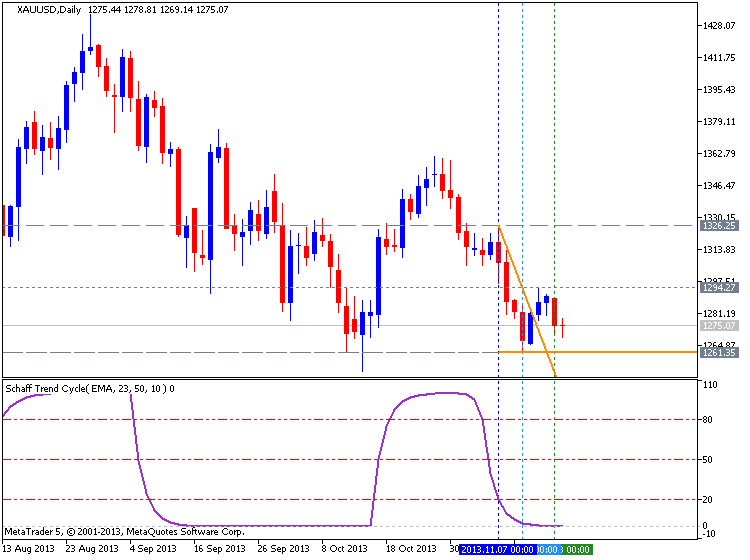
Gold Technical Analysis (based on Where are the Stops? Tuesday, November 19: Gold and Silver article)
Below are today’s likely price locations of buy and sell stop orders for the active Comex gold and silver futures markets. The asterisks (**) denote the most critical stop order placement level of the day (or likely where the heaviest concentration of stop orders are placed on this day).