Gold markets
tried to rally during the course of the week, but as you can see the
$1300 level offered a bit of resistance and ended up forming a shooting
star in this market. With that being the case, we feel that this market
will more than likely pullback from here. We believe that there is a
significant amount of support down at the $1250 level though, and most
certainly at the $1200 level. With that, we are still in a bit of a
downtrend, and with that you have to be careful. Ultimately, this is a
market that is probably better off being traded on shorter-term charts.
The USD/JPY pair
initially broke higher during the course of the week, but turned back
around at the 119 level to form a bit of a shooting star. Ultimately
though, this is a market that is very much in an uptrend, and should
continue to go higher. We believe that the 115 level is the “floor” in
this market, and as a result we look at pullbacks as potential buying
opportunities. We have no interest whatsoever in selling this market,
and do believe that eventually we break back above the 122 level and
grind our way up to the 125 handle.
The USD/CAD pair broke
much higher during the course of the week, using the 1.20 level as a
springboard to reach close to the 1.25 handle. This of course was
exaggerated by the Bank of Canada cutting interest rates in a surprise
move this week. Ultimately, we believe that the Canadian dollar is on
its back foot now, and should continue to be sold. However, we recognize
that we are approaching a significant round number, so we could get a
little bit of a pullback. Think of pullbacks as potential value in the
US dollar and therefore buying opportunities.
The GBP/USD pair
broke down during the course of the week, crashing into the 1.50
handle. Ultimately, it looks like the buyers are just below, and we do
believe that there is a significant amount of support going down to the
1.48 level as well. That being the case, we feel that the market should
continue to be one that is supported below, and as a result we are
waiting to see a buying opportunity. The Friday candle was a hammer, but
from a longer-term perspective we do not have that signal quite yet.
The EUR/USD pair
tried to rally at first during the course of the week, but with the
European Central Bank expanding its quantitative easing program, we
broke down below the 1.15 level and then crashed all the way down to the
1.11 region. We believe that the market is now heading to the 1.10
handle, and rally should be sold. It’s probably going to have to be done
off of the daily charts or even lower time frames though, as
longer-term charts don’t offer a lot of room between here and 1.10 at
the moment.
EURUSD
The EUR/USD pair
initially tried to rally during the course of the week, but as you can
see sliced below the 1.15 level. The market of course got a bit of a
surprise from the European Central Bank and its massive expansion of
quantitative easing. Because of this, it now looks as if the EUR/USD
pair is going to head to the 1.10 level, which is the next major support
level. That area could be a significant bounce waiting to happen, but
in the meantime I believe that the market will continue to sell off
every time it rallies. I look to short-term charts, and I believe that
the 1.15 level above is a massive resistance barrier.
USDCAD
The USD/CAD pair
broke much higher during the course of this past week, as the Bank of
Canada had a surprise interest-rate cut. With that, the market shot
straight up and we are now well above the 1.20 resistance barrier. In
fact, we are getting very close to the 1.25 resistance level, which
should cause a little bit of a pullback. If we get that pullback, we are
looking for supportive candles in order to get involved as the uptrend
is most certainly still in effect.
USDJPY
The USD/JPY pair initially tried to rally during the course of the
week, but as you can see had turned around and ended up forming a
shooting star. That being the case, the shooting star suggests that the
market is going to go down to the 115 level possibly, but at that point
in time I would anticipate seeing quite a bit of support. We could get a
bounce from there, and I would be willing to buy that bounce. I have no
interest in selling this market, as the uptrend is so strong. It’s
probably only a matter of time before we break out above the 122 level,
which should send this market looking for the 125 handle.
AUDUSD
The AUD/USD pair
broke down during the course of the week, and most importantly cleared
the 0.80 handle. With that being the case, the market looks as if it’s
ready to continue going lower, and short-term charts will more than
likely be the way that I continue to sell this market. This market is
not reacting positively to the gold markets rising, and that tells me
just how soft the Australian dollar truly is. I believe that the 0.75
handle will be targeted.
The euro fell to fresh 11-year lows against the dollar on Friday and
hit a seven year trough against the pound, a day after the European
Central Bank launched a large scale quantitative easing program to
combat slowing growth and inflation in the euro area.
EUR/USD
hit lows of 1.1118, the weakest since early September 2003 and was at
1.1203 late Friday, off 1.39% for the day. The euro ended the week down
more than 3% against the dollar and the pair has lost almost 7.5% so far
this year.
The drop in the single currency came after ECB President Mario Draghi
unveiled a €1.2 trillion asset purchase program on Thursday. The
central bank will purchase €60 billion in assets per month, starting in
March and continuing until late 2016.
Draghi said the program would help return inflation back to the
bank’s 2% target. Expectations had been building ahead of the ECB
meeting after official figures showed that the annual rate of inflation
in the euro area fell into negative territory in December, dropping
0.2%.
Draghi acknowledged the action the ECB took last year was “insufficient” to ward off the threat of deflation in the region.
EUR/GBP
hit lows of 0.7428 on Friday, the lowest since February 2008 and was at
0.7471 in late trade, ending the day down 1.31% and bringing the week’s
losses to 2.15%.
EUR/JPY hit a 16-month low of 130.95 on Friday and settled at 132.00, down 1.98%. The pair ended the week down 2.91%.
The euro was also under pressure amid uncertainty over the outcome of
Greek elections, due to be held on Sunday, with anti-bailout party
Syriza leading in the polls.
The dollar remained broadly stronger, boosted by the diverging
monetary policy stance between the Federal Reserve and central banks in
Europe and Japan.
The U.S. dollar index,
which measures the greenback’s strength against a trade-weighted basket
of six major currencies, rose to more than 11-year highs of 95.77 on
Friday and was last up 0.69% at 95.32.
The dollar slid lower against the safe haven yen, with USD/JPY down 0.61% to 117.78 in late trade, amid weakness in U.S. equities following lackluster corporate earnings results.
The Bank of Japan held off on expanding its monetary easing scheme on
Wednesday and instead expanded a loan scheme aimed at boosting lending.
In the week ahead, investors will be focusing on Friday’s preliminary
data on fourth quarter growth, while the latest euro zone inflation
data is also due out on Friday. Wednesday’s Federal Reserve monetary
policy statement will be closely watched, while New Zealand’s central
bank is also to hold a policy meeting.
Monday, January 26
The Bank of Japan is to publish the minutes of its latest policy
meeting, which contain valuable insights into economic conditions from
the bank’s perspective.
Japan is also to publish data on the trade balance.
In Germany, the Ifo research group is to publish its report on business climate.
The U.K. is to release private sector data on mortgage approvals.
Tuesday, January 27
New Zealand is to publish private sector data on business confidence.
The U.K. is to publish preliminary data on gross domestic product,
the broadest indicator of economic activity and the leading measure of
the economy’s health.
The U.S. is to release data on durable goods orders, as well as
private sector reports on consumer confidence and new home sales.
Wednesday, January 28
Australia is to produce data on consumer inflation, which accounts for the majority of overall inflation.
In the euro zone, the Gfk Institute is to report on German consumer climate.
The Federal Reserve is to announce its benchmark interest rate and
publish its rate statement, which outlines economic conditions and the
factors affecting the monetary policy decision.
Later in the day, the Reserve Bank of New Zealand is to announce its
benchmark interest rate and publish its rate statement. The country is
also to release data on the trade balance.
Thursday, January 29
Japan is to publish data on retail sales, the government measure of
consumer spending, which accounts for the majority of overall economic
activity.
Australia is to publish a report on import prices.
The U.K. is to publish private sector reports on house price inflation and retail sales.
In the euro zone, Germany is to release preliminary data on consumer
inflation and a report on the change in the number of people unemployed.
Later Thursday, the U.S. is to publish the weekly report on initial
jobless claims as well as private sector data on pending home sales.
Friday, January 30
Japan is to release a string of data, including reports on household
spending and inflation and preliminary data on industrial production.
Australia is to publish data on producer price inflation.
The euro zone is to release preliminary data on inflation as well as a
report on the unemployment rate. Germany is to report on retail sales,
while Spain is to release preliminary data on GDP growth and inflation.
Switzerland is to publish its KOF economic barometer.
The U.K. is to release data on net lending.
Canada is to publish its monthly GDP report.
The U.S. is to round up the week with preliminary data on fourth
quarter growth as well as reports on business activity in the Chicago
region and revised data on consumer sentiment.
The dollar slid lower against the safe-haven yen on Friday as
weakness in U.S. equities underpinned demand for the Japanese currency,
while the broadly weaker euro fell to 16-month lows against the yen.
USD/JPY was down 0.61% to 117.78 in late trade, not far from Wednesday’s lows of 117.17.
U.S. stocks fell following soft corporate earnings, which sparked concerns over the potential impact of the stronger dollar.
EUR/JPY
hit lows of 130.95, the weakest since September 2013, before pulling
back to 132.00, in late trade, off 1.98%. The pair ended the week with
losses of 2.91%.
The drop in the single currency came after European Central Bank
President Mario Draghi unveiled a €1.2 trillion asset purchase program
on Thursday. The central bank will purchase €60 billion in assets per
month, starting in March and continuing until late 2016.
Draghi said the program would help return inflation back to the
bank’s 2% target. Expectations had been building ahead of the ECB
meeting after official figures showed that the annual rate of inflation
in the euro area fell into negative territory in December, dropping
0.2%.
The Bank of Japan held off from announcing fresh easing measures
earlier in the week, despite cutting its inflation forecast for the year
from April 2015, a move that reinforced expectations for further
stimulus.
Speaking Friday, BoJ Governor Haruhiko Kuroda said it could examine fresh options if further stimulus was needed.
In the week ahead, investors will be focusing on Friday’s preliminary
data on U.S. fourth quarter growth, while the latest euro zone
inflation data is also due out on Friday. Wednesday’s Federal Reserve
monetary policy statement will be closely watched.
Monday, January 26
The BoJ is to publish the minutes of its latest policy meeting, which
contain valuable insights into economic conditions from the bank’s
perspective.
Japan is also to publish data on the trade balance.
Tuesday, January 27
The U.S. is to release data on durable goods orders, as well as
private sector reports on consumer confidence and new home sales.
Wednesday, January 28
The Federal Reserve is to announce its benchmark interest rate and
publish its rate statement, which outlines economic conditions and the
factors affecting the monetary policy decision.
Thursday, January 29
Japan is to publish data on retail sales, the government measure of
consumer spending, which accounts for the majority of overall economic
activity.
Later Thursday, the U.S. is to publish the weekly report on initial
jobless claims as well as private sector data on pending home sales.
Friday, January 30
Japan is to release a string of data, including reports on household
spending and inflation and preliminary data on industrial production.
The U.S. is to round up the week with preliminary data on fourth
quarter growth as well as reports on business activity in the Chicago
region and revised data on consumer sentiment.
The broadly weaker euro dropped to fresh 11-year lows against the
dollar on Friday one day after the European Central Bank unveiled a
large scale asset purchase plan, aimed at boosting slowing growth and
inflation in the euro zone.
EUR/USD
fell to 1.1118, the lowest since early September 2003 before pulling
back to 1.1203 in late trade, still off 1.39% for the day. The euro
ended the week down more than 3% against the dollar and has lost almost
7.5% so far this year.
The euro weakened across the board after ECB President Mario Draghi
unveiled a €1.2 trillion quantitative easing program on Thursday. The
central bank will purchase €60 billion per month of the region’s bonds,
including first-time purchases of government debt, starting in March and
continuing until September 2016.
Draghi said the program would help return inflation back to the ECB’s 2% target.
Expectations had been building ahead of the ECB meeting after
official figures showed that the annual rate of inflation in the euro
area fell into negative territory in December, dropping 0.2%.
Draghi acknowledged the action the ECB took last year was “insufficient” to ward off the threat of deflation.
EUR/GBP
hit lows of 0.7428 on Friday, the weakest level since February 2008 and
was at 0.7471 in late trade, ending the day down 1.31%, bringing the
week’s losses to 2.15%.
EUR/JPY
hit a 16-month low of 130.95 on Friday before recovering to 132.00 in
late trade, still down 1.98%. The pair ended the week with losses of
2.91%.
The euro was also under pressure amid uncertainty over the outcome of
Greek elections, due to be held on Sunday, with anti-bailout party
Syriza leading in the polls.
The dollar remained broadly stronger, boosted by the diverging
monetary policy stance between the Federal Reserve and central banks in
Europe and Japan.
The Bank of Japan held off from announcing fresh easing measures
earlier in the week, despite cutting its inflation forecast for the year
from April 2015, a move that reinforced expectations for further
stimulus.
Speaking Friday, BoJ Governor Haruhiko Kuroda said it could examine fresh options if further stimulus was needed.
The U.S. dollar index,
which measures the greenback’s strength against a trade-weighted basket
of six major currencies, rose to more than 11-year highs of 95.77 on
Friday and was last up 0.69% at 95.32.
In the coming week, investors will be focusing on Friday’s
preliminary data on U.S. fourth quarter growth, while the latest euro
zone inflation data is also due out on Friday. Wednesday’s monetary
policy statement from the Federal Reserve will also be closely watched.
Monday, January 26
In Germany, the Ifo research group is to publish its report on business climate.
Tuesday, January 27
The U.S. is to release data on durable goods orders, as well as
private sector reports on consumer confidence and new home sales.
Wednesday, January 28
In the euro zone, the Gfk Institute is to report on German consumer climate.
The Federal Reserve is to announce its benchmark interest rate and
publish its rate statement, which outlines economic conditions and the
factors affecting the monetary policy decision.
Thursday, January 29
In the euro zone, Germany is to release preliminary data on consumer
inflation and a report on the change in the number of people unemployed.
Later Thursday, the U.S. is to publish the weekly report on initial
jobless claims as well as private sector data on pending home sales.
Friday, January 30
The euro zone is to release preliminary data on inflation as well as a
report on the unemployment rate. Germany is to report on retail sales,
while Spain is to release preliminary data on GDP growth and inflation.
The U.S. is to round up the week with preliminary data on fourth
quarter growth as well as reports on business activity in the Chicago
region and revised data on consumer sentiment.
Gold forecast for the week of January 26, 2015, Technical Analysis
Gold markets tried to rally during the course of the week, but as you can see the $1300 level offered a bit of resistance and ended up forming a shooting star in this market. With that being the case, we feel that this market will more than likely pullback from here. We believe that there is a significant amount of support down at the $1250 level though, and most certainly at the $1200 level. With that, we are still in a bit of a downtrend, and with that you have to be careful. Ultimately, this is a market that is probably better off being traded on shorter-term charts.
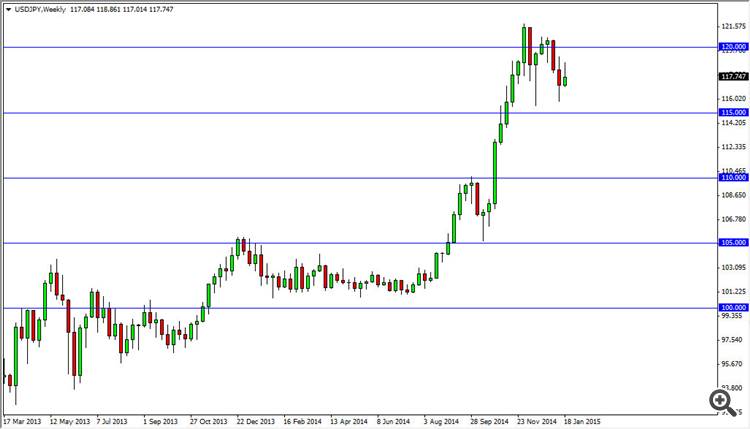
USD/JPY forecast for the week of January 26, 2015, Technical Analysis
The USD/JPY pair initially broke higher during the course of the week, but turned back around at the 119 level to form a bit of a shooting star. Ultimately though, this is a market that is very much in an uptrend, and should continue to go higher. We believe that the 115 level is the “floor” in this market, and as a result we look at pullbacks as potential buying opportunities. We have no interest whatsoever in selling this market, and do believe that eventually we break back above the 122 level and grind our way up to the 125 handle.
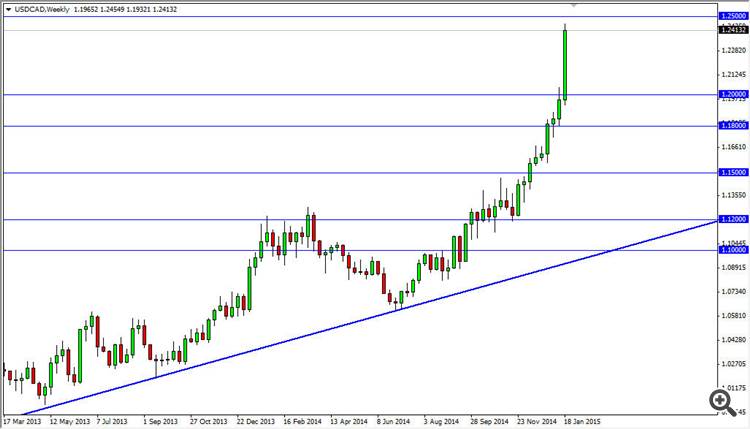
USD/CAD forecast for the week of January 26, 2015, Technical Analysis
The USD/CAD pair broke much higher during the course of the week, using the 1.20 level as a springboard to reach close to the 1.25 handle. This of course was exaggerated by the Bank of Canada cutting interest rates in a surprise move this week. Ultimately, we believe that the Canadian dollar is on its back foot now, and should continue to be sold. However, we recognize that we are approaching a significant round number, so we could get a little bit of a pullback. Think of pullbacks as potential value in the US dollar and therefore buying opportunities.
GBP/USD forecast for the week of January 26, 2015, Technical Analysis
The GBP/USD pair broke down during the course of the week, crashing into the 1.50 handle. Ultimately, it looks like the buyers are just below, and we do believe that there is a significant amount of support going down to the 1.48 level as well. That being the case, we feel that the market should continue to be one that is supported below, and as a result we are waiting to see a buying opportunity. The Friday candle was a hammer, but from a longer-term perspective we do not have that signal quite yet.
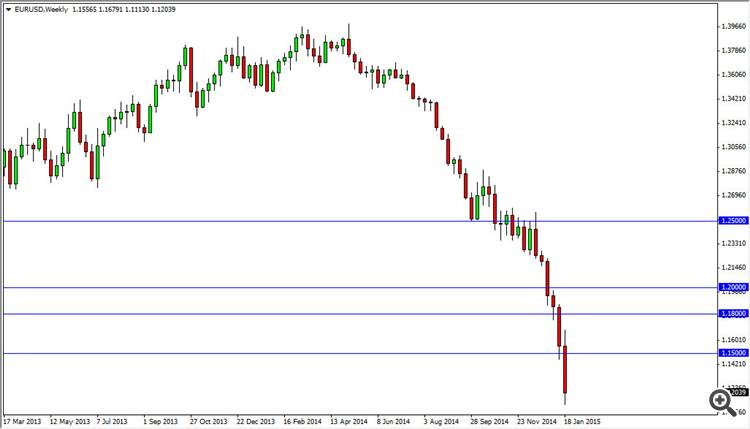
EUR/USD forecast for the week of January 26, 2015, Technical Analysis
The EUR/USD pair tried to rally at first during the course of the week, but with the European Central Bank expanding its quantitative easing program, we broke down below the 1.15 level and then crashed all the way down to the 1.11 region. We believe that the market is now heading to the 1.10 handle, and rally should be sold. It’s probably going to have to be done off of the daily charts or even lower time frames though, as longer-term charts don’t offer a lot of room between here and 1.10 at the moment.
Weekly Forex Forecast (based on dailyforex article)
EURUSDThe EUR/USD pair initially tried to rally during the course of the week, but as you can see sliced below the 1.15 level. The market of course got a bit of a surprise from the European Central Bank and its massive expansion of quantitative easing. Because of this, it now looks as if the EUR/USD pair is going to head to the 1.10 level, which is the next major support level. That area could be a significant bounce waiting to happen, but in the meantime I believe that the market will continue to sell off every time it rallies. I look to short-term charts, and I believe that the 1.15 level above is a massive resistance barrier.
USDCADThe USD/CAD pair broke much higher during the course of this past week, as the Bank of Canada had a surprise interest-rate cut. With that, the market shot straight up and we are now well above the 1.20 resistance barrier. In fact, we are getting very close to the 1.25 resistance level, which should cause a little bit of a pullback. If we get that pullback, we are looking for supportive candles in order to get involved as the uptrend is most certainly still in effect.
USDJPYThe USD/JPY pair initially tried to rally during the course of the week, but as you can see had turned around and ended up forming a shooting star. That being the case, the shooting star suggests that the market is going to go down to the 115 level possibly, but at that point in time I would anticipate seeing quite a bit of support. We could get a bounce from there, and I would be willing to buy that bounce. I have no interest in selling this market, as the uptrend is so strong. It’s probably only a matter of time before we break out above the 122 level, which should send this market looking for the 125 handle.
AUDUSDThe AUD/USD pair broke down during the course of the week, and most importantly cleared the 0.80 handle. With that being the case, the market looks as if it’s ready to continue going lower, and short-term charts will more than likely be the way that I continue to sell this market. This market is not reacting positively to the gold markets rising, and that tells me just how soft the Australian dollar truly is. I believe that the 0.75 handle will be targeted.
Forex - Weekly outlook: January 26 - 30
The euro fell to fresh 11-year lows against the dollar on Friday and hit a seven year trough against the pound, a day after the European Central Bank launched a large scale quantitative easing program to combat slowing growth and inflation in the euro area.
EUR/USD hit lows of 1.1118, the weakest since early September 2003 and was at 1.1203 late Friday, off 1.39% for the day. The euro ended the week down more than 3% against the dollar and the pair has lost almost 7.5% so far this year.
The drop in the single currency came after ECB President Mario Draghi unveiled a €1.2 trillion asset purchase program on Thursday. The central bank will purchase €60 billion in assets per month, starting in March and continuing until late 2016.
Draghi said the program would help return inflation back to the bank’s 2% target. Expectations had been building ahead of the ECB meeting after official figures showed that the annual rate of inflation in the euro area fell into negative territory in December, dropping 0.2%.
Draghi acknowledged the action the ECB took last year was “insufficient” to ward off the threat of deflation in the region.
EUR/GBP hit lows of 0.7428 on Friday, the lowest since February 2008 and was at 0.7471 in late trade, ending the day down 1.31% and bringing the week’s losses to 2.15%.
EUR/JPY hit a 16-month low of 130.95 on Friday and settled at 132.00, down 1.98%. The pair ended the week down 2.91%.
The euro was also under pressure amid uncertainty over the outcome of Greek elections, due to be held on Sunday, with anti-bailout party Syriza leading in the polls.
The dollar remained broadly stronger, boosted by the diverging monetary policy stance between the Federal Reserve and central banks in Europe and Japan.
The U.S. dollar index, which measures the greenback’s strength against a trade-weighted basket of six major currencies, rose to more than 11-year highs of 95.77 on Friday and was last up 0.69% at 95.32.
The dollar slid lower against the safe haven yen, with USD/JPY down 0.61% to 117.78 in late trade, amid weakness in U.S. equities following lackluster corporate earnings results.
The Bank of Japan held off on expanding its monetary easing scheme on Wednesday and instead expanded a loan scheme aimed at boosting lending.
In the week ahead, investors will be focusing on Friday’s preliminary data on fourth quarter growth, while the latest euro zone inflation data is also due out on Friday. Wednesday’s Federal Reserve monetary policy statement will be closely watched, while New Zealand’s central bank is also to hold a policy meeting.
Monday, January 26
Tuesday, January 27
Wednesday, January 28
Thursday, January 29
Friday, January 30
USD/JPY weekly outlook: January 26 - 30
The dollar slid lower against the safe-haven yen on Friday as weakness in U.S. equities underpinned demand for the Japanese currency, while the broadly weaker euro fell to 16-month lows against the yen.
USD/JPY was down 0.61% to 117.78 in late trade, not far from Wednesday’s lows of 117.17.
U.S. stocks fell following soft corporate earnings, which sparked concerns over the potential impact of the stronger dollar.
EUR/JPY hit lows of 130.95, the weakest since September 2013, before pulling back to 132.00, in late trade, off 1.98%. The pair ended the week with losses of 2.91%.
The drop in the single currency came after European Central Bank President Mario Draghi unveiled a €1.2 trillion asset purchase program on Thursday. The central bank will purchase €60 billion in assets per month, starting in March and continuing until late 2016.
Draghi said the program would help return inflation back to the bank’s 2% target. Expectations had been building ahead of the ECB meeting after official figures showed that the annual rate of inflation in the euro area fell into negative territory in December, dropping 0.2%.
The Bank of Japan held off from announcing fresh easing measures earlier in the week, despite cutting its inflation forecast for the year from April 2015, a move that reinforced expectations for further stimulus.
Speaking Friday, BoJ Governor Haruhiko Kuroda said it could examine fresh options if further stimulus was needed.
In the week ahead, investors will be focusing on Friday’s preliminary data on U.S. fourth quarter growth, while the latest euro zone inflation data is also due out on Friday. Wednesday’s Federal Reserve monetary policy statement will be closely watched.
Monday, January 26
Tuesday, January 27
Wednesday, January 28
Thursday, January 29
Friday, January 30
EUR/USD weekly outlook: January 26 - 30
The broadly weaker euro dropped to fresh 11-year lows against the dollar on Friday one day after the European Central Bank unveiled a large scale asset purchase plan, aimed at boosting slowing growth and inflation in the euro zone.
EUR/USD fell to 1.1118, the lowest since early September 2003 before pulling back to 1.1203 in late trade, still off 1.39% for the day. The euro ended the week down more than 3% against the dollar and has lost almost 7.5% so far this year.
The euro weakened across the board after ECB President Mario Draghi unveiled a €1.2 trillion quantitative easing program on Thursday. The central bank will purchase €60 billion per month of the region’s bonds, including first-time purchases of government debt, starting in March and continuing until September 2016.
Draghi said the program would help return inflation back to the ECB’s 2% target.
Expectations had been building ahead of the ECB meeting after official figures showed that the annual rate of inflation in the euro area fell into negative territory in December, dropping 0.2%.
Draghi acknowledged the action the ECB took last year was “insufficient” to ward off the threat of deflation.
EUR/GBP hit lows of 0.7428 on Friday, the weakest level since February 2008 and was at 0.7471 in late trade, ending the day down 1.31%, bringing the week’s losses to 2.15%.
EUR/JPY hit a 16-month low of 130.95 on Friday before recovering to 132.00 in late trade, still down 1.98%. The pair ended the week with losses of 2.91%.
The euro was also under pressure amid uncertainty over the outcome of Greek elections, due to be held on Sunday, with anti-bailout party Syriza leading in the polls.
The dollar remained broadly stronger, boosted by the diverging monetary policy stance between the Federal Reserve and central banks in Europe and Japan.
The Bank of Japan held off from announcing fresh easing measures earlier in the week, despite cutting its inflation forecast for the year from April 2015, a move that reinforced expectations for further stimulus.
Speaking Friday, BoJ Governor Haruhiko Kuroda said it could examine fresh options if further stimulus was needed.
The U.S. dollar index, which measures the greenback’s strength against a trade-weighted basket of six major currencies, rose to more than 11-year highs of 95.77 on Friday and was last up 0.69% at 95.32.
In the coming week, investors will be focusing on Friday’s preliminary data on U.S. fourth quarter growth, while the latest euro zone inflation data is also due out on Friday. Wednesday’s monetary policy statement from the Federal Reserve will also be closely watched.
Monday, January 26
Tuesday, January 27
Wednesday, January 28
Thursday, January 29
Friday, January 30
Euro tumbles on Greek vote results, approaches 11-year low
Euro falls to $1.1140 in early Australasian trade
Greek leftist party Syriza poised for big election win
Outright victory raises risk of debt standoff, more euro losses