Deutsche Bank analysis – EUR/USD targets(based on forexlive article)
Near-term, Deutsche Bank thinks that the recent pause in EUR/USD
drop could extend into year-end with market positioning very extended,
real yield fair value still in the high 1.20s, and ECB expectations
running ahead of what was delivered at its December meeting last
Thursday.
Going out to next year, DB sees more downside to the currency
with the risks being skewed to greater, rather than lesser weakness. DB
outlines 3 reasons behind this view:
First, ECB QE remains our baseline most likely delivered in
January. The intended effects are likely to be larger and more
protracted than equivalently-sized policies in the US or Japan due to
the presence of negative rates.
Second, we expect Fed rate lift-off to materialize over the
course of H2, with the dollar historically showing a strong appreciating
trend into the first central bank rate hike.
Finally, we believe next year will mark the beginning of broader
capital flow shifts into the US fuelled by persistent growth and
increasing monetary policy divergence.
In line with this view, DB targets EUR/USD in 2015 at 1.22 for Q1, 1.20 for Q2, 1.18 for Q3, and 1.15 for Q4.
what will be happen by ECB draghi QE approach ..........
We can start all movements behind to solve and escape from ECB draghi QE approach in EURO pair ,bcz QE make more changes at QE1 Time ..........so good comments welcome now here
The New Zealand Dollar launched sharply higher against its US namesake
following the RBNZ monetary policy announcement. A daily close above the
0.7897-0.7930area marked by the 23.6% Fibonacci retracement and a
falling channel top exposes the 38.2% level at 0.8076. Alternatively, a
reversal below the 14.6% Fib at 0.7787 opens the door for a test of the
channel floor at 0.7624.
We will tactically opt against entering long. The markets appear
enveloped by seasonal profit-taking on risk-geared positions, as
expected. That may bode ill for the sentiment-sensitive Kiwi, meaning
the up move might swiftly fizzle. As such, we will remain flat and look
for the bounce to yield a selling opportunity in line with the larger
trend.
Trading News Events: U.S. Advance Retail Sales(based on dailyfx article)
U.S. Advance Retail Sales to Increase for Ninth-Time in 2014.
Will Seasonal Factors Spur Better-Than-Expected Retail Sales Report?
Trading the News: U.S. Advance Retail Sales
A pickup in Advance U.S. Retail Sales may generate short-term decline in
EUR/USD as stronger consumption raises the growth and inflation outlook
for the world’s largest economy.
What’s Expected:
Why Is This Event Important:
Indeed, an expansion in household spending is likely to heighten the
appeal of the greenback and boost interest rate expectations as a
growing number of Fed officials show a greater willingness to normalize
monetary policy in mid-2015.
However, sticky inflation along with the slowdown in private sector
credit may drag on household spending, and a dismal development may
foster a more meaningful rebound in EUR/USD as it raises the FOMC’s
scope to zero-interest rate policy (ZIRP) for an extended period of
time.
How To Trade This Event Risk
Bullish USD Trade: U.S. Retail Sales Climbs 0.4% or More
Need red, five-minute candle following the release to consider a short trade on EUR/USD
If market reaction favors a long dollar trade, sell EUR/USD with two separate position
Set stop at the near-by swing high/reasonable distance from entry; look for at least 1:1 risk-to-reward
Move stop to entry on remaining position once initial target is hit; set reasonable limit
Bearish USD Trade: Private-Sector Consumption Falls Short of Market Forecast
Need green, five-minute candle to favor a long EUR/USD trade
Implement same setup as the bullish dollar trade, just in the opposite direction
Potential Price Targets For The Release
EUR/USD Daily Chart
Despite the string of lower-highs, a bullish break in the Relative Strength Index (RSI) may highlight a larger for EUR/USD.
Interim Resistance: 1.2600 pivot to 1.2610 (61.8% expansion)
Interim Support: 1.2280 (100% expansion) to 1.2290 (38.2% expansion)
Impact that the U.S. Retail Sales report has had on EUR/USD during the previous month
Period
Data Released
Estimate
Actual
Pips Change
(1 Hour post event )
Pips Change
(End of Day post event)
OCT
2014
11/14/2014 13:30 GMT
0.2%
0.3%
-17
+85
U.S. Retail Sales increased 0.3% from the month prior, with 10 of the 13
components showing an expansion in October. Despite stagnant wage
growth, the resilience in private sector consumption may put increased
pressure on the Fed to normalize monetary policy as it remains one of
the leading drivers of growth. The initial reaction to the
better-than-expected print was short-lived as EUR/USD climbed above the
1.2500 region during the North American trade to end the day at 1.2521.
Forex: Bearish EUR/USD Formation Remains in Focus- AUD Hit by RBA Rhetoric
EUR/USD retains the bearish formation amid growing bets for ECB QE,
while the aussie struggles to hold its ground as the RBA toughens the
verbal intervention.
Trading News Events: U. of Michigan Confidence(based on dailyfx article)
U. of Michigan Confidence Survey to Increase for Fifth Consecutive Month.
Print of 89.5 Would Mark Highest Print Since July 2007.
Trading the News: U. of Michigan Confidence
Another uptick in the U. of Michigan Confidence survey may spur a
further decline in the EUR/USD amid growing speculation for a Fed rate
hike in mid-2015.
What’s Expected:
Why Is This Event Important:
Positive data prints coming out of the U.S economy should continue to
fuel interest rate expectations and heighten the bullish sentiment
surrounding the greenback as a growing number of Fed officials scale
back their dovish tone for monetary policy.
However, we the survey may disappoint as U.S. households face sticky
price pressures paired with the ongoing slack in the real economy, and a
dismal print may spur a larger correction in the greenback as it drags
on expectations for higher borrowing-costs.
How To Trade This Event Risk
Bullish USD Trade: U. of Michigan Survey Climbs to 89.5 or Higher
Need to see red, five-minute candle following the release to consider a short trade on EURUSD
If market reaction favors a long dollar trade, sell EURUSD with two separate position
Set stop at the near-by swing high/reasonable distance from entry; look for at least 1:1 risk-to-reward
Move stop to entry on remaining position once initial target is hit; set reasonable limit
Bearish USD Trade: Consumer Confidence Falls Short of Market Forecast
Need green, five-minute candle to favor a long EURUSD trade
Implement same setup as the bullish dollar trade, just in the opposite direction
Potential Price Targets For The Release EUR/USD Daily Chart
Failed attempts to close above 1.2450-70 may highlight
near-term topping process for EUR/USD especially as the RSI largely
retains a bearish momentum.
Interim Resistance: 1.2600 pivot to 1.2610 (61.8% expansion)
Interim Support: 1.2280 (100% expansion) to 1.2290 (38.2% expansion)
Impact that the U. of Michigan Confidence has had on EUR/USD during the last release
Period
Data Released
Estimate
Actual
Pips Change
(1 Hour post event )
Pips Change
(End of Day post event)
NOV P
2014
11/14/2014 14:55 GMT
87.5
89.4
+52
+100
The U. of Michigan Confidence survey unexpectedly surged to 89.4 in
November from 86.9 the month prior to mark the fourth consecutive
advance. Despite the uptick in sentiment, 12-month inflation
expectations weakened further during the same period, with the figure
slowing to an annualized 2.6% from 2.9% in October. Nevertheless, the
ongoing improvement may highlight a stronger recovery for the U.S.
economy as private-sector consumption remains one of the leading drivers
of growth. The initial bullish dollar reaction was very short-lived as
EUR/USD pushed back above the 1.2450 region following the data print,
with the pair ending the day at 1.2521.
AUDIO - Global Commodities with Frank Holmes(based on dailyfx article)
CEO and Chief Investment Officer of U.S Global Investors, Frank Holmes joins Merlin Rothfeld and John O’Donnell
for a look at the macro issues facing global markets. Demographics play
a big part in Mr. Holmes’s optimistic view about markets going forward.
The trio also look at the prospects for Oil moving forward and a
potential bottom around $50.
The US dollar retraced some of the previous gains but managed to
retrace the retracement as well. Japan’s Lower House Elections, UK
inflation and employment data and the most important event: the last Fed
decision for the year are the main highlights for this week. Follow along as we explore the Forex market movers.
The US consumer is certainly upbeat: US retail sales release showed
Americans spent 0.7% more in November compared to the previous month
and core sales followed suit. Also confidence is high, the highest since
January 2007 according to UoM. This is partially attributed to the
collapse in oil prices, which is hurting the Canadian dollar. In the
euro-zone, the highly anticipated TLTRO fell short of predictions,
strengthening the notion that QE is coming to the old continent. The
antipodean currencies took different directions: the Aussie got a target
of 0.75 from the central bank, while the New Zealand’s central bank
seemed upbeat. Volatility continues being high despite the upcoming
holidays. And now, we have the most important central bank speaking out:
Japan Lower House Elections:
Sunday. Japanese Prime Minister Shinzo Abe’s ruling party is expected
to win sweeping victory according to media projection. Abe’s Liberal
Democratic Party (LDP) is expected to take 303-320 seats of the
powerful chamber’s 475 seats, reaching “super majority” needed to
override votes in the upper house. The elections were called after Abe
decided to push back the next sales tax hike as the previous one threw
the country into recession. With high expectations, a failure to win a
convincing majority could send the yen soaring and USD/JPY plunging
down.
UK inflation data: Tuesday, 9:30. UK
inflation edged up to an annual rate of 1.3% in October, following 1.2%
in the previous month. Analysts expected CPI to remain at 1.2%. Prices
in the recreation and culture sectors increased while transport costs,
as well as food and non-alcoholic beverages, fell. Despite this rise,
the Bank of England warned the inflation rate could dip to as low as 1%
in the coming months. However, the small rise in the rate of inflation
is unlikely to alter the central bank’s decision to keep its key
interest rate at 0.5% for the time being. Inflation is expected to
reach 1.2% in November.
German ZEW Economic Sentiment: Tuesday,
10:00. German economic sentiment rebounded in November, rising 15.1
points from October to 11.5. Analysts expected a modest improvement of
4.5 points towards 0.9 points. The recent encouraging signs of growth
in the Eurozone suggesting the economy is stabilizing, contributed to
the rise in sentiment. Economic sentiment is expected to edged up to
19.8 in December.
UK Governor Mark Carney speaks: Tuesday,
10:30. Mark Carney, head of the Bank of England is scheduled to hold a
press conference and talk about the Financial Stability Report in
London. Despite elevated household confidence, as well as other economic
indicators, including a recent positive trend in wage growth, the
Eurozone struggling economy poses the major threat to the UK’s recovery.
US Building Permits: Tuesday,
10:30. The number of permits for single- and multi-family housing
edged up 4.8% in October, reaching a 1.08 million-unit pace, the
highest since June 2008. The sharp rise in October was preceded by
another increase in the prior month indicate a recovery trend in the
housing market. However, the recent acceleration in demand is expected
to boost wages and contribute to economic growth. The number of permits
for single- and multi-family housing is forecasted t reach 1.06
million.
UK employment data: Wednesday, 9:30.
The number of unemployed in the UK fell by 20,400 in October, reaching
931,700, the lowest level since August 2008. The sharp drop continued a
positive trend in the UK labor market with an 18,400 fall in September
and a 33,400 decline in August. The ongoing improvement in the job
market is an encouraging sign that wages will eventually pick-up and
boost UK’s domestic economy. Claimant Count Change is expected to drop
by 19,800 this time. It is also important to note wages: a rise of 1.3%
is expected in average hourly earnings. The unemployment rate is
predicted to tick down to 6% from 5.9% last time.
US inflation data: Wednesday,
13:30. U.S. consumer prices remained unchanged in October, following
September’s rise of 0.1%. Analysts expected a 0.1% decline in October.
On a yearly base, consumer price index also remained unchanged from
September’s increase of 1.7%. Excluding food and energy costs core
consumer prices gained 0.2% in line with market forecast. On an annual
basis, core CPI rose 1.8%, and remains below the Federal Reserve’s
target of 2.0%. CPI is expected to decline 0.1%, while core CPI is
predicted to gain 0.1%.
Fed decision: Wednesday,
19:00, press conference at 19:30. In the last FOMC gathering in
October, the Fed ended QE3 as expected, ending all doubts. Their bullish
view of the labor market gave a boost to the dollar. The main focus of
this meeting is the “considerable time” phrase related to the timing of the first rate hike. There is speculation that the Fed will alter the phrasing and call for patience
on the rate hikes. Given the recent jobs report, which finally included
a rise in wages, there is also a chance that the Fed totally removes
this wording thus hinting of an earlier rate hike, perhaps even in
March. In addition to the statement, the Fed releases its forecasts,
including the famous “dot chart”. The last release showed rates rising
to 1.375 on average by the end of 2015. Will this average be pushed back with lower inflation expectations?
And last but not least, Fed Chair Janet Yellen meets the press and
reporters will likely try to extract some more specific wording about
the timing of rate hikes. There are quite a few wild cards here and
volatility is certainly expected to be wild. All in all, an upbeat view
on the US economy should keep the dollar bid, while dovish caution,
something that the Fed does very often, would weigh on the greenback.
NZ GDP:
Wednesday, 21:45. New Zealand’s economy expanded at the fastest pace
in 10 years in the second quarter, as Gross domestic product edged up
3.9% on a yearly base and 0.7% from the first quarter. Both readings
exceeded market forecast. Strong domestic demand is the major growth
force in New Zealand’s economy, but surging exports to China have also
contributed to this expansion. Gross Domestic Product is expected to
gain 0.7% in the third quarter.
German Ifo Business Climate:
Thursday, 9:00. German business sentiment rebounded in November,
reaching 104.7 from 103.2 posted in the prior month. The reading was
better than the 103 points forecasted by analysts, signaling the
downturn trend in German economy has halted. The slowdown in economic
activity was led by the euro-area partners’ sluggish demand and a sharp
drop in exports to Russia. The third quarter growth rate reached just
0.1% after a 0.1% contraction in the first quarter. However recent
economic data suggest an ongoing improvement in the German economy.
German business sentiment is expected to improve further to 105.6.
US Unemployment Claims:
Thursday, 13:30. The number of Americans filing initial claims for
unemployment benefits dropped 3,000 last week, reaching 294,000,
staying below the 300,000 level. Analysts expected claims to reach
299,000. However, despite the fall in weekly claims, the number of
continuing claims increased from 2.372 million to 2.514 million. The
4-week moving average increased to 299,250, from 299,000 posted last
week. The number of initial claims for unemployment benefits is
expected to reach 297,000 this week.
US Philly Fed Manufacturing Index: Thursday,
15:00. The Philly Fed manufacturing survey jumped from 20.7 in October
to 40.8 in November posting the highest reading since December 1993.
The big rise suggests increased growth in manufacturing activity. New
orders and shipments showed similar improvement this month. Employment
was higher and the outlook indicator showed expected growth will
continue over the next six months. Manufacturing activity in the
Philadelphia area is predicted to rise to 26.3 this time.
Japan rate decision:
Friday. The Bank of Japan’s November Statement revealed the bank is
willing to step up its operations of quantitative and qualitative
monetary easing and presented its assessment of the outlook of the
Japanese economy. The Policy Board members stated the weaknesses in
demand after the consumption tax hike implementation. Prime Minister
Shinzo Abe announced he would postpone the 2 percentage point tax hike
scheduled for next October and also called for a general election.
US Dollar may have finally turned, GBP may stage a recovery
The British Pound finished the week modestly higher but continued to
trade in a tight range versus the US Dollar. A busy week ahead threatens
to force a decisive break in the GBPUSD and other pairs.
The simultaneous release of UK Jobless Claims and Earnings data with Bank of England Minutes
will likely prove the highlight in the days ahead, and GBPUSD traders
should likewise keep a close eye on a highly-anticipated US Federal
Reserve interest rate decision that same day. Earlier-week UK Consumer Price Index inflation figures as well as late-week UK Retail Sales results could also elicit reactions from GBP pairs.
Whether or not the Sterling mounts a sustained recovery versus the US
Dollar will likely depend on the direction of interest rate
expectations for both the Bank of England and the US Federal Reserve. A
sharp compression in the spread between UK and US government bond
yields helps explain why the British Pound fell to fresh 14-month lows
versus the Greenback through November. Yet a great deal of uncertainty
surrounds both the Fed and BoE; any surprises out of the coming week’s
economic data and central bank rhetoric could easily force a repricing
of yields and the GBPUSD exchange rate.
The US Dollar in particular looks vulnerable on any disappointments
from the Federal Reserve, and indeed the previously-unstoppable USD finally showed concrete signs of slowing
through the past week of trade. And though the Sterling could itself
see fairly significant volatility on UK event risk, we expect that the
overall US Dollar trend will ultimately dictate whether the GBPUSD makes
a sustained recovery.
Yen Rally May Find Fuel in Russian Crisis Fears, ECB TLTRO
The near-term outlook for USD/JPY remains mired by Japan’s December 14
snap election, but the ongoing deviation in the policy outlook should
continue to produce a further advance in the exchange rate as a growing
number of Fed officials show a greater willingness to normalize
monetary policy in 2015.
Despite the risk for a material shift in fiscal policy, recent
headlines suggests ‘Abenomics’ will continue to influence the Japanese
Yen in the year ahead as the Liberal Democratic Party (LDP) is widely
expected to retain majority in the lower-house of the National Diet. As
a result, the Bank of Japan (BoJ) may continue to highlight a dovish
outlook for monetary policy at the December 19 meeting, and Governor
Haruhiko Kuroda may keep the door open to further expand the
asset-purchase program as the technical recession undermines the
central bank’s scope to achieve the 2% target for inflation.
In contrast, there’s growing speculation the Federal Open Market
Committee (FOMC) will remove the ‘considerable time’ phrase and
implement a more hawkish twist to the forward-guidance as lower energy
costs boost disposable incomes for U.S. households. The improved
outlook for personal consumption – one of the leading drivers of growth
– may encourage the Fed to boost its economic and interest rate
projections as the central bank anticipates a stronger recovery in
2015. With that said, the bullish sentiment surrounding the greenback
may gather pace over the remainder of the year should the fresh
developments coming out of the FOMC heighten interest rate
expectations.
In turn, the fundamental outlook continues to cast a long-term bullish
outlook for USD/JPY, and we will retain the approach to buy-dips in
the exchange rate unless there’s a meaningful change in fiscal/monetary
policy. Dollar-yen appears to be coiling for a move higher as it holds
above the 117.00 handle, with the next key topside objective for
USD/JPY comes in around 122.30-40, the 78.6% Fibonacci retracement from
the 2002 decline.
Deutsche Bank analysis – EUR/USD targets (based on forexlive article)
Near-term, Deutsche Bank thinks that the recent pause in EUR/USD drop could extend into year-end with market positioning very extended, real yield fair value still in the high 1.20s, and ECB expectations running ahead of what was delivered at its December meeting last Thursday.
Going out to next year, DB sees more downside to the currency with the risks being skewed to greater, rather than lesser weakness. DB outlines 3 reasons behind this view:
In line with this view, DB targets EUR/USD in 2015 at 1.22 for Q1, 1.20 for Q2, 1.18 for Q3, and 1.15 for Q4.
Forum on trading, automated trading systems and testing trading strategies
ramasubburam, 2014.12.10 13:45
what will be happen by ECB draghi QE approach ..........
We can start all movements behind to solve and escape from ECB draghi QE approach in EURO pair ,bcz QE make more changes at QE1 Time ..........so good comments welcome now here
NZDUSD Technical Analysis (based on dailyfx article)
We will tactically opt against entering long. The markets appear enveloped by seasonal profit-taking on risk-geared positions, as expected. That may bode ill for the sentiment-sensitive Kiwi, meaning the up move might swiftly fizzle. As such, we will remain flat and look for the bounce to yield a selling opportunity in line with the larger trend.
Trading News Events: U.S. Advance Retail Sales (based on dailyfx article)
Trading the News: U.S. Advance Retail Sales
A pickup in Advance U.S. Retail Sales may generate short-term decline in EUR/USD as stronger consumption raises the growth and inflation outlook for the world’s largest economy.
What’s Expected:
Why Is This Event Important:
Indeed, an expansion in household spending is likely to heighten the appeal of the greenback and boost interest rate expectations as a growing number of Fed officials show a greater willingness to normalize monetary policy in mid-2015.
However, sticky inflation along with the slowdown in private sector credit may drag on household spending, and a dismal development may foster a more meaningful rebound in EUR/USD as it raises the FOMC’s scope to zero-interest rate policy (ZIRP) for an extended period of time.
How To Trade This Event Risk
Bullish USD Trade: U.S. Retail Sales Climbs 0.4% or More
- Need red, five-minute candle following the release to consider a short trade on EUR/USD
- If market reaction favors a long dollar trade, sell EUR/USD with two separate position
- Set stop at the near-by swing high/reasonable distance from entry; look for at least 1:1 risk-to-reward
- Move stop to entry on remaining position once initial target is hit; set reasonable limit
Bearish USD Trade: Private-Sector Consumption Falls Short of Market Forecast- Need green, five-minute candle to favor a long EUR/USD trade
- Implement same setup as the bullish dollar trade, just in the opposite direction
Potential Price Targets For The ReleaseEUR/USD Daily Chart
- Despite the string of lower-highs, a bullish break in the Relative Strength Index (RSI) may highlight a larger for EUR/USD.
- Interim Resistance: 1.2600 pivot to 1.2610 (61.8% expansion)
- Interim Support: 1.2280 (100% expansion) to 1.2290 (38.2% expansion)
Impact that the U.S. Retail Sales report has had on EUR/USD during the previous month(1 Hour post event )
(End of Day post event)
2014
U.S. Retail Sales increased 0.3% from the month prior, with 10 of the 13 components showing an expansion in October. Despite stagnant wage growth, the resilience in private sector consumption may put increased pressure on the Fed to normalize monetary policy as it remains one of the leading drivers of growth. The initial reaction to the better-than-expected print was short-lived as EUR/USD climbed above the 1.2500 region during the North American trade to end the day at 1.2521.
MetaTrader Trading Platform Screenshots
XAGUSD, M5, 2014.12.11
MetaQuotes Software Corp., MetaTrader 5
XAGUSD ( silver/dollar )
Forum on trading, automated trading systems and testing trading strategies
Something Interesting in Financial Video December 2014
newdigital, 2014.12.12 05:39
Forex: Bearish EUR/USD Formation Remains in Focus- AUD Hit by RBA Rhetoric
EUR/USD retains the bearish formation amid growing bets for ECB QE, while the aussie struggles to hold its ground as the RBA toughens the verbal intervention.
Trading News Events: U. of Michigan Confidence (based on dailyfx article)
Trading the News: U. of Michigan Confidence
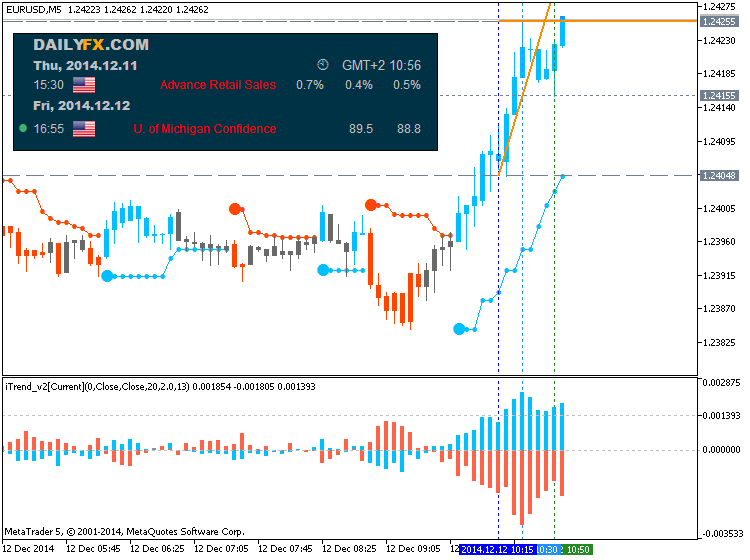
Another uptick in the U. of Michigan Confidence survey may spur a further decline in the EUR/USD amid growing speculation for a Fed rate hike in mid-2015.
What’s Expected:
Why Is This Event Important:
Positive data prints coming out of the U.S economy should continue to fuel interest rate expectations and heighten the bullish sentiment surrounding the greenback as a growing number of Fed officials scale back their dovish tone for monetary policy.
However, we the survey may disappoint as U.S. households face sticky price pressures paired with the ongoing slack in the real economy, and a dismal print may spur a larger correction in the greenback as it drags on expectations for higher borrowing-costs.
How To Trade This Event Risk
Bullish USD Trade: U. of Michigan Survey Climbs to 89.5 or Higher
- Need to see red, five-minute candle following the release to consider a short trade on EURUSD
- If market reaction favors a long dollar trade, sell EURUSD with two separate position
- Set stop at the near-by swing high/reasonable distance from entry; look for at least 1:1 risk-to-reward
- Move stop to entry on remaining position once initial target is hit; set reasonable limit
Bearish USD Trade: Consumer Confidence Falls Short of Market Forecast- Need green, five-minute candle to favor a long EURUSD trade
- Implement same setup as the bullish dollar trade, just in the opposite direction
Potential Price Targets For The ReleaseEUR/USD Daily Chart
- Failed attempts to close above 1.2450-70 may highlight
near-term topping process for EUR/USD especially as the RSI largely
retains a bearish momentum.
- Interim Resistance: 1.2600 pivot to 1.2610 (61.8% expansion)
- Interim Support: 1.2280 (100% expansion) to 1.2290 (38.2% expansion)
Impact that the U. of Michigan Confidence has had on EUR/USD during the last release(1 Hour post event )
(End of Day post event)
2014
The U. of Michigan Confidence survey unexpectedly surged to 89.4 in November from 86.9 the month prior to mark the fourth consecutive advance. Despite the uptick in sentiment, 12-month inflation expectations weakened further during the same period, with the figure slowing to an annualized 2.6% from 2.9% in October. Nevertheless, the ongoing improvement may highlight a stronger recovery for the U.S. economy as private-sector consumption remains one of the leading drivers of growth. The initial bullish dollar reaction was very short-lived as EUR/USD pushed back above the 1.2450 region following the data print, with the pair ending the day at 1.2521.
AUDIO - Global Commodities with Frank Holmes (based on dailyfx article)
CEO and Chief Investment Officer of U.S Global Investors, Frank Holmes joins Merlin Rothfeld and John O’Donnell for a look at the macro issues facing global markets. Demographics play a big part in Mr. Holmes’s optimistic view about markets going forward. The trio also look at the prospects for Oil moving forward and a potential bottom around $50.

The US dollar retraced some of the previous gains but managed to retrace the retracement as well. Japan’s Lower House Elections, UK inflation and employment data and the most important event: the last Fed decision for the year are the main highlights for this week. Follow along as we explore the Forex market movers.
The US consumer is certainly upbeat: US retail sales release showed Americans spent 0.7% more in November compared to the previous month and core sales followed suit. Also confidence is high, the highest since January 2007 according to UoM. This is partially attributed to the collapse in oil prices, which is hurting the Canadian dollar. In the euro-zone, the highly anticipated TLTRO fell short of predictions, strengthening the notion that QE is coming to the old continent. The antipodean currencies took different directions: the Aussie got a target of 0.75 from the central bank, while the New Zealand’s central bank seemed upbeat. Volatility continues being high despite the upcoming holidays. And now, we have the most important central bank speaking out:
GBPUSD Fundamentals (based on dailyfx article)
Fundamental Forecast for Pound: NeutralThe British Pound finished the week modestly higher but continued to trade in a tight range versus the US Dollar. A busy week ahead threatens to force a decisive break in the GBPUSD and other pairs.
The simultaneous release of UK Jobless Claims and Earnings data with Bank of England Minutes will likely prove the highlight in the days ahead, and GBPUSD traders should likewise keep a close eye on a highly-anticipated US Federal Reserve interest rate decision that same day. Earlier-week UK Consumer Price Index inflation figures as well as late-week UK Retail Sales results could also elicit reactions from GBP pairs.
Whether or not the Sterling mounts a sustained recovery versus the US Dollar will likely depend on the direction of interest rate expectations for both the Bank of England and the US Federal Reserve. A sharp compression in the spread between UK and US government bond yields helps explain why the British Pound fell to fresh 14-month lows versus the Greenback through November. Yet a great deal of uncertainty surrounds both the Fed and BoE; any surprises out of the coming week’s economic data and central bank rhetoric could easily force a repricing of yields and the GBPUSD exchange rate.
The US Dollar in particular looks vulnerable on any disappointments from the Federal Reserve, and indeed the previously-unstoppable USD finally showed concrete signs of slowing through the past week of trade. And though the Sterling could itself see fairly significant volatility on UK event risk, we expect that the overall US Dollar trend will ultimately dictate whether the GBPUSD makes a sustained recovery.
USDJPY Fundamentals (based on dailyfx article)
Fundamental Forecast for Japanese Yen: NeutralThe near-term outlook for USD/JPY remains mired by Japan’s December 14 snap election, but the ongoing deviation in the policy outlook should continue to produce a further advance in the exchange rate as a growing number of Fed officials show a greater willingness to normalize monetary policy in 2015.
Despite the risk for a material shift in fiscal policy, recent headlines suggests ‘Abenomics’ will continue to influence the Japanese Yen in the year ahead as the Liberal Democratic Party (LDP) is widely expected to retain majority in the lower-house of the National Diet. As a result, the Bank of Japan (BoJ) may continue to highlight a dovish outlook for monetary policy at the December 19 meeting, and Governor Haruhiko Kuroda may keep the door open to further expand the asset-purchase program as the technical recession undermines the central bank’s scope to achieve the 2% target for inflation.
In contrast, there’s growing speculation the Federal Open Market Committee (FOMC) will remove the ‘considerable time’ phrase and implement a more hawkish twist to the forward-guidance as lower energy costs boost disposable incomes for U.S. households. The improved outlook for personal consumption – one of the leading drivers of growth – may encourage the Fed to boost its economic and interest rate projections as the central bank anticipates a stronger recovery in 2015. With that said, the bullish sentiment surrounding the greenback may gather pace over the remainder of the year should the fresh developments coming out of the FOMC heighten interest rate expectations.
In turn, the fundamental outlook continues to cast a long-term bullish outlook for USD/JPY, and we will retain the approach to buy-dips in the exchange rate unless there’s a meaningful change in fiscal/monetary policy. Dollar-yen appears to be coiling for a move higher as it holds above the 117.00 handle, with the next key topside objective for USD/JPY comes in around 122.30-40, the 78.6% Fibonacci retracement from the 2002 decline.