Entry and exit arrow
- Göstergeler
- Sürüm: 1.10
- Etkinleştirmeler: 5

ENTRY AND EXIT ARROWS Indicator – Description
The Entry and Exit Arrows indicator is a simple yet effective momentum-based tool designed to highlight potential buy and sell opportunities directly on the chart using visual arrows.
It works by comparing two internal momentum measurements with different sensitivities. When both measurements align in the same direction, the indicator confirms a stronger directional bias and plots a signal.
🔹 How It Works
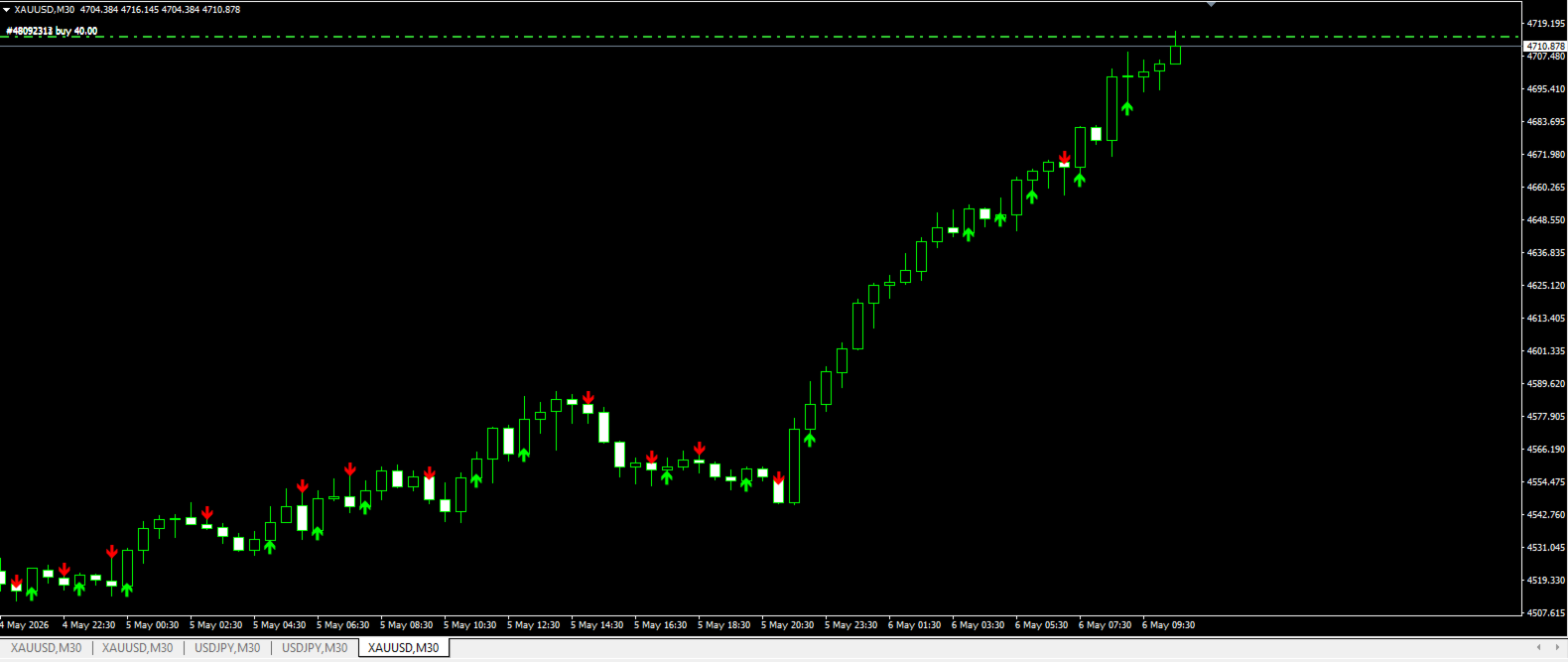
- Buy Signal (Lime Arrow Below Candle):
Appears when market momentum strengthens to the upside across both internal calculations. This suggests a potential upward move or continuation. - Sell Signal (Red Arrow Above Candle):
Appears when market momentum weakens and shifts downward across both internal calculations. This indicates a possible downward move or continuation.
🔹 Key Features
- Dual Momentum Confirmation:
Signals are only generated when both fast and slow momentum components agree, reducing noise and false entries. - Non-Repainting Logic:
Once an arrow appears on a closed candle, it remains fixed, ensuring reliable backtesting and live usage. - Customizable Sensitivity:
Users can adjust internal calculation periods and price types to suit different trading styles (scalping, intraday, swing). - Adjustable Arrow Positioning:
Arrows can be visually spaced from candles for clearer chart readability. - Optional Alerts:
Real-time pop-up and sound alerts notify traders instantly when a new signal is generated. - Performance Optimization:
Limits calculations to a defined number of recent bars for efficiency.
🔹 Best Use Cases
- Trend-following strategies
- Entry confirmation alongside support/resistance
- Scalping and short-term trading
- Filtering trade direction in automated systems (EAs)
🔹 Trading Insight
This indicator performs best in trending or momentum-driven markets. For higher accuracy, it is recommended to combine it with:
- Trend filters (e.g., moving averages)
- Key levels (support/resistance)
- Market structure analysis