Grid TrendMaster Pro EA
- Experts
-
AL MOOSAWI ABDULLAH JAFFER BAQER
 To trade successfully we need to go through the proven path that others had gone and reached!
Here are 17 quotes from such successful investors:
1- Limit your size in any position so that fear does not become the prevailing instinct guiding your judgment.
Joe Vidich - Versão: 3.0
- Ativações: 5
| • Please test the product in the Strategy Tester before purchasing to understand how it works. • If you face any issues, contact me via private message—I’m always available to help. • After purchase, send me a screenshot of your order to receive a FREE EA as a gift. |
|---|
Grid TrendMaster Pro EA
SHORT DESCRIPTION
The TrendMaster Pro strategy, wired into a complete grid, hedge and cycle engine. Price against a long reference average decides when and which way a cycle starts. Everything after that - the ladder, the fragmenting closer, the target slicer, the reopen guard, the optional hedge cycle - is handled by an engine that was built to keep a grid alive rather than to hope it never goes wrong.
WHAT THIS EA IS
Most grid robots are one idea: open a level, open another one further away, and wait. That works until it does not. This EA is three engines that share one chart and one account, wired together so money only ever flows in one direction.
1. THE OPENER - TRENDMASTER PRO
Two jobs, cleanly separated, and that separation is the entire design.
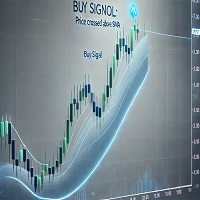
DIRECTION is decided by one thing only: whether the applied price is above or below a long reference average. Nothing else votes. No oscillator, no confirmation, no second opinion.
Typical price is the default rather than the close, and that is deliberate. The close is the single most manipulable price on any bar - it is whatever the last tick before the bar ended happened to be, and on a thin instrument at a session boundary that can be almost anything. The typical price averages the high, the low and the close, and cannot be set by one tick.
The TREND LINE does not decide direction at all. It is a stop line, drawn one volatility band away from the bar, and it ratchets: in an uptrend it may only rise, in a downtrend it may only fall. Its job is to show where the move would have to go to be wrong. It is drawn from ATR or from the standard deviation, and those two behave differently - ATR reacts to gaps because true range includes them, the standard deviation does not.
Most trend tools tangle these two jobs together, using the trailing line to set the direction as well as to display it. Then they wobble, because the thing setting the direction is also the thing chasing price. Here the direction is a clean binary and the line is purely informational, so neither can corrupt the other.
The EA arms a cycle when the direction changes hands, or follows it continuously if you would rather join a move already under way.
2. THE LADDER
Once a cycle is armed, the grid builds. BUY and SELL grids run independently, each with its own anchor, its own level counter, its own spacing and its own bar gate, so a market that trends one way and ranges the other is not forced into a single model. Single-grid mode is there when you want one direction at a time.
Spacing is fixed points or ATR-driven, with a floor, a ceiling and an option to freeze the ATR value for the whole cycle so the spacing does not drift under you mid-cycle. A per-level multiplier lets the grid widen as it goes deeper.
Lots climb by multiplication or by addition. Additive is the honest choice for most accounts: 0.01, 0.02, 0.03, 0.04 rather than a curve that doubles into margin call. Auto-lot scales the starting size with the balance, and scaling down is opt-in rather than assumed.
3. THE CLOSER - AND THIS IS THE REAL DIFFERENCE
A normal grid closes the oldest order against the newest and waits for the pair to cover its own cost. When the market does not come back, nothing closes, and the book grows.
This closer does not wait.
It scans combinations of both ends of the book - several of the oldest orders against several of the newest - and ranks the qualifying combinations by how much of the book each one clears. It counts swap and it counts commission, both sides, from your own trade history rather than from a number you typed in.
When no whole combination can cover the target, it buys a SLICE. Part of the oldest order is closed, paid for by the profit the newest orders have already made, and the rest of that order is remembered in a ledger. The ledger survives restarts, reattaches and terminal crashes, and the part already killed is rebuilt from deal history every time rather than trusted from storage. Over several slices the oldest, heaviest order is retired piece by piece while the market does whatever it wants.
A reopen guard refuses any closure that would immediately reopen the level it just closed, which is the quiet way most grids churn their own account into commission.
4. THE HEDGE CYCLE - OFF BY DEFAULT
An optional volume engine. It opens a perfect hedge - equal BUY and SELL on a rotating list of symbols - and then retires it in slices, each slice funded by a small surcharge added to the closures the grid was making anyway. The hedge is held in balance, verified on a timer, and repaired automatically if one leg is left naked.
There are hard limits on what the hedge may cost. A cap in money on a single closure, a cap as a percentage of any closure's target, and a weekly cash-day window that can hold new cycles and new slices before a withdrawal.
This is off by default and deliberately so. With it off, this EA is the direction reading driving a dual grid with a fragmenting closer, and nothing else is touched.
5. EXECUTION YOU CAN AUDIT
Every closure is a plan that is scanned, sent leg by leg, and then verified against the deal history. A leg that does not fill goes to a retry queue instead of being assumed. A market that refuses orders makes the EA wait rather than burn its retry budget. A book that changed between the scan and the send aborts the plan.
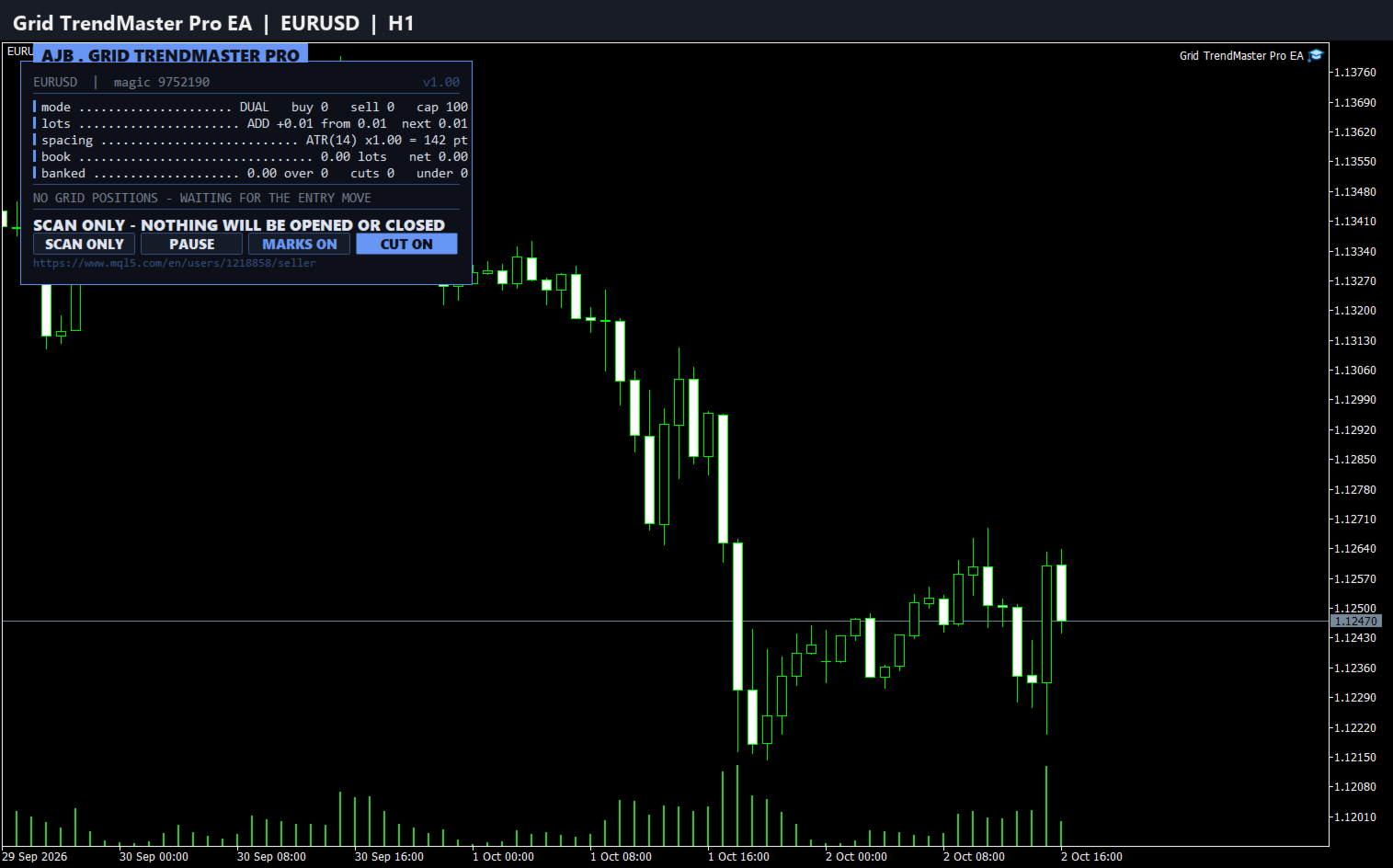
There is a run mode that scans and reports without trading, so you can watch what it would have done before you let it do anything.
6. THE PANEL
This product has its own panel, not a shared one. The theme is MASTER LINE: authoritative and plain: a dark navy base, one strong accent, and no decoration anywhere. Royal blue owns the grid, brass owns the hedge, and both cards sit low on the chart on a wide pitch, the way a stop line wants to be read.
Both cards are drawn in English with an Arabic line underneath, and both can be switched off. In a non-visual backtest nothing is drawn at all, so optimisation runs at full speed.
MAIN SETTINGS
Entry trigger: Strategy only, Distance only, or Both
Trend period, applied price, volatility period
ATR or standard deviation, direction-change-only firing, warm-up bars
Trade mode: dual grid or single grid
Spacing: fixed points or ATR, with floor, ceiling, freeze and per-level multiplier
Lots: multiply or add, maximum per order, auto-lot on balance
Profit target: fixed or scaled by volume, depth and a safety cap
Fragment scanner: how many oldest and newest orders may club together
Target slicing: minimum slice size, profit weighting, full-closure preference
Reopen guard, minimum margin level, maximum floating loss, maximum orders
Hedge cycle: symbols, rotation, cycle lots, slice lots, bonus, caps, repair
Panel position, font size, table depth, Arabic display, chart marks, verbose logging
REQUIREMENTS
A HEDGING account is required. On a netting account every grid level merges into one position, so there is nothing to fragment and no way to hold a hedge. The EA checks this at startup and stops with a clear message rather than misbehaving quietly.
Works on any symbol and any timeframe. No DLLs, no external indicator files, nothing to install beyond the EA itself. The strategy maths is written into the EA, so the reading on the chart and the reading it trades from are the same number.
A NOTE ON EXPECTATIONS
A grid is a way of managing a position, not a way of predicting a market. Price against the reference average decides when to start and which way to face. The closer and the slicer are what keep a cycle from becoming permanent. Size the ladder for the account you actually have, test on your own broker's spreads and swap, and start with the hedge cycle off.
Set files for the main configurations are included. Questions and setup help are welcome through private message.