Sterling Crest
- Experts
- Versão: 1.21
- Atualizado: 13 outubro 2026
- Ativações: 5

A Disciplined Limit-Order Entry System for MetaTrader 4
Overview
Most retail Expert Advisors open a market order as soon as a signal appears, accepting whatever price the market is offering at that moment.
Sterling Crest takes a different approach. Once a trend setup has been confirmed, the Expert Advisor places a pending limit order and waits for the market to return to the selected level. The objective is to enter at a price determined by the strategy rather than simply accepting the price currently imposed by the market.
The system is built around:
- a trend engine with ADX-based trend-strength filtering;
- an adaptive ATR-based entry channel;
- a two-stage trailing system;
- separate management of pending orders and open positions;
- configurable position sizing and risk management;
- optional position-chain construction.
1. Volatility Foundation
SignalATRLength measures current market volatility through ATR and determines the scale of the entry channel.
This allows the entry structure to adapt to the current volatility characteristics of the instrument.
2. Trend-Strength Filter
SignalADXThreshold defines the minimum trend strength that a setup must exceed before it can be considered by the system.
Quiet and range-bound market conditions are filtered out before the remaining order-management logic is activated.
3. Separate Entry and Holding Criteria
SignaADXOpenConfirmation defines how strong the trend must be to justify opening a new position.
SignaADXExitConfirmation defines how strong the trend must remain to justify continuing to hold an existing position.
This creates two independently configurable thresholds rather than relying on a single rule for both entry and position retention.
4. Asymmetric Entry Channel
SignalUpperMultiplier and SignaLowerMultiplier independently scale the upper and lower boundaries of the ATR channel.
This makes it possible to account for the fact that an instrument may exhibit different volatility and price behavior during upward and downward movements.
5. Secondary Filter
SignalOverboughtLevel and SignalMeasure provide an additional validation layer based on period and width on top of the primary channel.
Their purpose is to filter out setups that appear valid only from one side of the primary signal structure.
6. Adaptive Sensitivity
SignalThreshold continuously adjusts the strictness of the overall signal block from bar to bar.
Instead of relying on a single fixed threshold, the system can adapt its sensitivity to changing market conditions.
Sterling Crest uses a two-stage system for entry and position management.
Stage 1 — Pending Limit Order
Once a setup has been confirmed, the Expert Advisor places either:
- Buy Limit — for a long-side scenario;
- Sell Limit — for a short-side scenario.
The distance from the current market price is determined by:
LevelStart
The objective is to seek a more favorable entry price than would be available through an immediate market execution.
Pending-Order Trailing
While the limit order remains unfilled, TrailPendingActive enables active management of the pending order.
The adjustment step is defined by:
TrailPending
This allows the pending order to be repositioned as the market moves, preventing the intended entry level from becoming unnecessarily distant from the current price.
Once the pending limit order is executed, the second, fully independent trailing mechanism takes control of the open position.
TrailingEngineActive activates position trailing once floating profit reaches:
TrailEngagementDistance
After activation, the trailing mechanism operates using:
TrailStepPoints
The complete process can therefore be viewed as:
Pending Order → Execution → Open Position → Position Trailing
This separation allows Sterling Crest to manage the trade independently before and after actual execution.
Profit and Loss Protection
The open position is managed using:
- ProfitCeilingPoints — working take-profit distance;
- LossFloorPoints — working stop-loss distance.
Position Sizing
Sterling Crest supports two primary position-sizing modes.
Fixed Position Size
BaseContractSize defines a fixed position size.
Automatic Capital-Based Sizing
When AutoCapitalRegulationOn is enabled, position size is calculated relative to account balance using:
CapitalExposureRatio
This allows position exposure to scale with available capital.
If the market continues moving through the signal zone, the Expert Advisor can add additional positions.
The maximum chain depth is determined by:
PositionChainDepth
The size of subsequent positions can be scaled using:
AllocationScalingExponent
As a result, total market exposure depends not only on the initial position size, but also on the number of positions accumulated within the chain and the selected scaling factor.
CorrectionStrategy controls an additional risk-correction mechanism.
When set to:
0 — Disabled
the feature is turned off.
When enabled, the system progressively reduces stop distances as the position chain becomes longer, helping to automatically reduce risk during unusually extended sequences of positions.
Long and short exposure can be controlled independently:
- LongExposureEnabled — enables or disables long positions;
- ShortExposureEnabled — enables or disables short positions.
This allows the strategy to operate on both market directions or restrict trading to only one side.
Order Identification
StrategyInstanceID provides a unique identifier for the strategy instance.
ExecutionTag is used as the order comment.
Together, these parameters help keep Sterling Crest orders clearly separated from trades generated by other Expert Advisors or manual trading activity on the same account.
ECN Execution Mode
InstitutionalExecutionMode switches the Expert Advisor into an execution mode designed for ECN-style brokers, where a specific order-processing sequence may be required.
1. Test Before Live Deployment
Before deploying Sterling Crest on a live account, thoroughly test the Expert Advisor on the intended:
- financial instrument;
- timeframe;
- historical period;
- quotation/tick-data conditions.
Where possible, use real-tick testing for a more representative evaluation of execution behavior.
2. Tune ATR and ADX to the Instrument
The signal block, including the ATR/ADX parameters and channel multipliers, should be configured according to the typical volatility and behavior of the specific instrument.
Parameters that perform well on one market are not necessarily appropriate for another.
3. Treat LevelStart and Pending-Order Trailing as a Single Configuration Block
LevelStart, TrailPendingActive, and TrailPending collectively determine how patient the entry mechanism is.
For this reason, these parameters should generally be evaluated and optimized as a related group, rather than independently.
4. Account for Position-Chain Exposure
When configuring:
- PositionChainDepth;
- AllocationScalingExponent;
evaluate the total potential exposure of the strategy rather than focusing solely on the initial position size.
Overall risk can increase substantially as additional positions are added to the chain, even when the initial position remains relatively small.
5. Start on a Demo Account
Before moving to live trading, run Sterling Crest on a demo account.
This provides an opportunity to observe:
- actual pending-limit entry behavior;
- pending-order trailing;
- the transition from pending order to open position;
- the second-stage position trailing;
- position-chain formation;
- actual capital and margin requirements.
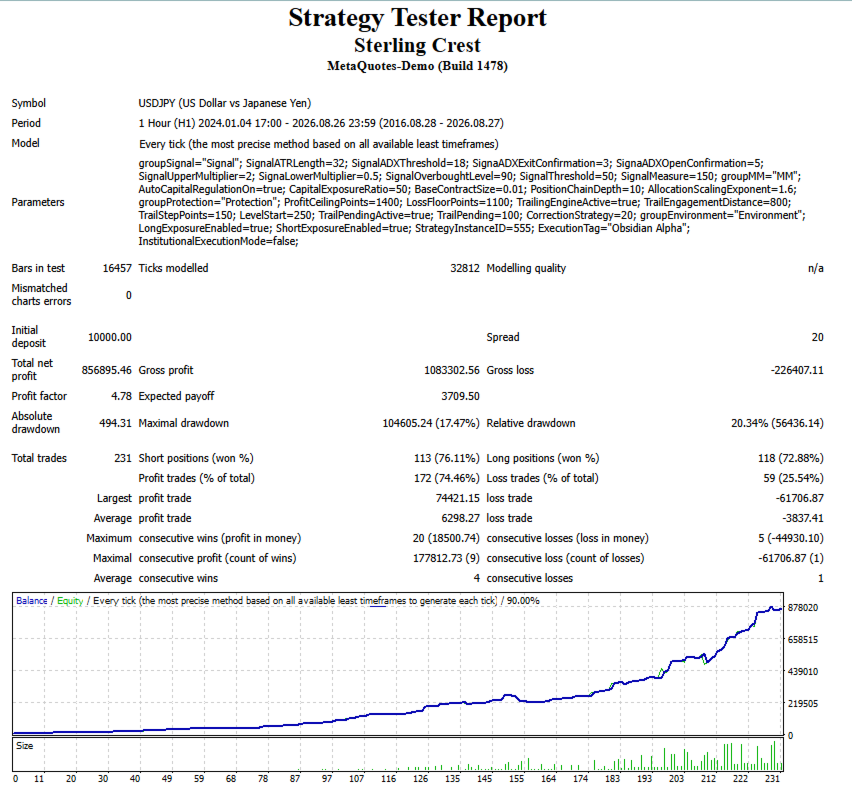
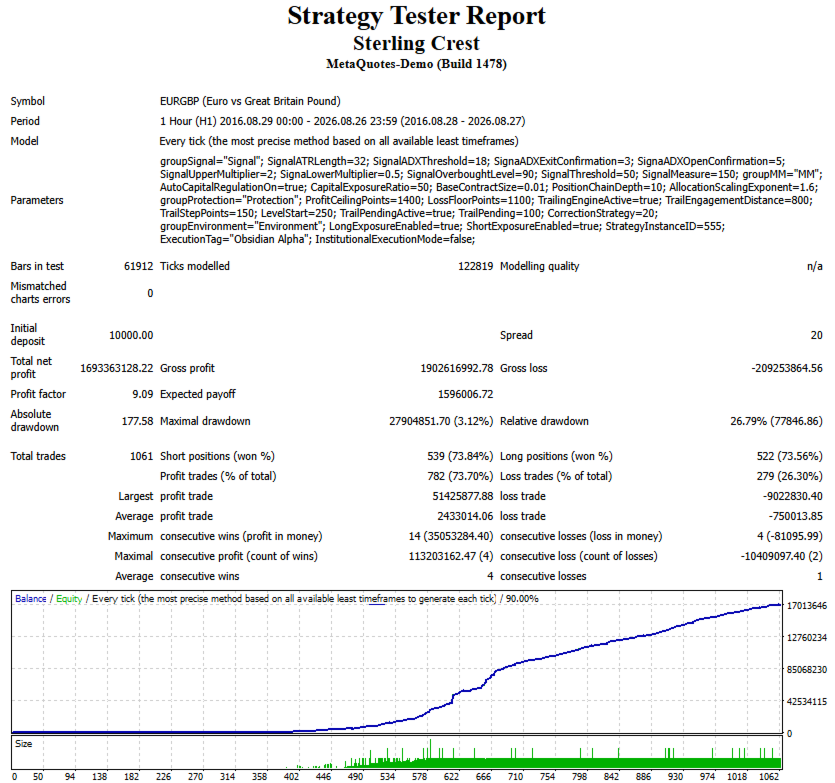
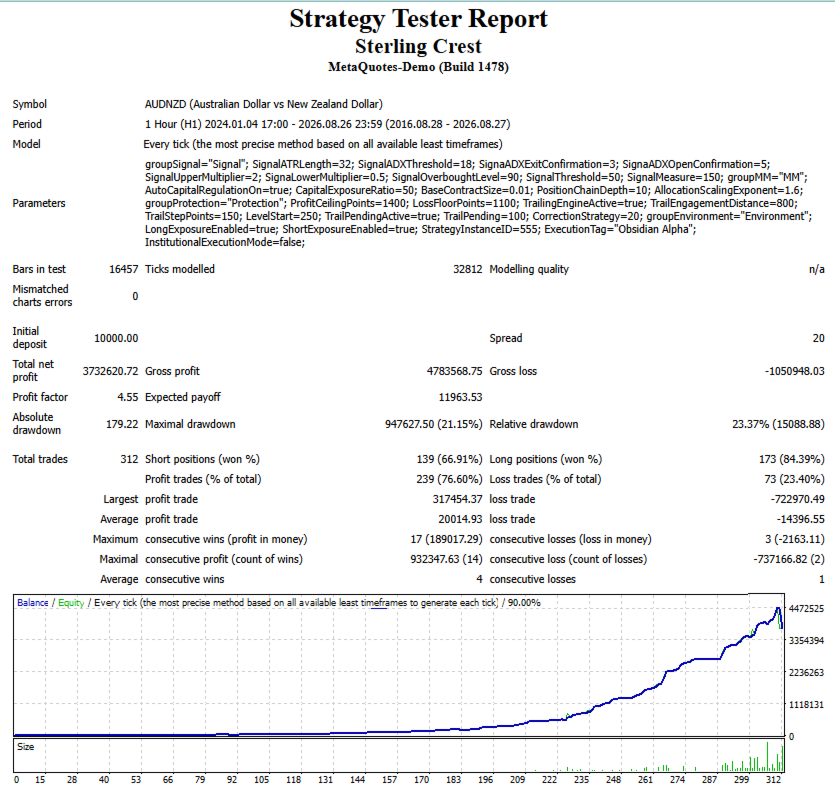
Trading financial markets involves a significant risk of capital loss.
Results obtained from historical data and strategy-tester simulations do not guarantee comparable results in live trading.
Before using the Expert Advisor on a live account, thoroughly test it on a demo account and ensure that:
- you fully understand the strategy logic;
- position sizing is consistent with your risk tolerance;
- PositionChainDepth and AllocationScalingExponent adequately account for potential growth in total exposure;
- stop-loss and other protective parameters are appropriate for your risk-management framework.
Sterling Crest is a tool for automating a trading strategy. It is not a guarantee of profitability or future trading performance.