Master KJ
- Experts
-
Khaled Haider Yousef Al Jboor
 Algorithmic trading developer and the author of MASTER KJ, a five-book trend-following Expert Advisor for MetaTrader 5.
- 버전: 3.26
- 활성화: 5
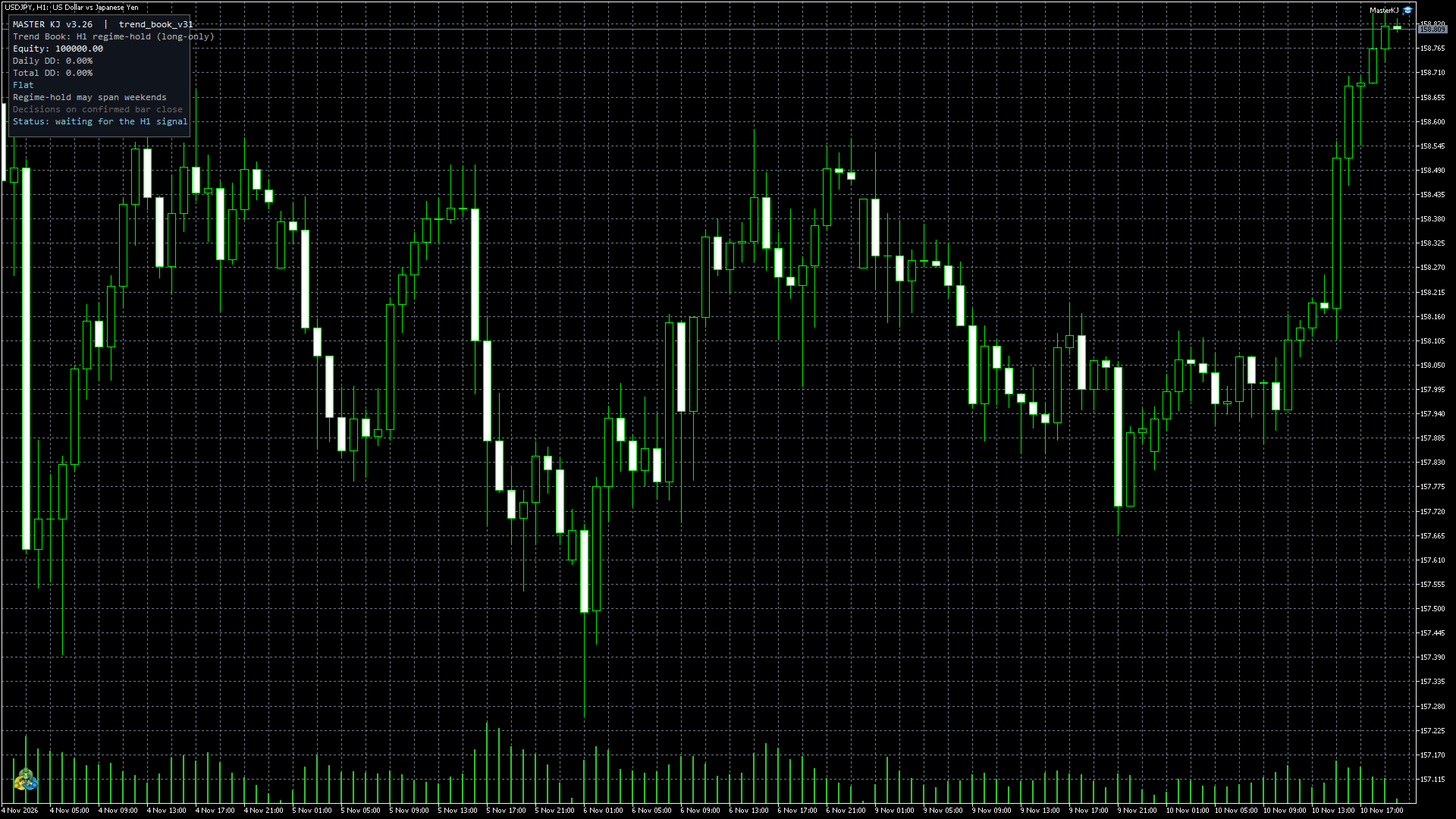
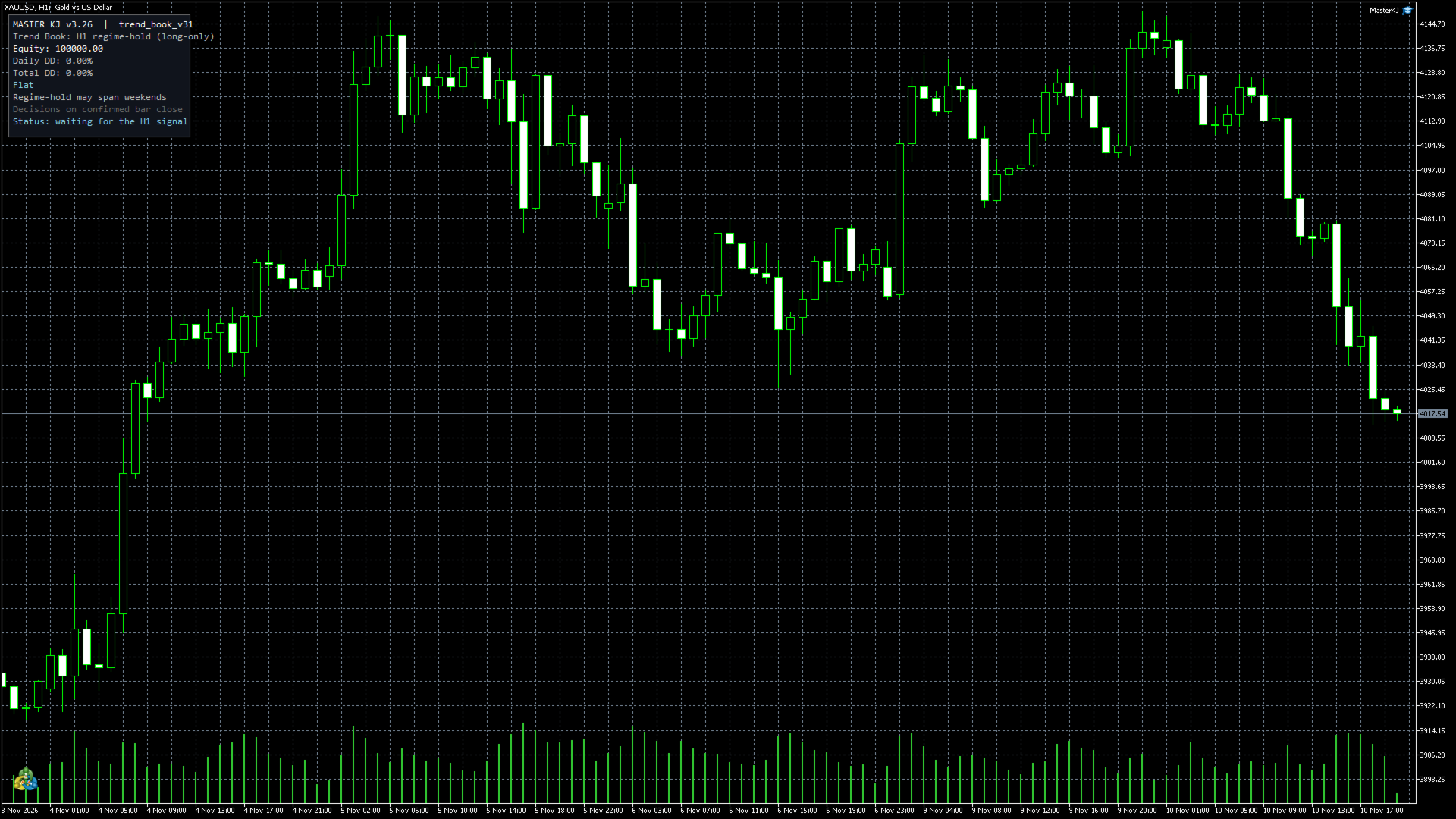
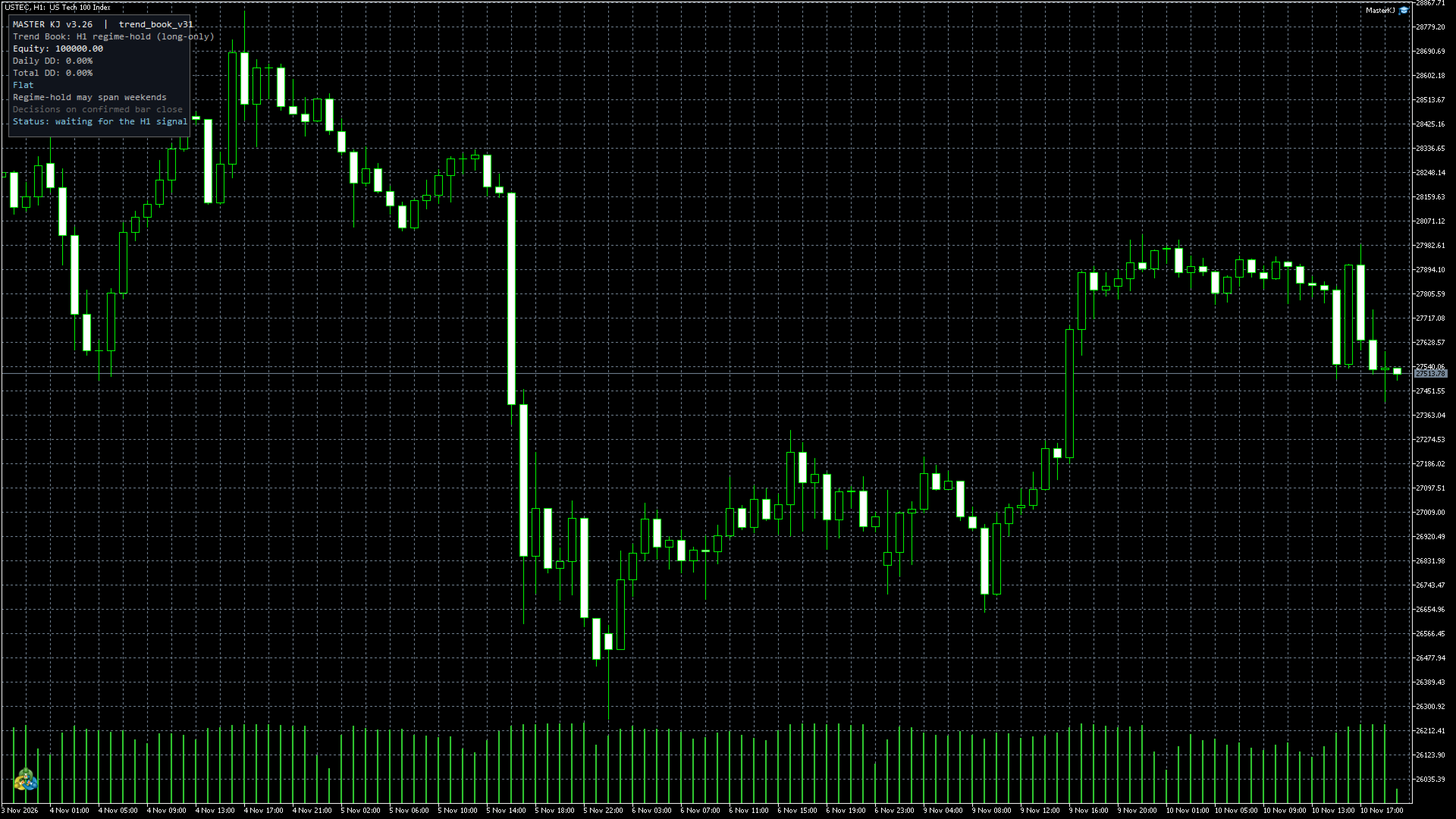
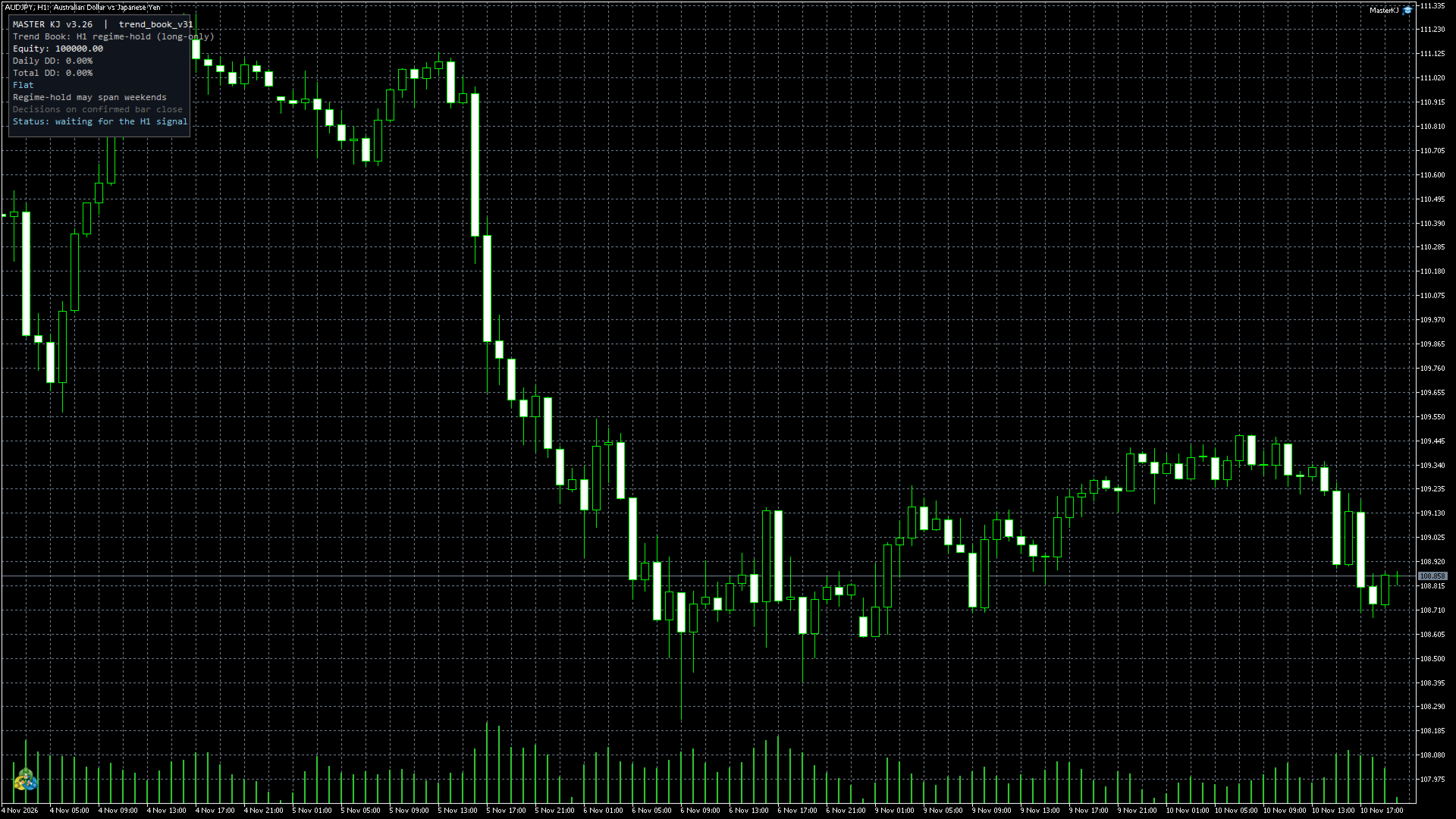
MASTER KJ is a trend Expert Advisor for MetaTrader 5: five H1 trend books on USDJPY, XAUUSD, NAS100 (USTEC), AUDJPY and EURJPY.
Long-only — the books never sell short. They buy sustained H1 trends and hold them for days to weeks by design. One position per book, one book per symbol, five charts to install. The USDJPY book may add up to two pyramiding positions on new trend highs on a hedging account — on a netting account that book runs single-position; disclosed in the manual. Every order carries a hard stop-loss.
It is built for the trader who wants simple, auditable mechanics instead of a black box: five books on five symbols (USDJPY, XAUUSD, NAS100 — the common broker name is USTEC — AUDJPY, EURJPY, all on H1), risk presets that differ only in risk (one disclosed exception: the USDJPY preset enables that book's measured pyramiding) — and every performance figure below is a measured, archived result with its measurement basis stated. No martingale, no grid, no lot escalation after a loss. What you see is exactly the mechanics that were tested — the configuration differences (the live-only protections, the drawdown halts, the news blackout) are disclosed where they appear below, and each book runs its own calibrated parameters.
Delivered version: 3.26
What's new in 3.26: a closed-session guard — new entries are not sent while the broker reports the symbol's trading session closed, every skip is counted and the journal reports the block once per episode, with the totals at shutdown. The journal self-documents the running configuration and the panel shows the version and the status. The broker-compatibility fixes from the earlier releases are all carried forward and re-verified. On every tick the EA re-checks its open position against the account's, so a position closed outside it — or opened while it was restarting — is reconciled instead of mis-tracked. A close is deferred and retried when the price sits inside the broker's freeze zone around the stops. Order sizes are clamped to the broker's limits. And every pyramiding add is checked against your account's hedging/netting mode before it is sent. The full feature list is in the user manual.
Past performance does not guarantee future results. Trading involves substantial risk of loss.
The product
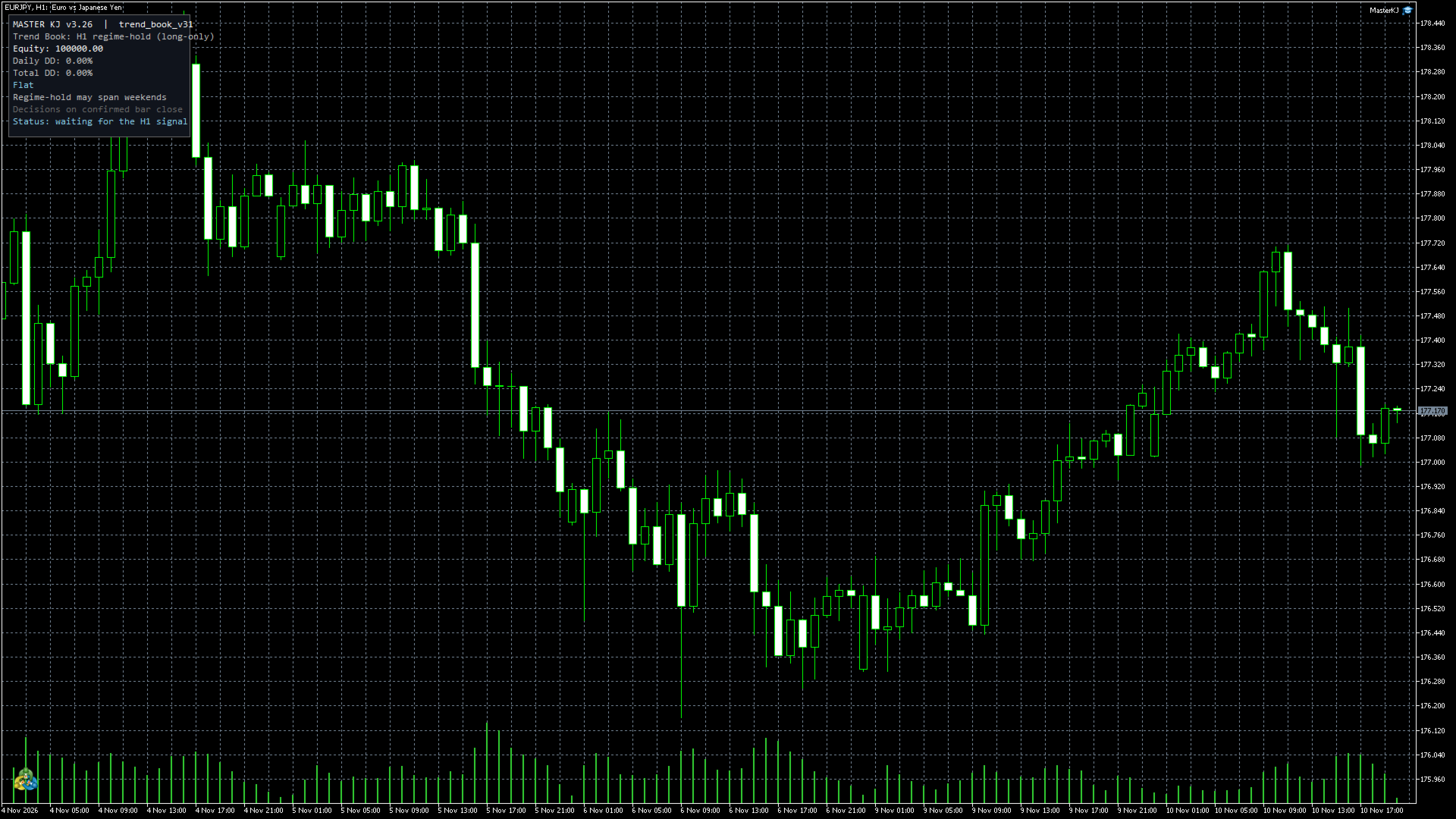
MASTER KJ v3.26 runs five trend books on H1:
- Enter: price closes above both the 200-bar SMA and the prior 55-bar Donchian high (the highest high of the previous 55 bars).
- Hold: while the regime persists — positions run for days to weeks by design. This is a patient trend system, not a scalper.
- Exit: on the regime flip. One position per book (the USDJPY book may add up to two pyramiding positions — disclosed in the manual). The five books share no symbol, so the four non-USDJPY books run on netting or hedging accounts alike. The USDJPY book's pyramiding needs hedging-mode position separation: on a netting account the EA runs that book in its single-position configuration (the pyramiding adds are disabled and the attach journal says so; the measured USDJPY figures were recorded with pyramiding on a hedging account).
Every order carries a hard stop-loss sized so a 5% adverse move costs at most 2% of equity at the shipped settings; margin is checked before every book entry (the USDJPY pyramiding adds rely on the per-trade sizing clamps — the manual's pyramiding note discloses this); position size is volume-step normalized and clamped to the broker's limits; the EA's daily (5%) and total (10%) drawdown halts block re-entry and exit the open position at the next H1 bar close. Live entry gating is additionally stricter than the backtest: a book's first entry (while that book is flat) is refused when the open positions' combined risk-at-stop plus the new trade's own risk-at-stop exceeds the total (10%) drawdown budget. No martingale, no grid, no lot escalation after a loss, no SL-less code paths.
Risk presets are risk-per-trade multipliers of one strategy (the one disclosed exception: the USDJPY preset enables that book's pyramiding, exactly as measured): Conservative 0.375% / Balanced 0.75% / Aggressive 3.00% of account equity per trade, with the per-trade disaster cap (a 5% adverse move costs at most 2% of equity) applying at every preset. A dedicated Prop-Firm Mode freezes the risk caps at 5% daily / 10% total — the way the major funded-account programs measure them (against your initial balance, with a configurable day-boundary alignment) — and a default-on high-impact news blackout (30 minutes before / 15 after, both currencies of each pair) stands guard. The risk preset changes the risk fraction — between the presets, the USDJPY pyramiding exception above is the only strategy-level difference, and it is the measured configuration. No preset files needed: attach the EA to a shipped book's chart and it applies that book's measured settings automatically. The fill applies to inputs still at their shipped defaults — a value identical to a default is indistinguishable from an untouched one, and the attach journal line is always the truth about what is running. The published figures below are the shipped conservative configuration at the deployed 1x multiple — the deployment is conservative by measured verdict.
Performance — measured, not projected
DISCLOSURE (honest labelling): the primary table is a backtest on a quality-adjusted historical dataset stitched from multiple broker price feeds, over the fixed window 2015-01-01 to 2026-08-31 (11.58 years of trade span), the five books' trade streams combined: 1,657 trades at the conservative risk. These are backtest results — not live performance — and the window itself is in-sample (the strategy's parameters were derived on it). The equity paths are measured by per-trade compounding; the EA's shipped 5%/10% drawdown halts are an additional protection layer not present in the measured path — and the same is true of the default-on (switchable) high-impact news blackout: the strategy tester cannot reproduce the economic calendar, so every published figure ran blackout-free. A deeper basis (the same engine on the full-depth corpus) is published below with its own honest labels.
The recent window (2023-2026) — all five books positive, in-sample by selection
These are backtest results — broker-data tester runs, not live performance.
In broker-data tester runs on a broker demo account (Tickmill EU, 100,000 USD virtual; leverage 1:100; January 2023 → June 2026, one 100,000 USD account per book, each book independently, 1-minute OHLC modelling), each book measured alone on its own account:
| Book | Net profit | Trades | Profit factor | Max balance drawdown |
| XAUUSD | +10,317 USD | 156 | 1.61 | 2.70% |
| USDJPY | +6,822 USD | 126 | 1.68 | 1.57% |
| AUDJPY | +4,568 USD | 132 | 1.33 | 3.05% |
| EURJPY | +2,765 USD | 137 | 1.24 | 1.66% |
| NAS100 (USTEC) | +2,512 USD | 125 | 1.09 | 5.76% |
All five books positive, led by XAUUSD and the USDJPY engine. These are the shipped H1 books' own records on this broker data; the long-window figures further below count the two sparse books on their daily-timeframe folds. The drawdown column is each book's own balance drawdown over this 3.5-year window, exactly as the tester reports it; the combined 2015-2026 record further below carries the 11.81% maximum drawdown. Each book's total above is the broker's own reported net profit for its run: the EA's emitted per-trade profit equals that trade's profit + commission + swap, and the EA's emitted total ties to the broker's total after the tester's end-of-run forced close of any still-open position (EURJPY held one at the run's end; that forced close is inside its 137-trade count). On the longer, deeper corpus the index book's own record is slightly negative (−1.11% over its 2022-07+ span, all of it inside the in-sample era); every book's standalone record is in the user manual.
A note on the measurement records: the figures above are the 2026-10-27 measured run. A separate confirmation run of the same labeled basis — same five books, same window, same tester settings — measured slightly different totals (e.g. USDJPY +6,850.54); all five books positive in both runs. Both are real measurements of the same basis; neither figure is projected.
The selection, stated plainly: the five books were retained because they are positive on this window. It is a robustness fact about the roster, not out-of-sample evidence, and we label it that way.
Primary basis — the fixed 2015-2026 window (in-sample)
| Measure | Result |
| Trades | 1,657 across five books over 11.58 years |
| Net return | +86.08% |
| Compound annual growth rate (CAGR), whole window, engine basis | 5.507% per year |
| CAGR, 2021 to 2026, census basis | 2.258% per year |
| Maximum drawdown | 11.81% |
| Modelled probability of ruin (stress basis: returns at 40% of measured) | 0.000 |
Honest note on the two conventions: the 5.507%/yr row and the 2.258% row are measured under two different, both-disclosed conventions (the engine basis and the census basis) and are never mixed. On the census basis — the convention behind the buyer-window row — the measured eras rise across the window, and the most recent (2021-2026) era reads 2.258%/yr. The most recent window is the strongest era measured on that basis, not the weakest. The earlier era buckets are deliberately not quoted here: the earliest is nominal-year-diluted on this 2015-start window (it holds barely two years of actual trades inside a nominal 17-year denominator). The buyer window itself is fully covered. Honest era shape: over the deep window the income is concentrated in the most recent era — the 2021-2026 buyer window carries the majority of the measured net (the census basis), and it reads 2.258%/yr. In dollars at that historical rate (the 2.258% row): $10,000 → about $11,350 after 5.67 years, before your always-on costs (a VPS runs about $30-60/month). The running costs exceed the historical-rate gain below roughly $16,000-$32,000 of account equity — that gain covers a VPS alone only above that range.
Trade share, stated plainly: 1,490 of the 1,657 measured trades (89.9%) come from two books (USDJPY 1,016 and XAUUSD 474); NAS100 adds 136; AUDJPY and EURJPY are rare (15 and 16 trades — roughly one per year each) and their record is backtest-only. In the long measurement window these two books are measured as sparse daily-timeframe breadth folds (that is why they trade so rarely), while the 2023-2026 demo window ran all five books on H1.
The deep long-run basis — the same engine, full-depth corpus
Backtest results — not live performance.
| Measure | Result |
| Trades | 2,302 (1,657 since 2015, in-sample; 645 before 2015, out-of-sample) |
| Net return | +133.17% (3.353% per year) |
| Maximum drawdown | 11.81% |
| Cost stress | +130.94% with spreads at 1.5 times the cost table |
Cost note: the deep basis' pre-2015 decades are priced with today's frozen cost table (older spreads were wider — the deep net is likely flattered); a ×1.5-spread stress rerun lands +130.94%.
Risk disclosures
1. This product is an Expert Advisor. It places trades on your behalf on the connected MT5 account. You remain responsible for monitoring the account, the broker relationship, and the risk per trade. 2. The hard stop-loss on every order is a software limit, not a guarantee. In fast markets the realized loss may exceed the intended per-trade risk due to slippage or gaps. 3. Past performance does not guarantee future results. The relationships present in the measurement windows may not persist afterward. 4. The figures are backtest results — the primary table on a quality-adjusted stitched historical dataset and the recent-window figures on broker-data tester runs — each with its measured cost model (spread/swap/commission); real broker execution may differ. Positions are held overnight and for days to weeks by design; overnight swap costs are included in the model. These are our measured records on our own data — the engine-basis figures cannot be reproduced from the listing alone. 5. The sizing math never rounds up to your broker's minimum lot: on accounts too small to carry it, the book skips the entry and journals the reason. Roughly $2,500+ per FX book is needed to size the minimum lot at typical specs (plan $3,000+); the same formula gives roughly $6,600+ for gold at $2,650/oz — gold and the index book need more, and broker minimums vary — check your broker.
What it does NOT do
- No martingale (no position size doubling after a loss).
- No grid — entries are never triggered by losses or drawdown (the USDJPY pyramiding adds only on new trend highs, disclosed above).
- No lot escalation after a loss.
- No SL-less code paths (every order carries its stop).
Setup in five minutes
Attach MasterKJ.ex5 to the chart of each shipped symbol — USDJPY, XAUUSD, NAS100, AUDJPY, EURJPY, all H1. The EA recognizes each book and applies its measured settings automatically (one journal line per chart confirms it); tick Allow Algo Trading in the inputs dialog and enable the AutoTrading button. If your broker renames NAS100, open the chart under your broker's own name (many use "USTEC") and attach the EA there — it is recognized automatically. Recognition covers the five shipped symbol names, their case variants (XauUSD), and their broker suffixes (XAUUSD.a, NAS100.pro, AUDJPY.pro): a suffixed or case-variant chart of any shipped book runs that book's measured settings, and the journal always states which configuration is running, while the risk math always computes from the actual chart symbol's specifications (tick size, tick value, minimum lot). Any other symbol name still runs on the baseline too. Known limitations, stated plainly. The news-filter timestamps follow the terminal's calendar conversion — measured correct at the current post-transition offsets (2026-11-06: every fixed-clock US release cluster rendered at the broker's declared UTC+2 after the November 1 US change). The crossing weeks themselves remain unobserved, and the blackout padding may not fully absorb a one-hour shift in those weeks. On accounts too small for the measured position size, the EA trades the venue-minimum lot and states it in the journal (the per-trade risk then exceeds the preset target; the account-size guidance in the manual gives the floor). Account-currency conversion for non-USD deposits is exercised in testing but not yet observed live across all broker types. A current MetaTrader 5 build is required.
About the author
Your MQL5 seller profile: https://www.mql5.com/en/users/elmk.j87
I build automated trading systems for MetaTrader 5 with a focus on trend-following strategies validated over long historical windows. MASTER KJ is the product of that work: one engine, five measured books.